SHADOWS OF THE PAST

 by Miko Johnston

My first book, A Petal in the Wind, begins a family saga that encompasses a half century. As each subsequent entry in the series carries a subtitle, my fifth and last book, which I’m writing now, will be called Shadows of the Past.

That phrase took on new meaning recently when my husband Allan and I traveled to Europe.

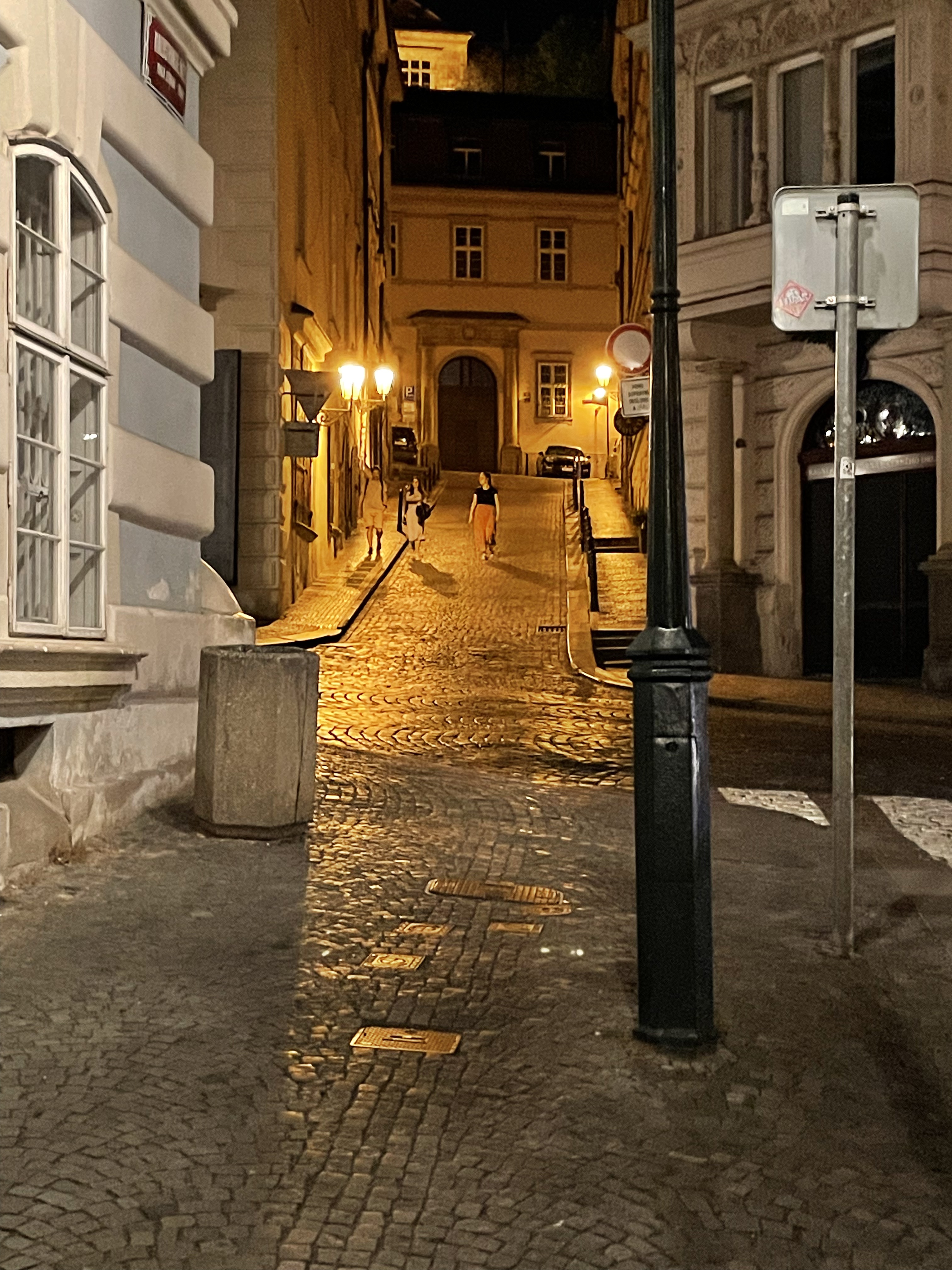
Our trip began in Prague, where much of my series takes place. I spent a day walking in the footsteps of my characters, visiting their homes, businesses and the landmarks mentioned throughout the pages. I’d selected most of the locations on Google Maps, so seeing them for real was, shall we say, enlightening. It took an hour to find U Seminaire, the location of the bachelor pad I’d used for the man who eventually marries my protagonist, Lala. I’d chosen it because it seemed like a quick walk from the Charles Bridge. In actuality it sits underneath the bridge, entangled in a labyrinth of short blocks and alleys. Somehow the building’s image got reversed on Maps – it’s on the opposite side of the street. Ouch. The little greenbelt across from Lala’s mother’s apartment, where ladies sat on benches underneath the shade trees and gossiped, actually sits below street level, though trees do line the sidewalk and there are benches. And the “gentle slope” of the street where Lala’s family lived for twenty years turned out to be a heart-pounding climb on a good day, and treacherous during inclement weather. Sigh. Still, as I stood in front of the building, seeing it for real, I felt thrilled.

In my fourth book, Lala launches her design career by converting a series of buildings into a world-class hotel. Ironically, the palace (the Czech term for a fine home), which I’d chosen for the location is now an actual hotel, and we decided to book it for our visit. It turned out the be the finest hotel I’ve ever stayed in, and although I have no right to take pride in that, I can’t help but feel delighted. On a slow afternoon I cornered the hotel staff and peppered them with questions about the building’s history, particularly during the Second World War. What began as a brief history lesson turned out to be a wild series of stories and gossip, which will inevitably solve some plot issues.

Three days later Allan and I bid ahoj to Prague and boarded a train bound for Poland. After an overnight stop in Katowice, the largest city in the region known as Upper Silesia, we took a cab to the nearby city of Bytom, the hometown of my father and his entire family. Back then Upper Silesia was part of Germany, the city known as Beuthen. As I walked along the streets, I tried to picture what his life must have been like. I gazed at the people who passed, wondering if I’d see any signs of familiarity in their faces.
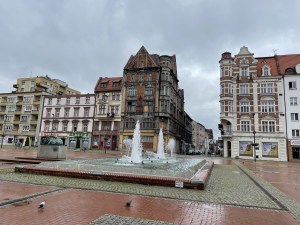
The picturesque parts of the town – with some remarkable architecture and a delightful town square, partially rebuilt after being bombed in WWII – surprised me, but other areas wore the hard reality of over a half-century of decline. I saw it in the run-down buildings left to rot and the pervasive trash, especially cigarette butts, in the street. I also saw it in the faces and the body language of so many, but most strikingly in the older folks, who’d lived through Nazi occupation, followed by decades of Soviet rule, only to be largely ignored by the European Union. They bore a sense of quiet despair, of resignation to the bleakness in their existence. The only signs of joy were in little children interacting with pigeons in the town square, swarming with them, chasing them or karate-kicking them away. I saw no faces that resembled mine, nor any signs of my past in the city. It had been wiped clean.  

Our next stop in Poland was Krakow, a city Allan has always wanted to visit. Rich in history, it has a beautiful castle on a hill overlooking the Vistula River, and the largest town square in Europe. I went for a different reason. On our second day there we boarded a bus to tour the two largest and most infamous Nazi-era concentration camps, Auschwitz and Birkenau.

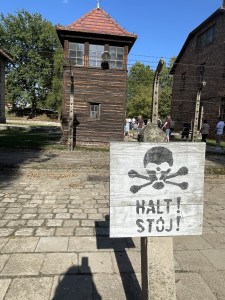
Entering into the first camp, with its ARBEIT MACHT FREI (“Work sets you free”) sign over the entrance gate, I wondered how I would react, or feel. I’m still not sure, to be honest, other than the eerie familiarity of what I heard and saw – from decades of studying photographs accompanied by written accounts, of documentaries and movies filmed on location, and stories I’d heard from survivors, including my father. For many, the trip was a history lesson. For me, it was akin to visiting the cemetery; I lost an estimated ninety members of my family there.

After a brief break, the tour continued to nearby Birkenau. Unlike Auschwitz, which to me felt small and claustrophobic, Birkenau is huge. You’ve seen it in many movies: a long low building with railroad tracks leading to a central tower, open at the bottom to allow trains to enter with their human cargo, like a gaping maw ready to devour all who arrive. Alongside and beyond the entrance, what seems like miles and miles of barbed wire fencing surrounds a huge open area interspersed with low barracks and guard towers. In the distance I could see different tour groups traversing the grounds, and for one brief moment I pictured them in the striped uniforms and hats of prisoners.  

Prior to abandoning the camp in January 1945, days ahead of the advancing Russian forces, the Nazis burned the meticulous records they’d kept of all who were brought to the camps and blew up the gas chambers. Only piles of rubble remain. Many, many piles. They left behind the prisoners too weak to continue; the rest (including my father) went on a forced march from one concentration camp to the next, always trying to stay ahead of the Russians, whom they rightfully feared more than the other Allies. It took several more months until my father was liberated, but at least the Americans freed him. Had he stayed behind in Auschwitz, he would have lived the rest of his life under the thumb of the Soviets. After what I saw in Bytom, I’m grateful he had the strength to wait.

The entire tour took seven hours and, although it allowed for a few bathroom breaks, it did not include a meal. The irony was not lost on me.

We left Poland and continued our travels, with France the next destination. There I stumbled upon traces of history that will influence my writing, and my life, but I’ll save that for a future post.

I can’t say these experiences will enrich the final chapter in my saga, but I can say I truly feel as though I’ve walked in the shadows of the past, both my characters’, and mine.


Miko Johnston, a founding member of The Writers in Residence, is the author of the historical fiction series, “A Petal in the Wind”, as well as a contributor to several anthologies including the about-t0-be-released “Whidbey Island: An Insider’s Guide”. Miko lives in Washington (the big one) with her rocket scientist husband. Contact her at mikojohnstonauthor@gmail.com


I DREAM OF WRITING

by Miko Johnston

We often say writing is a solitary endeavor, but that isn’t really true. It takes a village to be a writer, or at least to be a good writer, whatever that means to you. Certainly it includes getting published, selling books and receiving mostly favorable reviews.

The process of writing may not be solitary, but it is sedentary. It requires long periods of what former WInR Kate Thornton called BIC (butt in chair). Sitting at the computer may be good for building the story but not for building muscle. Therefore I must balance my writing time with more physical activities, and as I get older I find that normal routines like housework or light gardening are not enough. I need a regimen of specific exercises to ward off the effects of aging, arthritis and apathy.

One of my exercises is a type of squat, where I pretend to sit down and get up. I begin by standing with my upper arms straight out, perpendicular to my body and parallel to the floor, and then I cross my forearms. The pose reminds me of the titular character from “I Dream of Jeanie” so much, one day I started humming the theme song to keep time as I lowered and raised my bottom.

That’s what may have inspired this post.

If I met a genie who granted me three wishes, what would they be?

I’d have to establish the ground rules first: how big an ask is possible? World peace? Cures for the most horrendous diseases? Depolluting our planet? I suspect that would be beyond the scope of a genie, so I’d have to focus on more personal asks. And with only three, I’d have to be very shrewd about what I chose.

However, since every discipline nowadays seems to be super specific, perhaps that extends to genies as well. Might there be an athlete genie who can’t make your kids call you more often but can give you toned abs? Or a knitting genie who can correct those dropped stitches without ripping out multiple rows?

And what about a writing genie? Could they turn you into a best-selling author? Improve your dialogue? Inspire a brilliant twist in your mystery? Or finally get that idea you’ve toyed with for years (decades!) plotted out and on the page?

Imagine that I were a genie and had the power to grant you three wishes, only they had to be specific to writing. What would your three wishes be?

Miko Johnston, a founding member of The Writers in Residence, is the author of the historical fiction series, “A Petal in the Wind”, as well as a contributor to several anthologies including the recently released “Whidbey Landmarks”. Miko lives in Washington (the big one) with her rocket scientist husband. Contact her at mikojohnstonauthor@gmail.com

Lessons From A Child Poet

by Miko Johnston

If you’ve read my biography, you know my earliest ambition was to become a poet. I began writing poems at age six, and continued until I discovered it wasn’t a mainstream career – I found no “help wanted” ads for poets in the New York Times classified section. Being a practical sort, I changed my goal, but I’ve been writing ever since.

I still remember the first poem I wrote. I actually sat down and evaluated it line by line, and found that I had good instincts about the process. I recalled how I’d spent time playing with the wording, the rhyming and the rhythm, which created imagery through words. I also found parallels with my current approach to writing.

Let me show you what I mean. The poem goes:

I went to the moon

One sunny afternoon

Where I saw a sight

That gave me a fright

A man from Mars

With green and purple scars

The poem rhymes because I felt at the time poems should rhyme. It has a rhythm as well, for the same reason.

The first two lines had come to me immediately. I liked the way they sounded, with a sing-song bounciness reminiscent of a good nursery rhyme. The sound of words, how they flow together and the rhythm they create when read, remains an important aspect of writing to me and something I always strive to attain. The lines also comprise the first third of the poem. They introduce the setting, the character, and launch the story, as a first act should.

I don’t specify how I got to the moon, whether I rocketed, incorporated some other form of transport, or jumped, but I don’t think it matters. Rather than fill in every detail, it leaves that to the reader’s imagination, which is still characteristic of my style

The next two lines bring in an element of tension through emotion, as well as the possibility of conflict arising from it. Fear can be very potent in motivating a character. These lines also comprise the middle of the poem, but the sudden change from the playful couplet that opens the poem grabs our attention. No sagging middle here, another goal in my writing.

The last two lines are, to me, the most interesting. Finding another “non-resident” on the moon is more curious than scary, which brings the poem back to the mood set in the opening. A good ending should always reference the beginning. I contemplated the Martian’s coloring for a long while. At least some of the scars had to be green, since that was all we knew about Martians in those days. I toyed with using red or blue for the second color – the rhythm would have matched better. Somehow it had to be purple, an uncommon color in the fifties, which made it exotic. And I decided I liked the hiccup effect it gave the rhythm, like going over a speed bump or pot hole. It jars you, which also fits the theme. It also leaves it to the reader to decide whether the Martian’s appearance was scary or humorous.

Is it a great poem? No, but come on, I was only six. If this were a story, it would be incomplete. I could have added more, but it does convey an image and an emotional response. I say it’s complete as is.

I don’t write much poetry anymore, except for an occasional musing on a subject or a haiku in a humorous vein. I like fitting an idea to a very specific and brief formula. I’ll share my favorite haiku with you:

FOR THE RECORD

                                                Born in thirty-three

                                                Celebrated forty-five

                                                In seventy-eight

The math works out, but finding the right title was critical, as much for this poem as for a novel

As I consider my very first attempt at writing with the benefit of more than a half century of hindsight, I can see the roots of my development as a writer of prose.

For those of you who write, do you remember the first piece you wrote? How would you trace your development as a writer from that piece to today?

Miko Johnston, a founding member of The Writers in Residence, is the author of the historical fiction series, “A Petal in the Wind”, as well as a contributor to several anthologies including the recently released “Whidbey Landmarks”. Miko lives in Washington (the big one) with her rocket scientist husband. Contact her at mikojohnstonauthor@gmail.com

A New Book Release Party!

Release party for Miko Johnston’s

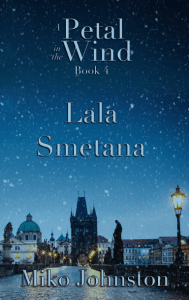
A Petal in the Wind Book IV: Lala Smetana

Sunday Sep 11 2022 5:00pm – 6:00pm

Kingfisher Bookstore, 16 Front Street NW, Coupeville WA

 **

We are thrilled to announce the long-awaited continuation of Miko Johnston’s Petal in the Wind saga. A founding member of Whidbey Island’s Writers in Residence, Johnston’s historical novels beautifully capture the heartbreaks and triumphs of a young Jewish woman coming of age in early 20th century Europe.

Please join us for an exclusive free event as we celebrate the release of Johnston’s newest novel on Sunday, September 11th at 5 pm in the Kingfisher Bookstore’s lower level. Champagne and small bites will be provided by our neighbor, Front Street Grill.

While this is a free event, tickets are required. Please secure your place by calling the Kingfisher Bookstore at  360.678.8463 or by emailing hello@kingfisherbookstore.com.

Petal in the Wind Book IV: Lala Smetana

As the Great War rages, Lala dreams of someday having it all — marriage, motherhood, and a career. She reunites with Josef Smetana, the man she loves, and they marry. Amidst a world-wide pandemic and political discord rippling through Europe in the aftermath of war, Lala and Josef encounter undercurrents of mistrust and bigotry that sprout like noxious weeds. Lala notes a disquieting change of attitude in Josef as well; he no longer supports her desire to work.

The Smetanas move to Prague and start a family. When an opportunity arises for Lala’s final dream to come true, she plots to keep her secret from Josef, until she learns he’s kept a far more dangerous secret from her. With her family’s fate hinging on her success, together they must navigate a new resurgence of an old hate that threatens to shatter their lives.

A Final Pass

by Miko Johnston

By the time you read this, the manuscript for my fourth A Petal In the Wind novel will be back from the editor and ready for its final draft before publication. Prior to sending it out, I made several passes through it, each time searching for ways to fix or improve the work.

In my first pass I searched for everything from formatting issues to misspelled words. In light of recent events I found parts of the story, which I’d begun writing in 2017, had become dated. I couldn’t gloss over a worldwide pandemic and the social rifts that emerged from political discord. Several new characters who were introduced in chapters written years before the book’s conclusion sounded too generic; I’d gotten to know them better as the story progressed and that needed to be reflected in their earlier dialog and mannerisms.

Other passes looked for repetition, excess verbiage, more precise word choices, missed misspellings, lapses in logic, and incorrect information. With that complete, I sent out my manuscript, anticipating a few more changes would be needed once I heard back from my editor. I took advantage of the wait time to put together all the additional material needed – logline, book blurb and synopsis.

Whenever I have to write marketing stuff, I cringe. It’s not what like to do, or do well. I view it as a necessary evil, and many authors I know feel the same way. However it must be done, and the good news: I’ve found an advantage to it beyond promoting the book.

When you have to encapsulate your x-hundred page novel into a one page summary, then a teaser for the back cover, and finally a one-sentence logline, it forces you to look at your theme in a different way. Gone are the long passages of prose, the snappy dialogue, the transitional scenes and flashbacks. You must have a laser focus on what your story is about – what you’re trying to get across to the reader in terms of theme, character, and plot. By doing so you sometimes will see aspects of the story that are important but may not have been shown in a compelling or complete way. So beyond my editor’s input, I saw that I wasn’t done with my revising.

I came to that conclusion when I encapsulated a 106,500 book into a few paragraphs with just a hint of where the story will eventually wind up. I had my external conflict and internal struggle, and pointed that out in my blurb. Then I wrote my logline:

Amidst the social and political upheaval in the aftermath of WWI, a woman who identifies as an artist marries the love of her life, but chafes at being relegated to wife and mother.

We can understand the difficulties a woman would face in giving up her career to marry and have children, especially at a time when such notions weren’t as accepted as they are today. But had I adequately shown how she feels in the book? Could I have made it not only clearer, but on a much deeper level?

The logline hints at the deeper issue. What she rails against is not being married to the man she loves, or even the challenges of motherhood. It’s losing her identity, having to see herself as only a reflection of her husband and children. When Jane marries John Doe, she becomes Mrs. John Doe. Her baby’s mama. She’d wonder—what happened to Jane?

My character Lala is a woman who’s accomplished a great deal despite her youth. She not survived the trauma and hardships of WWI and kept her family alive, but her home town as well. It’s described as a factory town north of Prague throughout the series. In America we’d call it a company town, where a single business – in this case a furniture factory – provides the economic base of the area.  Circumstances force her to take charge of the factory and oversee its conversion to wartime production. If it had closed, which it nearly did, the town would have been devastated. How can someone like this ignore all she achieved, the skills she developed, the talent that resides within her?

When the manuscript returns from the editor, I will review the comments and make some changes, including a few of my own – adding more layers of my character’s internal dilemma to the story. Then I’ll probably rework my promotional material. A writer’s work is never done…that is, until it goes to the publisher.


Miko Johnston, a founding member of The Writers In Residence, is the author of the historical fiction saga A PETAL IN THE WIND, as well as a contributor to anthologies, including “LAst Exit to Murder” and the soon-to-be-released “Whidbey Landmarks”. The fourth book in her series is scheduled to be published later this year. Miko lives in Washington (the big one) with her rocket scientist husband. Contact her at mikojohnstonauthor@gmail.com


WHAT WOULD YOU SAY? 

by Miko Johnston

No tutelage or reflections on my writing today. I’m attempting to reboot – physically, emotionally and creatively. Instead, I want to know what you, our readers, have to say.

My original idea for this week’s blog post was to ask you if you’ve incorporated any of the recent turmoil in your writing, or if you’ve chosen to sidestep it. I see that topic very differently now than I did when I first wrote this piece.

Back in 2018 I began a mentoring program for a local high school’s creative writing class*. Along with other published authors, I offered critique and encouragement to these young writers. Alas, a combination of budget cuts and Covid put the program on hold for over a year, but it has been reinstated. I recently received sixteen submissions from the current class and as I always do, I read each entry before dividing the work between the volunteers.

In the past, many of the stories mirrored themes from books and television shows that were popular, filled with paranormal characters ranging from vampires to dragons. Other plots were taken from everyday life – going to school, hanging out with friends, getting dumped by a boyfriend, and family squabbles. One or two pieces dealt with darker subjects, usually following a death or other traumatic loss, but the majority had a light tone and many were flat-out funny.

The class assignment was to write a piece of flash fiction. With their submissions came a note from their teacher, informing me that prolonged isolation from school, and each other, had made her students shy and hesitant to share their work, so it lacked the usual peer review. I assumed the writing would be rough, and it was, but not in the way I expected.

I was shocked but not surprised at the bleakness that pervaded every single submission. At least half included nightmarish scenarios, and most involved death or dying. I felt saddened because I knew this was not an attempt to be “artsy”, but a reflection of the reality these teens face in uncertain, and even frightening, times.

My volunteer mentors’ purpose is to encourage and uplift young students in their writing, but somehow a verbal pat on the back for a good story or vivid imagery doesn’t seem enough. Nor do I want to push them into further gloominess. Does expressing dark thoughts on the page exorcise demons, or give them life?

We may have enough time for a second round of submissions. Should I ‘interfere’ and suggest writing prompts that would prod them into some more positive thoughts, or let them write what they want? What would you say to these teens?

*see “WORD FOR WORD”

Miko Johnston, a founding member of The Writers In Residence, is the author of the historical fiction saga A PETAL IN THE WIND, as well as a contributor to anthologies, including LAst Exit to Murder and the soon-to-be-released Whidbey Landmarks. The fourth book in her series is scheduled to be published later this year. Miko lives in Washington (the big one) with her rocket scientist husband. Contact her at mikojohnstonauthor@gmail.com


Another Look At Descriptions

by Miko Johnston

In my contributions to this blog, I’ve written about descriptions several times. Describing, or as Jackie likes to say, illustrating in our writing has always presented a challenge to me. Part of it is how much? and is this necessary? There’s also how well…? – am I using fresh word pairings and metaphors that impress, not impede? Will readers not only ‘see’ it, but believe it?

All writing needs description to bring the story to life, but contemporary fiction usually depends on what we see around us. Science fiction, fantasy and, to a lesser extent, alt-reality requires more description as the reader can’t assume anything in a newly created world. So does the procedures of a character with an unusual or highly technical occupation, or day to day life in historical fiction to avoid anachronisms.

Writing historical fiction, as I do, requires a great deal of research, not only of history but images that represent the time. Clothing, hairstyles, machinery and tools, art and architecture infuse the story with the flavor of authenticity. In managing the word count, one picture can truly be worth a thousand words – if you find the right words.

I faced an insurmountable challenge in my latest novel. I wanted a character to wear a dress I’d seen illustrated in a period catalogue, a flamboyant style from the early 1920s. Today I’d describe it as having a side hooped (pannier) skirt with rolls of fabric resembling vertical soda can stackers hanging from each hip. However, that would not be time-appropriate for the era I write in and I couldn’t come up with a better way to depict the dress. It forced me to change her garment into something equally ridiculous but more describable, something Little Bo Peep might have worn.

That wasn’t the first time I’ve had trouble describing something in a way that a reader could visualize it. I envy writers who have that knack. I recently read a piece by Eric Asimov, who writes the Wine column for the New York Times, describing the ideal corkscrew, sometimes referred to as a waiter’s friend. He writes:

“It’s essentially a knifelike handle with a spiral worm for inserting into the cork, a double-hinged fulcrum for resistance and a small, folding blade for cutting the foil that protects the cork.”

Brilliantly descriptive and clear. You can not only see it, but see how it’s used.

Another challenge is trying to describe a situation that many have gone through; for example, pregnancy and labor. If you’ve given birth, you would probably rely on your personal recollections. If not, you’d research what others have endured, like I did. Either way, some readers will tell you that’s not what they experienced. In my first literary pregnancy, I was so concerned about the birth that I left that scene ‘off the page’; my character leaves town a month before her due date and returns with babe in arms.

Now several of my characters have gone through pregnancy and childbirth. I’ve gotten more controversial feedback on that subject than any other, and always from mothers. Certain suggestions, such as those little moments you could never envision unless you were ‘there’, helped. Other comments were less beneficial, for although there is much commonality in the experience, little of it is universal. “That’s not how it was for me,” they’d say, and I’d tell them “Okay, but that’s how it was for my character.”

*          *          *

As I’ve recently finished my fourth novel in a series, I’ve reviewed the manuscript multiple times and also reread sections of the earlier books. In doing so I learned something about my method of describing. The more important an element is, the more I’ll usually describe it. For instance, in my second book, my character meets a family that will play a prominent role in the rest of the series. It’s my young protagonist’s first impression of them, so I devote at least a full paragraph to the description of each person, I’ve augmented the descriptions as time passed to show how they’ve changed with age. Minor characters, such as the housekeeper, merit a phrase, enough to picture the woman when she returns later in the story. Thanks to Gayle’s tutelage, I’ve learned a title – waiter, shopkeeper – often suffices for ‘walk-on’ characters, though I might include a glimpse to set the scene, such as the wizened mother-in-law of a black marketeer, opulent earrings hanging from her lobes like chandeliers.

The character’s perspective also plays a role. My heroine, Lala, is introduced as a child, “almost eight”, who grew up poor. Her thoughts and observations had to be filtered by her age and experience, which is why it took me weeks to come up with a way for her to ‘describe’ a terrazzo floor (…like flat pebbles floating in a sea of cream). As she matured, so did her perceptions and understanding of human nature. Whatever captures her interest, or she feels passionate about, will inspire a more detailed description.

I approach themes in the same way. In my most recent novel, I chose to represent the political and social turmoil of post-WWI Europe with an image I found in my research. Lala, now married with child, observes it while stuck in traffic:

She perused the art work, most of it propaganda celebrating the recent wave of Communist Party member assassinations in Germany. One placard illustrated a macabre street scene in Hungary, judging by the uniforms worn by a line of soldiers hanging from gallows. Wives and children wept at the dead men’s feet while, standing in the middle of the road, a Bolshevik in uniform observed the carnage with a haughty air of satisfaction. The caption read, Erzet Harcoltunk? – ‘This is what we fought for?’…The artist had placed the smug-looking Bolshevik in the foreground, hands on hips, an unkempt uniform wrapped around his fat middle. Skinny legs stuffed into unpolished boots. Thin arms as well, implying physical weakness…Then she noticed the slight alteration of the Bolshevik’s cap, a subtle nod to a trait he shared with many of the political assassination victims.

The gold star affixed above the brim did not have five points, but six.

Rather than rely on the headlines of the day, I chose to let the reader “see” what she’s describing and understand the meaning behind the images.

This method works for me. What techniques do you rely on to get the right balance of description and imagery in your writing?

###

Miko Johnston, a founding member of The Writers In Residence, is the author of the historical fiction saga A PETAL IN THE WIND, as well as a contributor to anthologies, including LAst Exit to Murder. She has recently completed the fourth book in her series. Miko lives in Washington (the big one) with her rocket scientist husband. Contact her at mikojohnstonauthor@gmail.com

Why Aren’t You Writing?

By Miko Johnston

It’s a valid question. Maybe a few of you can’t think of an idea, but I’m willing to bet that you’re in the minority. In most cases we have an overabundance of ideas and at least one work in progress, if not more. Why are we having so much trouble writing? In a word:

PROCRASTINATION

Okay, we can admit it. We do procrastinate. Why? There are many reasons why, and they’re tied to different types of procrastination.

A dear friend and fine writer often wore a sweatshirt that said, EASILY DISTRACTED BY BRIGHT SHINY OBJECTS. This describes procrastinators who get sidetracked by other projects. Often they take on more than they can handle, or they get diverted by the next big thing. The only cure is to acknowledge writing is important enough to do. Focus on what’s in front of you for a set amount of time and literally time yourself.

Do you suffer from perfectionism syndrome? If you have a deadline and still can’t make progress, this may be why. If we can’t get it right, we don’t want to commit to working on our projects. I have a suggestion: GET OVER IT. You can argue about whether there’s crying in baseball, but there is no perfection in writing. Commit to doing the best that you can, then review it and make it better.

Sometimes I open a work-in-progress document and stare at the last bit I wrote, wondering where to go next. Then I close it because I can’t think of anything. Does this happen to you?

Try creating a separate ‘work’ sheet, copy the last paragraphs you’ve written onto it and then…just write. Don’t concern yourself with anything other than getting words down on the page. This technique opens the door to creativity; once your mind is free to explore ideas without judgement, the ideas will flow. Write until you come to a natural concluding point, then read back what you’ve written. I guarantee that most times you’ll find something useful for some part of the story, and sometimes you’ll get what you need. If the block occurs at a point where the story is still open-ended, your ideas may give you some direction to move forward, or warn you, “don’t go there”. If you’re trying to connect your scene with an approaching plot point, try the bridge technique I explained in an earlier post .

Easier said than done, you say? True. But I’m guessing that none of you became writers because you expected to become rich, famous, younger and more beautiful. You did it because you had a passion to write, or a story to tell, or characters whom you’ve created who deserve to live. The world is not an easy place right now; has it ever been? We need your stories out there, whether to entertain or to educate, distract us from our problems or understand them better. Or all of the above. So please sit down, take out your computer, or notebook, or whatever you use to write, and WRITE!.

And why not begin by commenting on this post – do you procrastinate, and if so, how do you get past it?

###

Miko Johnston, a founding member of The Writers in Residence, is the author of the historical fiction saga A Petal In The Wind, as well as a contributor to anthologies, including LAst Exit to Murder. She has recently completed the fourth novel in her series. Miko lives in Whidbey Island in Washington (the big one) with her rocket scientist husband. Contact her at mikojohnstonauthor@gmail.com

FUN WITH WRITING (AGAIN)

by Miko Johnston

It’s summertime, so let’s have some fun. Inspired by Jackie’s piece on Spine Stories, I decided to update my “Fun With Writing” post from five years ago –  here goes:

One Picture Is Worth….

Many groups and websites offer pictures for writing prompts; this is different. If you’ve seen any of the greeting card lines that use old photographs and insert funny comments, then you know what this is about. Select a picture from your photo album or a magazine and write a line or two about it. It can be funny, like one of my favorite birthday cards, which shows a pregnant woman with two pre-school children. The caption: All I wanted was a back rub. It can be poignant, a reminder of how things were vs how they are now.  See if you can come up with a clever interpretation of the photo.  You don’t have to write a thousand words.

Rapid Writing

This is an exercise that my local Whidbey Writers Group has done in the past. One person (usually the host) comes up with a concept and the group has ten minutes to write something. Previous ideas include rewriting a scene from an iconic book, describing an event from the past, and having everyone volunteer a word, then write a short piece incorporating all the words.

Crossover Appeal

If you’re in a writers group or have friends who are authors, try writing a scene featuring a character from another writer’s novel. Compose it in first person so the name isn’t revealed, avoid using any characters’ names or obvious settings. Then see if anyone can guess who you’ve written about. You can also have one of your characters interact with one of theirs.

If you write mysteries, you probably love at least one mystery series. Write a scene where your character meets that detective or P.I. Select a character from the same era as yours if possible, otherwise consider time-traveling the classic character to the present; think of how many modern-day iterations of Sherlock Holmes have been done.

“Honku”

Based on a witty book of haiku – “the zen antidote to road rage” – a  subject rife with possibilities. It you want to attempt poetry, try writing dedicated to driving. If cars aren’t your thing, pick any topic that lends itself to commentary and use the 5-7-5 syllable format to ‘haiku’ your idea. For example, my take on social media:

Why do you delight

 in photographing your meal?

I’d rather eat it

“Spelling Bee”

Last year I discovered this word-making game on the New York Times website’s puzzle section. I got myself and hubby hooked; we played it daily. It helped keep us sane during the pandemic lockdown as well as stimulated our brains. You don’t need a subscription to access the letters, only to play online. Or, play the DIY version:

24/7

Come up with as many seven letter words that don’t repeat letters or include S or X – a challenge in itself. When you have a list, pick a word at random; whatever day of the week it is, use that for your center number. Then make as many words out of the letters that include your center letter. Letters can be used more than once and four letter word minimum. No proper nouns, hyphenates, contractions or foreign words unless they’re in general usage, like pita or latte. Play alone or challenge a friend. Return the word to the pile and use it again on another day, when the center letter would change.

For example: Take the word MIRACLE.  Today is Wednesday, the fourth day on the calendar. My 24/7 challenge would be to make words that include the letter A. Had I picked MIRACLE on a Friday, I’d have to include L in each word.

DYI “Mad Libs”

Take a page from a book, edit out a series of key words and play “Mad Libs”. If you’re not familiar with the classic game, you create a list of nouns, adjectives and verbs and insert them into a story. Try it with a classic novel, a current best-seller, something awful, or if you’re brave, your own work.

“The Dating Game” for words

The clever pairing of an adjective and noun can replace a thousand words, a great way to create the sense of languid prose with brevity. It’s how I came up the phrase, overpriced abscess, to illustrate a McMansion enclave set in a wilderness area in my first published short story.

An interesting two-word combination works in any type of writing, and when it succeeds, it’s like a love match. As an exercise, see how many ‘matches’ you can make. Then save them; they could be incorporated in one of your WIPs.

We at The Writers In Residence always say “writing is writing”, and sometimes mixing it up can encourage creativity. Try an exercise for fun or to stimulate the creative brain.

###

Miko Johnston, a founding member of The Writers in Residence, is the author of three novels in the A Petal In The Wind saga, as well as a contributor to anthologies including LAst Exit to Murder. She has recently completed the fourth novel in the series. Miko lives on Whidbey Island in Washington (the big one) with her rocket scientist husband. Contact her at mikojohnstonauthor@gmail.com

Photo by Agence Olloweb on Unsplash

Mining Your Own Business

by Miko Johnston

That’s not a typo, it’s a play on words, inspired by a stream of advice I’ve gotten from many writing experts on a touchy subject. We’re told, write what you know. Does that include exploiting who we know?

MINING. Miriam pexels-keira-burton-6147138

How far are you willing to go to write a tantalizing mystery, an emotionally powerful drama, or a deeply moving character study? Would you base it on an actual incident or situation in someone’s life and its effect on them? I’m not talking about libel, but morality.

A piece in your news source of choice might inspire you to write a “ripped from the headlines” novel. Legitimate public information is fair play for adaptation, such as a criminal case or someone’s media appeal to raise attention to an issue. For example, some couples have had children in hopes of providing bone marrow or other vital tissue to save a stricken older child. In addition to non-fictional accounts and memoirs written by family members, many authors, including Jodi Picoult, opted that storyline for novels. Dramatic, yes. Is it exploitive?

What if something noteworthy happened in your own life? You might write a memoir detailing the experience and how it changed you. Or you could draw on the event to fashion a scene, and more importantly, for the emotions it evoked, whether it’s the pain of loss, the thrill of first love, the shock of violence or post-traumatic stress inflicted by a drastic incident. When I write about grieving or passion, feeling afraid or distraught, it comes from my own experience, but I do so voluntarily.

We base our characters, at least in part, on people we’ve known. We imbue them with that person’s physical characteristics or personality traits. Say you’ve given your sleuth, a Vietnam vet, the same war wound as your brother, and his nemesis flashes the pasty-faced smirk of your loathsome ex-boss. Those qualities illustrate the characters, but don’t define them.

Great writers incorporate their lives into their stories. They tend to base some characters on family members and people closest to them, portraits which are often unflattering and unkind.  Writers also mine tales from family and friends for source material. My own series of historical fiction novels began with a rumor about my grandmother. Stories about transformation, triumph over tragedy, and overcoming loss are rich with potential. As an example, a brilliant, successful woman marries a man who never divorced his first wife – and his family knows that when he walks down the aisle – makes a great storyline. What if she was your best friend? Or if a couple in your family, grappling with an intellectually disabled son who’s growing stronger and more aggressive, are agonizing over whether to institutionalize him?

In Betsy Lerner‘s excellent book, “A Forest For The Trees”, she urges writers to use whatever they can in their own lives to enrich their story, including incidents in the lives of the people closest to them. “If you are going to be honest and write about all the untidy emotions, the hideous envy, and disturbing fantasies that make us human, how can you not offend your loved ones, your neighbors and community?” A New York Times piece by James Parker, contributing editor at The Atlantic, endorses the practice of “invading” other people’s lives, but only if you can elevate it above exploitation; the purpose must be empathy.

For me the issue goes deeper than adapting an external experience. We can take plotlines from personal sources and show how one might feel in that situation, but what about someone far removed from ourselves? Each day I’m exposed to people whose experiences, based on their race, religion, ethnicity or sexuality, shape their world view, which differs vastly from mine. Are there places within a person that are too intimate to go, too unreachable to know?

MINING. miriam pexels-anna-shvets-5325091

In 1990 I worked on a conference sponsored by an organization of scientists who explore the repercussions of technological advancement. They chose as their conference  theme: Can We Do It? How Do We Do It? Ought We Do It? As a writer, I ask myself the same questions in understanding the social implications of storytelling, crafting diverse, authentic characters and emotionally compelling plots. Characters and plots that ring true to those outside the world I create as well as to those within.

A fiction writer’s goal is to produce a logical and believable manuscript, populated with characters, many who’ll be familiar to us and a few who thankfully bear no resemblance to anyone we know. We can borrow from their histories or instead, as Parker says, “invade” other people’s lives; strive for realistic portrayals or take Lerner’s advice to “be honest” enough to “offend”. That leaves me wondering: Is it proper to take the experiences of those we know best for the sake of a good plot?  Is it possible to mine the depths of emotions, or the most intimate thoughts, of someone so dissimilar from us?

Can we? How? Ought we?

###

Miko Johnston, a founding member of The Writers in Residence, is the author of three novels in the  A Petal In The Wind  saga, as well as a contributor to anthologies including  LAst Exit to Murder. She is currently pages from competing her fourth novel in the series. Miko lives on Whidbey Island in Washington (the big one) with her rocket scientist husband, who graciously helped her revise this post. Contact her at mikojohnstonauthor@gmail.com

Photo by Keira Burton from Pexels  

Photo by Anna Shvets from Pexels