Your lead characters, from Sister Grace to Neeta Lyffe, are strong women of action inhabiting extraordinary environments. Has your imagination always been this active, or did you begin to create new worlds as you grew as a writer?
I tend to start with characters or situations, and the worlds grow as they move, interact, affect, and are affected by it. But yeah, my imagination has always been overactive. It’s why I write. Otherwise, my brain would be too crowded with characters telling me their stories.
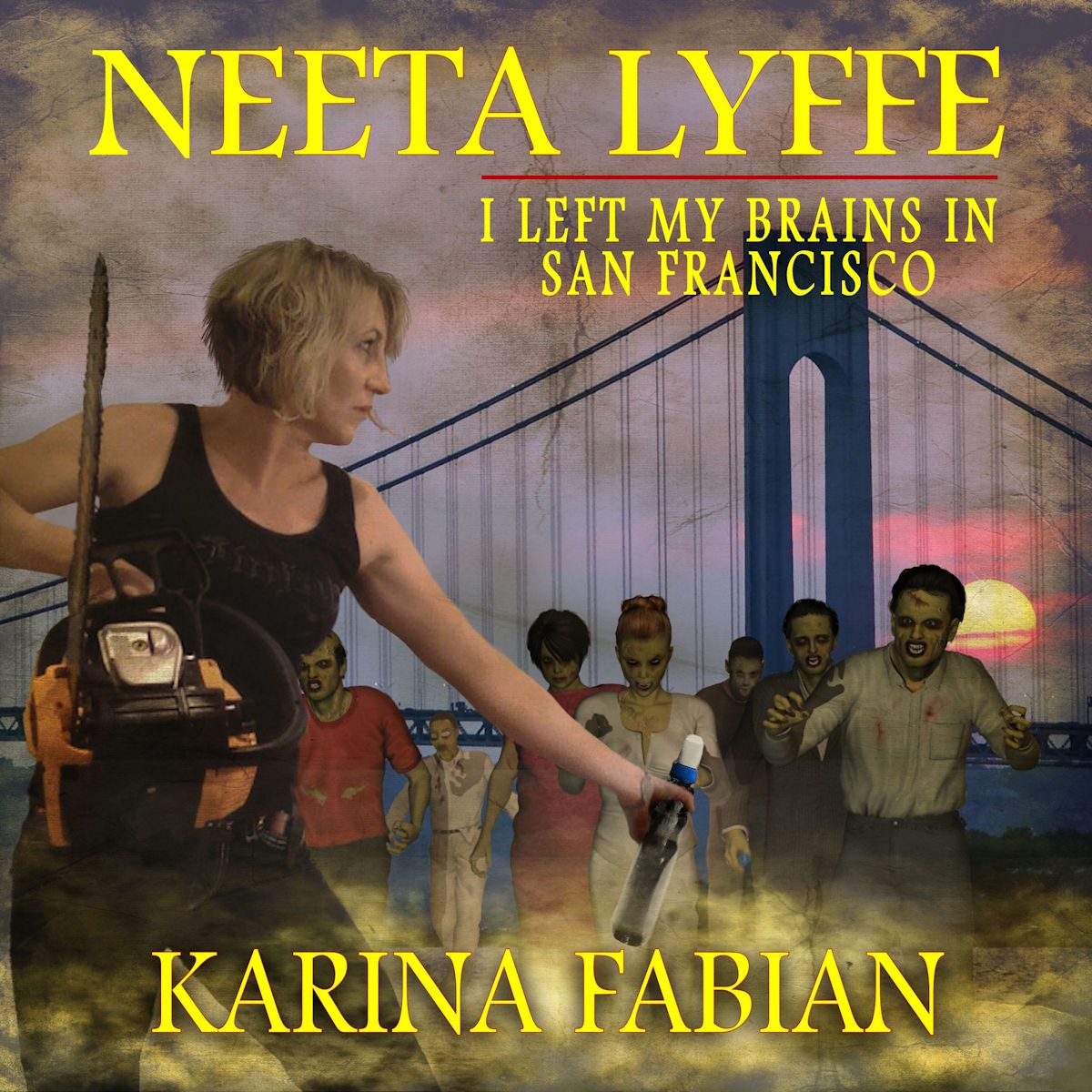
I also write strong men (and dragons), and weak men and women – and some who are stronger than they think. I like Tess, the little bartender at the Crude Lady, who has a small but important role in I Left My Brains in San Francisco. She has always wanted to be strong and brave, but never felt like she was. Yet in the end, she’ll offer herself as bait to draw away a zombie from her friends. (She survives by holing up in the walk-in freezer. And no, she did not consider that the zombie could have opened the door. Fortunately, it didn’t think about it, either.)
Next, let’s summarize the process from each professional’s point of view.
Karina:
1. My publisher, Kim, tells me she wants to have the next Neeta Lyffe book produced by Becky. I do a happy dance and post on social media.
2. Becky contacts me with questions about character voices, pronunciations of odd words, and any special sound effects.
3. Becky starts doing the voiceover, emailing me with any issues. I forward any caught typos to Kim in hopes we can fix them. (In fact, next book, I’ve suggested just going to go straight to producing I think, so Becky can find more typos for us; she’s very good at it. J )
4. Becky posts the chapters. The first time, I think Kim proofed them. This time, I did. It was a surreal experience for me. If I catch anything that seems odd (like a mispronounced word or a difference of inflection that changes the meaning of the word or phrase), I email her and she tweaks that part.
5. In the meantime, we’ve been working together on ways we can promote the book. Thanks so much for interviewing us.
Becky:
1. I either get contacted by the publisher or the independently published author that they’d like an audiobook produced.
2. If I haven’t worked with them before, I will send one or more sample reads (auditions) from myself and/or other narrators on my team. When I’ve worked with the client before or they know my work well, we might bypass this step as we did in this case.
3. I start reading in advance of recording, figure out what questions I need to ask, pronunciations, etc. In a case like this where we’re adding sound effects, I start a sound effects ‘map’ so I know what sounds I’ll need and get a sense of the soundscape so there is balance overall in the audiobook.
4. I record and edit my recording chapter by chapter. I’m editing out re-takes, re-recording anything that seems unclear or where I could improve the way the words are stressed – stuff like that.
5. In this particular case, I ended up creating a song for the book. THAT was fun. Since the whole Crappy Crude song can’t be heard during the audiobook itself, we’re going to make it available as a download on my site – with a freebie code in the About the Author section of the audiobook.
6. Then I master the edited audio file – that’s stuff like making sure the volume is within the accepted range, sort of the technical quality control and polish piece.
7. I send the finished audio files to the client for any feedback or corrections or tweaks.
8. I make any requested adjustments and send them back for proofing.
9. I upload the files to ACX and submit. The client then does her submit to ACX. It takes about 2-3 weeks to get through their QC queue and then the audiobook is launched!
10. Throughout all this, but especially when it launches, my marketing efforts kick in to help boost sales.
Karina, when you first decided on this venture, were you worried that no one would ever be able to bring your characters to life as you imagined them?
Not worried at all. I did hear the characters in my head, but I also know that others will hear them differently, so I didn’t have an especially strong attachment to a particular voice. In fact, it’s been very interesting to hear Becky’s interpretation. Her inflections are not mine. It added a new dimension to the story, and it made some scenes take on different levels. I especially love Neeta’s voice when talking to Ted.
I will admit (and Becky knows) that Roscoe is nothing at all like I imagined. It was jarring for me at first, but after a chapter or two (because he has short appearances in this one), my ear got used to it. Now I hear his “Oh, gawd!” like Becky says it.
Becky, do you need to really love the material to take a job, or are you game for anything?
I’m pretty game for anything. But what I am not really interested in is poor writing or unedited writing. There’s a saying: Good authors have talent; great authors have editors. Yeah, that was probably written by an editor, but I think it is safe to say that every manuscript that is going to be published really should have an editor. Too many don’t. But I’ve narrated a wide range of genres. My favorite, though, is audiobooks that call for sound effects. That is SUPER fun – creating and sourcing sound effects and mixing those in. Good times. These are a couple reasons I so love doing Karina’s books: she’s an excellent writer, her books are edited, and we’ve juiced them up with sound effects and music.
Becky, when you are preparing to record a book, do you pre-read the entire book, or just get a feel for it and then read it cold?
I usually read ahead a few chapters so I’m not reading cold. The thing about reading cold is that I am more likely to have to re-do a section, so that’s more time-consuming than going in prepared. For example, the attitude of a character sometimes does not become clear until the next character responds or the scene is further along. I always want to make sure the emotions and attitudes are where they should be, because that’s like the blood flowing through the veins of the story.
Karina, was this a collaborative process from start to finish, or was the finished product a surprise?
A little of both. Becky emailed me about particular characters and phrases (and caught some typos!), and I made a couple of suggestions (like adding “Unchained Melody” to a section.) But other things I did not expect, and more than once, I buckled over laughing. Then Becky gave me the best surprise of all.
In I Left My Brains in San Francisco, a song plays an important part of the plot. I won’t explain because – spoilers! – but I had to make up lyrics. I am not a poet. I am not a songwriter. I did some lame rhyming and vague meter, had one character say it had kind of a reggae beat because I thought that would be the funniest contrast to the words, and left it at that.
Becky put them to music.
Wow! What a difference someone with talent can make to a bunch of flat (albeit funny) words.
Becky, how do you make the voices of the various characters in a book distinct, and do you ever try accents?
Distinct voices is actually a very important aspect of narration to me. So many narrators don’t differentiate enough for me as a listener and I get annoyed when I think one person is talking then find out it was someone else and I have to go back and listen again to understand what is going on. I use several techniques in changing my voice. I can focus it more into my nose for a more nasal sound, drop it into my chest for those big heavy guys, add raspiness or breathiness, raise or lower the register. Sometimes I’ll talk more out of one side of my mouth or the other, or open the back of my throat more. Even just changing my face into a squint or scrunch can change the voice. It’s really fun. But one of the challenges is remembering, in a book with lots of characters, who sounds like what and how I made that voice. Consistency. The toughest is when a minor character suddenly turns up again. At times I have to go back to listen to what I did before.
Becky, what makes the perfect author client and what makes your worst nightmare?
Perfect author client: works collaboratively and enjoys the process; is clear on who the characters are and provides me with pronunciations of made up names and words (since researching those is impossible); understands the importance of editing; is engaged in social media; loves writing and publishing and keeps doing it. Like Karina. J
Worst nightmare: gives me an unedited manuscript with lots of errors and expects me to figure it out; has no marketing presence or activity; is not available if I have questions.
Generally, my worst nightmares don’t happen because I’m looking for those perfect clients.
What is the demand for audio books and who do you see at the target audience? Do you see them most often rented from libraries or Amazon etc. or purchased? And are they most popular as downloads or physical copies?
Karina: That’s probably a question better answered by my publisher and Becky. Personally, I’d see the target audience as people going on long drives looking for something to keep them amused and alert. This book is funny, fast-moving, and doesn’t need a lot of deep thinking or concentration to enjoy. I’d love to see these in truck stops.
Becky: The audiobook market is growing annually by double digits. Increasingly they are bought as downloads (about 70%), especially now that newer cars let you plug your phone into them. But there is still a fairly strong market for CDs as well. Audible.com (a division of Amazon – no surprise there) is by far dominating the audiobook market. There is an increasing number of audios showing up as available through libraries as downloads – through OverDrive. And I think Karina’s idea of CDs in truck stops is fantastic! Yes! As for the target audience for audiobooks overall, it is definitely adults listening to fiction.
Do you have any advice for writers on the hunt for a voiceover artist to read their book?
Karina: I didn’t look for a voiceover artist. My publisher did. However, I would say find someone who will work with you and get some samples of the work.
Becky: Get auditions that are at least 5 minutes long. And listen to other audiobooks narrated by the narrator. Listen to the whole thing. Because many narrators can deliver an audition piece that sounds like you could listen for hours, but after an hour you may be tired of listening. A narrator needs to stay fresh and keep the listener engaged throughout. S/he needs to understand the flow of storytelling. Also, I strongly suggest using a narrator who is a trained, professional actor. That makes a huge difference. I’ve had clients come to me who had contracted with a narrator through ACX after the audition and then couldn’t get the person to make any changes when given direction. It’s a good idea to request a different reading of part of an audition before hiring just to see if the narrator knows how to take direction and implement it.
Thanks for interviewing us!
You can find more about Becky at the following links: Website, Blog,
Check out Karina’s latest books and find out more about the author at the following links:

















You must be logged in to post a comment.