
Here’s a life lesson from our very own Jill Amadio. Whether you’re a writer and need to make that deadline or a racecar driver in your first race… just put your foot down and get on with it.
As I’ve noted before, newspaper reporters often find themselves with unexpected assignments. One of my editors when I was living in Connecticut assumed that being a Brit I was brilliant at anything I tackled. It’s the accent, of course. Wonderfully misleading. Besides, no one else in the newsroom wanted to take this assignment on. I’ve never refused a project because whether one is aware of it at the time or not any experience can become grist for the mill when turning to write crime novels. As did this story, which has already spawned a main fictional character in my mystery series.
Although most journalists who cover auto racing itch to get behind the wheel at a race track, even if it’s only while the race car is in the pits, I never, ever aspired to be a race car driver, However, the only job on a newspaper I could get when I first arrived in America was as a novice automotive reporter because I once covered the Macau Grand Prix when working for the Bangkok Post in Thailand.
To tell the truth, I knew very little about cars in general, especially race cars. But all that changed when this editor sent me to cover a Can-Am Grand Prix during a steamy October weekend at Watkins Glen, New York. Volkswagen Worldwide Corporation was staging its Stingy Driving race, sort of a crowd warm-up before the big event whereby each participating member of the press was loaned a VW Rabbit with a ration of fuel, a precisely-measured 32 ounces, and let loose on the track. The winner would be the driver who squeezed the most mileage from this meager ration of liquid gold. That meant a very light foot on the gas pedal.
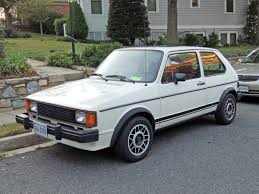 Assigned identically set-up cars, we stood dutifully at the starting line. Taped to the passenger side window of each Rabbit was a glass vial containing the precious gas. A narrow plastic tube ran from the vial, across the hood, and into the engine much like an I.V. line dripping life-saving fluids into a heart patient.
The start was a la Le Mans whereby drivers queued up very neatly on the tarmac across from their cars like Brits waiting for a bus and sprinted over at the signal. There were supposed to be three of us females reporters competing, along with 21 men. One lady was disqualified for reasons unknown to me. The second never showed up. Thus I found myself unwittingly representing the whole world of women drivers in the Bunny Hop VW Rabbit race.
When I realized the honor that had been bestowed upon me, I decided I really wasn’t worthy. I’ve never been much of a women’s libber and I dreaded the thought of what might happen if I let my side down. Would I be chased through the streets by angry females waving signs reading: “Jill’s a Dumb Bunny?”
I offered to step down. I pleaded to step down. But by this time genial Chris Economaki, the iconic, gravelly-voiced ABC-TV race commentator had already pushed a microphone under my nose as we waited for the starter pistol to pop.
“How will you handle the chicane?” he asked me.
I’d never, ever, heard of a chicane. What the heck was it? How did one spell it?
“Oh,” I replied airily, “That’s going to be a surprise. It’s my secret weapon!”
Chris peered at me, a pitying look on his face, and moved on down the line, interviewing other journalists. Next to me was Ahmad Sadiq, art director for Penthouse magazine. He’d brought along a stable of voluptuous models who draped most of their bare flesh all over the hood of his fire-engine red Rabbit.
Nearby stood a car-less driver, Junius Chambers, who wrote for the New York Amsterdam News. He was unable to participate because the Rabbit he’d been given the night before was stolen from in front of his apartment in Manhattan. Was he going to sprint towards my entry and try to beat me to the door? Or was he here simply to drool at the models?
Time for the race to start.
The popgun popped and we all ran madly towards our cars. We jumped in (no one got in the wrong car; I knew mine was white) and fastened our belts. Or at least, I tried to. I got my elbow caught in the shoulder strap and ended up starting the car with the harness doing a great job of hanging my left arm uselessly in the air as I clumsily changed gears and steered with one hand suspended.
 No matter. I was on my way around the track for the first lap. The only problem was we were supposed to drive as slowly as possible to preserve the fuel and thus achieve high mileage, a great promo for VW. Here we were on one of America’s most famous race tracks and to win we were to dawdle all the way. Well, women never like to follow the crowd, just ask any husband, so I must admit I gave in to temptation and led the rest of the field at first, all 21 of the men behind me as I pressed the pedal to the metal.
The circuit was 3.377 miles and went up hill and down dale in a zig-zaggy fashion, twisting and looping most of the time. Thousands of spectators — most of them still bleary-eyed from a night camping in the track’s infamous Snake Pit swamp — were on the hillsides, a veritable tent city spread out behind them. These fans were obviously not too keen on watching 22 silly Rabbits hopping along at a snail’s pace. They’d traveled here from far and wide to watch Grand Prix champions tear up the track at better than 180 m.p.h.. But they were good sports.
Halfway around my car coughed, choked, bucked a couple of times, and sputtered to an ignominious stop. Nonplussed, I wondered if the car was going to roll over on its back and expire like a real rabbit. What was happening? Was I a victim of the dreaded chicane, whatever it was?
“Hey, lady!” shouted one of the rather rude spectators. “Step on the gas!”
I looked at the transparent hose. Aha! An air bubble was blocking the flow from the vial to the engine. What to do? My Rabbit needed an emergency transfusion. I was soon surrounded by a gaggle of hung-over hippies who’d jumped over the guard rail and were offering to push the car home.
Dodging my competitors who drove sedately past shaking their heads, a track mechanic ran over.
“Get a move on, lady! You can’t stop there!” he yelled. Did he think I’d stopped to do some sightseeing?
“Oh,” he said brightly. “You’ve got an air bubble. Here, I’ll blow it out.”
This “expert” stuck the plastic tube between his lips and took an almighty breath. Instantly, the air bubble disappeared. It had been sucked into his mouth along with half my bottle of gas.
“Hey! You’ve swallowed my ration!”
His face turned green as he spat out some of the liquid he’d stolen from me.
“I knew it was a mistake to let women on this track,” he muttered, stalking off.
With what was left of my 32 ounces I restarted the Rabbit and continued around the track accompanied by hoots of derision from the fans. I decided to enjoy the scenery, waving to my fans and trying to eke out as many miles as possible from my seriously-denuded fuel supply.
The Watkins Glen circuit was a sweet grid and if you weren’t in a hurry as I certainly wasn’t there’s a lot to see. The first curve is a ninety-degree turn which got you all psyched up for that infamous chicane which, after all my fears, turned out to be merely a split speed bump to slow the field down. So what was the big deal? The chicane was followed by a very nice straightaway from which one may observe the lovely foliage on the surrounding hillsides. Then the track sent you along a tortuously twisting loop that could be hazardous if you’re not paying attention. It was a pleasant way to spend a Saturday afternoon in upstate New York, I must say, and I was pleased the editor had given me the assignment.
Almost at the finish line my Rabbit slowed to crawl and, with a lurch, stopped dead in its tracks. Out of gas. I had to be towed back to the start/finish line. At the same internationally famous race track where Niki Lauda steered his Ferrari to victory I had completed two and a half laps in the most sensational car race of my rather short racing career. Very short. I never took to the track again.
The winner of our Bunny Hop was Bill Turney of the Hartford Courant who feather-footed his Rabbit gently enough to get 72.8 miles per gallon. Second was Jim Patterson of the Long Island Press, at 64 miles per gallon. My mileage? A paltry 36. I knew Volkswagen wouldn’t be too happy. The two winners were awarded all-expense paid trips to the Bahamas. Neither invited me along.
I don’t know if the guy who selfishly swallowed my petrol perished (sorry, God) or merely suffered several extremely painful spasms. I never wanted to be a race driver anyway. But I was inspired to create such a character in my series as the daughter of my amateur sleuth.
Jill Amadio is from Cornwall, UK, but unlike her amateur sleuth, Tosca Trevant, she is far less grumpy. Jill began her career as a reporter in London (UK), then Madrid (Spain), Bogota (Colombia), Bangkok (Thailand), Hong Kong, and New York. She is the ghostwriter of 14 memoirs, and wrote the Rudy Valle biography, “My Vagabond Lover,” with his wife, Ellie. Jill writes a column for a British mystery magazine, and is an audio book narrator. She is the author of the award-winning mystery, “Digging Too Deep.” The second book in the series, “Digging Up the Dead,” was released this year. The books are based in Newport http://www.jillamadio.com
Books: Digging Too Deep, Digging Up the Dead
Non-Fiction: My Vagabond Lover: An Intimate Biography of Rudy Vallee; Gunther Rall: A Memoire, Luftwaffe Ace and NATO General

 novels. Her current literary focus is Route 66 as it traverses California’s Mojave Desert in her “Rhodes” series. Madeline is a lifetime lover of mysteries, and besides reading and writing, is also an occasional potter. She lives with her husband and assorted canines in the High Desert. Visit her

 I TASTED the cool creamy sweetness of real Italian Gelato, bit into crusty (salt-free) Tuscan bread piled high with fresh-made tomato Bruschetta and drizzled with first-press virgin olive oil from an orchard that covered the nearby rolling hills. I sipped a frosty pale green menta (mint) icy that tingled my taste buds and sent shivers of coolness through my mouth and throat…on a baking-hot humid day.
 I sampled a vast array of Italian cheeses (said to outshine France’s), from wedges of soft, creamy whites, protected by powdery rinds, to the mellow, medium-soft, large-holed varieties (not Swiss), that were delicious in a salty-sweet way with a dollop of apricot jam on top, to the hard, net-wrapped aged cheeses that take a good strong knife to slice, and a hunk of soft Italian bread to eat it with to even out the sharpness.
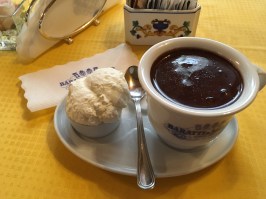 What about a decadent hot chocolate so thick and rich that it looks like Hershey’s Chocolate Topping, but more delicious, served with a scoop of freshly whipped cream so thick you could eat it with a fork.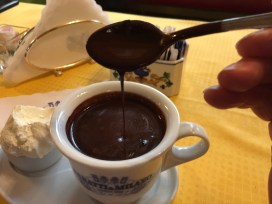
 Move through wet heat that causes limp hair, sticky skin, and clothes that cling. And then come upon an arched metal fountain in a park or piazza in the shape of a bull’s head (honoring “Torino”) that flows with cool sweet entirely drinkable water from its mouth. Hold out an empty water bottle, or cup your hands to catch the coolness, or even bend your head and drink freely.
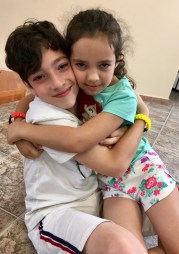 Kids walk down the streets holding hands and they hug their siblings freely, unembarrassed.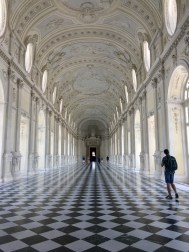


 Why do I use a time machine when I write? For Sandy Fairfax, I had no choice. I wanted to write about a ‘70s teen idol because of the culture of that time when teen idols were promoted through TV shows. I like the melodic songs from the era, the cheesy clothes, and the drama that often took place behind the idols’ innocent façades. \
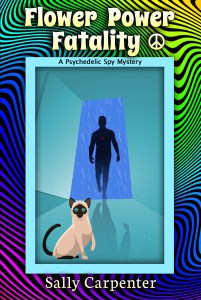 In “Flower Power Fatality,” Noelle McNabb is an actress at a Christmas-theme park in Yuletide, Indiana. Her drab routine is interrupted when a stranger shows up on her porch with a bullet in his chest. Then, a super-secret spy agency recruits Noelle to find missing microdots along with veteran agent Destiny King. As Noelle goes undercover, she finds herself dancing in sleazy nightclubs and chasing bad guys at night while wondering who is going to feed her pet cat.


 Sally Carpenter was born and raised in southwest Indiana but now lives in Moorpark California, leaving the land of rain and snow for wildfires and earthquakes. She has a master’s degree in theater from Indian State University. She also has a master’s degree in theology and a black belt in tae kwon do. She’s also “mom” to two black cats.




 When I came up with
  The first story I wrote had Johnny mention that he once worked for the Mob. I was channeling his voice and the words just came. Then I realized I needed to know a little bit about the Mafia. An ex-cop acquaintance with a rather interesting connection to the Mafia told me what books to read and he also shared some insights that you might never find in a book, but if you did, you would think it was fiction.
 As I was on this road of discovery, I realized I had given Johnny the title:
  My newest character in a series is Chance McCoy. I bill him as a third rate P.I. in a secondhand suit who blows half the cases he takes on. Not a great track record. Then Chance is shot… and killed. But Chance gets the opportunity of a lifetime. He gets to come back, alive. Now he can fix some of those old cases and take on some that challenge even the brightest detectives. What does he use? As the guy who sent him back tells him: You use what’s inside. Chance’s discovery process is a trip in book one:
  Aren’t memorable characters what writers want to create? And isn’t that what readers want to read. You betcha.

 Then there’s the
  Either way,
  So yes, this year I’m particularly jazzed about milestones. But whatever stage of writing a writer happens to be in, whatever way they choose to be published, milestones can occur anytime.
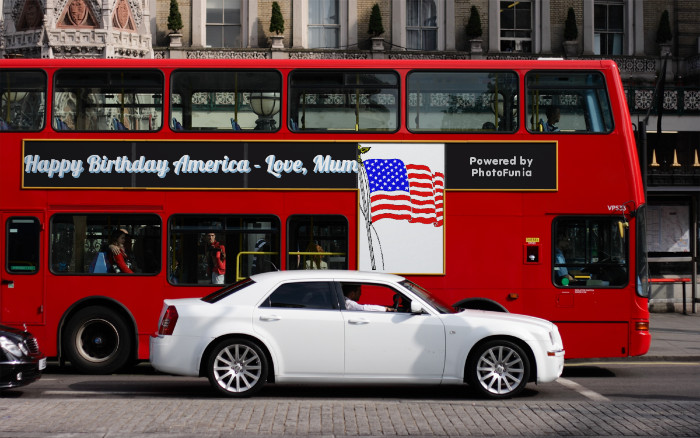
 That first July 4th was spent with an international group in an Australian friend’s back garden (or yard, to use the local term) where we all celebrated the start of our new lives in California – the land of such promise, excitement and new ideas.
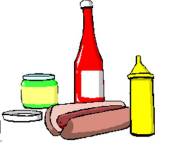 I also found myself a wonderful, gorgeous American husband, Rick! And so Independence Days were filled with our own new traditions of hot-dogs, baked-beans and hamburgers with friends and neighbors. Some years we had picnics in the park or by our favorite lake, creating lovely memories. And always the fireworks burst forth over the nearby Hollywood Bowl.
 Some of the July 4ths we spent in Kentucky at my late mother-in-law’s farm. What a wonderful slice of Americana: the local town congregated together and roasted a wild hog over coals in a huge, rusty brazier thingy. A local country and western group performed on a flat-bed truck and American flags flew everywhere. It was a ‘pot-luck’ affair, so there were tables groaning with an assortment of pies, savory things and desserts. A delicious chicken-like dish that one of the neighbors had brought turned out to be frogs’ legs! “Frog Gigging” was a local past-time, I learned. “Ya just have to remember to cut the tendons before ya cook it, or the darned leg will hop right out of the pan before ya can catch it!” As Hardin County was a ‘dry’ county, I am not sure what they were all drinking from an assortment of bottles. “It’ll put hair on yer chest…” I heard. I decided to pass on that one.
 One memorable Independence Day we spent at sea. Rick’s boss, Oprah Winfrey, had rented a luxury cruise ship (as you do!) to celebrate the 25th anniversary of her television show and to thank her entire staff for all their hard work over the years. Rick and I were tickled pink when we were invited to join this Mediterranean cruise. After we left the last stop on the island of Malta, we headed back to Barcelona and we were at sea on July 4th – of course, not an occasion celebrated in Europe. The organization for that day was mind-boggling! The huge swimming-pool deck was covered and, after a ‘group photo’ of all the Harpo staff with their ‘plus-one’ and guests like Rick and me, the festivities began with a live band and several long tables filled with every sort of food imaginable and a large barbeque. The music and dancing went on until the small hours, long after we had retired. It was a good thing we were in the middle of the ocean with no neighbors to disturb – except the fishes and the dolphins.
 I grew up watching American movies with July 4th Independence Day celebrations. They always appeared such a fun gathering for families and friends where everyone prepared their special dishes and decorated whole neighborhoods with red, white and blue. I loved being able to share this tradition.

 The Writers in Residence
You must be logged in to post a comment.