Is Handwriting Dead Or Just Dormant?

“The pen is like the needle of a record player held in one’s hand,” Donald Jackson, calligrapher, and scribe to the Late Elizabeth II, once observed. “As it moves across the paper, it releases the music of our innermost selves.”

Wow. I just love that. Sadly if Mr Jackson saw my handwriting he would accurately surmise that I am permanently scattered.  

Mahatma Gandhi declared that a poor hand is “the sign of an imperfect education.” But mine leans more towards P.G. Wodehouse who said his, “resembled the movements of a fly that had fallen into an inkpot, and subsequently taken a little brisk exercise.”

Computer keyboards ruined everything for me.

I had the most perfect handwriting. As a Brit we were not trained to write “cursive” which I think is an American form of script. Here is an excerpt from my Home Economics book circa 1969 – please note the hilarious and dated content.

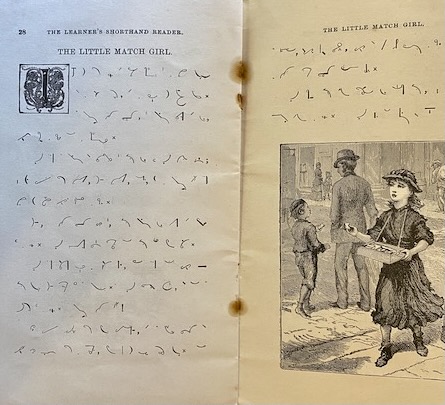
In 1977 I trained as a “shorthand typist” before Dictaphones were invented. In the UK the shorthand was Pitman shorthand;  – in the USA it was “Gregg,” although there are many other forms like Teeline or Fastnotes. I could boast 125 wpm (words-per-minute). I loved it. Here is an example of Pitman shorthand taken from “The Lerner’s Shorthand Reader” circa 1892 and priced at 6d.

Isn’t it pretty? If you’d like me to transcribe, I will …

I could “touch type” i.e. there were no letters on the keyboard so I would type the copy without looking at my hands (for those youngsters out there who have never heard the expression). There was also something immensely satisfying about coming to the end of the line and pushing the lever of the carriage return to be rewarded with a cheerful ting!

With the advent of computers, my typing has speeded up dramatically (I just did a free test) and it’s 75 wpm.  There is no way my handwriting now could keep up with my brain. Unfortunately, I can hardly hold a pen let alone write with one.

But let’s not forget the reality of handwriting of centuries past. It’s tempting to think that 19th century penmanship was beautiful and legible. This was not the case. Paper, ink, and postage was expensive. People wrote as small as they could. Anne Brontë’s famous final letter had the lines criss-crossing each other. So even if 21st century handwriting has deteriorated, in the big scheme of things, that’s nothing new. Sadly, a recent survey found that in the past five years, 12% of Britons have written nothing at all – not even a note. With the demise of the check book here in the UK, signatures are barely needed either. Some people don’t even have a PEN!!! I was at the post office recently using my USA credit card which demanded a signature to find that I was the only person in the store who carried a pen!

“When you type on a screen, the words seem as fleeting as rays of light. When you write, there’s a real physicality to it that adds another dimension to how you experience your own writing. It fosters a deeper engagement with the material you write, makes the writing voice inside your head clearer and louder.” Quote from Omwow blog, https://omwow.com/longhand-writing/

I love that expression “words seem as fleeting as rays of light.”

Handwriting is deliberate and intentional and requires focused attention. It encourages us to be fully present in the moment. Neat and well-formed handwriting can also indicate a level of discipline and organization. It’s also lovely to receive a handwritten note. It feels personal because it is personal. Someone has taken the time to write and not just zip off an email.

In the meantime, I’m just grateful that my appalling handwriting doesn’t get me into the following kind of trouble:

In 1636 an employee of the East India Company in London wrote to a colleague in India asking that he ‘send me by the next ship 2 or 3 apes.’ Unfortunately – his letter ‘r’ in the word OR caused some confusion. As a result, he received 80 monkeys, together with a note saying that the remaining 123 would be with him shortly.

What about your handwriting? Please share and shame mine.

Writers Collaborating: How does it work?

By Jill Amadio

Co-authors, such as the several collaborators who write with bestselling James Patterson, are freely acknowledged by the thriller writer, and he gives them public credit for their work. Is there also an increasing trend for mystery writers to team up? One successful couple, Greg Wands and Elizabeth ‘Liz’ Keenan, are finding their books more and more popular, and sell in twelve languages. Here they explain how their writing process works:

What are your writing backgrounds? Were you published before collaborating?

Greg: Liz and I both wrote short fiction separately for many years, and I tried my hand at screenwriting. While we were early readers and supporters of each other’s work, it wasn’t until our debut, The Woman Inside, in 2019 that either of us became published authors, and it was a real thrill to be able to do it together!

How did you decide to collaborate and why crime?

Greg: We’d been discussing the idea of collaborating on a project together in the abstract for many years when we both suffered separate tragedies: my father passing away from cancer and Liz having a long-term relationship unravel in heartbreaking fashion. While supporting each other through the grief and trauma, we cooked up the seed of the idea that became our debut novel. A crime story seemed like the proper genre, as we were interested in exploring the more clandestine aspects of the human condition and the capacity people have for secrecy and deception.

What system do you use to organize and collaborate?

Greg: We write in Google Docs, which allows both of us to work on the manuscript simultaneously. As a duo, this helps when we’re in the revision or copy edit phases and often need to tackle separate plot points in a complementary fashion.

Which strengths and weaknesses do you each bring to the writing?

Greg: Liz is wonderful at scene setting, character development, and creating a visceral experience for the reader through the use of a specific image, textural description, or the like. And she’s marvelous with a turn of phrase! I enjoy writing dialogue, and would like to think I’m good at creating atmosphere. I think we’re also both skilled at being able to nudge the other in the right direction when one of us starts to lose the thread of the plot or makes a narrative decision that feels untrue to a character.

How have you changed or adjusted your system as you wrote more books?

Greg: We fell into our routine fairly organically, by volleying chapters back and forth with only a loose framework in place. This seemed to give the work an improvisatory energy that kept each of us–and by extension, the reader–on their toes. Thankfully, we’ve been able to keep our formula reasonably intact, which works well for us. With a couple of the books, the publisher has requested a more comprehensive breakdown, but we still find ways to surprise and confound one another on the page, to our mutual delight.

Which obstacles/pitfalls/challenges did you face in the writing of the books? Arguments? Agreements?

Greg: It can be a bit of a challenge having two separate brains tackling one story, mostly from a logistical point of view: keeping timelines straight, having slightly different ideas behind character motivations, and trying to foresee where your writing partner might take the plot of the book. But the uncertainty can also be thrilling, and lend to the feeling of discovery and surprise that makes for an engaging writing experience.

Do you think having two writers can shorten the length it takes to write a book?

Greg: Because we write in a back-and-forth style, with one author penning a chapter and then kicking it over to the other, it takes about the same amount of time to finish a draft as it would a solo writer. The advantage we have is that our method allows for extra time in between chapters to clean up the text and to find places where we may have slipped into some inconsistency or other in the plotting of the story.

Your separate backgrounds appear tailor-made for a collaboration. Have your experiences in publishing and screenwriting helped you write, publish, and market your books?

Liz: Our respective backgrounds have given us several useful tools. Our experiences in the film and publishing industries have informed our understanding of effective storytelling, audience, and the publishing process. For marketing, our past experience has helped us to succinctly pitch our books and connect with influencers and other writers in and out of our genre, as well as our understanding of how much authors have to be entrepreneurial when it comes to marketing their books.

Who does the research?

Liz: Since we typically split up the characters in writing our novels, we research our designated parts and their history, professions, passions, etc. For the broader story elements like forensic and legal procedures, we also split research and share our findings, which often spur new story elements in our plotting. We pick themes and story elements we are interested in learning more about, knowing we’ll spend six months to a year immersing ourselves in these topics.

What is your publishing history?

Liz: Our first novel, The Woman Inside came out in January (2019), and the following year, In Case of Emergency was published (2020), and The Rule of Three was released in 2022. We have a fourth novel publishing in 2024. Our books are all published by Dutton, an imprint of Penguin Random House

Either of you writing other books, fiction or non-fiction,  that are non-collaborative?

 Liz: Yes! We are both working on novels separately in between our collaborative projects. They are in various degrees of completion; Greg is further along than I am!

Which of your books did you have the most enjoyment writing?

Liz: Each of our novels has brought immense joy in the writing process in different ways. If I had to pick one, I think The Woman Inside was the most exhilarating to write since it was the first, the most personally motivated, and we were doing something completely new.

 Most effective marketing strategy?

Liz: This is a hard one since effective marketing is so elusive. However, the approach with the most ‘legs’ is personal recommendations from fellow thriller writers and bookstagrammers of our books when they are released. The trust of readers that these well-read influencers and writers have fostered is priceless and effective in spreading the word about our work, and we are eternally grateful to the people who support us in that way. We aim to do the same with all of the incredible books that are published each month!

Advice for budding collaborators?

 Liz: Like any healthy relationship, creative collaborators should focus on the foundation of the partnership as much (if not more) than the creative output. Communication, trust, and encouragement are vital to keeping momentum when things get creatively challenging. Making the work an extension of the friendship is the core of our collaboration; we write for the amusement and shock of the other, which keeps us motivated. Laughter is essential, too.

###

..

This interview by Jill Amadio was posted by Jackie Houchin.

My First Santa

by Gayle Bartos-Pool

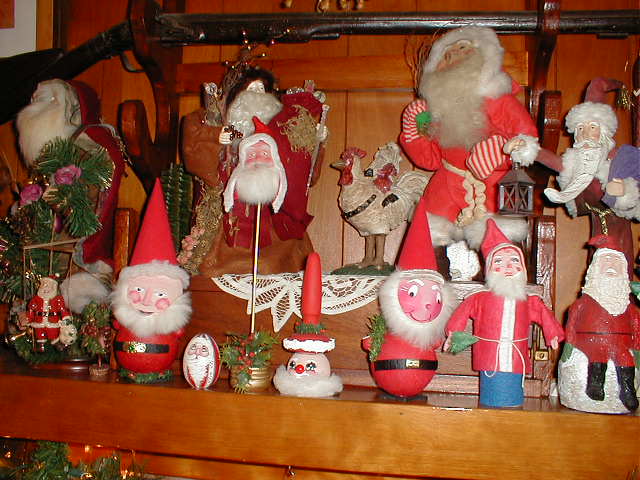
Most people who know me know I love Santa Claus. I have a rather large collection of Santas. About 3000 of them. Some are Christmas cards, old and newer ones, vintage Santa stickers, and assorted paper Santas, but two-thirds are figures, large and small. My basement now houses a good selection of these treasures, set out all year.

OLYMPUS DIGITAL CAMERA

(The Santa with the striped gloves was the first. The others are some I made through the years.)

When my dad was stationed in France when I was in my teens, we went to Germany and I got my first Santa. That was 1963-66. Later, when I had moved to California and started working for a miniature store that sold dollhouses, the owner also had a room dedicated to holiday decorations. She had it open for Easter, Halloween, and especially Christmas. Since I could buy things wholesale, I did just that and added to my growing collection. We would also go to the Rose Bowl Swap Meet in Pasadena every month and I could get small Santas for $.50 to a few dollars. That was great for my limited budget.

My collection started to grow. I saw some really nice Santas and other holiday decorations in magazines. These were for Halloween, Easter, as well as Christmas. Now, I couldn’t afford most of these cool items, but I could make my own version. And I did. This added to my growing holiday decorations collection.

13628_13

This is one of the Santas I made. Jackie Houchin mentioned that most of the ones I crafted had a bald head just like Richard, my beloved husband. Maybe that’s why I did them that way.

OLYMPUS DIGITAL CAMERA

(These I made after seeing ones like them in magazines. Hey, I’m on a budget.)

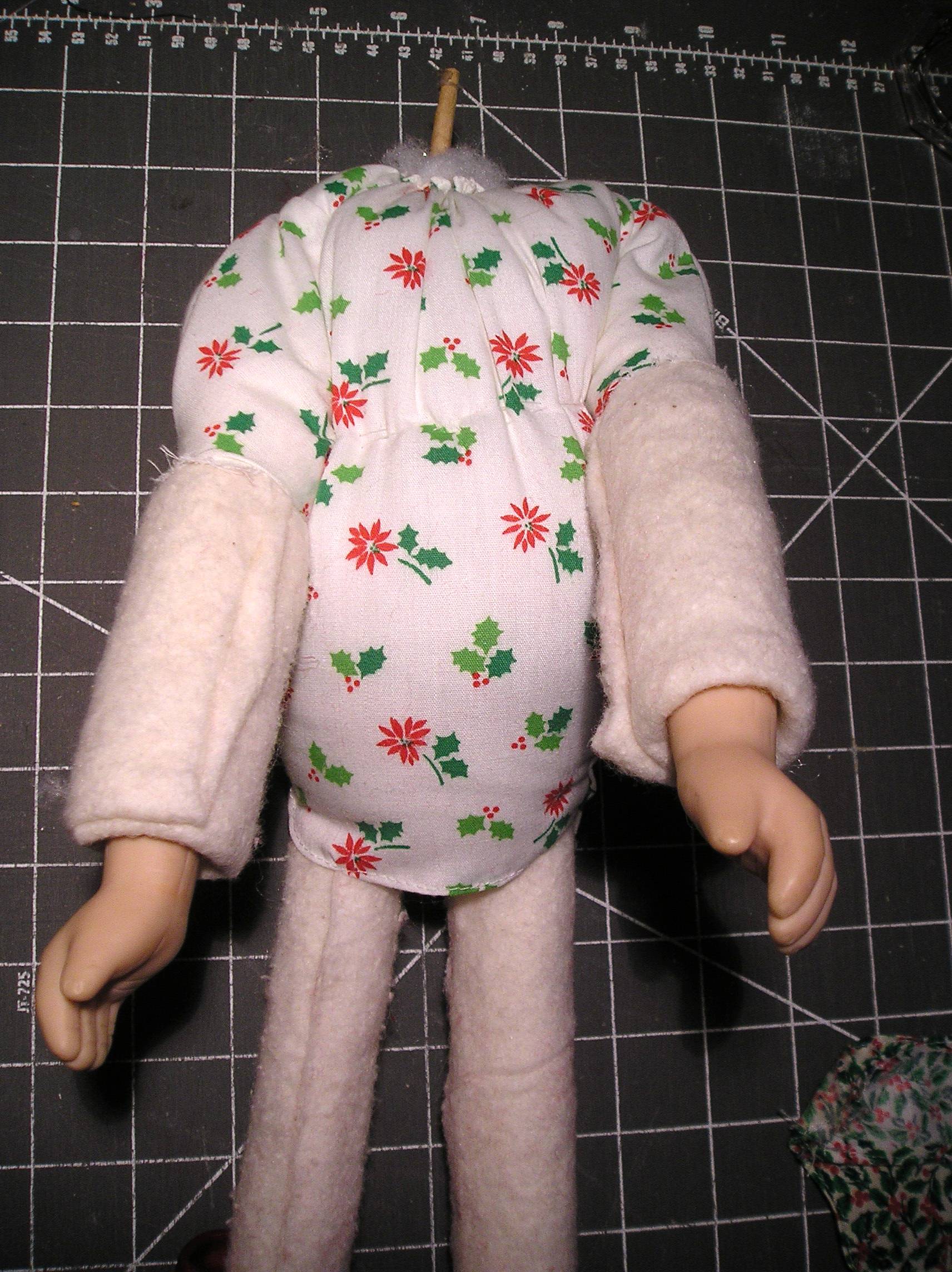
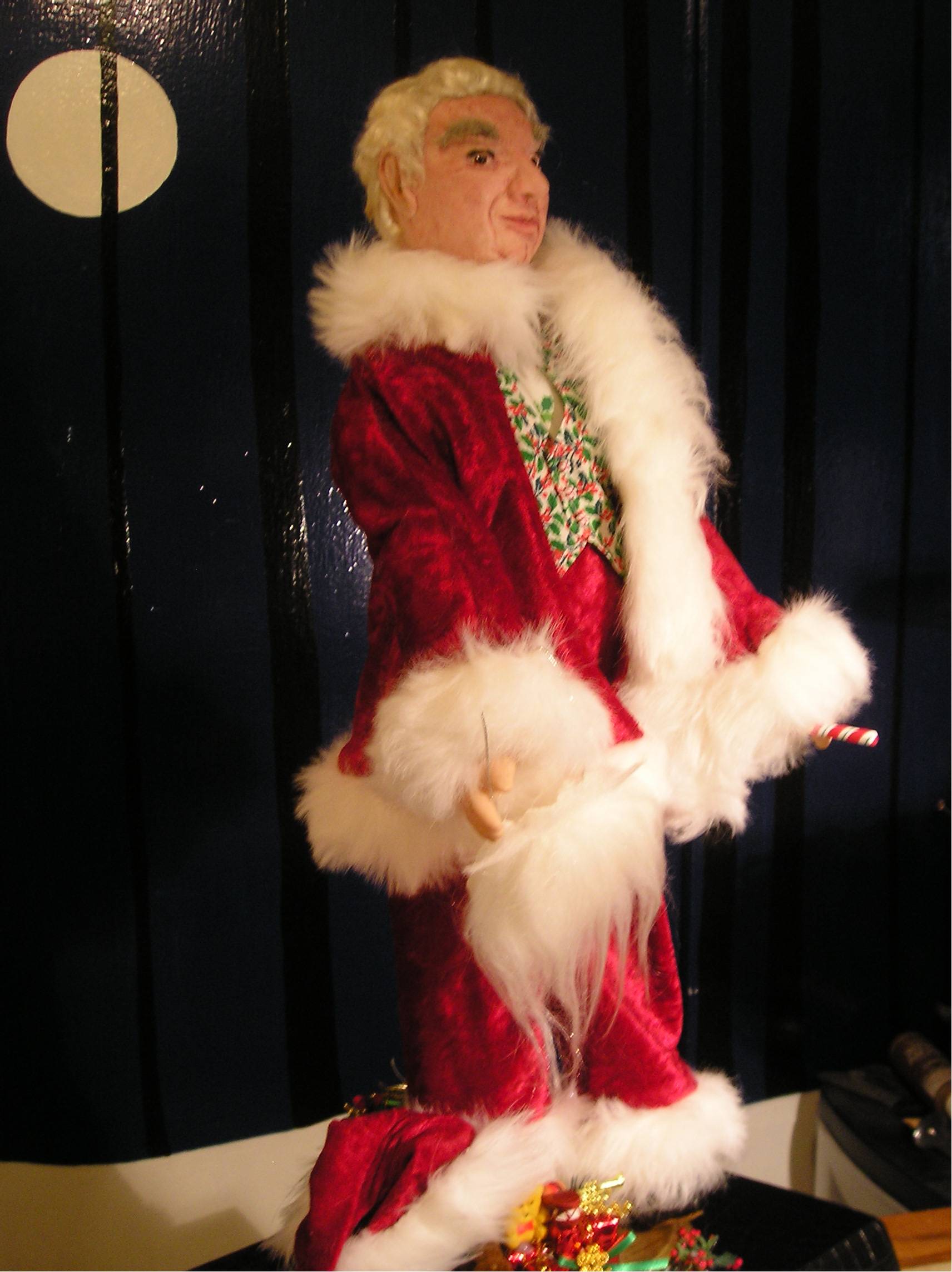
After a while I had a revelation. I actually had an older Santa than the one we got in Germany. That was my dad. He was born on December 6, 1917. That is St. Nicholas Day. So, my dad was my first Santa. To commemorate that event, I made a figure of my dad in a Santa suit. It makes me smile every time I see it amongst the other Santas that I crafted.

Santa Dad (11)

OLYMPUS DIGITAL CAMERA

Santa Dad 27

But my dad being born on St. Nicholas Day doesn’t end there. You see, my dad gave me so much, just like Santa does for kids and us kids at heart. First, he gave me life along with my wonderful mom. That’s just about the greatest gift of all if you think about it. He provided me with a great education and I don’t mean just college. He was there to teach me how to fix things around the house if they got broken. He built a den onto our first house in Memphis with his own hands. I might not have built a house, a large one, but I sure built my share of dollhouses. I even designed and built one from scratch, not from a kit. Just knowing my dad had that skill made me believe I could do the same thing.

When I left their home in Memphis when I was twenty-four and moved to California, my mom was worried about me heading off to this new place, but my dad said that they had raised me well and that I would do just fine. I heard him say that. And by golly, I did manage to make a life for myself in the wilds of Southern California. His faith in me kept me strong.

Dad gave me another gift, the “git ’er done” attitude. If something needed to be done, he always found a way to do it. He was a pilot in the Air Force and many times he did the impossible because something had to be done. I have maintained that attitude in my business and well as personal life. Dad was a great role model.

So when I think of Santa Claus doing nice things for kids and grownups alike, I think of my dad. He was my first Santa and on December 6th I think of him and St. Nicholas. Thanks, Dad, for helping to make me who I am. Being that role model was the greatest gift you could have ever given me. I love you. Happy Birthday.

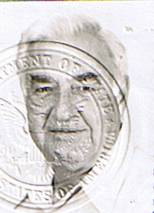
Dad's Passport PicDad and me

(Dad’s passport photo and one with Dad and me when he took me to work one day way before it was done as a regular thing.)

Podcasts for Writers and Readers

I’ve never been a news hound, but felt a need to keep abreast of what was going on, locally and globally. For the most part, I watched the news while walking nowhere (treadmill). But a couple of months ago, I said “enough” and went on a news fast. I’ve been on many such fasts through the years, but this one’s lasting longer—all because I discovered podcasts!

Even though I’ve been a guest on a few podcasts, I rarely listened to them. They can run quite long, up to an hour and more. But many are much shorter, and I now listen to the long ones in segments.

A few of my favorites:

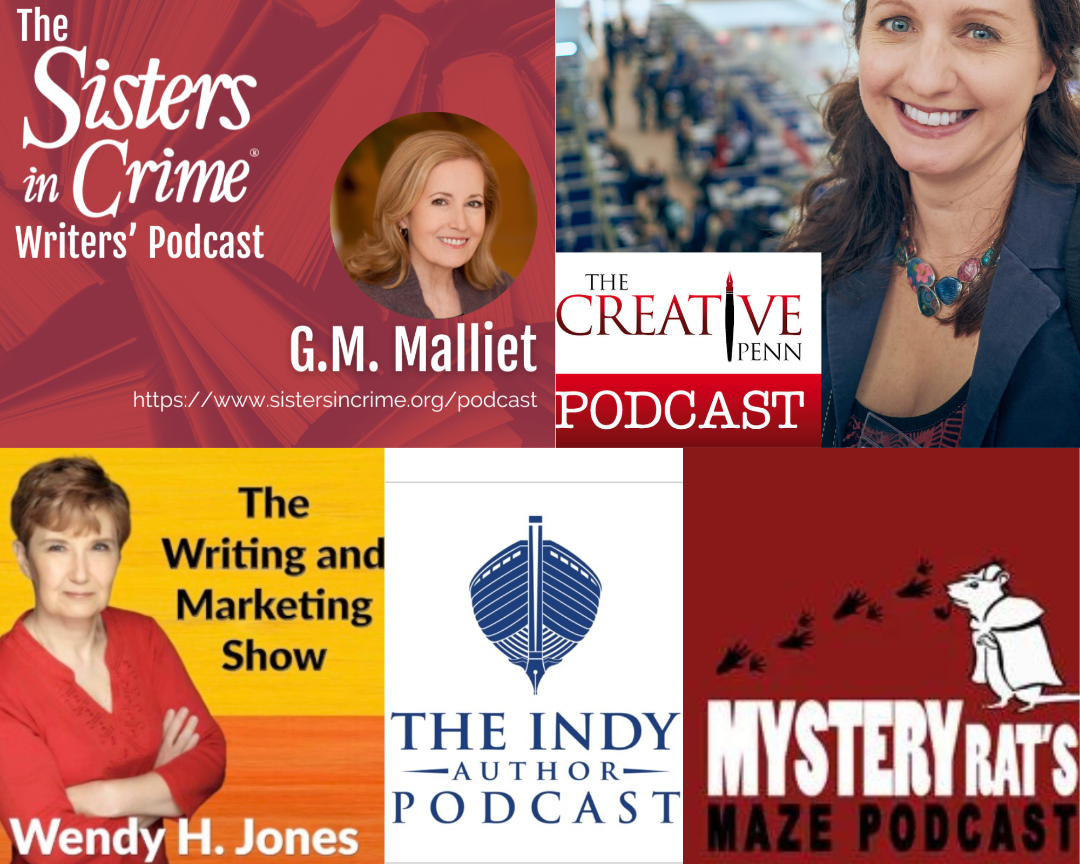
Sisters in Crime. Many of you belong to SinC and Executive Director Julie Hennrikus produces weekly interviews featuring author members discussing  their writing journeys. She kicks off each podcast with the question: “When did you first know you wanted to be a writer?”

Readers get to know more about their favorite authors and discover new ones. View the list of episodes here.

The following three podcasts are educational and offer information, tips, and advice on many writing-related topics, including craft, publishing, marketing, promotion, and social media. The podcast hosts interview writers, editors, and industry experts. Some hosts present the material themselves. Many of the podcasts are accompanied by transcripts.

The Writing and Marketing Show with Wendy H. Jones. Wendy is a Scottish crime writer. In 2022, she visited my Sisters in Crime chapter with a virtual presentation, “Storytelling in Marketing.”

I get that kid-in-a-candy-store feeling when I scroll through Wendy’s long list of podcasts. In “Using AI In Your Writing and Author Business” she presents both sides of the AI controversy. I have my own thoughts and preconceived notions about AI, but I like to make informed decisions, so appreciated her sharing.

Wendy’s podcasts on TikTok are interesting, but I’m NOT embracing that platform. While it’s no longer limited to the young (at least not for writers using BookTok), I don’t see myself producing videos on a regular basis. Still I appreciated Wendy providing information that allowed me to make another informed decision.

Wendy’s many episodes on craft include “Mastering the Art of Crime Story Writing,” “Writing Romantic Suspense,” “Writing for Children,” and “Using Your Own Life Story in Fiction”. View the list of episodes here.

Indy Author Podcast is the brainchild of Matty Dalrymple. As the “Indy” name suggests, this podcast focuses on self-published authors, but the traditionally published can certainly benefit from Matty’s many current and archived episodes.

I had read about auto-narrated audiobooks created by Google Play Books and wondered if I could produce two of my novels as audiobooks without spending thousands. I listened to Matty describe her process in turning out an audiobook for a non-fiction book she had written. It sounds quite challenging—and may be fine for non-fiction, but the monotone doesn’t suit fiction with its variety of voices and accents. Just imagining how my dialogue in the redneck bar scene in Murder at the Moonshine Inn would sound makes me shudder.

Again, a podcast gave me the information I needed to make another—you guessed it—informed decision. View the list of episodes here.

The Creative Penn is produced by Joanna Penn. She spends time at the beginning of each podcast with updates on the publishing industry as well as on her personal news. I’m currently listening to guest Douglas Smith, a Canadian author of speculative fiction who has much knowledge of publishing rights as well as how to sell our work to foreign markets. Where has Mr. Smith been all my writing life! View the list of episodes here.

Mysteryrat’s Maze Podcast, brought to listeners by Kings River Life Magazine, caters to readers. Each episode features a local actor (Fresno, CA) reading a short story or first chapter of a novel. View the list of episodes here.

Recently I learned of these two podcasts, but haven’t listened yet:

Alliance of Independent Authors
View the list of episodes here.

Novel Marketing Podcast
View the list of episodes here.

So I’ve been able to acquire much useful information, and “meet” interesting writers and experts, all while keeping in shape. Multi-tasking at its best, and so much more enjoyable and inspiring than the news. If you think I should know what’s going on in the world, let me assure you that I do. News is in the very air we breathe.

There are lots of podcasts available, on a variety of subjects. Just do a search and you’ll find more than enough choices. Here’s a good resource.

Do you listen to podcasts? Any favorites to recommend?

Leave a comment

  1. Miko Johnston's avatar

    We always say writing is writing, so what you describe can be considered responding to the challenge.

  2. lindaojohnston's avatar

    Can’t commit to that, Miko. Sure, I still write every day but some of it involves editing what I’ve done…

  3. Miko Johnston's avatar

    Brava, Gayle. What you’re doing makes sense, and what a perfect way to stay motivated. Can’t wait to see what…

  4. gbpool's avatar

    I have been doing just that this year. I started two new books last year, but kept stopping because I…

  5. lindaojohnston's avatar

Christmas Stories

By Gayle Bartos-Pool  (G.B. Pool)

Ideas for stories come from everywhere whether it’s a person, a memory, a trip, a news article, an object or a picture. Something triggers a writer’s imagination and a story starts to form. Every short story or novel I ever wrote came from something I came across in my life. My three Christmas novels are no exception.

Bearnard’s Christmas was the first one. Many years ago I worked at a miniature store in California. It was one of the first of its kind in the country and the owner had a great store. She also had a holiday shop in a backroom off the open patio. We did Easter, Halloween, and most of all, Christmas. I could buy Santas for my budding collection wholesale which helped my bank account, but we also went to the Rose Bowl in Pasadena when they had their monthly swap meet. I could get Santas for $.50 to $1.00 way back then.

But Kay Kelley also had Christmas cards. I remember seeing one with a Polar bear in a Santa hat. Bing! That got me thinking about a story about this Polar bear who helps Santa and a lady who just happened to collect dollhouses who ends up at the North Pole one Christmas Eve and helps both Santa and Bearnard, the Polar bear.

Now, on my salary, I couldn’t afford to buy a dollhouse, much less a castle, but I could sketch one out that fit my story. Then I started writing that story. A few years later the shop closed and I had to find another job, but I finally found a new one that paid more in salary and I also met and married my wonderful husband, Richard. Within a few years I could buy a dollhouse kit or two, but my story was about a castle.

By then, I had written my story, but I figured I should build the castle to go with it. I did. And I fashioned the characters in the story out of clay and took pictures of everything for my book. Eventually I got the book published.

Then I saw this Christmas card with a mechanical Santa. Bing! Another idea popped into my head. What if Santa had mechanical likenesses of himself made that could be sent around to stores so his favorite stories could be told to children in his own voice? Santa has his elves make a few mechanical Santas, but a bad guy has them reprogrammed to tell kids to demand more and more toys. What is Santa to do? The Santa Claus Machine tells that story.

A few years later I happened to find this dragon ornament at the hardware store. He was just a little guy, but cute. While I was walking one of our dogs one day, I happened to spot one of those stretchy things girls use for their ponytails on the sidewalk. It was sparkly and just fit around the little dragon’s neck like a Christmas wreath. I slipped it on him and then took him upstairs where the Santa Castle was sitting. I placed the dragon on the roof and said: “Every Castle Needs a Dragon.Bing! Guess what the name of the third book is?

A Christmas card or two, an ornament, and some imagination provided me with three story ideas and three books. Ideas do come from those things. But there is another holiday story that I wrote that had its own origin.

After the miniature store closed, I got a job at two stores in the Glendale Galleria before I got the better job at a bank. First, it was in a card store and then a bookstore. Both had their moments, but at the mall during the holidays, they had a Santa Claus. We’ve all seen them at stores as we were growing up. Well this guy was a neat Santa, but when kids weren’t around he sang. He had a microphone and he would entertain us with all kinds of songs. Bing!

I moved my singing Santa to Las Vegas where he started out as a lounge singer in really small places, but his agent, just an employment agency guy, gets him a job as a Santa in a mall during the holidays. He meets this little girl with an illness who needs some help and this Santa has to decide between his career and this kid. A few things pop up to let him know what life is all about and he makes his decision. This book is called The Santa Claus Singer.

(All books are available on Amazon.)

So ideas come from everywhere. It just depends on what you do with those ideas that determines if you get a story out of it. Write On!

A NOVEMBER TO REMEMBER…

By Rosemary Lord

“Remember, remember the 5th of November,

With gunpowder treason and plot.

I see no reason why gunpowder treason,

Should ever be forgot.”

So begins the English children’s rhyme. Back in 1605, when Frenchman Guy de Fawkes tried to blow up the Houses of Parliament, his plot was discovered, and he was stopped. And each November since, the Brits celebrate their victory with ‘Guy Fawkes Night’ or ‘Bonfire Night.’ The children make a ‘guy’ – a dressed-up scarecrow figure that looks like Guy Fawkes. They take their effigies around the streets (usually in a cart or pram) asking for “A penny for the guy!” collecting money to buy fireworks.

The evening festivities include huge bonfires, in your own garden or in community squares, with informal fireworks displays, chestnuts and potatoes roasted on the fires and hot cocoa to drink. A fun winter evening for all ages.

November is a busy month.

The Hindu celebration, Diwali: The Festival of Lights, is November 12th this year. It is a Hindu new year celebration to say goodbye to the negative and welcome the positive for the year to come. It is a five-day celebration of the triumph of light over darkness, where candles and lights abound, children with sparklers, music and dance (Bollywood style) delicious food and henna tattoos.

A more somber but very heartfelt event is Remembrance Day in England on November 11th.

It commemorates the Armistice of 1918, signaling the end of the First World War. In England, Australia, and Canada – the Commonwealth countries – people wear a red poppy in respect. At 11 am – the eleventh hour of the eleventh day of the eleventh month, at the Cenotaph in London, the guns fire a salute, broadcast throughout the countries, followed by two minutes silence. The buses, trains and traffic stop. The River Thames and various spots like Trafalgar Square are covered in red poppies in the tribute to the men and women who served in military and civilian service in World War I, World War II and later conflicts. The poppies are a reminder of the red poppies that grew in Flanders Field where so many perished and are buried.

In America, November 11th is Veteran’s Day: a time to thank and pay tribute to all the men and women who have served or are serving in the military. A grateful nation decorates their homes and gardens with the American flags, and as they pay homage to the veterans, they celebrate with barbeques and patriotic concerts. Coffee shops, restaurants, shops, pay homage to the veterans with welcome signs in the windows and gifts and special discounts. Flags are proudly displayed everywhere. It is a National Holiday.

So, with all this pageantry and celebration going on you might ask, what has this to do with writing? Well – for me, it’s the inspiration. As a historian and writer, I just love to write about these amazing points in history. I think the human angle to these great events gives us rich sources of personal encounters, heroic actions, missed opportunities for mayhem and miracles. Finding a personal account of someone who was there, an eyewitness. I like the idea of using actual historic events and traditions as a backdrop. And when we delve into the real-life stories, we uncover real people; from the big heroes to the ordinary folk just trying to survive the challenges of everyday life. We discover fascinating tidbits of human nature that raise our stories to make something very special.

 And November ushers in the winter months, when we turn our clocks back, the days are desperately shortened, with darker mornings and a chill spreads around us. (Unless you’re living in Australia, of course). We dig out that cozy, thick wool sweater, heavyweight sweatpants, fuzzy slippers and we’re ready to sit at our computers with a mug of something hot. The empty page beckons and away we go: off to write another best-seller!

Every November I promise myself that in these ensuing long, dark evenings I will get a lot more writing completed.

And the winter season presents even more back-drops for our mysteries, romances, horror stories or science fiction. Holiday themed novels are always popular. Christmas stories are especially fun to write and popular – except you’re not allowed to call them Christmas stories anymore. So, that’s a fun writer-challenge: how to write about Christmas without using the word Christmas! But I digress…

Another really good challenge for some of us during the winter months is… decluttering the computer files. I didn’t say it was fun challenge, did I? But it is surprisingly therapeutic.

I discovered this need, after spending almost an hour trying to find a file I had just been working on. You see, I couldn’t remember exactly what I had labelled it. If you add a ‘the’ or start with a date, you have to know where to search. (Sometimes, learning Greek seems easier than mastering computers!)  

In this quest I discovered dozens of files in a foolishly labelled folder “Assorted writing.” Lesson #1: NEVER file anything under “Assorted” or “Miscellaneous”.

That was another file: “Miscellaneous” with ‘2022’ added for supposed clarity! Didn’t help. I learned the hard way.

Despite the fact that my hunt for my file was lengthy and tedious, I discovered a few gems of old, forgotten, partially written tales and story ideas. Hmmm.

And so I resolved to declutter (there’s that word again!) my files and create a comprehensive labeling and filing system.  One that I could remember! A Herculean task, I realize. But one that I can work on during the long, dark, winter evenings.

It’s either that – or I’m diving back under the duvet –and reading my kindle in the dark, where no one can find me!

What’s your plan for the winter months ahead?

Making Your Words Count

I went to a gathering of local writers from Devon and Cornwall last week. Although I have been living back in the UK for five years, I have been a bit of a recluse. A lot had to do with Covid and the self-enforced isolation that seemed not only to curb my freedom, but my confidence too. It’s only now that I am slowly putting out feelers and making new writer friends.

Anyway, about twenty of us met in a lovely restaurant in Exeter and I found I was sitting next to a writer who epitomizes the word “prolific.” I won’t list the number of books of all genres (from Sci-Fi to Romance and non-fiction to ghost writing), that she churns out annually but what stopped me in my tracks (actually, I almost choked on my Halloumi fries) was her goal to write HALF A MILLION WORDS a year. And she casually said she usually comes close.

My first thought was that she had to be a robot. My second, maybe she uses ChatGPT, or maybe she’s a “first line writer.” I use that phrase because my former husband wrote for a TV show and was once accused of being a “first line writer” which upset him greatly. For those unfamiliar with the term, it’s an insult literally saying, “writing the first thing that comes to mind.” I did ask my new writer friend (who was also very nice which made it hard to dislike her) her process. Was she a Pantzer? Did rewriting, editing, and proofreading count towards the magic 500,000 words but nope, I was assured her words were all brand new.

So what’s wrong with me? If I’m lucky, on a good day, I could write nine hundred new words. I’ll probably go back and rewrite them a few times. My books under contract ask for 70,000 to 75,000 words (relatively small if you are used to 80,000 and above). Once, I wrote two books in one year so that topped at 140,000. I never used to be obsessed with my word count until that lunch.

To make myself feel better, I did a bit of research. In my defence, I still have a full-time job, a sick mother, two demanding dogs and – fanfare of trumpets – I’ve just become a grandmother for the first time … so I’m a little busy.

Even so – here are a few famous authors and their daily word counts.

  • Tom Wolfe: 135 words. As you can imagine, each book takes a very long time to write.
  • Ernest Hemingway: 500.
  • Graham Greene: 500. He said that when he has written his 500 words, he stops – even if it’s in the middle of a scene.
  • Ian McEwan: 600.
  • W. Somerset Maugham: 1,000. Maugham said there was no set formula on writing. “There are three rules for writing a novel,” he said. “Unfortunately, no one knows what they are.”
  • Peter James: 1,000. Once you start writing a book, make time to write every single day. Find a comfortable number of words for you to write each day and stick to that number. I am comfortable with 1000 words.
  • Margaret Attwood: 1,000-2,000.
  • Mark Twain: 1,400 to 1,800. Twain believed that location was important to his word count. I write very well on transatlantic flights, so I think he has a point.
  • Lee Child: 1,800. He says it takes him about six months from the first blank screen until the end.
  • Stephen King: 2,000. As a side note, if you haven’t read his book On Writing: A Memoir of the Craft, or you haven’t read it for a while, it’s worth revisiting. Stephen says that following this would add up to about 180,000 words in three months … well on track for the annual 500,000 goal but what about rewriting? Speaking of Ernest Hemingway, he famously said that “All writing is rewriting.”
  • Nicholas Sparks: 2,000. He says his is a daily goal which takes him about five or six hours to write.
  • Anne Rice: 3,000.
  • Arthur Conan Doyle: 3,000.
  • Michael Crichton: 10,000. Okay, this one got my attention. He’s up there with my new writer friend.

POSTSCRIPT: Okay … yesterday I was part of an event at the Torquay Museum called Crime at the Coast – sitting next to me was another prolific author who writes four, 70,000-word cozies a year, screenplays for her TV job and a standalone. I didn’t have the courage to ask her if she topped half a million words a year but one thing is certain, I’m just desperately slow.

So … what about you? Do you write to a daily word count?

SHADOWS OF THE PAST

 by Miko Johnston

My first book, A Petal in the Wind, begins a family saga that encompasses a half century. As each subsequent entry in the series carries a subtitle, my fifth and last book, which I’m writing now, will be called Shadows of the Past.

That phrase took on new meaning recently when my husband Allan and I traveled to Europe.

Our trip began in Prague, where much of my series takes place. I spent a day walking in the footsteps of my characters, visiting their homes, businesses and the landmarks mentioned throughout the pages. I’d selected most of the locations on Google Maps, so seeing them for real was, shall we say, enlightening. It took an hour to find U Seminaire, the location of the bachelor pad I’d used for the man who eventually marries my protagonist, Lala. I’d chosen it because it seemed like a quick walk from the Charles Bridge. In actuality it sits underneath the bridge, entangled in a labyrinth of short blocks and alleys. Somehow the building’s image got reversed on Maps – it’s on the opposite side of the street. Ouch. The little greenbelt across from Lala’s mother’s apartment, where ladies sat on benches underneath the shade trees and gossiped, actually sits below street level, though trees do line the sidewalk and there are benches. And the “gentle slope” of the street where Lala’s family lived for twenty years turned out to be a heart-pounding climb on a good day, and treacherous during inclement weather. Sigh. Still, as I stood in front of the building, seeing it for real, I felt thrilled.

In my fourth book, Lala launches her design career by converting a series of buildings into a world-class hotel. Ironically, the palace (the Czech term for a fine home), which I’d chosen for the location is now an actual hotel, and we decided to book it for our visit. It turned out the be the finest hotel I’ve ever stayed in, and although I have no right to take pride in that, I can’t help but feel delighted. On a slow afternoon I cornered the hotel staff and peppered them with questions about the building’s history, particularly during the Second World War. What began as a brief history lesson turned out to be a wild series of stories and gossip, which will inevitably solve some plot issues.

Three days later Allan and I bid ahoj to Prague and boarded a train bound for Poland. After an overnight stop in Katowice, the largest city in the region known as Upper Silesia, we took a cab to the nearby city of Bytom, the hometown of my father and his entire family. Back then Upper Silesia was part of Germany, the city known as Beuthen. As I walked along the streets, I tried to picture what his life must have been like. I gazed at the people who passed, wondering if I’d see any signs of familiarity in their faces.

The picturesque parts of the town – with some remarkable architecture and a delightful town square, partially rebuilt after being bombed in WWII – surprised me, but other areas wore the hard reality of over a half-century of decline. I saw it in the run-down buildings left to rot and the pervasive trash, especially cigarette butts, in the street. I also saw it in the faces and the body language of so many, but most strikingly in the older folks, who’d lived through Nazi occupation, followed by decades of Soviet rule, only to be largely ignored by the European Union. They bore a sense of quiet despair, of resignation to the bleakness in their existence. The only signs of joy were in little children interacting with pigeons in the town square, swarming with them, chasing them or karate-kicking them away. I saw no faces that resembled mine, nor any signs of my past in the city. It had been wiped clean.  

Our next stop in Poland was Krakow, a city Allan has always wanted to visit. Rich in history, it has a beautiful castle on a hill overlooking the Vistula River, and the largest town square in Europe. I went for a different reason. On our second day there we boarded a bus to tour the two largest and most infamous Nazi-era concentration camps, Auschwitz and Birkenau.

Entering into the first camp, with its ARBEIT MACHT FREI (“Work sets you free”) sign over the entrance gate, I wondered how I would react, or feel. I’m still not sure, to be honest, other than the eerie familiarity of what I heard and saw – from decades of studying photographs accompanied by written accounts, of documentaries and movies filmed on location, and stories I’d heard from survivors, including my father. For many, the trip was a history lesson. For me, it was akin to visiting the cemetery; I lost an estimated ninety members of my family there.

After a brief break, the tour continued to nearby Birkenau. Unlike Auschwitz, which to me felt small and claustrophobic, Birkenau is huge. You’ve seen it in many movies: a long low building with railroad tracks leading to a central tower, open at the bottom to allow trains to enter with their human cargo, like a gaping maw ready to devour all who arrive. Alongside and beyond the entrance, what seems like miles and miles of barbed wire fencing surrounds a huge open area interspersed with low barracks and guard towers. In the distance I could see different tour groups traversing the grounds, and for one brief moment I pictured them in the striped uniforms and hats of prisoners.  

Prior to abandoning the camp in January 1945, days ahead of the advancing Russian forces, the Nazis burned the meticulous records they’d kept of all who were brought to the camps and blew up the gas chambers. Only piles of rubble remain. Many, many piles. They left behind the prisoners too weak to continue; the rest (including my father) went on a forced march from one concentration camp to the next, always trying to stay ahead of the Russians, whom they rightfully feared more than the other Allies. It took several more months until my father was liberated, but at least the Americans freed him. Had he stayed behind in Auschwitz, he would have lived the rest of his life under the thumb of the Soviets. After what I saw in Bytom, I’m grateful he had the strength to wait.

The entire tour took seven hours and, although it allowed for a few bathroom breaks, it did not include a meal. The irony was not lost on me.

We left Poland and continued our travels, with France the next destination. There I stumbled upon traces of history that will influence my writing, and my life, but I’ll save that for a future post.

I can’t say these experiences will enrich the final chapter in my saga, but I can say I truly feel as though I’ve walked in the shadows of the past, both my characters’, and mine.


Miko Johnston, a founding member of The Writers in Residence, is the author of the historical fiction series, “A Petal in the Wind”, as well as a contributor to several anthologies including the about-t0-be-released “Whidbey Island: An Insider’s Guide”. Miko lives in Washington (the big one) with her rocket scientist husband. Contact her at mikojohnstonauthor@gmail.com


Roadblocks

In responding to a wonderful post a couple weeks back by Gayle Bartos-Pool, I said I write what I like to read. Not a new statement or thought from me. But then, as I finally started working on my latest, I said to myself, you’re not writing what you like to read (or even writing similar stuff to dramatizations of what you like to read). At a minimum, what I was flippantly saying/repeating was “off-handed;” and at a maximum, I was deluding myself, and probably to my writing detriment.

I’ve also commented in my own blog posts more than once in the past, about what I like to read, what authors I admire, and characters I like. Then Maggie King so thoughtfully talked about short stories and I remembered Hector Hoggs my first ever protagonist, and then Jackie Houchin talked about character names—and Eureka! The essence of this post came together.

Also, as an aside, I sometimes believe in channeling from the past—i.e. channeling Agatha Christie in particular. I would have loved to know her. Indeed, her writing is what I like to read…smart, quirky, protagonists who pull the murderer “out of the bag of all the clues that have trickily/sneakily been presented.” Hercule Poirot and Miss Marple are my prime examples. When I look back, these are not the protagonists I attempt to write. Truth is of course, there’s no way I can approach Queen Agatha. But the process of trying to is the motivator. (wonder where she got the name Hercule! And where/why/how come I chose the name Hector Hoggs(good grief))

Well, this last weekend I finally came up with major character names! I even have a name—there’s a third person narrator who is also a character who speaks to you at beginning and end. In my mind, that’s me calling myself Margo. My hubby picked my alter-ego name. (better than Lucretia his other choice!)

My intent in this post is to once again highlight a side trip on the trickily winding writing-road. Nonetheless, I can’t imagine life these days without writing. And consequently all this thinking stuff—starting with a negative revelation has led me to a new enthusiasm for writing. Writer, or “want to be writer”—the winding road I’m always jabbering about is tricky, but well worth it. And for me, writing what I like to read is definitely going to be an uphill challenge! Though so glad to have actually started my latest.

I would love to hear what you think. Is writing a true love? Stumbling blocks? What would you do instead (I’d love to have been a tv star(famous of course) but don’t have the stamina or the “put myself out there part to my personality,” nor the Talent! Another problem, I can only work with what I’ve got!

Happy writing trails!

Short Stories: The Writer

by Maggie King

In my July post, I discussed short stories from the point of view of readers. You can read it here. But what about the writers? Why do they write short stories? Why do some not write them?

If you exclusively write short stories, or want to, there are several good reasons why you’re making a good choice:

  • There’s a tremendous satisfaction in completing a story in days, a few weeks at the most.
  • Short stories can be sold over and over, as long as the market accepts reprints. Reprints don’t pay as much as an original story (I can attest to that!)—still, it’s another publishing credit, and the work’s already done. I understand that reprints often pay well if included in an annual best-of anthology.
  • Writing short stories trains you to write with tightness and economy of words. This is great preparation for other kinds of writing, fiction and nonfiction alike.
  • For short stories, you don’t need an agent.
  • That muddy (aka sagging) middle of a story, so challenging to novelists, may still  challenge short story writers–but the middles are, well, short.

But be aware of the pitfalls. John Floyd, author of over a thousand short stories, has this to say: “Now, what’s the downside of writing only short stories? I can think of only one: as a short-story writer you will probably not become famous or make a zillion bucks from your writing. But here’s another newsflash: neither will most novelists.”

Another pitfall short story writers may encounter is the Rodney Dangerfield syndrome: “I don’t get no respect.” There are any number of short story writers who are respected for their work: the aforementioned John Floyd, Barb Goffman, Art Taylor, Eve Fisher, and Michael Bracken are just a few. But short story writing in general is frequently discounted. Anything from “So when’s she going to write a novel?” to “I don’t read short stories” are comments authors often hear. I know a gifted writer of short stories who won’t create a website until she publishes a novel.

Art Taylor, winner of many awards for his short stories, says, “I’ve had people hear me say I’m a short story writer and then tell me straight out that oh, they don’t read those. (I try not to be insulted.)”

My former agent scowled when I mentioned  writing short stories. “Write the real stuff,” he advised.

If you primarily write novels, writing short stories can offer a different experience:

  • After struggling with your novel, writing short can give you a feeling of accomplishment.
  • It helps you to hone your writing skills.
  • Writing short is a challenge like any good writing (you need to develop a compelling plot and characters); but as you’re dealing with a minimum of scenes and characters, the process is simpler.
  • It gives you fresh material to promote while you’re working on your novel, keeping your readers engaged.
  • In a short piece, you can resurrect scenes and characters that were edited out of your novel.
  • You can further develop a minor character from your novel in a short piece.
  • You can experiment with new genres.
  • And you will have respect!

I’m a big fan of writing short stories. To date, I’ve published seven and have several others in various stages of completion. This fall I’m writing two for anthology submissions.

You may be a pro at writing short stories, or you may be getting started (or at least thinking about it), but we can always learn about craft. Read and study the works of the greats, like Agatha Christie, Arthur Conan Doyle, Edgar Allan Poe, Ruth Rendell, and many others. Note that these are crime writers, but the basic principles apply to all genres.

On a final note, consider this advice from the late, great Ray Bradbury: “The best hygiene for beginning writers or intermediate writers is to write a hell of a lot of short stories. If you can write one short story a week—it doesn’t matter what the quality is to start, but at least you’re practicing, and at the end of the year you have 52 short stories, and I defy you to write 52 bad ones. Can’t be done. At the end of 30 weeks or 40 weeks or at the end of the year, all of a sudden a story will come that’s just wonderful.”

For more information on writing short stories, check these resources:

What is a Mystery Short Story? And How Do You Write One? by John Floyd

Kurt Vonnegut’s 8 Tips on How to Write a Great Story. Some fascinating and surprising insights here 

Short Mystery Fiction Society(SMFS). Join and maybe you’ll win a Derringer!

Our own Gayle Bartos-Pool wrote an excellent guide, THE ANATOMY OF A SHORT STORY WORKBOOK

Do you write short stories? If so, tell us about your experience.