Pet News by Jacqueline Vick

Since animals have broken loose on the Writers in Residence blog, I thought I would post a part of a newsletter I wrote to introduce the real life pets behind the characters in my novels. I give you, Chauncey. Enjoy!

Chauncy

577d861cd3822ba86c96e42c63007a61“A solid, ginger mutt glanced up from his position on the couch, but he didn’t move his eighty pounds to greet me. I’d rescued Chauncey from a local shelter three months ago. Rescued animals usually brought baggage with them, but Chauncey had an entire set of luggage.”  

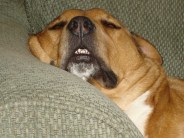
Frankie Chandler’s rescued mutt, Chauncy, is the star of her home. He enjoys laying on the furniture, passing wind, and eating. The real-life model for his character is Buster, also known as Buster Brown and Busterlicious.

Buster was rescued from the Castaic Animal Shelter by author Jacqueline Vick, and she was his last shot at a forever home. He’d been adopted and returned twice, which meant three different homes in less than seven months!

His troubled puppyhood, which his current vet believes included abuse, caused him many neuroses, including a fear of loud noises, a fear of riding in the car (sometimes), a fear of walking near the street (which thankfully passed) and an inability to greet other dogs face-to-face (which makes his pet parents want to murder people who let their dogs off leash, free to rush Buster.)

Soon after his arrival at his forever home, Buster entered doggie day care for a few hours each week in order to develop his social skills. He loved playing with every dog, but his favorites were a pair of boxer siblings and a standard poodle named Rocky. He also took an agility class at a local park, but when the trainer parked a jeep nearby in which she had recently transported a mountain lion, he caught a wiff of the scent and that put an end to his classes. His boycott of that particular park is still in force.cone of shame 005

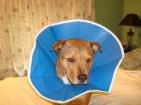
He was 55 pounds at 7 months old, and to his family’s surprise, grew to 82 pounds! They also discovered that Buster had colitis. He’s on a diet that consists mainly of homemade dogfood, and he’s doing just fine! His large size doesn’t make him any less active, and he’s suffered a few minor injuries, which have forced him into the cone-of-shame!

Buster is the proud recipient of the Canine Good Citizenship award, and he hopes to train as a therapy dog when he finally calms down. His other talents include barking at cars and sleepiheadshot and buster 015ng in his appointed chair, but his absolute favorite activity is eating, which caused one trainer to nickname him Bear.

Buster takes his new celebrity status in stride.

Delusional…

I haven’t met a dog I didn’t like, even the guard dog[i] varieties in Jackie Houchin’s wonderful post last week about dogs in Malawi. But when it comes to writing, from the very first, I wanted to make a point of not writing about animals (many of my fellow authors already do that soooooo well!) So I haven’tat least that’s what I’ve told myself for many a year before gathering my thoughts to write my Writer in Residence animal-series-post here.

Blogs are better with pictures, I’m told and think is true, so going back since starting to use a digital camera, I looked on my computer for pictures of pets we’ve known and lovedthinking an animal collage would be good to include in my post. So, I copied and pasted into PowerPoint all the pictures I could find, (some I didn’t have digital pictures of) all the while saying things to myself like, “Oh yeah, I did use Dobie in Mojave-Stone,” and “Jasmine was Della’s buddy in the Ravens books…” as I made my collage. Well, I finally realized how delusional/clueless I was about animals in my writing. A few examples are:

Mugs Nightshade–a character’s name inspired by Margery Allingham’s Albert Campion’s sidekick Lugg, and my dog Mugsin my latest Rhodes book

Dobie – playing herself in two Rhodes books

Tempefaithful friend to Elizabeth-May in latest Rhodes book

Silky and Samara (a friends cats)playing themselves in two Rhodes books

JoeysJoey was honored by having Hugh Champion’s mini-mart “Joey’s” named after him

Jasmine—Della’s faithful companion in two Hugh Champion books

Dogue—Camille’s faithful companion in Lies of Convenience

Tasha—Jada’s companion in Death of a Perfect Man

Naja and Buster—as themselves in my first novel Uncle Si’s Secret (with POV scenes of their own no less!)

I also forgot about the Ravens, itinerant residents here with us in the Mojave. Inspiration for Reticence of Reticence and Counsel of Ravens.

And then, I took a step even farther backthe first story I ever had published was in Alfred Hitchcock Mystery Magazine many-many-moons ago—title, Duck Soup. with characters, Dogue (my German Shepherd at the time) and some ducks. And the second story they published, The Case of the Lost Collie (their title, not mine. But there indeed was a Collie involved.)

So how could I not think I write about animals? The honest-to-goodness truth is I didn’t think I did.

My writing point here—clearly my subconscious author-mind has been writing about my lifelong “friends” all along. Even if they aren’t the main characters, or crucial to the plot line. They are there. And the further I thought, the less surprised I was. Clueless as I was about my animal friends, I’ve written about what’s inside mewhat I’ve experienced, liked, and disliked. From animals, through locations, character traits, situations, and more. In the past I’ve gone on-and-on about locations, settings, sensory experiences, even lyricism—and how these items can make our writing better. Clearly, my dear animal friends have been “singing” to my writing-mind all along, and are embedded in who I am, and what I write.

From now on, I’m going to embrace on a conscious level any richness their presence in my life can provide to my writing. And my other take-away from putting together this post—is the question of what else is out there that needs conscious thought on my part?

My final thought, maybe advice? from this whole exercise is “Write what you know—even if you don’t know you’re doing it.” (Smile)

One little closing note: My characters are often talking to their animals. Why? Because I do. All the time. Hmmm…


[i] As a child we had a big black Belgium Sheppard named Champ

Big Black Dogs, a Writing Inspiration

The Dogs of Africa, by Jackie Houchin

I’ve just returned from two weeks in Lilongwe, Malawi. Two things I’ve noticed in the four times I have been there is that many American families (teachers, missionaries, administrators) live in “compounds.” Many well-to-do Malawians do too.

These are large houses – really, amazingly so – inside large, high walled yards. Some of these enclosing brick walls sport coiled barbed wire or broken glass on top. All have solid metal sliding gates that are opened only by guards who work in shifts and only for residents and acknowledged visitors. And…. only after the DOGS are chained.

The transition from red-dusty, pot-holed roads to the lush garden interiors of these compounds is quite astonishing. So is the first sight of the…. huge, barking, slavering, jumping against chains, black guard dogs.

Malawi is known as “The Warm Heart of Africa,” and there has never been a war there. So why the over-the-top security? Poverty and hunger.  Malawi is now officially the poorest country in the world.

But thank God, this year there was sufficient rain, The maize crop – their main food source – did well. Harvesting had begun in earnest while we were there.

But for the last number of years, many, many people in the villages went hungry.  They see (or imagine) the things inside these fortresses as a means to feed themselves and their families. They steal to sell to buy food. Occasionally someone gets hurt if the residents are unexpectedly at home. The intruders’ greatest fear is not the guards, but the dogs. Big dogs. Black dogs.  The color is important; they see them as especially evil and powerful.

IMG_3221 - CopyThe first home our visiting short term missions team stayed at had Simba and Samson – father and son Great Dane/Rhodesian Ridgeback mix dogs. Their shoulders are at hip joint level. Their massive heads taller. Their shining fur, black as night.

Once inside the gate and approved by the owners, the dogs are really quite friendly to visitors and buffet each other to get the most petting. They run loose in the compound, and can be seen lazing about on the thick grass under flowering trees or Hibiscus bushes.  But let a car toot at the gate, and they pound into action. The guard chains them to the wall near his shack at the gate before rolling it open.

My second Missionary Kids’ Story, titled Big Black Dogs, was inspired by these two beasts, with my made-up names of Gideon and Goliath. You can read the story here, (https://jackiehouchin.wordpress.com/2016/10/17/kids-stories-of-missionary-life-in-africa-2-big-black-dogs/ ) and marvel at their instinct for protection and their cunning ways.

This last trip, we stayed at another home (the family I patterned my MK Stories after).  They have been in Malawi only since last summer, but one of the first things they did was to purchase two Great Dane-Shepherd mix pups; black, of course, and big.

FullSizeRender (21)Their young children – fans of the Lord of the Rings series – named them Samwise and Frodo. They are only eleven months old and have some puppy ways, but let a horn sound at the gate and they are transformed into something like the Hound of the Baskervilles.

There is one other Big Black Dog that I have met in Malawi.  He belongs to a family with three children, who hang on him and throw toys for him to fetch. Grown men who frequent the house are, however, quite fearful of him. I think it’s the eyes, because once a car enters the compound, he is quite silent. He watches, his tail never waging. A silent menace.

The family has a large Kondie – screened patio – at the back of the house where they entertain guests. It’s a great place (free of those pesky, dangerous mosquitoes) to talk while the chicken and beef sizzle on the grill.

Their Big Black Dog will appear silently as you relax and gab, and stare at you through the screen. You think that if you approach him all friendly-like and let him sniff your hand, all will be well. He’ll see you are no threat.

FullSizeRender (18)But as you rise and move toward him, a flimsy screen the only barrier separating you, and your eyes meet… he stands and growls deep in his throat and lifts a lip to show long canine teeth. His stiff-legged stance and erect tail warn of horrors to come should you venture closer.

You back away slowly and he stops. Eventually, as you sit down, he turns and resumes his guard duty around the house and other buildings. You notice sweat at your temples and armpits although it’s a fairly cool evening. Eventually your heart beat slows.

When it’s time to leave, the gate guard whistles for the Big Black Dog and secures him to the sturdy chain.  Safe inside your car you drive slowly through the gate. “Killer” – as you have dubbed him – barks viciously and lunges against the chain as you pass.  When you turn into the street and the metal gate rattles along the rail and bangs shut, the barking ends.

As the car moves away, you hear the young daughter of the family call the monster for a game of fetch. “Get it!” she shouts, and you hear nails scrape on cement. “Good boy, Sniff.”

Sniff??


Lions, Tigers, and Bears. Oh, My!

by Gayle Bartos-Pool

Friends usually have things in common. Writer friends might have even more in common because we incorporate things we have learned, researched, or stumbled across into our writing and we read each other’s work. (Books teach!) Being Facebook friends, too, brings many of those experiences into focus because we can see what each of us is doing… Sort of like a spy camera watching our every move if we happen to post parts of our lives and experiences on Facebook.

Recently, The Writers-in-Residence bunch happened to discover that we all had a strong affinity for pets… cats, dogs, birds, you name it. And something else we noticed. Those pets turn up in our pages. Even if we don’t currently have a furry or feathery face gracing our home, we have had one at one time or another that made a difference in our lives. And often we write about those experiences.

Over the next few weeks we are going to share with our readers some of these encounters. We hope you enjoy our memories and our pets and see how we incorporated them into our work.

99be9-gayle51closeupAs for me, since I have always had a pet in my house, as a kid and as an adult, I never thought it odd to put a cat or dog in a story. My Ginger Caulfield private detective character has two dogs, Sherlock and Foxtrot. In reality, my husband and I got our two Italian Greyhounds, coincidentally named Sherlock and Foxtrot, from the Los Angeles pound. The two canines don’t solve mysteries in Gin Caulfield novels… yet. Though you never know. But I will tell you one thing… no dead dogs will EVER turn up in my stories.

bookcoverpreviewcroppedThe three books in my Christmas series are full of animals even though Santa doesn’t consider them pets. After all, Bearnard, the Polar bear from Bearnard’s Christmas, works in the castle and even helps solve a mystery in the third book, Every Castle Needs a Dragon, coming out at Thanksgiving. Even the dragon, Orville by name, plays a rather large part in the story. (He reads as well as talks!) Every Castle Needs a Dragon cover trial 2 cropped

But at the North Pole many things are just a tad different from anywhere else. One of our cats, Sylvester, actually makes a guest appearance at the North Pole in Bearnard’s Christmas. Angel, Sylvester, Winston and Cookie also drop into the story.

Bearnard & SylvesterAngel0002

Sukoshi Painting 2My spy novels reference Sukoshi, the Beagle I had as a kid and up until I was working as a private detective at the age of 21. She is mentioned because the books are loosely based on my dad’s career in the Air Force and Sukoshi went to France with us when my father was stationed there. When we were visiting West Berlin, she had a very long leash that allowed her to wander under the barricade into the no-man’s land that separated West and East Berlin, so she actually got closer to the commie-side than I did.

CAVERNS is crawling with animals, mostly rats because the little dears are carving out caverns under the high-rises in Chicago. The story was actually based on something I heard from a co-worker who read about a 105 pound rat being found along the wharf area while she was living in New York City. Her story and the fact I had a case in Chicago while being a P.I. brought those two pieces together.

Most recently, I finished my latest book called SECOND CHANCE which has a rather “coincidental” tie-in to the subject of pets. Chance McCoy just got the opportunity of a lifetime. That’s the title page blurb.

Chance McCoy is a private detective killed during a routine case, but he is given a second chance to make good. But with his track record as a P.I., he just might blow this chance, too. That’s the book summary. So far, no pets… but

All through the book, Chance views people he encounters as some kind of pooch. Droopy Bloodhound eyes on one guy. A teenage girl’s bodyguards are viewed as Bulldogs. Another set of hired muscle are called Rottweilers. Chance even enlists the services of a cadaver dog named Maurice to see if a body is buried in someone’s backyard.

Fred Closeup cropped 2It really wasn’t a coincidence on my part to make these comparisons because, you see, I dedicated the book to Freddy J. Feathers, our beloved parakeet who recently passed away. I found Fred wandering in the backyard about six years ago and he got a “second chance” with us. That fact fit perfectly with this particular book. And the short piece at the end of the book ties my love of pets up with a big ribbon. (You’ll have to read that part for yourself.)

But pets, or members of the family as we call them in our house, have been a large part of my life and they seem to have played a big part in my writing as well. I guess we do leave bits of our heart in everything we write. So if you have room in your heart and your house, adopt a pet or get one from a reputable kennel. It’s one of the kindest things you can do for a furry or feathery friend in need.Valentines 2014 (13)

Respecting the Muse by Bonnie Schroeder

Bonnie_Schroeder-McCarthy-Photo-Studio-Los-Angeles-7077-Edit-web


Bonnie Schroeder started telling stories in the Fifth Grade and never stopped. After escaping from the business world, she began writing full-time and has authored novels, short stories and screenplays, as well as non-fiction articles and a newsletter for an American Red Cross chapter.


Most writers inevitably encounter the question, “Where do you get your ideas?” I’ve been on the receiving end more times than I can count, and I often wonder aLife after Lifebout other writers, too.

Where, for example, does Stephen King come up with all his intricate storylines? Where did Kate Atkinson get the idea for Life After Life? 

Actually, ideas are everywhere, and they’re often triggered by those magic words, “What if . . ..?”

In my experience, however, the initial spark tends to morph into something quite different when I begin to work on a story. My first novel, Mending Dreams, came about because I knew a woman whose husband did the same thing my protagonist’s husband did: came home one day and told her he was leaving her because he was in love. . . with another man. “What if,” I wondered, “that had happened to me? How would I react?” The eventual premise turned into something quite different than I expected, as themes of love and courage emerged from the mess I created in those first pages.

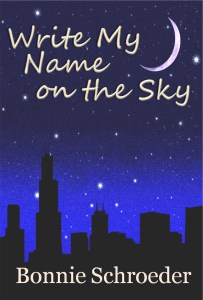
I was married to an artist in the 60s and 70s, and as I was looking over old photos from those days, I asked myself, “What if my husband had become really famous?” This led to Write My Name on the Sky, which will be published this summer. The story changed tremendously in the execution, but that first flash of inspiration arose from those old pictures.

A couple of years ago, during my annual physical exam, my doctor remarked that both my hearing and breathing capacity had improved in the past year. Hmmm. What if I was growing younger? That idea became the cornerstone of the novel I’m currently writing, and it’s become more than a case of mere wish fulfillment.

Webster’s New World Dictionary defines “Muse” as “a source of genius or inspiration,” but I have other names for her. She is quite a trickster, and if I don’t pay attention to her whispered ideas, they vanish like smoke. That’s why I am almost never without pen and paper—or in today’s world, without my trusty iPhone, which I use to record the Muse’s suggestions and sometimes even to photograph the source of them.

Yes, ideas are everywhere, but writers need to respect them when they appear; don’t squander them; nurture them and preserve them.

I believe the writing process is at least one part voodoo. Inspire

For me, it seems that once I set my intent to write about a particular topic, the creative universe springs into action. For my woman-getting-younger novel, even while I was sketching out the premise, articles started appearing in newspapers and magazines I read, about “age disruption” and “life extension.” My research file on the subject is over six inches thick!

I would love to hear from my fellow writers and readers about this subject. What inspires you? Where do you get your ideas? And how do you hang onto them when they appear? What do you do with them? Please share!

Everything is Research by Linda O. Johnston

lindaphoto
Linda O. Johnston, a former lawyer who is now a full-time writer, currently writes two mystery series for Midnight Ink involving dogs: the Barkery and Biscuits Mysteries, and the Superstition Mysteries.  She has also written the Pet Rescue Mystery Series, a spinoff from her Kendra Ballantyne, Pet-Sitter mysteries for Berkley Prime Crime and also currently writes for Harlequin Romantic Suspense as well as the Alpha Force paranormal romance miniseries about shapeshifters for Harlequin Nocturne.  Her upcoming May release is her 45th published novel, with more to come.
 *  *  *
I’m  writer, and I assume that’s true of many people who read The Writers in Residence blog posts.  I’ve been doing this for quite a while, and it dawned on me long ago that I could, and do, use many aspects of my life as research for what I’m writing: what I read, what I accomplish, in effect nearly everything!
 
For one thing, I love to incorporate dogs in my stories.  I’ve been owned by Cavalier King Charles Spaniels for many years, and most of my friends, neighbors and relatives own dogs.  Plus, I’ve been able to observe a lot of dog training and other events involving dogs–and often what I see and experience shows up in what I write.
 
I’m not much of a cook, yet one of my mystery series, the Barkery & Biscuits Mysteries, includes not only dogs but the protagonist, Carrie Kennersly, owns both a human bakery and a barkery where she sells dog treats.  Some of the barkery material is derived from my visits to local shops in Los Angeles where dog food and treats are cooked and sold–so just visiting there, even if I’m hoping to buy things for my own dogs, is research.
 
Carrie is also a veterinary technician, so when I take my own dogs to the vet I’m also doing research.
 
I’ve also written Superstition Mysteries, and there are a lot of superstitions out there.  While I’m walking I’ve watched strangers stoop to pick up “lucky” pennies–and I do too, just in case.  Others cross their fingers while saying something, or knock on wood.  I’ve heard a lot of people extol their black cats and say they’re lucky, no matter what the superstition says.  Of course black cats being unlucky is a U.S. superstition; in other countries they’re considered lucky.
 
I haven’t run into real shapeshifters yet, I’m sorry to say–I think–but it’s fun researching the legends about them for my Alpha Force paranormal romance stories for Harlequin Nocturne about a covert military force of shapeshifters.
 
Just walking out the front door of my house provides me with ideas and research for some stories.  At the moment all my neighbors are good, but we’ve had some bad ones who, at least, give me story ideas as well as providing research regarding attitudes of some of today’s mostly younger folks.  I also derive ideas and research from some of the things picked up on the security cameras my husband mounted as a result of some of those bad neighbors, as well as from thieves and vagrants who’ve visited our street.  Do we live in an awful, rundown area?  No, just the opposite.  Our neighborhood is great, which may be why it attracts these kinds of issues.  Not fun in reality–but research!
 
Then there’s a new idea I’m working on now that was created after I went on a holiday outing to an interesting area–and my mind just took off on what kinds of mysteries could evolve around there.  Of course I’ve been doing additional research on that area.  Don’t know if this idea will go anywhere, but I’m certainly having fun working with it.
 
And meeting with other writers?  Everyone’s outlook on things is different, even if they’re writing in similar genres, so just talking about life and writing can also be considered a kind of research.
 
So here I am, writing this–and wondering what the next piece of research I’ll pick up will be, and how I’ll incorporate it into a story! 
 
How about you?  What is the most fun or helpful kind of research you’ve happened into in your life?
 

Yak Shaving 101 by Rosemary Lord

just-rosie-3Rosemary wrote her first book when she was ten years old – for her little brother. She also illustrated it herself. It was later rejected by Random House! She has been writing ever since.

The author of Best Sellers Hollywood Then and Now and Los Angeles Then and Now,  English born Rosemary Lord has lived in Hollywood for over 25 years. An actress, a former journalist (interviewing Cary Grant, James Stewart, Tony Hopkins, John Huston amongst others) and a Senior Publicist at Columbia Pictures, she lectures on Hollywood history. Rosemary is currently writing the second in a series of murder mysteries set in the 1920s Jazz Age Hollywood featuring Lottie Topaz, an extra in silent movies.

* * *

 What, you might ask, is ‘Yak Shaving’?  Where do I start…?

I was writing a new chapter in my next book, when I needed some research information that I could not find online. (If only I wrote about the present day, I wouldn’t need all this specific research – I could make it up.)  A visit to my local library was needed. So… I got dressed and headed out. I knew my car had the little orange light flashing, so I would have to get gas first. But, lo and behold, the universe had another idea. I had a flat tire. So I called the AAA and waited. My spare was flat, too, so the AAA guy towed me to the local Tire place. Eventually, I was able to drive my car away, go get some gas and head to the library for my research. I found the book I needed and copied my notes. It was a reference book, so I could not take it out.  After which, I was hungry. I can’t think or write when I’m hungry. So on my way home, I had to stop by Trader Joe’s and buy some food, before heading home to cook, eat, then pick up where my writing left off –  many hours later.

This is known as ‘Yak Shaving’ – when you find yourself doing something as irrelevant as shaving a yak (don’t ask!), instead of the goal you set out to accomplish.

It’s a term invented by MIT student Carlin Vieri and made famous by blogger Seth Gordon, who told his own tale of, “the seemingly unrelated, endless series of small tasks that have to be completed before the next step in a project can move forward.” There!

Hey – maybe I can absolve myself from the  personal responsibility for not finishing my current book: I have the Yak Shaving Syndrome.

But writers are known for procrastinating. Sometimes we find it is essential to clean out our fridge, before we can write that next article – or re-pot those pesky plants in the garden, before we write the next pages. Essential stuff, eh?

But then, we could turn Yak Shaving to our own benefit. When you’re writing a novel – especially a mystery novel – you usually have a vague idea how it ends, and maybe an overall feel about the way you want your characters to interact. So perhaps, if you’re stuck, you can work backwards.  Think about what has to happen just before the end. How you resolve your different characters storylines at the finale. What has to happen just before that?  And what has to happen before that point in your plot – and so on. Yak Shaving in reverse.

I digress. Because one can easily get distracted by all the Yak Shaving things life throws at us. Finding the perfect printer, the best notepads on which to write your literary gems, sharpening your pencils to perfection, then choosing just the right font when you finally get to type it all up.  I get so busy and distracted by little things that I have to constantly remind myself, what is it I really want to accomplish or be doing?

Remember that old saying: ‘When you are up to your neck in alligators, it is easy to forget that your original mission was to drain the swamp.”


How Rough Will You Go?

FROM SCREEN TO PAGE, Part 3 with Miko Johnston

Miko Johnston is the author of A Petal in the Wind and the newly released A Petal in the Wind II: Lala Hafstein.

She first first contemplated a writing career as a poet at age six. That notion ended four years later when she found no ‘help wanted’ ads for poets in the Sunday NY Times classified section, but her desire to write persisted. After graduating from NY University, she headed west to pursue a career as a journalist before switching to fiction. Miko lives on Whidbey Island in Washington. You can find out more about her books and follow her for her latest releases at Amazon.

* * *

Last summer I created a four-part seminar, “The Rules, And How To Break Them” for this blog. My intention was to show how crucial it is to learn the guidelines and formulas in writing fiction, because once you understand them, you can work around them.

There is a singular exception in my opinion, one rule that should never be broken: always treating your work in a professional manner – using standard formatting with readable fonts, and correcting your copy before showing it to anyone.

I still believe that. I set my Word docs to one-inch margins, double-spaced, usually Times New Roman or Cambria 12 point font. I check my work for spelling, grammar and punctuation before presenting it to a critique group or beta reader. What I present is never perfect, but I catch and correct a lot more errors than I let through.

Not everyone follows that policy. I don’t understand why. Pages with odd or odd sized fonts and single line spacing can be difficult to read. I don’t take issue with the occasional extra or dropped word, a few typos, or missing dialog tags. Writers who’ve caught an error after the fifth proofing of their work know it can happen.

However, when I have to review pages that are hard to read or overloaded with avoidable mistakes, I feel more like a teacher correcting papers than a writer offering critique. In fact, too many errors distract me from the writing, from finding the real gems within the pages as well as the core issues with character or plot.

I recently submitted pages from my third novel to a critique group with the up-front warning that they were a first draft. I’d been struggling with how to develop the story, which plot points to follow and which to drop. Even so, I made sure to present the material as though it was my final draft – proofed for typos and other errors. Their feedback was extraordinarily helpful, but I doubt they would have been able to provide so much insight if I hadn’t done my cleanup first.

Some writers I’ve worked with over the years don’t agree with me. They’ll submit a rough draft and make corrections after the critique. I’ve even heard some say they don’t care about grammar, punctuation and spelling – they can hire someone to do that for them. What professional would admit to being unable to handle some of the most basic elements of their job?

Doesn’t submitting sloppy work unchecked for common errors not only show a disregard for one’s own material, but disrespect for the readers?


“Vortex” Review by Jacqueline Vick

As writers, it’s tempting to remain focused on our own works-in-progress, but savvy authors know that one of the best ways to remain fresh is to read other books in our genre.  It’s also a good idea to move a step outside of your comfort zone when composing your reading list. Consider it a mental stretch. I’ve been gorging on mysteries, and though I usually stick to golden age, British traditional, and humorous, I recently picked up a crime thriller to round out my list. Here’s the scoop:

Vortex
Paul D. Marks
Timeless Skies Publishing

It’s apparent from the first page that Paul D. Marks writes stories that move. Fast. Hard-to-put-down fast. Which is probably why he has a Seamus Award for his novel, White Heat.

Vortex, protagonist Zack Tanner returns from Afghanistan to find that he isn’t the same shallow, fun-loving man that left Los Angeles for an adventure in the army. Unfortunately, no one else seems to have changed. Not his girlfriend, Jess, who is forever dreaming of stardom, nor his best friends and fellow soldiers, Bryan, Carlos and Matt.

Well, maybe Carlos and Bryan have changed. They believe that Zack has possession of something they desperately want, and suddenly the friendly banter takes a sinister turn. And the chase begins.

Marks, known for his love of Los Angeles noir, honors the moral ambiguity of that genre with a complex hero who straddles the line between being the good guy and being the guy who simply isn’t as bad as the rest.  Zack, who functions as the point-of-view character, presents an authentic voice reflecting the difficulties a soldier might experience when faced with his former life.

The supporting characters ring true, and you won’t know whether to love them, pity them, or hope they get bumped off before they cause additional damage. You can never be sure who’s on Zack’s side.

Marks knows the Los Angeles area well, and whether the scene takes place in the affluence-surrounded-by-grunge Los Feliz neighborhood, on the touristy Santa Monica Pier, or zooming up the famous Pacific Coast Highway, it feels as if you’re there.

The only problem with the novel is that it ends, because you won’t want to lose touch with Zack Tanner.

headshot

Jacqueline Vick spent her childhood plotting ways to murder her Barbie doll. Mystery writing provided a more productive outlet.

 You can find out more about the “Barbie Death Ritual” at http://www.jacquelinevick.com.

Spring and the Comeback of Writing Richness

By Madeline (M.M.) Gornell

Rest Stop on the Writing JourneyIf you are a follower of our Writers in Residence blog, you may have noted by now my fellow writers possess a wealth of knowledge! I’m always learning from them, especially when it comes to where to, how to, and when to.[i] You’ve probably also gathered I spend a lot of time sitting around thinking about the art and craft of writing. Time, I must confess, that might be better spent actually writing or promoting. Nonetheless, everything started blooming out here in the Mojave last month, and I’m once again sitting around and thinking some more, and still reading Ngaio Marsh, and thinking about/starting several new books that would hopefully incorporate these thoughts and goals ((key word starting(smile)).

Spring Blooms

One of the things I’ve been thinking about is the art of bringing richness to my work. So what the heck am I talking about? Around Christmas I was thinking (posting) about lyricism, and recently just finished a Surfeit of LampreysNgaio Marsh’s tenth book, and written in 1941. In this novel, there is so much richness of characters and sense of place. I became one with the Lamprey family members and with Chief Inspector Alleyn. Not to say her dialogue isn’t snappy enough, or plot movement quick enough, or descriptive passages manageable. But given there is some reading-patience required, the rewards are great!

And where am I going with this? Sometimes, no matter what the current wisdom is, you have to write what you feel, like, and admire. Contrary to that concept, last year I spent too much time trying to tighten, streamline, improve my writing in line with current-guru directions (not necessarily a bad exercise for sure.) But now though, good or badI’ve finally realized the heck with it—just not me. Indeed, to the opposite end of current writing conventions, I’m going to go back in timeembrace, not try to eliminate or modernize a certain richness of style. One reader once mentioned to me, “I like your books, but you take too long to get to the action!” That reader is right. But the nugget for me there is—how important is that to me/you to the enjoyment of the tale and the emotional remnants remaining with the reader? It might just be a matter of prioritizing preferred outcomes?

An added note in taking my ramblings into account, I still don’t have a Smartphone. Maybe I’m also just a literary Luddite (living in the past maybe?) My hopefully helpful thought is, there are still people out there like me who when reading actually do want to  feel, know about settings, locations, character feelings, and emotional impacts in depth. And dialogue alone doesn’t get you there. I’m not sure exactly how to accomplish all of what I’m talking about, but I’m certainly trying in my rewrites to incorporates all the thoughts I’ve had lately into my work. (probably with an outcome of using more adjectives and adverbs than current writing connections condone–and not getting to the action soon enough!)

I’m also thinking about “words” and how picking just the right one brings lyricism and richness…but I’m out of time. Next post. Also thinking about the “leftover emotion” and imagery left after reading a book—I can still see Lamprey’s “lift” in my mind’s eye.

Comments are most welcome! And continued happy writing trails…


[i] Take for instance, last weeks post by Jackie Houchin on Making a booklet https://thewritersinresidence.com/2017/03/15/how-to-make-a-booklet-in-23-easy-steps/