“Off The Top”

by Jackie Houchin

What do I mean when I say, “off the top of my head…”?

Dictionaries say it means derived from the knowledge you have in your memory or impromptu, without previous thought or preparation.

Does it mean the same as “seat of my pants”?  Hmm. We often say we are “pantsers” when we sit down and start writing a story without a formal outline.

Although I love outlines, pages of notes, and lists of resources, I often sit down and simply start writing. Some call this ‘free writing,’ and it sometimes begins with a prompt. I did that recently with a short story I wrote using the prompt “The Convenience Store Was a Sad Place.”  That prompt made me think of our neighborhood store and gas station. I pictured myself walking into that store, looking around, dealing with a smarty-pants cashier, and away I wrote. The story came to me in a series of vivid mind pictures.

Was it seat-of-my-pants? Or something “derived from the knowledge I had in my memory.” Hmmm.

More recently, in April, to be exact, I joined a month-long Writers Digest PAD Challenge. The idea was to write a Poem-A-Day (PAD) on the daily prompt they gave. You could write any type of poem, from a limerick to a sonnet or free verse.  (I liked the shortness of this challenge.)

I did it. For nineteen days, at least. And the poems were totally “off the top of my head.”

April 1 – An optimistic poem.

There once was a gal with a lump.

When first it was found, she did jump.

“Oh, my! I shall die!”

Was her terrified cry!

But a doctor cut out that bad bump.


April 3 – A sad poem.

The rosebud is gone.

Cut from a lily-white breast.

Warm tears down the drain.


April 4 – A mistake poem, one you made or witnessed.

The mistake was mine. I’ll confess

I love whodunnits. But I digress.

I put down the fiver. I looked away

Hmm, stab or shoot? Which way to slay?

Wait! I’m not stealing a book!

Look in my bag? Really, just look!

There’re TWO books by Christie???

Well, I declare. It IS a mystery.


April 8 – A major event poem.

I gasp and stutter and lisp,

For today, I saw an eclipse.

The sun was gone

But not for long

It returned; its edges all crisp.


Off the top of my head – derived from knowledge I have in my memory.

It was fun for those nineteen days last April. There were longer poems, too, and some more serious.  I’ve often said I’m a short writer. I don’t think I could actually write a book, although I’ve tried.  I admire the Writers In Residence here on this blog for doing just that!

Do you write short or long?  Off the top of your head or from detailed outlines?

..

If you want to see more of my PAD poems, go to my blog, Words and Reviews, and scroll down the right-hand side column to April 2024. 

In the week before June ended, there was a 7-day challenge by Writers’ Digest for personal essays. Again, you have a topic, and you write about it.  My first one was about “a job experience,” and I titled it “Knick-knack, Paddywhack, Give A Dog a Bone.”  You can find that one on my blog site at: Words and Reviews Essays

Listening for the Rhythm of What Your Characters Say: Applying Poetry Writing Techniques to Writing Dialogue

by  Guest Blogger, Tammy D. Walker

           Writing dialogue can be difficult.  First, there’s the content of what the characters say.  And then, there’s the subtext, or what the characters are trying to communicate to each other without saying something that might be too awkward or imperiling for them to say directly.  And, also, there are the actual words that need to go between those harrowing quote marks.

            As readers, we want what characters say to sound realistic, even though, as writers, we understand that the best-sounding dialogue in the context of a story might strike us as odd if we heard it in real life.

            So how do we balance all these moving parts to make them work as solid dialogue?

            One solution I’d like to offer is to use techniques from crafting poetry.

            Before I started writing mysteries, I’d had a couple collections of poetry published, and I studied the form in grad school.  And while I find writing poems and novels to be quite different in most ways, I did find that the “ear training” required for writing poems has helped me fine tune my dialogue writing process. 

            Though most of the poems we encounter are in print, poetry is still a very auditory art, meant, for the most part, to be read aloud.  So when I’m thinking about how to construct dialogue, I apply the same sound-related techniques in writing poems as I do while writing dialogue.  Though dialogue in fiction, like poems, isn’t generally read aloud, we should still consider its sound and how that sound serves the story.

            Writing poetry requires the poet to not only think about individual words but also their arrangement in syntactic units, in lines, and in juxtaposed groupings.  As fiction writers, we can apply these ideas to writing dialogue to give our characters words that make them more compelling to our readers.

Countering Some Possible Objections

            Let’s just get something out of the way, first: Poetry has a reputation among the general public for being obscure, enigmatic, and perhaps also stodgy.  Which, I think, is unfair.  The poems most of us encountered in high school are throw-backs to previous centuries, when flowery language twisted harder than barbed wire to fit the perimeter of some rigid form might well have kept all but the most diligent reader out of the green pastures of meaning. 

            Okay, maybe I took that metaphor too far.  But I think you’ll get my meaning. 

            Contemporary poetry, and that leading up to it in the last century, relies on plainer language.  Sure, there’s metaphor, simile, and all the other techniques we learned about in freshman English class, but there’s also a directness and freshness to language used now.  Victorian poems were written for Victorian audiences; poems written in the 2020s were meant to be read by, well, you and me.  In general, the language is accessible by your average reader. 

            So, for the most part, the language in this poetry-techniques-in-dialogue should be what your character would use in day-to-day life.

            Unless you don’t want them to, of course.

What the Characters Say

            So, that out of the way, let’s get to content.

            Before I write either a poem or a scene, I first think about what the content of the poem or the scene and outline what needs to take place.  For a scene, of course, that means thinking about what the characters want and how they’ll either achieve that or how I can thwart them.  For a poem (and yes, I outline my poems before I begin drafting) I think about the arc of the poem, or what argument the speaker of the poem will make.

            (A note on terms: even though many poems are autobiographical–or even confessional–many aren’t, including almost all of mine.  The “I” of the poem is the speaker, who may or may not be the poet, so it’s useful in this context to think about the poem as spoken by a character, even if that character functions more as a narrator than a in-the-scene actor.)
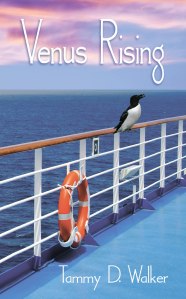
            Since most of my fiction these days is cozy mystery, I’ll use examples from that genre.  Let’s say we have two characters, Curtis, an art collector and one of the suspects in my novel Venus Rising, and Amy, a librarian intent on solving the mystery of a painting at the center of the book’s mystery.

            Amy joins Curtis for dinner in his suite.  She wants to know more about his art collection, but, of course, being a good amateur detective, she can’t ask her pointed questions directly.  But she’s there to gather information.  Curtis, on the other hand, just wants to impress Amy.  So this gives me both Amy’s content–she wants information–and Curtis’s–he just wants Amy.

How the Characters Say It

            So now we know what the characters want to say.  But Amy can’t tip her hand about her suspicions just yet, and Curtis can’t come on too strong.  Let’s go back to a few ideas from poetry about wording, rhythm, line length, and syntactic units. 

            Curtis wants to woo Amy, and his language is more song-like.  The rhythm of the words is more lilting.  He calls Amy “A vision in aquamarine,” and later asks “Champagne for my lovely companion?”

            To which Amy replies, “I don’t drink.”  Her words here are clipped and emphatic.  (She’s caught on to Curtis’s intentions by this point, and she has no interest in him.)

            The rhythm of the words in this short example show how differently the characters are approaching each other.  The words themselves are also worth noting, as Curtis uses Latinate language (“vision,” “aquamarine,” and “companion”) to inflate is dialogue, whereas Amy’s more Germanic retort punches back.

            Line length is also key to establishing rhythm and the perceived speed at which the dialogue is spoken by characters.  While dialogue isn’t split by line or stanza breaks in the way poems are, it can be split by tags (“she said,” for instance) or by the end of a sentence.

            Longer lines tend to quicken a reader’s pace.  Shorter lines, conversely, slow it.  Poems such as H. D.’s “We Two” cause us to stop more often at the ends of short lines: “We two are left: / I with small grace reveal / distaste and bitterness[.]”  Poems with longer lines draw us forward at a quicker pace.  W. B. Yeats’s “The Lake Isle of Innisfree” does just this: “And I shall have some peace there, for peace comes dropping slow, / Dropping from the veils of the morning to where the cricket sings[.]”

            So as I’m writing dialogue, I think about whether I want the character to speak quickly, perhaps revealing their anxiety, or slowly, to reveal their uncertainty.  And then, from there, I’ll decide whether to use longer or shorter words in longer or shorter phrases, and how I’ll either break them (or not) with tags, interruptions, or actions.

            In this example, I wanted to show Amy’s distaste for Curtis, even though she can’t reveal the fact that she does not like him just yet, since she needs to know more about his art collection.  She backtracks a bit and later says, “Sparkling water would be lovely, thank you.”  I wanted to move her more toward Curtis’s rhythm and longer lines, so that she doesn’t reveal her suspicions too soon.

Concluding Remarks Using the Best Words

            One of the concerns of poets in the early 20th century was that the language of poems had been, too often, contorted to fit forms, and that the resulting work sounded contrived and unnatural.  This carries forward through contemporary poetry, and poets do strive to make the sounds of the words, lines, and syntactic units fit with, complicate, and enrich the arguments of their poems.         

            This concern with the naturalness of language is also useful to fiction writers crafting dialogue.  We want the content of what our characters say to sound natural.  Considering the content in light of poetic sound craft can give the characters compelling things to say in a way that enriches the characters themselves and their movements through the story. 

            Which is an aim that, I hope you’ll agree, sounds good.

#

Bio: Tammy D. Walker writes mysteries, poetry, and science fiction. Her debut cozy mystery, Venus Rising, was published by The Wild Rose Press in 2023.  As T.D. Walker, she’s the author of three poetry collections, most recently Doubt & Circuitry (Southern Arizona Press, 2023).  When she’s not writing, she’s probably reading, trying to find far-away stations on her shortwave radios, or enjoying tea and scones with her family.  Find out more at her website: https://www.tammydwalker.com

#

Tammy D. Walker’s article is posted by member, Jackie Houchin  (Don’t you want to run out and buy her cozy mystery to see how she does this?  Wow!)

Lessons From A Child Poet

by Miko Johnston

If you’ve read my biography, you know my earliest ambition was to become a poet. I began writing poems at age six, and continued until I discovered it wasn’t a mainstream career – I found no “help wanted” ads for poets in the New York Times classified section. Being a practical sort, I changed my goal, but I’ve been writing ever since.

I still remember the first poem I wrote. I actually sat down and evaluated it line by line, and found that I had good instincts about the process. I recalled how I’d spent time playing with the wording, the rhyming and the rhythm, which created imagery through words. I also found parallels with my current approach to writing.

Let me show you what I mean. The poem goes:

I went to the moon

One sunny afternoon

Where I saw a sight

That gave me a fright

A man from Mars

With green and purple scars

The poem rhymes because I felt at the time poems should rhyme. It has a rhythm as well, for the same reason.

The first two lines had come to me immediately. I liked the way they sounded, with a sing-song bounciness reminiscent of a good nursery rhyme. The sound of words, how they flow together and the rhythm they create when read, remains an important aspect of writing to me and something I always strive to attain. The lines also comprise the first third of the poem. They introduce the setting, the character, and launch the story, as a first act should.

I don’t specify how I got to the moon, whether I rocketed, incorporated some other form of transport, or jumped, but I don’t think it matters. Rather than fill in every detail, it leaves that to the reader’s imagination, which is still characteristic of my style

The next two lines bring in an element of tension through emotion, as well as the possibility of conflict arising from it. Fear can be very potent in motivating a character. These lines also comprise the middle of the poem, but the sudden change from the playful couplet that opens the poem grabs our attention. No sagging middle here, another goal in my writing.

The last two lines are, to me, the most interesting. Finding another “non-resident” on the moon is more curious than scary, which brings the poem back to the mood set in the opening. A good ending should always reference the beginning. I contemplated the Martian’s coloring for a long while. At least some of the scars had to be green, since that was all we knew about Martians in those days. I toyed with using red or blue for the second color – the rhythm would have matched better. Somehow it had to be purple, an uncommon color in the fifties, which made it exotic. And I decided I liked the hiccup effect it gave the rhythm, like going over a speed bump or pot hole. It jars you, which also fits the theme. It also leaves it to the reader to decide whether the Martian’s appearance was scary or humorous.

Is it a great poem? No, but come on, I was only six. If this were a story, it would be incomplete. I could have added more, but it does convey an image and an emotional response. I say it’s complete as is.

I don’t write much poetry anymore, except for an occasional musing on a subject or a haiku in a humorous vein. I like fitting an idea to a very specific and brief formula. I’ll share my favorite haiku with you:

FOR THE RECORD

                                                Born in thirty-three

                                                Celebrated forty-five

                                                In seventy-eight

The math works out, but finding the right title was critical, as much for this poem as for a novel

As I consider my very first attempt at writing with the benefit of more than a half century of hindsight, I can see the roots of my development as a writer of prose.

For those of you who write, do you remember the first piece you wrote? How would you trace your development as a writer from that piece to today?

Miko Johnston, a founding member of The Writers in Residence, is the author of the historical fiction series, “A Petal in the Wind”, as well as a contributor to several anthologies including the recently released “Whidbey Landmarks”. Miko lives in Washington (the big one) with her rocket scientist husband. Contact her at mikojohnstonauthor@gmail.com

A Thank-You Note That Led to Story

by Jackie Houchin

Do you like receiving a thank you note for some little thing you did (or even said)?  I recently received “three thank yous” via email (one was from my very well-trained, sweet granddaughter for a gift I sent).

It used to be something we would pound into our kids’s heads when they got birthday or Christmas gifts. “Write Aunt Dottie a thank you!”  “Tell grandma you loved her gift!” 

One boy at church ALWAYS wrote such sweet notes to me as his Sunday School or AWANA teacher. They were well thought out, and even used “bigger words” than I expected. Many had little drawings of something I might have given him. I would tell his mom that she sure trained him well, but she told me, “Oh, that’s his idea. I don’t say anything.”  Sadly he’s graduated out of my class now.  I miss his notes and illustrations.  (Yes, I’ve saved them.)

I enjoy writing thank you notes as well. I’m always surprised when someone I sent a card to exclaims “Oh, what a wonderful surprise! That was so nice of you!” Sometimes I send an email, and very occassionally a quick text message. But I enjoy writing out my thoughts on real-life cards. And since my granddaughter now has a little business* making greeting cards, I get to use all kinds of them. She’s the artist and designer.

I also write birthday and holiday cards . Dear Kerry!  Don’t make so many cute ones I just HAVE to buy and use!!

    *     *     *

Recently there was an article in our newspaper, The Epoch Times, January 26, 2022, titled “The Importance of Thank-You Notes”. I loved the sentiments and agreed with what was written.

This morning, February 25, 2022, there was a response in the form of letter in The Readers’ Turn section.  It is a wonderful story of one particular thank you.  Here it is (I hope it’s clear enough to read.)

As we here at The Writers In Residence are always encouraging our readers to WRITE, have any of you recently received something in the mail – snail, email, or text – that you could turn into a short story, essay, blog post, or even a poem? Ok, yes, even a utility bill that came. (Have you seen how Natural Gas prices have skyrocketed?? You could write a letter to the editor, or the company!! Haha.)

But I had something else in mind. Something creative. I recently got a snail mail letter from my sister who will be 89 next month. She is super spry physically and mentaly. She is now taking a writing class, and had to write a small piece from each of 30 prompts. She did it, and now she says her local newspaper wants to publish a few of them. Wow! Who knew? MY sister!!!

So… a thank you note that caught your attention, a birthday card, a GALentine’s Day card (yes, my granddaughter makes those!) or perhaps a mailing from a charity with a photo of a needy child, a disaster, or a pet who needs a home might spark a thought. Maybe even a gardening catalogue with seeds from an old variety of flowers that your grandma grew might inspire you to write a mini-memoir.

Go look through your mail. If you’ve got an idea now, let us know below. If it turns out nice, I might consider posting it in one of our GUEST BLOG spots this year. Just go do it! Write!

#

*PacificPeachDesigns.com

Creating “Spine” Stories

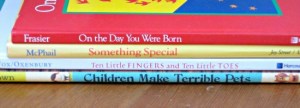
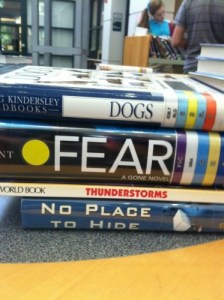
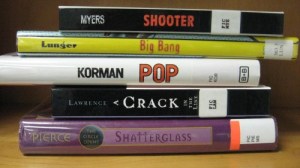
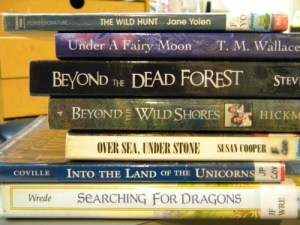
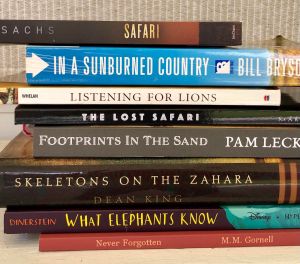
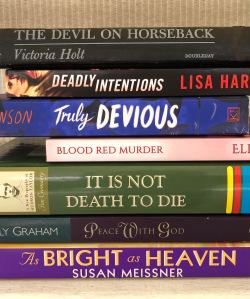
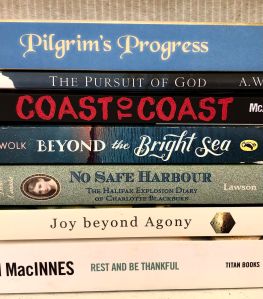
If you are like me, you’ve never heard of a Spine Story (or Poem) before.  I hadn’t until I read Erica’s wonderful children’s blog “What Do We Do All Day?” about a Summer Literacy BINGO game.

In the game, some of the squares were titled; learn a new song, finish a crossword puzzle, read a book outside, listen to an audiobook, and write a comic strip. As the the kids do each thing, they cross off the square. Five in a row means a BINGO win.

The square that caught my eye  was, create a spine poem.

I’d never heard of a spine poem before so I clicked on a link to her page that explained them. Of course, if you’ve viewed the photos in this post, you will already know what one is. I call them stories instead of poems. A real challenge would be to do a Haiku poem in Spines.

I’ve yet to create one myself, but by the end of this post, I promise to put one together to share. Meanwhile, here are a few in Erica’s post.

(In case you can’t read the above Spines, they say “How to Write Poetry” “Brainstorm” “Where do You Get Your Ideas?” “All the world.”)

At the end of her blog on Spine Poems, she added a link to 100 Scope Notes which had a slew more of these poems/stories, titled “2013 Book Spine Poem Gallery”. There are other years of galleries available too. Lots of laughs and some really good Aligned Spines.

Okay, here are a few I tried. (haha) It was actually more fun than I thought. Once I’d done two, I saw many more possibilities!

Now it’s your turn.

Gather some of the books on your shelves or TBR stacks and try to create a few stories or poems?  I’d love to see a photo, or just write the titles in your comment below. Hey, you are very talented storysmiths. Let’s see what story you can tell… from your bookcase? Create a cool, scary, funny, mysterious, clever, or romantic “aligned spines” story.

###

Erica’s Literacy Bingo page: https://www.whatdowedoallday.com/reading-bingo-for-kids/

Erica’s Spine Poetry page:  https://www.whatdowedoallday.com/spine-poetry-activity-for-kids/

100 Scope Notes Book Spine Galleries:  https://100scopenotes.com/2013/04/02/2013-book-spine-poem-gallery/

“A Cruel Blessing” a Ballad

by Jackie Houchin

                 I know this is an unusual post, but in this time of lock-down, I’ve not been able to focus on writing anything new. So I’m presenting this Ballad I wrote for a Creative Writing class at Glendale Community College. I’ve tried to publish it, but no one will take this many stanzas (27), although one of the lines is only ONE word. Can you find it?  And it’s less than 600 words. 

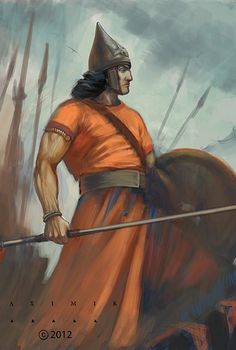
                This ballad is based on a real person I knew, a man who had Grand Mal epilepsy.  


“A Cruel Blessing”


In olden days, the ancient Land

Of Ararat became

The birthplace of a first born son—

So beautiful, but lame.


The lameness was inside of him,

A sleeping fiend, unseen,

That would attack and seize him fast

Once he became a teen.


But now, the babe lay peacefully

Against his mother’s breast,

And drank her nectar, white and rich,

And safely took his rest.


They double blessed and named the boy

Vartan and Victory.

Then sprinkled him with holy oil

To seal his destiny.


A close-knit tribe, his kin instilled

Within their growing child,

A pride of place, and heritage,

A name kept undefiled.


The father taught Vartan to war,

Retaliate, defend,

And laid in Victory the love

Of truth, and God and friend.


The mother gave him nourishment

To make him strong of limb.

Likewise, the food for soul and mind

She gently forced within.


Then on their son they placed this grave

Responsibility,

“The future of this clan does rest

On your integrity.”


Relentlessly the clock of months

Ticked thirteen times around.

Vartan approached his manhood proud,

A prince as yet uncrowned.


But on his honored day there struck

A death – so fresh, so raw.

The gruesome end of one most dear

Was what young Vartan saw.


Then deep within the boy-man’s frame

An aura and a flash

Preceded tremors, shakes and quakes,

A weakness, then a crash.


Like frozen forms the family

Around the crumpled lad

Took in with shock and fright the sight,

And wailed, “Our son is mad!”


They mourned the loss of hopes and dreams,

(As well, the one so dear),

And wake became a vigil grim;

A sick bed and a bier.


Vartan lay still as death that night;

The other’s corpse quite close.

At dawn they lowered bones below,

But Victory arose!


A celebration wild with joy

Then met the rising son.

They dared to hope that only once

The dreadful foe had won.


Forgotten soon the grievous curse

As manly, Vartan grew.

A wanton woman caught his eye,

Then taught him all she knew.


But in the rush of ecstasy

The pleasures turned to pains.

He screamed, convulsed, then toppled down

Amidst a dozen stains.


In shame they found the fallen oak

And slowly hauled him home.

Beside the hearth, he warmed and woke

With kin, but all alone.


A disciplined and structured life

He thought would bring release.

Vartan desired glory bright,

But Victory sought peace.


So in the frozen, northern wastes

A soldier he became.

And hardship burned the dross from him;

A cruel and thorough flame.


But still, in light-less days he fell

A victim to his plight.

And so there came to dwell in him

A darkness more than night.


A disciplined and structured life—

This time, a different kind;

In solitude and quietness

Release he’d surely find.


So to the Church, went Victory.

He knelt, and prayed and read.

Now sixty months of sanity

Have eased his tortured head.


A Holy Man, a Prophet true

Is what he’s meant to be.

For holy oil had marked him thus,

And sealed his destiny.


Now from the monastery, he

Speaks out the Truth he’s learned,

And prays forgiveness from his kin

For hopes and dreams he’s spurned.


For from Vartan no seed will flow

To populate the clan,

And to defend the name and place

There’s no one who will stand.


But, praise! The sleeping fiend has fled—

It dared not seize a priest!

So God and Church held Vartan in…

And Victory released.

Vartan 2

Vartan woman

Vartan 3

Vartan monestary


  • * * * * *