Author: Jackie Houchin
Copy Work: What is it? Why do it?
by Jackie Houchin
If you are an avid reader, you know that the best writers pull you into their worlds. Their words become images in your imagination as soon as you read them. The writing itself becomes invisible. (Or at least it should.)
That is a problem when reading to learn how the author did it. Instead of paying attention to the sentence structure, you are immersed in the story.
That is where copy work comes in.
What is Copy Work?
It is the practice of exactly copying another writer’s words, omitting no punctuation mark or capitalization, usually done with a pen.
Who even does this?
Jack London trained himself to be a better writer by copying out (in longhand) passages from Rudyard Kipling’s work.
Other writers have used Ernest Hemingway’s writings or copied out “The Great Gatsby” by F. Scott Fitzgerald. (A short novel)
Morgan O’Hara copied the U. S. Constitution by hand, word by word.
Greg Digneo, on SmartBlogger, tells the story of salesman Dan Kennedy, who copied a two-foot stack of sales letters by hand. Twice! He wanted to become the best in this field. Today, you would have to pay him $100,000 to write a sales letter for you. And he would get a commission on every sale you make.
What is the goal of copy work for writers?
The goal is to understand how authors write and express their ideas. What makes their writing work and flow? How do they structure their paragraphs and sentences? How do they create compelling characters?
Copy work helps you identify bad writing habits, like passive voice, stale metaphors, repeated words, etc. It will help you with good punctuation and grammar, spelling and vocabulary, pacing, scene description, and using dialog tags. It will help you write more precisely, with fresher, more original words.
Seriously!
Artists copy the Masters to improve their skills. If you want to be a better writer, copy great writers.
How do you make the most of your copy work?
- Choose a writer you love, the book(s) you could not put down.
- Set aside time to do your copy work daily (20-30 minutes for handwriting, 10-15 for typing). Use a timer.
- Select a moderate-sized chunk of text. (Not War & Peace, but also not a Haiku)
- When you finish copying one story, pick another one to work on. Keep going for at least 90 days. (The magic of copy work happens through repetition.)
- Don’t stick to a single author. The goal is to learn writing techniques, not imitate one author.
- Mix genres: nonfiction to fiction, fantasy, science fiction, mystery, poetry, film scripts. (They all teach different writing methods, scene structures, dialogue, setup, etc.)
- Practice daily, if you can
- At the end of each session, review the passage you copied and add notes. Reflect on what you liked and what you learned.
- Follow copy work by moving into your regular writing. You are all primed to go.
By doing copy work every day, you will be writing every day. It will train your brain to see writing as a no-stress, no-pressure practice. It will make it easier to turn to your own writing. If you are having writer’s block or just can’t come up with a new idea for a project, story, or book, you can still do your copy work to keep that daily writing habit going. You know, seat of your pants in a chair…. etc.
What do you NOT do with your copy work?
You will not publish your copied text or try to pass it off as your own. Copy work is for your eyes only. It’s a writing exercise. It is not plagiarism.
Need some suggestions? Try copying out these.
- Cat Person by Kristen Roupenian
- A Death by Stephen King
- The Veldt by Ray Bradbury
- Hills Like White Elephants by Ernest Hemingway
Have YOU ever tried COPY WORK? Did it help you? How? If not, will you give it a try? If you can’t comment below, drop me an email at Photojaq@aol.com.
CONFESSION: Years ago, I read that I could become a great writer if I could copy a book I admired in its entirety. Yes, the WHOLE book. I thought that sounded too good to be true. But, as I admired Rosamunde Pilcher and loved THE SHELL SEEKERS, I thought I’d try that book. (The paperback edition is 656 pages!) I think I got to page 35. I wasn’t becoming a great writer. I was getting bored, and my hand was cramping. I quit.
But now, after this research (short sessions, consistency, review and take notes), I’m willing to try again. I may not become great, but I think I’ll improve my writing skills. I have another book in mind to copy.
Perhaps in my next rotation post, I’ll tell you what I learned from the experience.
##
- And thanks to the following for their insights on this “cool” topic.
- RADEK, founder of Writing Analytics
- ELIOT CHAN – Eliotchan.com, April 14, 2020
- MATTHEW ENCINA – thefutur.com, July 13, 2020
- JULIA HESS – craftyourcontent.com, May 17, 2018
- LORRAINE THOMPSON – marketcopywriterblog.com, March 14, 2012
- ANN KROEKER – Annkroeker.com, June 27, 2017
Group Post #1 – How do you handle TECHNOLOGY?
Occasionally, we have an open spot on our blog schedule. One of our members suggested we all (or those able) could jump in for a group blog question. Our first was suggested by Miko Johnston.
How do you incorporate ever-changing technology in your writing, especially in a series that covers years?
Jackie Houchin — In my short stories, I use the technologies needed in the story’s time and place. I used GPS settings to find a long-buried stash in one mystery set in modern New York. In that story, the dates were firmly set by newspaper clippings. In my missionary kids’ series set in modern but rural Africa, cell service is spotty (indeed, you can’t even be sure of electricity), so I use these technologies but don’t depend on them. Actually, “no cell service” adds to the suspense of the moment when an emergency happens.
#
Gayle Bartos-Pool — If you write stories set in the Roaring Twenties, you might want to include a bunch of things to define that era, like telephone operators connecting you to whomever you are calling or a radio program providing music and some news. There were no televisions or cell phones back then. The automobile was new with the Ford Model T, and assembly lines were just gearing up.
Every era has its newfangled gadgets, but do they have to do more than set the stage in the story? Sometimes, too much detail distracts from the narrative unless there is one particular thing that plays a key role in your story, like the old typewriter with the damaged key and the ransom note with that same twisted letter. That’s been done before in several old movies, but it worked.
But if you are writing a contemporary tale, do you have to rely on the main character’s cell phone on every page? After a while, it gets old to have the characters pull out his or her phones rather than use their eyes and ears to see the problem at hand.
I do like gadgets, but I don’t depend on them totally in my books. My characters will use a computer, but they use their brains more.
#
Miko Johnston — Back in the 1990s, before I started my series of historical novels, I attempted to write a (then) present-day mystery thriller that centered around a secret high-tech device. The problem was that I knew nothing about the subject and figured what I’d made up would ring false with knowledgeable readers, so I put the manuscript aside. Twenty years later, I revisited the story and realized I knew enough about what had been developed back then to finish the story with authenticity.
I do incorporate technology in my modern work as it’s such an integral part of life now. For example, my short story, Senior High, comically follows three older women who travel to Washington, one of the first states to decriminalize marijuana. Although they haven’t “partied” since the seventies, they decide to get high one more time but can’t figure out how until Siri comes to their aid.
Research Can Be Dangerous: A Cautionary Tale
By Maggie King
The Confederate statues on Monument Avenue in Richmond, Virginia came tumbling down. For this author, that meant a scene rewrite and a research trip. I didn’t expect the trip to end in the ER.
In my recently released story, Laughing Can Kill You, Hazel Rose investigates the murder of an obnoxious writer given to laughing at others’ expense. In one scene, Hazel and her cousin Lucy attend the victim’s memorial service, hoping to ferret out who killed the man. The service is held in one of the stately homes on Richmond’s Monument Avenue.
Here’s my thumbnail description of the area:
Statues memorializing notable players in the Confederacy punctuated Richmond’s Monument Avenue. The statue paying homage to African-American tennis star Arthur Ashe lent an incongruous note to the lineup of Civil War monuments. Various groups clamored for the removal of the monuments that they considered reminders of slavery and racism; other groups believed removing them was tantamount to erasing history. A grassy mall divided the wide avenue, lined with trees and architecturally-significant houses.
If you’ve kept up with events of recent years, you know that the statues (except for the Arthur Ashe one) were taken down in 2020 and 2021, amid a flurry of protests, acts of vandalism, and government orders. But Laughing Can Kill You is set in 2018, when the statues were still in place. So I was okay? Right?
Maybe not. Would my readers be aware it was 2018? While it was clear to me, it may not be to them. Plus, the statues were still a hot-button topic, regardless of one’s position. I’m not looking to get readers riled, I simply want to give them an enjoyable story.
Monument Avenue was not important to the plot, but I could hardly feature it in a scene without mentioning the famous statues that give it its name. Talk about the proverbial elephant in the room. Street, rather. So I needed a different, but similar, location. It didn’t take long to come up with a Plan B: Richmond’s Northside, just ten minutes from Monument Avenue.
Here’s the description that replaced the Monument Avenue one:
The Hermitage Road Historic District on Richmond’s Northside started life as a streetcar suburb in the late 19th century. Developing the area north of the city to solve the housing problems caused by a rapidly growing city population became possible with the invention of the electric streetcar. The trolley line ran down the middle of Hermitage Road. At some point, a wide, grassy median replaced the line.
As I drove along the historic stretch lined with trees and architecturally significant houses …
It was a beautiful Saturday in May of 2021 when I drove to the Northside to scope out the area for sights, sounds, traffic patterns, etc. to add authentic detail to my story. I had a house in mind, a Colonial Revival I’d visited on a long-ago walking tour of the area. It was similar to the Monument Avenue house and I could use the same interior details.

I walked down Hermitage Road and what did I see in front of the house? A “For Sale” sign!
I started to cross the street, thinking I’d get a better picture of the place from a distance. I hesitate to take pictures of people’s houses, feeling I’m invading their privacy. If challenged, I could say I knew a prospective buyer. Or I could offer a copy of Laughing Can Kill You when it came out. That should certainly appease them.
I looked around at the other houses, at the trees, flowers, taking in the scene, framing photo shots.
No photos were taken. With all my looking around, I didn’t look where I was walking. In an instant, I fell off the curb, landing splat on my shoulder.
When I picked myself up, my arm felt fairly useless. Thinking, hoping, that I’d only suffered a bruise, I decided to go home and ice my arm. But some persistent voice buzzing in my ear said “Go to the ER.” My guardian angel? Where had she been a moment before? Why hadn’t she grabbed me by the hair and pulled me back from that nasty asphalt? Oh well, God and angels work in mysterious ways.
At St. Mary’s Hospital (incidentally, it’s on Monument Avenue), I learned that I had a fractured shoulder. I went home with a spiffy sling that accessorized my wardrobe for six weeks. Luckily, it was my right shoulder and I’m left-handed.
Back to my rudely interrupted research trip. As the Colonial Revival was on the market, there were plenty of pictures of it online. The owners were asking a cool million. I bet you know what I’m going to say next—-that I purchased the place! Um, no, but I did find lots of beautiful interior and exterior pictures.
Shortly before this unfortunate incident, I’d written a scene where Hazel trips over a crack in a sidewalk and uses balance skills she didn’t know she had, avoiding a spill. Hazel is like me in some ways (except I don’t investigate murders) but apparently I’ve given her better balance and coordination skills.
My original plan was to end the research trip with a latte at Crossroads, a fun and funky coffeehouse on Richmond’s Southside. Hazel and Lucy got to enjoy that treat after the memorial service (although I named the place The Beanery in the story). They needed to compare notes on what was becoming an intriguing investigation.
By the end of a summer spent in PT, my shoulder was declared healed.
Laughing Can Kill You was published just after Thanksgiving of 2021.
There you have it: my cautionary tale on the perils of research.
Originally published in Kings River Life Magazine, January 5, 2022
Seven Story Plots
By Jackie Houchin
I recently talked to a young man involved in theatre at his university. He longs to write a play or musical and has all kinds of ideas about special effects, music, and costumes. He has even imagined a few characters. But he has no story. No plot, only a few imaginative scenes.
I told him there are just a few basic plots in the world from which all books and plays originate. I told him there were five, but on researching them, I found it is seven. (Christopher Booker’s 2004 book The Seven Basic Plots: Why We Tell Stories.)
Here they are.
- Overcoming The Monster.
Christopher Booker suggests Dracula by Bram Stoker, The Lion, the Witch, and the Wardrobe by C.S. Lewis (the White Witch), or The Help by Kathryn Stockett. In the “monster” story, you need a chilling threat (human or not) and a brutal contest that will probably require a significant sacrifice.
- Voyage and Return.
The Odyssey in Greek myth and The Hobbit by J.R.R. Tolkien are examples. Your protagonist will need a dangerous journey or impossible quest with an uncertain outcome. He needs opportunities to turn back but to show heroism, he will continue and return with new strength.
- Rags to Riches.
Cinderella, Jane Eyre by Charlotte Bronte, and Memoirs of a Geisha by Arthur Golden are all examples. Your protagonist should grow in character, strength, and understanding, helping them to be empowered. This sometimes involves romance.
- The Quest.
The protagonist sets out to find someone or some object, like buried treasure. At each step the stakes need to be raised, making it harder and harder to achieve. The hero emerges stronger or more mature. J.R.R. Tolkien’s The Lord of the Rings and J.K. Rowling’s Harry Potter and the Deathly Hollows are examples.
- The Comedy
The idea of Comedy is to create many misunderstandings for the protagonist to get involved in. The plot continues to muddle events, feelings, and perceptions until the end when all will be “miraculously transformed.” The action moves from dark to light. The Inimitable Jeeves by P.G. Wodehouse and Bridget Jones’ Diary by Helen Fielding are examples.
- The Tragedy
Tragedy is the opposite of Comedy and goes from light to dark. The protagonist has a deep flaw or makes a horrible mistake, causing his undoing and failure. Think of all the “if onlys” that could have happened. Give him ways “out,” which he won’t take, then close off any exit options. Classic examples are Othello, King Lear, and Macbeth by Shakespeare, The Great Gatsby by F. Scott Fitzgerald, and Anna Karenina by Leo Tolstoy.
- The Rebirth
Rebirth is like a tragedy but with a hopeful outcome. The protagonist’s journey has a redemptive arc and sometimes includes romance. The “happy ending” should depend on that arc. Fairy tales are good examples, as are The Secret Garden by Frances Hodgson Burnett, Emma by Jane Austen, and The Kite Runner by Khaled Hosseini.
Of course, you can combine multiple plots and add subplots, too. These seven plots are a guide to building your story. You can elaborate as your fancy suits you.
Now, give it a go!
A New & Short Mystery!
by Guest Writer Alice Zogg
Hello friends, readers, and fellow authors,
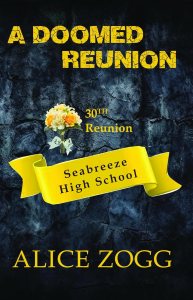
I penned another stand-alone mystery. A DOOMED REUNION is fresh off the press and available in hardcover, paperback, and e-book editions.
This one is short (170 pages). Either I have learned to get my point across with fewer words or have become lazy. (haha)
As to the location, I invented a fictional town called Seabreeze and placed it along the California coastline between Del Mar and La Jolla.
People with old school ties attend a 30th high school reunion and are shocked to hear one of the attendees say he knows who murdered a classmate years earlier. That knowledge gets him killed.
Can Detective Scharfkopf with the San Diego County Sheriff’s Department piece together what happened back then to catch the person who has lived with this secret all these years… before another body is added to the list?
Happy reading,
Alice Zogg was born and raised in Switzerland. She met her husband, a fellow Swiss, in New York City, and the two made their home in the United States. The family relocated to Southern California in 1967, where they have resided. She is an avid traveler and plays racquetball and golf. She has written over 20 books.
###
BOOK REVIEW – I read Alice Zogg’s new book. Yes, it is short, but the crime, plotting, and investigation are complete. You don’t feel cheated at all. The murder happens after a high school class reunion when one person blatantly claims to know the murderer of an unpopular student 30 years previously. Does he? Someone believes him and, in unusual circumstances “offs” the guy. The detective is charged with solving not one but two murders. The questioning, deduction, and final moments of revelation are well-plotted and written. I enjoyed reading it! ~~~ Jackie Houchin
OOPS. A scheduling boo-boo. Check back on the 31st for a “Bride’s Tale.”
Finding Time to Write: a “Flashback” Post from 15 years ago. Still True?
by Jacqueline Vick
Some writers snatch a few moments of time wherever they find it. Others adhere to strict schedules. Walter Mosley tells us to write every day. Peter Brett wrote his first novel on his smartphone during his daily travels on the F train. Do you follow a set writing schedule? Write every day? Have a favorite writing spot? Do you put ‘butt to chair’ until you’ve finished a specific word count? Tell us about your writing schedule.
***********
Writers Write by Bonnie Schroeder
I try (emphasis on “try”) to write every day first thing in the morning — okay, I feed the dogs and make coffee first and then retreat to my desk with one dog underfoot and one cat in my lap. On my desk, I have a kitchen timer that I set for one hour. Some days, I actually write for the full hour before the phone rings or the other cat barfs or my stomach starts growling. Some days I have to stop the timer until the aforementioned distractions are dealt with; then I try to finish the hour later on. I don’t always make my goal, but occasionally, I actually exceed it.
For me, the important thing is to try for it every day — weekends included. It keeps the circuits open and the muse engaged. When I worked at a job 50 miles away with a two-plus hour daily commute, there were times when I could only manage 15 minutes a day, so an hour is a huge luxury for me now. But even with those quarter-hour writing sessions, I finished the draft of a novel. It took a few years, but that daily contact with the pages kept them in my mind and kept me plugged into the current. And that, to me, is the secret: write something every day, even if it’s just a paragraph or even a sentence. Then I can legitimately say, “I’m a writer.”
***
Lucky by Jacqueline Vick
I’m extremely lucky. I was able to quit my day job to pursue writing full-time. (Well, writing AND homemaking full time.) That means that every morning when I rise, my day is my own and my schedule is whatever I want. Sounds great, doesn’t it? There are a few downsides.
When I’m working on a novel manuscript, there is no boss handing me deadlines, no client with a specific need to fill. I have to set all of those goals myself…and keep them. Repercussions can be a wonderful motivator; without them, it’s more difficult to stay on course.
My deadlines consist of “finish the first draft by May 1st.” I’m always happy to find a short story contest, because that gives me a specific deadline and specific criteria to meet.
Yesterday, I was talking to my brother, who is a personal coach, and he said that the difficulty most people run into is keeping promises to themselves. They don’t value their own time and their own goals as much as they value other people’s time and goals. I’m starting to get around this by setting more specific goals and deadlines and then pretending that I work for a fabulous author named Jacqueline Vick. She has high expectations, and I don’t want to disappoint her. I imagine her asking me to have the rewrites on chapter one on her desk by Friday. It’s a bit kooky, but it works.
I write every day, including weekends. My butt is in the chair for about 8 hours on weekdays, a few hours here and there on Saturday and Sunday. I write in the only place available to me–the dining room table. It’s a pain to keep cleaning off the table each night, but the thought of my husband reaching around a stack of papers for the pepper mill helps keep me organized.
***
Writing Away by Jackie Houchin
For an organized, everything-in-its-place kind of person, my writing schedule is very haphazard and irregular. I mostly write when a deadline looms, so I’m thankful I have those. I write reviews for magazines and articles for a newspaper and newsletters. If I don’t get my copy in, it doesn’t get printed, and I don’t get paid. Simple as that, and no amount of boo-hoo’ing will fix it. The next issue already looms on the horizon.
If I were to write a book, I fear I would find myself writing franticly for 23 hours every day during the last weeks before the agent/editor/publisher’s scheduled deadline. I admire my fellow Wonder Women, who persistently and faithfully write for months and even years to bring their creations into the world. Their ultimate satisfaction will far outshine my instant bursts of pride.
So which style is best? “Whatever works for you.” Yeah, you’ve heard that before, but it’s true. Whether it’s dedicating specific minutes, hours, and days to craft a novel or franticly writing and rewriting and “ripping the paper out of a typewriter” before rushing it to an editor…it doesn’t matter. If our words, opinions, ideas, and stories are read (sooner or later), well, that’s what counts.
That’s my opinion, and I’m sticking to it. Now, let’s see… when’s my next deadline?
PS: Where do I write? Either at my dinosaur desktop PC in my office until the “backside” can’t stand sitting anymore, or more recently, standing at the breakfast bar in the corner of my kitchen with a 6-foot cat tree behind me (usually occupied by three cats lounging and looking over my shoulder, and trying to foil my thought processes with their diabolical purring and mind games) while I pound away on my laptop.
***
“Finding Time to Write,” from June 2009, was reposted by Jackie Houchin.
Photo by Andrey Grushnikov:
“Off The Top”
by Jackie Houchin
What do I mean when I say, “off the top of my head…”?
Dictionaries say it means derived from the knowledge you have in your memory or impromptu, without previous thought or preparation.
Does it mean the same as “seat of my pants”? Hmm. We often say we are “pantsers” when we sit down and start writing a story without a formal outline.
Although I love outlines, pages of notes, and lists of resources, I often sit down and simply start writing. Some call this ‘free writing,’ and it sometimes begins with a prompt. I did that recently with a short story I wrote using the prompt “The Convenience Store Was a Sad Place.” That prompt made me think of our neighborhood store and gas station. I pictured myself walking into that store, looking around, dealing with a smarty-pants cashier, and away I wrote. The story came to me in a series of vivid mind pictures.
Was it seat-of-my-pants? Or something “derived from the knowledge I had in my memory.” Hmmm.
More recently, in April, to be exact, I joined a month-long Writers Digest PAD Challenge. The idea was to write a Poem-A-Day (PAD) on the daily prompt they gave. You could write any type of poem, from a limerick to a sonnet or free verse. (I liked the shortness of this challenge.)
I did it. For nineteen days, at least. And the poems were totally “off the top of my head.”
April 1 – An optimistic poem.
There once was a gal with a lump.
When first it was found, she did jump.
“Oh, my! I shall die!”
Was her terrified cry!
But a doctor cut out that bad bump.
April 3 – A sad poem.
The rosebud is gone.
Cut from a lily-white breast.
Warm tears down the drain.
April 4 – A mistake poem, one you made or witnessed.
The mistake was mine. I’ll confess
I love whodunnits. But I digress.
I put down the fiver. I looked away
Hmm, stab or shoot? Which way to slay?
Wait! I’m not stealing a book!
Look in my bag? Really, just look!
There’re TWO books by Christie???
Well, I declare. It IS a mystery.
April 8 – A major event poem.
I gasp and stutter and lisp,
For today, I saw an eclipse.
The sun was gone
But not for long
It returned; its edges all crisp.
Off the top of my head – derived from knowledge I have in my memory.
It was fun for those nineteen days last April. There were longer poems, too, and some more serious. I’ve often said I’m a short writer. I don’t think I could actually write a book, although I’ve tried. I admire the Writers In Residence here on this blog for doing just that!
Do you write short or long? Off the top of your head or from detailed outlines?
..
If you want to see more of my PAD poems, go to my blog, Words and Reviews, and scroll down the right-hand side column to April 2024.
In the week before June ended, there was a 7-day challenge by Writers’ Digest for personal essays. Again, you have a topic, and you write about it. My first one was about “a job experience,” and I titled it “Knick-knack, Paddywhack, Give A Dog a Bone.” You can find that one on my blog site at: Words and Reviews Essays.
Writing About Bloodhounds & Pet Detection
Guest post by Landa Coldiron
I’m a Bloodhound Handler. I’ve been using my bloodhounds to find lost pets for 18 years.
I recently had a book published by Austin Macauley about my work as a pet detective. It is a work of ‘faction,’ as I like to call it. Some stories are true, some are fiction, and some are combined (real and made up).
It is titled ‘The Bloodhound Handler—Book One: Adventures of a Real-life Pet Detective.’ Like people, in search and rescue, search dogs are used for a direction of travel that can locate the pet, provide evidence, clues, and eyewitnesses, and /or target a search area where resources can be deployed. In my book, I wrote about these abilities in stories, using the character Kalinda Dark as me.
My book is currently available on Amazon as a paperback or Kindle. It is a great action adventure with some mystery and has had many positive reviews. It has also been featured at Barnes & Noble.
I wrote the book a few years ago after my first bloodhound, Ellie Mae, died. She was young, and it took me by surprise. I knew I had to write about her and our life together. Ella Mae won the 2011 California Veterinary Medical Association Animal Hall of Fame award for her work in finding lost pets.
Writing The Bloodhound Handler book took me three years of writing every day and another two years of rejections. Finally, I got an offer from a publisher!
The book also contains stories about Glory, my second bloodhound. She won the American Humane Search Dog of the Year in 2015. It was a national award over a weekend at the Beverly Hilton. Many celebrities were in attendance. Glory won over 500 other dogs in the category.
We were also flown to Washington, DC, to speak in front of a small congressional hearing on the lost pet problem in America. You can search her name on YouTube under American Humane, and you will find her story. It is really something. Glory has a Facebook following of over 16,000 people!
Thanks to anyone who supports my book. If you are an avid Kindle reader it is only $4.50 and even has colored pictures.
#
Landa Coldiron is a two-time award-winning bloodhound handler in Los Angeles. Her website and Facebook are Lost Pet Detection, and her Instagram is @thebloodhoundhandler.
###
NOTE from Jackie: I knew and wrote about Landa for a newspaper when I lived only blocks from her in Shadow Hills. I was privileged to watch Ellie Mae in action and learn about what pet owners can do when their pet goes missing. (The book covers this too.)
Landa has also owned and trained Cadaver Dogs for her work.
The Bloodhound Handler book is a fascinating read. It follows cases of lost (or stolen) pets from the first panicked telephone call through the process to the ending, which is sometimes joyous and thrilling and sometimes disheartening. One case toward the end of the book involves a missing dog and little girl and reads like it was “ripped from the headlines.” I enjoyed it very much.


You must be logged in to post a comment.