THE WEIGHT OF WORDS

 by Miko Johnston

Words have become a frequent topic for my posts. I often say they’re a primary tool in the writer’s toolbox, and like all tools they need to be kept sharp as well as up-to-date.

When I read, I’ll occasionally come across a word I don’t know or might be unsure of its meaning, whether in English or another language. Whether plots or articles, writing that includes corporations or government agencies and bureaus often use acronyms, and thanks to texting, so does modern fiction. We all know FBI, CEO, LOL. If the mystery is set in the fictional Gotham City, we can figure out what GCPD stands for. When the unfamiliar term is foreign, an acronym or other modern slang I’ll search for it online. I don’t mind doing this, as I enjoy learning new words, terms and expressions to expand my vocabulary, even if I never use them.

I used to keep my dictionary and thesaurus handy when I write. Now, I prefer to look up words online when I’m not sure of the proper meaning, or if they’ve changed over time. I google “(language) to English” if I need a translation, or the reverse if I need the word or phrase in another language. If I’m uncertain if a word I want to use is best or if another would be clearer, I check the thesaurus. I often understand the meaning better from similar examples than dictionary descriptions. If the synonyms don’t relate to what I want to express I delete the word and find another. You could say the dictionary “tells” me the meaning while the thesaurus “shows” it.

My thesaurus also comes in handy when I need a substitute for an overused word, or if I can’t think of the right one to use. However, it’s old and doesn’t reflect modern speech. If I want the language to be au courant, I google the word, or the idea I want to express, and add synonym. The results help me decide whether to stick with my original word, choose a better one from the list, or pick a different word that more closely expresses what I want to say. 

I also search for the etymology of words, phrases and expressions. As a writer of historical fiction, I must know when they came into usage to avoid anachronisms. The reverse is true as well. A word or phrase that brings authenticity to a period in history would sound ridiculous spoken out of time – who says 23 skidoo, groovy, or gag me with a spoon anymore? Then, I consider who will use the word. For example, I wouldn’t have a fusty old person use hipster (for the time) jargon, or vice versa.

Sometimes I must use an obscure word. When it’s foreign or an historical reference, I often describe it in the sentence following its usage. Sometimes the meaning can be gleaned by context, such as when my characters lit a yahrzeit candle to commemorate a loved one’s death. However, some terms can’t be explained without a dictionary-like entry – for example, plastron, which I used in my first novel, set in 1899. I expect most readers had to look that word up to find it meant “an ornamental front of a woman’s bodice or shirt consisting of colorful material with lace or embroidery, fashionable in the late 19th century”. Hardly something that could evolve naturally in dialogue. Certain genres, such as historical fiction and hard sci-fi, as well as unique careers and hobbies of the characters, give the writer some leeway for the occasional obscure term. So does a post on a writer’s blog.

Even so, I sometimes question the use of vocabulary that may be unfamiliar to the average reader, like etymology or anachronisms. I don’t want to oversimplify the subject, nor do I want to write over the reader’s head. I wonder – should I find another way to express myself? Is there a better way that won’t send readers rushing for their dictionary? Or is that necessarily a bad thing?

Some believe using more complex terminology – what we used to call “hundred dollar words” – makes them sound smart, while others find it pompous and pretentious. A wise person can explain complex ideas in complex terms, but a wiser person can do the same using plain language. I wouldn’t consider that “dumbing down.”  I’d call it making the information more accessible to more people. Even so, the best word may be foreign to some, including me. As a reader, I will look up a word I don’t know or am unsure of its meaning in the context of what’s on the page. If I have to do that once or twice, I will, but too many unfamiliar words put me off.

Some writers must use foreign words, terminology, slang, or acronyms related to the time period, profession, or avocations of their characters. How do you handle challenging vocabulary as a writer and as a reader?

.

Miko Johnston, a founding member of The Writers in Residence, is the author of the historical fiction series “A Petal in the Wind” as well as a contributor to several anthologies, including the about-t0-be-released “Whidbey Island: An Insider’s Guide”. Miko lives in Washington (the big one) with her rocket scientist husband. Contact her at mikojohnstonauthor@gmail.com

Deadlines, Deadlines, Dead Lines

by Jill Amadio

Whether you self-impose a deadline or your publisher sets one for you, a looming deadline (pardon the cliché) for writers can send terror racing through our veins, to say nothing of a scramble for inspiration for that perfect ending to our story.

Time as a concept rules our lives but little comes as close to engendering fright as an editor’s reminder, if any, that you have three days to send in your manuscript.

Idioms that refer to time are many but the word ‘deadline’ has few competitors for sheer panic, leading to writer’s block. Mine was so pronounced a couple of years ago that instead of diligently finishing editing my mystery prior to submission, I took off for a lecture on The Hidden Infrastructure of Waterways.

The deadline effect can strike as early as signing a publisher’s contract to write a book, with the due date blithely ignored in order not to spoil the moment.  

If we separate the word into ‘dead’ and ‘line’ we can carry on without another thought. ‘Dead’ is, of course, a wonderful word for crime writers. It finds its way into titles, sub-titles, true crime, novels, and non-fiction. It is often overworked, but there are some great substitutes that have a satisfying, final ring to them. Even time itself cannot escape its fatal meaning when we talk of ‘killing time.’ As for ‘line,’ it can refer to the last line of your book or, my favorite, The End.

I remember talking to Michael Connolly at the Los Angeles Festival of Books one year when we were suddenly interrupted. I assumed he was urged away by one of his publisher’s staff for more book signings with the threat of ‘we have a deadline before the store closes..’ 

Escaping one’s deadline can become quite a game. We can close the document and play online Solitaire; dig into more research; meet a friend for coffee; walk the dog, or read someone else’s book and envy the author  who made their deadline and is subsequently well-published and a much-in-demand panelist at writers conferences.

It is easy for creative people to bristle at a deadline but without one, would we ever finish a book? Many deadlines hang over our heads such as filing taxes by April 15, but it doesn’t seem to make us feel pressured as we fall into line without protest or ask for a delay.

Self-published writers, of course, have the luxury of ignoring any deadline they may initially give themselves,  but adhering to a disciplined writing life points to a professional approach to one’s career. 

Often, we use the word ‘deadline’ as an excuse to avoid doing something, seeing someone, or simply to justify lazing around claiming we are mentally sorting out a plot, a character trait, or a setting.  

Throwing out the word has its own resonance. We sound important. It surrounds writers with an aura of being special when uttering it, often with a fake facial expression begging sympathy.

I wonder if a deadline has the same time limit if it were to fit into a short or a long day, month, or year. Does the deadline contract or expand with these descriptions depending on our individual sense of time? When push comes to shove, do we tend to interpret a deadline one way while its dreaded imposer means it in an entirely different context?

As a reporter, I was always under deadline, which I credit for bringing me to heel and making it easy to comply with my traditional publishers’ edict. But once released from their tyranny,  plunging into self-publishing, and receiving monthly royalties I discovered how simple it was to let the world go by with no deadlines to obey.

Roget’s Thesaurus has zillions of ways to describe a deadline, not the least of which include  crunch time, point of no return, and my favorite, kairotic. What? Oh, that means time-sensitive.

I once read that a character ‘insisted on killing time before his deadline.’ Is that an oxymoron?    

Finally, there is an upside to a deadline: it can get writers into the chair and tapping the keyboard. Perhaps my colleagues on this blog have a secret way to beat a deadline. Care to share?

Mystery Books to TV Series

by Jackie Houchin

After reading Maggie King’s intriguing post last week about writers and an old movie, I realized that many of the mysteries we watch on cable (Acorn and others) are based on books by mystery writers.

We have watched many of The Murdoch Mysteries, set in late 1800s Toronto. The original writer of the books is British Canadian author Maureen Jennings. Her most recent book (2019) is HEAT WAVE, which introduces Murdoch’s son as a police detective in 1936. It has not been made into a TV show (as yet.) She is 86.

We enjoy most of the episodes, and although they have evolved into semi-comedic, some are absolutely silly. We stopped watching them for a while! 

How much can an author control content once the series is bought? (Probably none.)

.

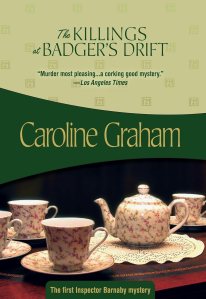
We have also enjoyed many, many episodes of The Midsomer Murders. Caroline Graham is the British author of the Inspector Barnaby mysteries. Her first five Barnaby books formed the basis of the Midsomer episodes.

The plots are complex and sometimes dark but have a touch of comedy, primarily as Barnaby interacts with his wife, dog, and sergeant. As of Oct. 2024, Graham was still alive at age 93.

Can an author still write books after her books are bought for television?  Would they automatically be a part of the filmed series? Hmm.

.

P.D. James is the author of the darker Adam Dalgleish mystery series, which has 14 books and a few TV episodes we have just begun watching. She (Phyllis Dorothy James) was an English Baroness. She wrote 14 books about the Poet/Detective and was planning a 15th when she died at age 94.

If you have watched them, have you ever noticed how they frame his face with a peculiar expression for the last few seconds of the episode?  I like it.

.

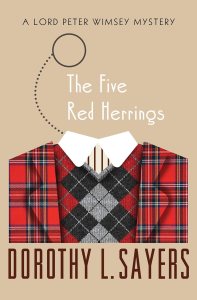
Of course, Dorothy L. Sayers wrote the clever and popular Lord Peter Whimsey novels adapted into a TV series. Along with mystery, there was the added pleasure of a romance. (Such a handsome and wealthy sleuth!) Sayers lived 64 years.

My absolute favorite Lord Peter Whimsy book was THE NINE TAILORS. I wonder if it was ever made into a TV episode or film?

.

Very recently on PBS, we watched the 4-season adaptation of Frank Tallis’ book, Death in Vienna, the diary of Dr. Max Liebermann (based on Sigmund Freud), a fictional Viennese crime solver, with his pal Detective Oskar Rheinhardt, in the series Vienna Blood.

They were well-written, had strong plots and vivid characters, and were very cinematic. The setting (Vienna and Istanbul) was gorgeous.

They say there will not be another season because the story in Tallis’s book is finished.  Hey, that didn’t stop Midsummer Murders…. 

.

Two more present-day shows follow.

Dark Winds is a new series on Acorn (4 episodes so far) based on Tony Hillerman’s Leaphorn and Chee novels.

It is on my list to begin watching. I’ve read many of Hillerman’s mysteries, so I hope these are good.

.

And lastly, we have also tried the new series on Acorn, Case Histories, based on Kate Atkinson’s Jackson Brodie private investigator books, also set in England.

The first one was pretty good. Brodie investigated and unraveled several cases, either distinct or entwined with each other. There was a sex scene, however, which I didn’t enjoy watching.

We will try another and decide.

.

Of course, we have watched many old and newer adaptations of Agatha Christie’s and Arthur Conan Doyle’s  Hercule Poirot, Miss Marple, and Sherlock Holmes novels.

And I know YOU can name many more shows that you watch.

.

My first question is, which do you enjoy more, books or screen adaptations?  And what is the “why?” for your choice?

I enjoy the books, but I must admit that my decreasing vision makes reading fine print daunting these days. I get more involved in watching the actors (especially the settings) in the series’ episodes.  

My second question for authors is, other than the monetary reward, why would you like (or dislike) to have your books made into a TV series?

Double Indemnity: A Crime Writers Film

By Maggie King

“How could I have known that murder could sometimes smell like honeysuckle?”

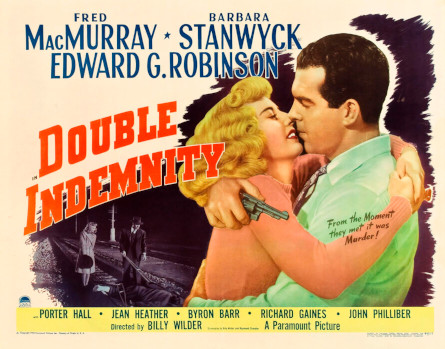
One of many memorable lines from Double Indemnity (1944), a film I never tire of watching—even after the fifth or sixth time! It’s a film I urge all crime writers to study—whether you’re writing cozies or hard-boiled detective stories. The superb dialogue, with its emphasis on double entendres and provocative banter, not only entertains but moves the plot along. The use of light and shadow create a virtual underworld that emphasizes the unsavoriness of the characters and plot. It is film perfection.

Double Indemnity is the ultimate film noir—it’s dark, steamy, loaded with atmosphere, and the characters are sleazy as all get out. In this story, originally penned by James M. Cain and adapted for the silver screen by Billy Wilder and Raymond Chandler, discontented housewife Phyllis Dietrichson (Barbara Stanwyck) bewitches insurance salesman Walter Neff (Fred McMurray) into killing her husband. Together, she promises, they will collect on a double indemnity insurance clause.

Phyllis is film noir’s classic femme fatale, luring a man whose brain goes on hiatus the moment he sees her. Walter seems like a good guy, but he’s no match for the lovely and smoldering Phyllis. She doesn’t even seem good—she’s evil to the core. Since he’s only marginally good, ensnaring him in her web is child’s play. Indeed, Double Indemnity’s best lesson for writers may be its showing how easily someone can be led astray by promises of a lifetime of riches and passion.

Writers are frequently advised to show, not tell. Double Indemnity follows this advice to good effect in its depictions of the life styles of Phyllis and Walter. Phyllis lives in an elegant Spanish house in the hills overlooking the Loz Feliz section of Los Angeles. Walter spends his days selling insurance, operating out of a ubiquitous office building in downtown LA, where the worker bees toil in a pre-cubicle bullpen desk arrangement (I worked in a few bullpen set-ups myself). Evening comes and Walter returns to his cramped apartment not far from his office. The contrast of life styles is stark, but never verbalized, only shown.

When it comes to sex scenes, the censorship of the day forced writers to show without telling, allowing them to achieve higher levels of creativity. Sex was left to the imagination, using suggestive dialogue and longing looks. A scene in Walter’s apartment hints that Walter and Phyllis had just been intimate. You don’t know for sure … but you’re pretty sure.

Elements of Alfred Hitchcock are evident in Double Indemnity. You don’t see the murder but you know it’s happening just out of camera range. Phyllis’s satisfied look and the gleam in her eye are what tell you that her husband is now thoroughly dead.

So … no sex, no violence, no profanity. Sounds like a modern day cozy. Not a chance! Double Indemnity is far from a cozy, and a current version of it would include all three no-nos. Body Heat (1981) is an example.

And there’s the creative way the senses are incorporated into the narration: “How could I have known that murder could sometimes smell like honeysuckle?” and “I couldn’t hear my own footsteps. It was the walk of a dead man.” There are many such quotes in Double Indemnity.

Here’s a quote that sums up the film in a nutshell: “I killed him for money and for a woman. I didn’t get the money. And I didn’t get the woman.”

You can almost feel sorry for Walter—after all, if you go to all the trouble of murdering your lover’s husband, shouldn’t you reap some of the benefits? Perhaps the film’s best lesson for writers is showing how easily someone can be led astray by promises of a lifetime of riches and passion. It makes you wonder how many of us are just a whisper away from evil.

After the murder, things go downhill. For one thing, Walter’s boss, Barton Keyes (Edward G. Robinson), is highly suspicious of Phyllis’s double indemnity claim and investigates it like a dog with ten bones. And Walter and Phyllis grow to distrust each other (no surprise there). By the time Walter realizes that murdering Mr. Dietrichson wasn’t such a good idea, it’s too late. But is he sorry that he killed the man? Or does he only regret that he’s left with nothing to show for his efforts beyond a bullet in his shoulder?

Often when I re-watch a movie, or re-read a book, I start finding flaws and turn critical. Not so with Double Indemnity. But I will notice something new with each viewing. Like how Barton Keyes never has a match, and Walter Neff has to light his cigar. But in the last scene, it’s Mr. Keyes who lights a cigarette for Mr. Neff (there’s that bullet in his shoulder). An unexpected touching moment.


James M. Cain took his inspiration for Double Indemnity from a real life case. In 1927 a New York woman named Ruth Snyder persuaded her lover, a corset salesman named Judd Gray, to kill her husband. She had recently convinced her spouse to take out a $48,000 insurance policy with a double indemnity clause. For more information on the case, read this Wikipedia article.