NEW IDEAS, PAST AND PRESENT

by Miko Johnston

We’re barely two months into the new year, but as I contemplate what we’ll write about in the future, and what will inspire us to keep at it, I’ve found some of my answers to those questions in our posts from the previous year.

Hannah wrote about overthinking. How many of us are guilty of getting obsessive about our writing? Characters, plots and background have to be thought out, but we also must keep it all in balance. That has become harder for me to achieve, partly because age has undermined my ability to multitask and partly because my priorities have shifted. I still enjoy writing and am committed to finishing at least two more books, but I’m reminded of Madeline’s piece on Writing Scared, and the idea of switching up the type of writing you do. I’ve done that in the past, so now I’m adding a new avocation – photography.

Years of writing has given me a sense of what works and what doesn’t, and while I still rely on critiques from fellow writers, I often can figure out problems in my manuscript on my own. Not so with my new hobby. I look at a photo and I may like it, but I don’t know why, exactly, nor can I be certain it’s any good. I’ve joined a photography club and have been invited to participate in their biannual exhibit. I’m going to need a lot of critique and advice before I select which pictures I want to use.

Linda’s piece on attending writers conferences reminded me that many more may be held this year as the risk from the recent pandemic fades from our memory, if not from our lives. Will these events be successful, or will the attendance habit, having been interrupted, be broken? Costs, from registration to travel to hotels and meals, will likely be higher than we remember. I can see where some will be very selective about which they’ll attend while others choose not to register for conferences at all.

Gayle’s piece on The Future of the Written Word really resonated with me. I’m often puzzled, even shocked, by how many words have been usurped and had their meanings altered, some with additions, some with subtractions. Regardless, these 2.0 definitions have led to divisions. A lack of clarification, or precision, makes the word’s meaning, well, meaningless. I suspect if any of the worst offenders of this phenomenon were reading this, they would have stopped at usurped (insert my sarcastic smirk here).

And speaking of the written word, Jill contributed a post on a similar, if lighter, topic – the subtle differences between American and British English. With three Brits in our WinR group and many others within our writing circle, it can be a challenge.

Rosemary’s Collecting Memories touched me. While clearing out closets and shelves in anticipation of a thorough spring cleaning, I’ve uncovered a trove of precious mementos – cards, notes and letters from family and friends, some going back to my birth. Programs from bar/bat mitzvas, funerals, and other events. Menus from private supper clubs, conference galas and corporate dinners at restaurants. Each find brought back wonderful memories of the people and places I’ve enjoyed over the years. That included a copy of the dedication that went into the L.A. Library’s copy of Rosemary’s book, “Hollywood Then and Now”, in memory of her beloved husband Rick. Her post reminded me that these keepsakes – all comprised of words – and the memories they invoke, are precious, something Maggie explained so eloquently in her post based on the “a reason, a season, or a lifetime” quote.

Jackie’s interviews with writers as well as all the fabulous guest posts she’d arranged added dimension to our blog, and her piece on naming characters had many solid tips I’ve come to rely on. And I’ll add a special shout-out for all the technical help she’s provided to us, especially a technical “muggle” like me.

There are many more posts from my co-WinRs that have and continue to inspire me. I can only hope I might have had the same effect on them, as well as our readers.

Miko Johnston, a founding member of The Writers in Residence, is the author of the historical fiction series, “A Petal in the Wind”, as well as a contributor to several anthologies including the about-t0-be-released “Whidbey Island: An Insider’s Guide”. Miko lives in Washington (the big one) with her rocket scientist husband. Contact her at mikojohnstonauthor@gmail.com

Let Me Entertain You!

by Jackie Houchin

Lots of medical stuff going on with me right now, so I thought I’d simply share a fun aspect of our Alaska cruise last fall. That aspect is called MUSH.  No, not yelling at sled-pulling dogs (although we DID do that), but a different kind of Mush.

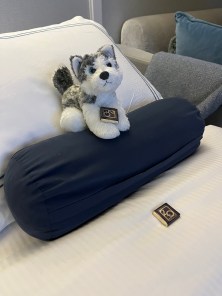
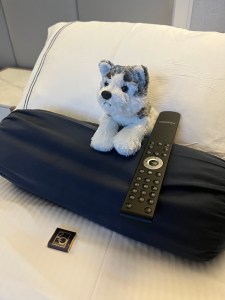
In Skagway, Alaska, I bought a small toy Husky, a beanie-bag size and shape little guy, with soft gray/white fur, big blue eyes, and the name MUSH printed on the tag. I loved the little guy from the first glimpse and perched him on my pillow in the stateroom when we got back to the ship. Joel, our cabin steward aboard the Oceania Regatta ship, loved Mush too.

When we left for dinner in the evenings the steward would come in to straighten up and turn down our beds. When we returned later, we found the usual chocolate candy on our pillows, AND…..Mush, posed in a series of so cute antics. The first time, he was propped on a pillow with the TV remote, watching a football game on the screen.

Another time he was standing on an open book (that I’d been reading), as if he were reading too.

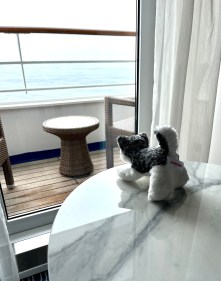
Once when we came back from an excursion ashore and after we’d had lunch at the buffet, we found him on our small room table with the curtains draw slightly, looking out at sea.

And then, every evening HE started getting chocolate candy too, an additional piece placed between his paws. We were absolutely delighted.

Of course “I” started posing Mush for Joel too when we went out for the day, hiding him where the pitcher of ice water was kept, or behind the desk alarm clock, or sometimes just lying on the bed, his head tucked in and front feet up, waiting for a belly rub.

We had such fun with Mush and our very good and so kind cabin steward.  Another sweet memory.  And now, Mush resides on my dresser at night, guarding my glasses, and sometimes on my pillow during the daytime.  (But he’s on a diet now – no chocolate.)

##

Maybe I could write a cute kid’s story starring Mush on an ocean cruise. He could meet friends, find a missing object, solve a mystery, or rescue someone in danger.  Now that’s an idea!! Mush and I might have to put our heads together and come up with a plan!

Q&A With Marilyn Levinson

by Maggie King

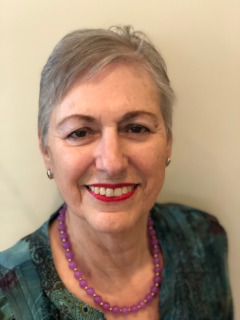
Marilyn Levinson is my guest today. A former Spanish teacher, Marilyn writes mysteries, romantic suspense, and novels for kids. Her books have received many accolades, and we expect more accolades in a year that’s shaping up to be a big one for Marilyn.

When I asked Marilyn about her upcoming releases and the “secret” of her success, this is what she shared. Enjoy!

2024 promises to be a busy year for you. Tell us what you’ll be publishing, and re-publishing.
Yes, 2024 is a very busy year for me, with eight books and a short story coming out. The new books: Rufus and the Witch’s Drudge, the second in my middle grade series, comes out in early April; my romantic suspense, Come Home to Death, comes out April 30th; and Booked On Murder, the eighth and last book in my Haunted Library series, will be released on August 6th.

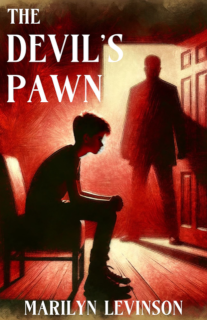
I also have five books scheduled to be republished: my YA horror, The Devil’s Pawn, just came out. Coming soon are two books in my Golden Age of Mystery book club series, and two novels for kids: And Don’t Bring Jeremy and Getting Back To Normal.

My short story “Stabbed in the Heart” will appear in the anthology, First Comes Love, Then Comes Murder. (Note from Maggie: I’m lucky to share space with Marilyn in this anthology!)

Please share about how persistence has contributed to your success.
I wouldn’t be anywhere if I hadn’t persisted in writing more books and sending them out. Also, being involved in the writing community has kept me informed re which agents and editors are open to new authors and new series.

What part of writing is the most fun for you? The most challenging?
I love writing dialogue. I find some plotting situations, especially when writing mysteries, the most challenging.

How long have you been writing? What started you on your writing journey?
I suppose we won’t count the years in elementary school, though I still have my notebook of stories from then. I started writing when my sons were very young. I wrote short stories and poetry, then segued into middle grade and YA novels, and eventually into mysteries.

What characters in your books are most similar to you or to people you know?
I suppose my sleuths are most like me, though they are braver and more adventurous than I am. But truthfully, my characters come from my imagination and are not based on people I know.

What comes first for you, the plot or the characters, and why?
A simple story idea comes first. Then the characters and plot come to mind and work together. That said, my characters and their relationships with one another are of utmost importance to me.

How important is setting in your stories?
Setting is very important in my stories. For one thing, it impacts my characters’ personalities and their lives. Working in a small town is very different from working in a city office building. Setting also dictates activities because of the weather and the terrain. It also can play a role in the mystery aspect of the story.

If you could tell your younger writing self anything, what would it be?
Don’t worry. You’ll get there. 😊

Please share your process for getting your books re-published.
I told my agent, Dawn Dowdle, who has recently died, that I wanted to make my “Children’s Choice” middle grade novel Rufus and Magic Run Amok the first book in a short series. And so she got me a contract to republish Rufus and to write three more novels. She also arranged to have my YA horror republished. A new publisher asked to republish some of my older books, and a publisher I’ve known for some time asked to republish others.

How do you use social media as an author?
Since my readers are on Facebook, that’s where I’m in constant contact with them. I love Author Takeovers. I do guest blogs and virtual book tours when a new book comes out. I also post occasionally on Instagram and X. I love doing video interviews and chats. And I write a monthly newsletter.

What marketing strategy works best for you?
Hard to tell. The ones I mentioned above seem to work.


As Allison Brook, Marilyn writes the Haunted Library series. Death Overdue, the first in the series, was an Agatha nominee for Best Contemporary Novel in 2018. Other mysteries include the Golden Age of Mystery Book Club series, the Twin Lakes series, and Giving Up the Ghost.

Marilyn’s juvenile novel, Rufus and Magic Run Amok, was an International Reading Association-Children’s Book Council Children’s Choice and has recently come out in a new edition. And Don’t Bring Jeremy was a nominee for six state awards.

Marilyn lives on Long Island, where many of her books take place. She loves traveling, reading, doing crossword puzzles and Sudoku, chatting on FaceTime with her grandkids and playing with her kittens, Romeo and Juliet.

Marilyn’s books are available for purchase on Amazon via her Amazon Author page.

The Devil’s Pawn is available for purchase at Barnes & Noble and Fantastic Fiction.

Connect with Marilyn on her website (signup for her newsletter), Facebook, Goodreads, X, BookBub, Pinterest, and Instagram.

Happy Valentine’s Day to the talented Writers in Residence and to the readers we treasure.

Writers & Time

by Linda O. Johnston

 I’m a writer, and I’m a fan of time—but sometimes it stumps me. Kicks me in the butt. Gives me a hard… time. 

For one thing, time in stories is a major factor. How long will the story go on? How old is the protagonist, and will they age much in it? 

And what is the time when the story takes place: contemporary times? Historical?  Sometime in the future?

And then there’s my own time. I’m good at fulfilling deadlines, but sometimes I really have to work at it. 

In fact, one of the reasons  I swapped the date for my post this month is because I was determined to finish a first draft of a novel I’m currently working in, with a deadline approaching, and I was focusing mainly on that. 

But I’m generally used to dealing with time and finding ways to handle it. For example, years ago when my kids were young and I was practicing law, I got up an hour earlier than the others in my household and wrote then. And a while later, when I wound up having to commute for more than an hour each way every day for my law job, I’d already started getting published, so I’d head very early to my job and hide in my office for an hour before starting to work—and everyone knew I was writing then and left me alone. 

And now? Hey, I’ll stop writing this soon and get into the edits of that manuscript I mentioned. I did finish a very rough first draft, but there’s lots more work to do. 

How about you? How do you deal with time in your life and writing or other work?


Character Flaws

by Gayle Bartos-Pool

gayle-at-bills-house-sept-2022

Through the centuries man has written novels and other stories using that plan old Aristotle, born in 384BC, came up with and documented in The Poetics. He said there are 5 Basic Elements used in writing a story: Plot, Character, Dialogue, Setting, and the Meaning of the story. He was so right. As for the people who populate said story, many authors utilize the “Character Flaw” idea to give their main character some quirk that might trip them up while pursuing their goal.

Whether it’s a private detective with a drug problem (Sherlock Holmes), a gal who drinks too much (the woman in The Days of Wine and Roses), or even the kid who can’t tell the truth (The Boy Who Cried Wolf.), when the reader learns the character has this flaw and also learns what the goal is in the story and what the roadblocks are in trying to achieve that goal, there will be anxiety on the part of the reader to see if the hero can overcome his or her problem and succeed.

This method has been used for centuries and works, but there have been other ways to toss a curve to the hero just to see how he or she handles it. A blind main character (in the movie: Wait Until Dark) or a blind detective (the movie and book called exactly that: The Blind Detective) or a hero in a wheelchair (the TV show: Ironside) worked just fine in catching the bad guys.

Rob a Bank

A physical handicap can actually make the hero stronger. I’ve known real people who had severe health problems turn into some of the strongest people I have ever seen in my life. But a drug addict or an alcoholic isn’t exactly wearing a badge of courage. I’ve also known people who had those issues as a part of their character and who had no intention of getting rid of them. I probably wouldn’t turn to them in a crisis. In a story they might be the main character with what is known as a “fatal flaw” who solves the problem or reaches the final goal as he dies on the last page. That’s been done, but it’s a bit of a downer.

But there can be other ways to give the main character something to deal with besides thrusting negative points on him. In fact, some TV characters don’t really have major flaws, but some of their friends do. The main character in the series Magnum, P.I., and Jessica Fletcher in the TV show Murder, She Wrote were basically good people, but some of their acquaintances had problems. Usually those problems were thrust upon them by someone else, otherwise known as the villain, and the hero has to solve the case before the jail cell closes on their friend.

So, are we supposed to make our main characters flawed? I’ve read some best-selling books where the hero had flaws that were rather unpleasant and I only read one of their books. I didn’t find that trait a selling point. I often say that I want my main characters to be people I would invite to my house. They don’t have to be sickeningly sweet or holier-than-thou, but I would like to respect them.

But these heroes might have a friend with a major flaw and part of the story is to get the friend on the right track so they don’t die or end up in prison. You can even have the hero mention that he almost went down that same path until somebody straightened him out. My Johnny Casino character used drugs when he was a kid while he was growing up in the Mob. They were importing and selling those drugs until a local priest challenged him to a boxing match and whooped his little butt. Johnny never touched a drug again. This revelation in one of the stories let Johnny use himself as an example to help somebody else shake their dependency.

people-4

I’ve wrestled with the notion that the main character should have something wrong with him since that theme is prevalent in many books and movies, but I prefer my main character to have either overcome some minor flaw or never really had one in the first place. Most people I know aren’t one step away from the slammer or psycho ward, so I’m not stuffing my character in that camp. He can have doubts and reservations, but in the end his upbringing and persona got him where he is, so I’m not going to let him fall into a pit. And anyway, that’s what heroes are…heroes.

People with problems don’t usually go to people with their own troubles. They go to the guy or gal who made it through the gauntlet and survived. We learn from characters like that, so my heroes fight to keep on an even keel and get us all to shore.

Coast Lighthouse