
by Jill Amadio
I looked forward to spending Christmas in Bangkok, Thailand. We’d moved there four months earlier when my husband was posted to Saigon, and I landed a job as a reporter for the Bangkok Post.
Writing about an Asian Christmas energized me, and I eagerly looked around the local shopping districts for gifts, decorations, and seasonal goodies for the kitchen. Writing features and pointing out the differences between our holiday in England and America and our current home seemed like endless discovery.
Alas, none of these visions came to a realization. Thailand, like most other Southeast Asian countries, does not celebrate Christmas because it is Buddhist. With three children expecting to wake up early on The Big Day and rush downstairs to open their gifts, what to do?
 Ah! Got it! We’d spend the holiday in Hong Kong, just an hour’s flight away. At the time, the colony was highly attuned to British customs, and the big hotels, I was assured, displayed a splendid farang (foreign) Christmas that would enthrall any Westerner. In addition to enjoying the holiday, I planned to interview hotel guests, locals, market stall owners, and tourists. Among the latter I encountered, were Swiss, German, Swedish, and Australians.
I’d visited Hong Kong several times due to assignments and visited the island of Macau to cover auto racing. There were always a plethora of stories worth reporting for the newspaper in Bangkok but I was eager to experience how stupendous this Christmas adventure would surely prove to be.
My husband and I decided it would be silly to take wrapped gifts with us, so we planned to take the kids shopping to choose their own. My editor agreed that I would write about the trip, sending in daily reports and photos taken with my Polaroid camera before we skipped New Year’s Eve and returned to Bangkok. As our last day drew near and we were anxious to return home, we booked an earlier flight.
Big mistake.
It turned out that December 31 was always a massive celebration for both Brits and Chinese, a richness of reporting I decided to cover, even though I had plenty of stories of our own excursions in Hong Kong. Besides, who wanted to miss the turn of a century in this historic city at the southern tip of China?
Our children had never been in a toy store because two were born in Spain, where Christmas was essentially a religious holiday. Our third child was born in the U.S. during a quick turnaround trip to New York and back to Thailand to ensure her American citizenship by being born in the States. My son was already pledged to fight, at 18, in any war that Spain became involved in because he was born in Madrid, but his second sister was registered as American, as by then, I had received my own U.S. citizenship.
Our shopping trip was a great success with many changes of mind as we, as parents, pointed out the mounting cost of their decisions. Finally, having selected their toys and new clothes, and I had talked to several shoppers from various countries, we returned to our hotel. It was my turn to choose a gift. My husband wanted to go out alone and buy me a watch. I told him I’d like a Patek Phillipe, please. Off he went but returned rather quickly.
“Are you insane?” he asked. “Do you know what those watches cost? No way. You’re going to have to settle for a Rolex.”
 At the time, Hong Kong was turning out fake Rolexes by the thousands. Most had wristbands that looked like gold but were, in fact, made from anything but that precious metal. Aha! Another good story! In fact, the bona fide Rolex dealer pointed out our mistake when we showed him the watch we’d bought elsewhere. Never mind. The band looked authentic, and the watch itself was confirmed as the real McCoy.
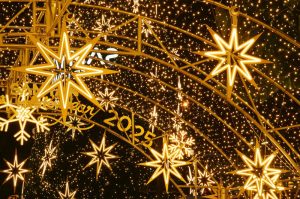
The festive air in the colony extended everywhere we went through the perpetually crowded streets. I knew that more than 7 million people lived in the small British enclave, and they invaded every restaurant, bar, and all the shopping districts in sight. Antique stores added red ribbons to their vintage wares, and the buildings were ablaze with Christmas lights. Even the hotel’s small office for guest use had a small Christmas tree. Laptops didn’t exist back then, but the electric typewriters fit the bill for typing up my interviews.
After a great New Year’s Eve, the hotel manager asked if we planned to stay on for January 6, the Chinese New Year, but by then, we’d had our fill of festivities.
I returned to Bangkok with a new satchel filled with notes and an extra suitcase for the kids’ toys and outfits. In Bangkok, we had to have our clothes tailor-made as there were no ready-made stores. The upside was that a dressmaker charged $5 or $6 to create a dress, a blouse, or a skirt. I’d simply bring in the fabric, show her a Chanel photo in Vogue or another magazine, and she’d copy it.
We left Hong Kong after two glorious weeks and enough material for several follow-up feature stories in the Bangkok Post.
Now, permanently living in America, with stores brimming with seasonal cheer, I wish my dear friends and readers at The Writers in Residence a Happy Hanukah, a Merry Christmas, and a Happy New Year!


 The Writers in Residence
You must be logged in to post a comment.