
by Jill Amadio
Whether you self-impose a deadline or your publisher sets one for you, a looming deadline (pardon the cliché) for writers can send terror racing through our veins, to say nothing of a scramble for inspiration for that perfect ending to our story.
Time as a concept rules our lives but little comes as close to engendering fright as an editor’s reminder, if any, that you have three days to send in your manuscript.
Idioms that refer to time are many but the word ‘deadline’ has few competitors for sheer panic, leading to writer’s block. Mine was so pronounced a couple of years ago that instead of diligently finishing editing my mystery prior to submission, I took off for a lecture on The Hidden Infrastructure of Waterways.
The deadline effect can strike as early as signing a publisher’s contract to write a book, with the due date blithely ignored in order not to spoil the moment.
 If we separate the word into ‘dead’ and ‘line’ we can carry on without another thought. ‘Dead’ is, of course, a wonderful word for crime writers. It finds its way into titles, sub-titles, true crime, novels, and non-fiction. It is often overworked, but there are some great substitutes that have a satisfying, final ring to them. Even time itself cannot escape its fatal meaning when we talk of ‘killing time.’ As for ‘line,’ it can refer to the last line of your book or, my favorite, The End.
I remember talking to Michael Connolly at the Los Angeles Festival of Books one year when we were suddenly interrupted. I assumed he was urged away by one of his publisher’s staff for more book signings with the threat of ‘we have a deadline before the store closes..’
Escaping one’s deadline can become quite a game. We can close the document and play online Solitaire; dig into more research; meet a friend for coffee; walk the dog, or read someone else’s book and envy the author who made their deadline and is subsequently well-published and a much-in-demand panelist at writers conferences.
It is easy for creative people to bristle at a deadline but without one, would we ever finish a book? Many deadlines hang over our heads such as filing taxes by April 15, but it doesn’t seem to make us feel pressured as we fall into line without protest or ask for a delay.
Self-published writers, of course, have the luxury of ignoring any deadline they may initially give themselves, but adhering to a disciplined writing life points to a professional approach to one’s career.
Often, we use the word ‘deadline’ as an excuse to avoid doing something, seeing someone, or simply to justify lazing around claiming we are mentally sorting out a plot, a character trait, or a setting.
Throwing out the word has its own resonance. We sound important. It surrounds writers with an aura of being special when uttering it, often with a fake facial expression begging sympathy.
I wonder if a deadline has the same time limit if it were to fit into a short or a long day, month, or year. Does the deadline contract or expand with these descriptions depending on our individual sense of time? When push comes to shove, do we tend to interpret a deadline one way while its dreaded imposer means it in an entirely different context?
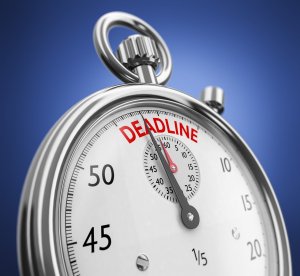 As a reporter, I was always under deadline, which I credit for bringing me to heel and making it easy to comply with my traditional publishers’ edict. But once released from their tyranny, plunging into self-publishing, and receiving monthly royalties I discovered how simple it was to let the world go by with no deadlines to obey.
Roget’s Thesaurus has zillions of ways to describe a deadline, not the least of which include crunch time, point of no return, and my favorite, kairotic. What? Oh, that means time-sensitive.
I once read that a character ‘insisted on killing time before his deadline.’ Is that an oxymoron?
Finally, there is an upside to a deadline: it can get writers into the chair and tapping the keyboard. Perhaps my colleagues on this blog have a secret way to beat a deadline. Care to share?


 I’m a writer.
 Now I’m working on the fourth of those books. I’m first doing a synopsis and three chapters to turn in, then finishing the rest of the manuscript. I have a few months, so I should be fine. But right now I’m looking at all the weekend events, panels and more, that I’ve agreed to in the near future. Then there will be a visit from some dear family members that will probably use up a week. And an annual trip that has been extended to see those family members at their home. So… well, I’m worried about meeting that deadline.
 Yes, deadlines are a part of life.
 Linda O. Johnston, a former lawyer who is now a full-time writer, currently writes
 The Writers in Residence
You must be logged in to post a comment.