My Reading Life in Classics

by Maggie King

My love affair with the classics took off in 1989. Why 1989? That was when I started a job in downtown Los Angeles. One day at lunch a co-worker asked if I wanted to go to the library. Surprised, I said, “Sure!” I’d never worked with anyone who spent her lunch hour at the library.

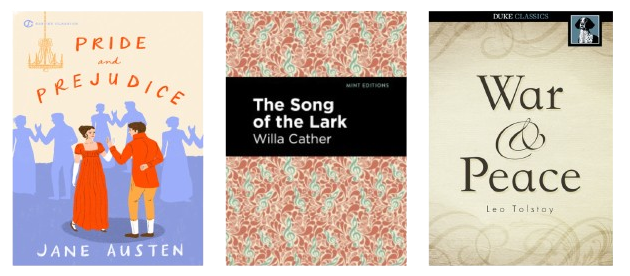
We walked to the Los Angeles Public Library and I checked out Jane Eyre. I had a vague memory of reading Charlotte Bronte’s tome in high school and decided to try it again. Over the next few years, I read—in many cases revisiting my high school reading list—works by Jane Austen, the Bronte sisters, Willa Cather, Theodore Dreiser, F. Scott Fitzgerald, Gustav Flaubert, Thomas Hardy, Nathaniel Hawthorne, Washington Irving, D. H. Lawrence, Sinclair Lewis, W. Somerset Maugham, Ayn Rand, Robert Lewis Stevenson, Leo Tolstoy, Mark Twain, Edith Wharton, and Virginia Woolf, among others.
Many I loved, with a few being okay. Sad to say, I didn’t like Wuthering Heights any better in the early nineties than I had in high school. Heathcliff was just too dark (funny reaction from a crime writer, but there you have it). For many years, Jane Eyre topped my list of favorite classics. But a year ago, I picked it up for the third time and didn’t even finish it. Jane Eyre was given to monologues! Apparently that didn’t bother me thirty-plus years ago.

In 1993 I joined a mystery group and became obsessed with that genre, classic and contemporary. Up to that point, I’d read many Agatha Christie mysteries, but few by other authors. It wasn’t long before I started penning my own.

I try to read at least one classic a year, and sometimes it’s a mystery. A favorite is Wilkie Collins’s early example of detective fiction, Woman in White. I read the epics Brothers Karamazov and War and Peace from start to finish and lived to tell it! I finally got to Little Women a few years ago. I had seen countless film versions but never actually read the delightful autobiographical novel by Louisa May Alcott. David Copperfield was wonderful but populated with characters who, like Jane Eyre, spoke at great length.

Why do I love the classics? They have a timeless quality and universal appeal, essential traits that make a classic a classic. Little Women—despite the lack of texting and social media—could be a contemporary coming-of-age novel.

The classics are known for well-drawn characters and compelling storylines. That said, it can take time for a classic story to be compelling. Contemporary books have to grab the reader on page one; classics require more patience, but are worth the wait. My friend who took me to the LAPL and I started Middlemarch together. Several times I was ready to close the book for good but, being a faster reader, my friend assured me that the story would pick up. Sure enough, George Eliot’s masterpiece became a page turner.

What’s my next classic? Many of my author friends rave about The Count of Monte Cristo by Alexandre Dumas. And I’ve had Elizabeth Gaskell’s Wives and Daughters on my TBR list for some time.

Would reading the classics benefit writers? Absolutely! Have they improved my writing? As an optimist, I want to think so—but such a belief is hard to verify. This post on KindredGrace, “5 Reasons Why Every Serious Writer Should Read Classic Literature”, is worth reading. I especially like #4: Classic literature expands our knowledge base for literary allusions.

Renowned author Joyce Carol Oates suggests that writers read Ulysses by James Joyce. According to her, our vocabulary will improve (or, if nothing else, we’ll want our vocabulary to improve). I take Ms. Oates’s point, but will pass on Ulysses (I managed to get through one chapter).

Back to where the classics began for me: here’s a photo of the beautiful and impressive Los Angeles Public Library. During my stint working downtown, this building was closed for renovations due to two fires, and the collection was temporarily housed on South Spring St. By the time the original building reopened in 1993, I was working elsewhere, but occasionally returned to visit this stunning structure. If you can visit, do so, but you can read about it here.

Closing thoughts: what contemporary novels will become classics? Any of our own? Perhaps works by Margaret Atwood, Toni Morrison, and Joyce Carol Oates will stand the test of time. As for contemporary crime novels, would any make the cut? As much as I enjoy them, they lack the timeless quality—even the historical ones. I’d love to be proved wrong. In the meantime, we have Arthur Conan Doyle, Wilkie Collins, Anna Katharine Green, Agatha Christie, Dashiell Hammett, and many others.

A big thanks to Alison, my long ago library pal!

2020 Visions For The New Year!

Read. Learn. Enjoy.

by Gayle Bartos-Pool

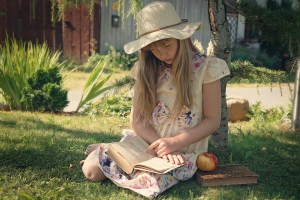
girl-reading 1423501_960_720Try the classics. Try some older writers. Try a new writer and hope they have something clever or interesting to say.

We are losing the language and our sense of humor and even our sense of right and wrong by leaving those books on the shelf. People are afraid to tell a joke for fear of offending somebody. Hey! The joke’s on them. They don’t realize they ARE the joke… and the joke isn’t funny. Suggest a book for them to read.

Some are eye-opening like Orwell’s 1984. Some are riveting like E. Phillips Oppenheim’s spy novels. Some are clever like Mary Roberts Rinehart’s mysteries. Some will stun you like Edgar Rice Burroughs Tarzan or the Barsoom series. Read. Learn. Enjoy.

What is your reading pleasure in 2020? Will you share a few titles on your TBR list?  Who are your favorite authors? What genre do you like to read?


2020 Reading Challenges

 by Jackie Houchin

And, if you’d like some direction, I have several reading plans for you for 2020. They range from DYR20 (Diversify Your Reading) which lists just ONE BOOK PER MONTH, but in categories that may make you “stretch” a bit, especially if you’ve been reading books in just one genre.  Here’s the link:  Diversify Your Reading Challenge – 12 categories  (Follow another link in this site, for the blogger’s 3-book recommendations for each category.)

Could you read ONE BOOK PER WEEK? (Whew!)  New mom, Mommy Mannegren, has a list of 52 categories for you to read in. You can interpret a category any way you choose (“a book with a senior character” could be an elderly woman, or a teenager in 12th grade), and you can read them in any order.  The 2020 52-book Reading Challenge

And…. how about TWO BOOKS PER WEEK??  This site is for the light reader (13 books), avid reader (26 books), committed reader (52 books)  and the obsessed reader (104 books).   About 25% of the book categories at this site are suggested reading for Christians.  (Read in them, or not.)   Multi-level Reading Challenges

And last, but no way least, if you are interested in reading the Bible in 2020, here are  23 Bible Reading Plans to Satisfy everyone.


 Wishing you the best health, success, happiness, and reading throughout the New Year!

new-years-eve-4652544_640

Starting a New Series

by Elise M. Stone

When I was a little girl, I dreamed of being a writer. I put that dream on hold for decades while I got married, had a family, and built a career. It was one of the many things on my “someday” list. Then 9/11 happened, and I realized that “someday” might never happen. If I wanted to write a novel, I’d better get started.

I’ve written nine cozy mysteries in two different series over the past few years. Cozies generally have a romantic subplot, and mine are no different. While writing the last book, I realized I was enjoying writing the romance more than the mystery. What if my next book was a romance novel instead of a mystery? An intriguing question, which I decided to answer.

I began 2019 by starting on a sweet historical western romance series for a change of pace. This has been coming for a long time. Years, in fact, although I didn’t realize it myself at the time.

I have trouble sleeping. In the quiet, my brain is like a hamster on one of those spinning wheels. It thinks of all kinds of things it should not be worrying about at midnight. I have to distract it in order to fall asleep.

OTRW-TotTROne of the things that helps is listening to a podcast of Old Time Radio Westerns. Before most of the classic western series of the 1950s and 1960s were on television, they were on radio. I grew up with those TV series, so the stories, while different, are very familiar. Now I fall asleep to the Lone Ranger or Gunsmoke or the less-familiar Frontier Gentleman.

I’ve been absorbing these stories in my dreams for at least two years.

I find the time between the Civil War and the beginning of the twentieth century, when cowboys and outlaws and marshals were in their heyday, fascinating. The legends in themselves are romantic.

But I’d forgotten how hard it is to start a new series in a new genre. There are new characters in a new place in a new time.  The people are like cartoon outlines with indistinguishable features. They’re not even wearing any clothes. They’re white blobs like the Pillsbury Doughboy. This is quite a change from going back to my senior citizens in the fictional town of Rainbow Ranch, Arizona, characters I love who live in places I’ve visualized dozens of times.

Another stumbling block is the historical aspect of this series. I often find myself stopped with questions like when did the railroad arrive in Tucson? (1880, which means I can’t use it because my story takes place in 1872.) Or did Philadelphia have mass transit in 1872? (It did: a horse-drawn streetcar.) Or handling issues of diversity for today’s sensitive audience.

The biggest threat to the settling of southern Arizona was Apache raiders. The attitude of most back then was that the only way to solve the problem was to exterminate the Apache. This was the opinion of not only whites, but Mexicans and the Papago, an Indian tribe now known as the Tohono O’odham. In fact, these three groups banded together and massacred a group of over ninety Apaches, mostly women and children, in a peaceful settlement outside Camp Grant in 1871. But not all Apaches were peaceful, and they were a serious problem for the ranchers and miners and homesteaders in the late nineteenth century.

And then there’s the romance plot itself. I bought several books on how to write a romance novel because—ahem—I’d only read one or two of them prior to this year. Unlike cozy mysteries, where I’d read hundreds over the years before I tried to write one, I had no gut feel about how a romance needs to work. A lot of times, I feel like I’m stumbling in the dark.

I know, eventually, the whole story will start playing itself out in my head faster than I can type. I’m looking forward to that stage because that’s when the magic happens. In fact, it happened for a time his past week as I was writing a scene and the characters started interacting in a way I’d never thought they would. I love when that happens. So I’ll keep pushing forward, stumbles and all, because I’m addicted to that magic.

And I love a happily ever after.


Elise StoneBest Photo Reduced Size Lavender Background 2Brief Bio:

Elise M. Stone was born and raised in New York, went to college in Michigan, and lived in the Boston area for eight years. Ten years ago she moved to sunny Tucson, Arizona, where she doesn’t have to shovel snow. With a fondness for cowboys and westerns, Arizona is the perfect place for her to live.

Like the sleuth in her African Violet Club mysteries, she raises African violets, although not with as much success as Lilliana, who has been known to win the occasional prize ribbon. Elise likes a bit of romance with her mysteries. And mystery with her romance. Agatha and Spenser, her two cats, keep her company while she writes.

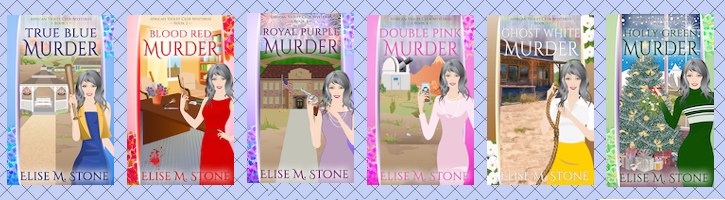
Elise StoneAVC Series Six Books
Elise M. Stone
***
Elise M. Stone’s article was posted by The Writers In Residence member Jackie Houchin.