
by Miko Johnston
A diva actress infuriates everyone with her demands. A rich businessman takes pride, even joy, out of snookering his customers. A domineering tycoon sets ultimatums for his relatives lest they be cut out of the will. They’re spoiled, stingy, slick, or just plain mean, and the next thing you know, they’ve been murdered. News spreads, often through a small town filled with quirky folks, and soon a person with no experience in criminology (beyond, perhaps, reading or writing mystery novels, or selling them in their charming bookshop) takes an interest in the murder and decides to investigate. They may not have access to the minutiae of crime scene investigations or forensic reports, but thanks to a police force with little skill or interest in solving the mystery, they unmask the perpetrator.
Welcome to the world of cozy mysteries, where life can be pleasant, eccentric, and even humorous in the face of death. Where someone’s humdrum existence can be invigorated by a murder.
A sub-genre of cozies takes crime more seriously, dealing with social issues such as addiction, abuse, homelessness, and trafficking, however peripherally. Others feature amateur sleuths who partner with the real investigators – police detectives – sometimes literally; many have spouses on the force.
Bearing those exceptions in mind, please don’t hate me for what I’m about to say – I do not, and will not, read cozy mysteries that involve murder, for one simple reason: the punishment rarely fits the crime.
People kill or get killed for a variety of reasons. Some killings are justified, as in self-defense or on the battlefield. And don’t confuse the broader legal term, homicide, with murder, as the former includes the accidental and the justifiable killing of another. The law defines murder as a deliberate act, targeting a person with the “intent to kill,” “cause grievous bodily harm,” or “a depraved indifference to human life”. This does not sound very “cozy” to me. Nor does killing someone simply because they’re not nice, or did something mean-spirited or even ruinous (short of murder) sound justifiable.
Some cozy murders occur “off the page”. I’ll grant the more grisly details of murder can be the exception to the “show, don’t tell” rule, but even so a murder has been committed. I’ve also heard cozy murders described as bloodless, or even “painless”, but is there such a thing? Any police officer who’s been to a crime scene, or EMT who tried unsuccessfully to save the victim, will tell you NO. Most poisons cause pain, convulsions and organ collapse. And what about other methods, such as strangulation, drowning and suffocation? I feel miserable when I’m congested with a cold. I can’t accept being deprived of oxygen as anything less than cruel and unusual. Even if the crime is violent, such as a gunshot, the description sidesteps the gory details. Really? Please tell me how a gunshot wound wouldn’t be gruesome to an average person. And don’t get me started on humorous murder mysteries. I’ve seen farces that involve a dead body where the death occurred from natural causes, or an accident due to the victim’s stupidity, silly but harmless. However, a murder victim’s body crosses the line for me.
I have two other reasons for not reading cozies. I lived in New York during the crime-riddled seventies. I knew two people who had dear ones murdered. A co-worker’s boyfriend was shot to death in a case of mistaken identity, and a gang of robbers murdered my friend’s nineteen-year-old cousin as he was unloading a delivery truck. Fifty years may have passed, but I still recall the anguish in their faces, the tremble in their voices when they told me what happened. They never witnessed the crime in progress, nor saw the bloody crime scene, but from the moment the police notified them, their lives changed. Forever.
I get it. A mystery can be enjoyable without forensic-level descriptions of crime scenes, as is trying to put the clues together and solve the puzzle. Of course, if that’s what readers want, then there’s no reason to include murder, rape or kidnapping – a non-violent crime would allow the reader to solve the case along with the sleuth. Why does it have to be murder? Apparently, having a cozy revolve around a high crime raises the stakes, and the level of interest, beyond lesser crimes. Making the victim as unsympathetic as possible makes us feel less guilty as we focus on the clues and not on the tragedy.
This is just my opinion, and I don’t expect others to share it. Yet I can’t help but think no matter how horrible, difficult or mean the victim is, and even if the characters in your story aren’t upset by the murder, somewhere in the world beyond your pages is someone who will care, who’ll mourn the loss and be devastated by the cruelty of it.
Miko Johnston, a founding member of The Writers in Residence, is the author of the historical fiction series, “A Petal in the Wind”, as well as a contributor to several anthologies including the recently released “Whidbey Island: An Insider’s Guide”. Miko lives in Washington (the big one) with her rocket scientist husband. Contact her at mikojohnstonauthor@gmail.com

 Why do I use a time machine when I write? For Sandy Fairfax, I had no choice. I wanted to write about a ‘70s teen idol because of the culture of that time when teen idols were promoted through TV shows. I like the melodic songs from the era, the cheesy clothes, and the drama that often took place behind the idols’ innocent façades. \
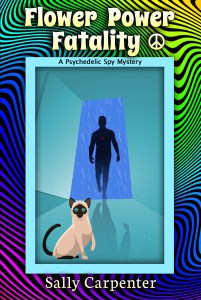 In “Flower Power Fatality,” Noelle McNabb is an actress at a Christmas-theme park in Yuletide, Indiana. Her drab routine is interrupted when a stranger shows up on her porch with a bullet in his chest. Then, a super-secret spy agency recruits Noelle to find missing microdots along with veteran agent Destiny King. As Noelle goes undercover, she finds herself dancing in sleazy nightclubs and chasing bad guys at night while wondering who is going to feed her pet cat.


 Sally Carpenter was born and raised in southwest Indiana but now lives in Moorpark California, leaving the land of rain and snow for wildfires and earthquakes. She has a master’s degree in theater from Indian State University. She also has a master’s degree in theology and a black belt in tae kwon do. She’s also “mom” to two black cats.


 The Writers in Residence
You must be logged in to post a comment.