Writing in the Other Place by Kate Thornton

Kate Thornton is a retired US Army officer who enjoys writing both mysteries and science fiction. With over 100 short stories in print, she teaches a short story class and is currently working on a series of romantic suspense novels. She divides her time between Southern California and Tucson, Arizona.


Writing in the Other Place

Writing is a solitary pursuit; when we write, we are alone with just a gazillion characters, situations, what-ifs and possibilities. It is a good time to create, experiment, and procrastinate.

Writing needs its own space, its own time and place. For some, it is the dining room table after the kids are asleep, or the home office complete with bookshelves and cat. For others it is the local Starbuck’s or the cluttered desk at work before work starts.

For a few of us, it is a different house in a different state.


I live in Paradise, in Southern California, where it is beautiful every single day of the year. I live in the house of my dreams, a mid-century modern masterpiece of light and space, with lush gardens and a small pool. I have my own office, a light-filled room with bookshelves. I am fortunate to see these dreams realized after a lifetime of hard work.

So what’s the problem?

Like a suitor who has been wooing the beautiful sister only to have his heart stolen by the mousy little girl with the great personality, I have been seeing another house on the side for a couple of years. A vacation home to start, it has become The Place and will soon become my permanent home.

I am moving to Tucson, Arizona. 


Photo by Albert Voirin

Yes, the house is smaller, not so beautiful, with a much smaller garden. A garden, I might add, not filled with fruit trees and orchids, but cactus, for crying out loud. There isn’t a home office, just a little desk almost big enough for my laptop. Yes, the light alternates between blinding sun and dark clouds. Yes, it is hotter than buried coals in the summer and it actually freezes in the winter. There are monsoons and floods and heat so dry you could juggle your laundry in the air for 10 minutes and everything would be perfectly crisp.

But what can I do? It is the place where I can write. It is the place where I can be happy. When I am there, I don’t want to come back. When I am there, I write.

I have friends there now, and enjoy the company of other writers. There is a thriving community of arts and letters in Tucson, and now I am a part of it.

So I am moving there. Moving – especially at my age – is a big pain, but it is necessary. I can’t believe how much junk I have accumulated over just the last ten years, but only the necessities are going with us. Yes, my dear husband is on board with this. In fact, he may be even more eager to move than I.

Photo by Albert Voirin


So for now, we make periodic trips across the deserts to take stuff and when I am there, I write. I have dug out trunk novels and unfinished short stories. I spend time at the computer undistracted by television or Facebook or anything. I feel the light and the sun on me, and the gentle whoosh of the air conditioner or the cries of unfamiliar birds through an open door or the crackle of a log in the fireplace. And sometimes, I hear the pounding of rain, relentless, almost frightening in its intensity. But when I get up to look, the sky is already clear and the sun is making steam rise from a hot pavement.


I make a cup of tea and go back to the computer. I dread the night before we leave, when everything gets packed up for the trip back.

I have found my writing place and it is 500 miles from where I am writing this now.

I look forward to this new chapter in my life, although I know I won’t have much of an excuse for procrastination there. All the more reason to do it.

Editing and Outlines by Gayle Bartos-Pool

A former private detective and reporter for a small weekly newspaper, G.B.Pool writes the Johnny Casino Casebook Series and the Gin Caulfield P.I. Mysteries. She teaches writing classes: “Anatomy of a Short Story,” “How To Write Convincing Dialogue” and “Writing a Killer Opening Line.”

Editing and Outlines

by Gayle Bartos-Pool

As a writer I have become a fanatical editor… of other people’s work. That’s not to say I don’t edit the heck out of my own work before I send it off for publication, but I can’t watch a TV show or a movie or even the nightly news without thinking of a better line to use or a better plot or a better word to describe what they are talking about. I have ripped apart old television shows when they were so outrageously bad and rewrote the plot before the final credits ran. Even my husband is getting into the act by pouncing on a plot line when it doesn’t fit.
The moral of this post is: Don’t Send Your Work Out if it Doesn’t Make Sense.
The advantage of dissecting other people’s work is to catch the same mistakes in our own writing… and fix them. I can’t tell you how many things I’ve changed in my own work after I saw the same error in someone else’s story. Little things like using the apostrophe in dates. The “1970s” doesn’t have the apostrophe unless it is used as an adjective. Example: He lived in the 1990’s but drove a 1970’s automobile… The first is incorrect; the second is correct. I have seen this mistake in books by big name authors.

But it’s the bigger things like not tying up a loose end or having the heroes show up in a spot where they had absolutely no reason to be just so they can find a clue that drives me nuts. (I saw this recently in an NCIS episode.) It’s like you cut out the linking scene just to shorten the story. But if the connection isn’t there, you have cheated your reader.
We were watching an old episode of Columbothe other evening and the story disintegrated into foolishness when the implausible kept happening. The audience always knows whodunit from the beginning in that show, but that can also play against credibility when we know what happened and Columbo seems to have watched the same opening and spots all the clues before there is a reason to question them as clues.

But there is a remedy.

I discovered this when writing the lesson plan for a course I teach called: The Anatomy of a Short Story. (It works for novels and screenplays as well.) A terrific way to see if your story hangs together during that editing phase is to write down each LOCATION and which CHARACTERSare in that scene IN ORDER. Write it like bullet points. Each location should add something new to the story or ask a question that needs to be answered later. If your characters go someplace and learn nothing, cut that scene.
Next, look at that list and see if the locations and what happens in each are a mix of HIGH and LOW points. If you have too many low points together, move a high point into the list to give your story movement. And vice versa.
Then look at those points and see if all the questions have been answered. If not, add that scene and wrap up that point.

Next, check to see if your opening is a GRABBER. Since readers are becoming scarcer and scarcer, you’ll want to pull them into the story as fast as you can and keep them. You do that by dangling a puzzle in front of them early so they have to finish reading just to find out what happens. This is what TV shows do with that four minute teaser at the beginning of the show. Works in short stories and novels, too.
Now ask yourself: Does the OPENING FIT the ENDING of your story? Any story: mystery, romance, adventure, has to have a satisfying ending. And the ending should answer the big question that is asked at the beginning.

Next, check to see if the story MAKES SENSE. This is tough because you might have a great idea in your head, but it might not have made its way onto the paper. What is your story about: Man against Man? Man against Nature? Man against Himself? Are there good reasons why your characters do what they do? Is there a resolution?
Last of all, see if your TITLE fits what you have learned while going through all those bullet points. Does the over-all meaning of your story fit that title? Sometimes you will discover a different meaning to your story and the title needs to be changed.

As one last pass-through in the editing process, while I am reading each sentence I ask myself THREE QUESTIONS:
Does it advance the story?
Does it enhance the story?
Is it redundant? Is it redundant?


            For those who don’t outline before you write, remember, this outline happens AFTER you have written your story. It is a great EDITING TOOL. It lets you look at your work objectively and see if all the pieces fit. And one more benefit, it provides a TIMELINE so you can see if all the action you are writing fits into any given day. Nothing like finding out you have penciled in 32 hours of action in a 24-hour day.
Give it a try.

I am teaching a four-hour course, How to Open Your Story with a Bang, at the Woman’s Club of Hollywood on May 7th. It will cover this aspect of writing and a lot more. If you would like more information about the class, leave a note on this blog.
 

DIVERSITY MATTERS

by Bonnie Schroeder
 
Bonnie Schroeder started telling stories in the Fifth Grade and never stopped. After escaping from the business world, she began writing full-time and has authored novels, short stories and screenplays, as well as non-fiction articles and a newsletter for an American Red Cross chapter.
 
The recent uproar over the lack of non-white nominees for the Academy Awards got me thinking, because I seldom explicitly depict people of color in my books and stories. I don’t think I’m a racist, so why is that?
First off, although I have many friends who are Black, Asian and Latino, I don’t think of them by that label. I think of them as my friend who was with me during a traumatic purge at our former employer, or my gal pal who shares my love of classical music. And so on.
Therefore, I don’t often assign a racial label to the characters I write about. Many of my characters could be black or green or blue or purple, but it’s not relevant so I don’t go into it.
Should I?
The reason I ask is that our books and stories are often source material for films and television programs, so in a sense, diversity starts with the writers. But is it myjob to impose diversity? I’m not sure.
When I was working in the business world, I certainly enjoyed a diverse assortment of co-workers, many of whom became close friends. Then I retired and spent more and more time in my home community, which has a predominantly White population. I didn’t notice the change at first, preoccupied as I was with making the transition from worker bee to independent writer.

Then I joined a Tai Chi class at the local Y, and the first people to welcome me were an Asian couple. The teacher was Black. A graceful Filipina taught me some of the moves. Suddenly, my world grew more colorful again—no pun intended there, or maybe it is. And I realized how I’d missed hanging out with people who didn’t look or talk like me. Variety is, after all, the spice of life.

We need variety and color in our lives; it enriches us and makes the world more interesting. The universe offers a panorama of colors, shapes, sizes, sounds, tastes and smells to experience.
But back to my question: should I be more explicit in my character descriptions to make it clear that the protagonist or her friend or her boss is a particular race or color? Is there a way to denote ethnicity—to make my writing more polychromatic—without being obvious or patronizing?
After all, despite the self-important proclamations of certain performers, Hollywood would be nothing without the written word. So to circle back to my original premise, your book or my short story might be the starting point.
Sometimes the story or the situation demands a character be a certain race, but often he or she could be any race, at least in my stories. Then the reader can decide for himself or herself if the character is Black or Asian (or Martian.)


Weigh in with youropinion on this admittedly tricky subject. Do you consciously include a variety of ethnicities in your writing? Do you think it’s a good thing to do? Or is it better to let the reader fill in the blanks and imagine a character in any color they want?

Where Did I Get That From? Childhood Reading from Across the Pond with Rosemary Lord

Rosemary wrote her first book when she was ten years old – for her little brother. She also illustrated it herself. It was later rejected by Random House! She has been writing ever since.

The author of Best Sellers Hollywood Then and Now and Los Angeles Then and Now,  English born Rosemary Lord has lived in Hollywood for over 25 years. An actress, a former journalist (interviewing Cary Grant, James Stewart, Tony Hopkins, John Huston amongst others) and a Senior Publicist at Columbia Pictures, she lectures on Hollywood history. Rosemary is currently writing the second in a series of murder mysteries set in the 1920s Jazz Age Hollywood featuring Lottie Topaz, an extra in silent movies. 


WHERE DID I GET THAT FROM? – My Childhood Reading bug…. by Rosemary Lord

Luckily for me, I come from a family that loves reading, loves books.

My dad always had his head in a book: mostly mysteries. Shelves were lined with well-

thumbed Agatha Christie novels, Lesley Charteris’ Simon Templar The Saint books. Dad read George Simenon’s whodunits about Inspector Maigret, in English and in French. From my mum and sister, Angela, came the gateway to a swathe of other adventures.

Johanna Spyri’s Heidi is one of my earliest recollections. Even today, when things get too much, I think back to the grassy Swiss mountainside where young Heidi lived with her grandfather, her best friend was Peter-the-Goatherd and her diet was toasted bread and cheese washed down with milk straight from the goats. Yum!

Edith Nesbit’s The Railway Children followed – three children, living alongside a railway track, trying to solve the mysterious disappearance of their father.

It was Enid Blyton’s books about The Famous Five – five young friends who get involved in school-holiday adventures – that got me interested in mysteries, long before I discovered the grown-up Agatha Christie titles.

My brother Ted says that, when he was old enough to join the local library, his Library Card was his proudest possession. “That first Saturday, I was allowed to take out The Secret Island (by Blyton). I dashed home and read it cover-to-cover. Later that afternoon I hurried back to the library to return it and take out another book. The Librarian told me I could only take out one book a day! I was devastated.”

I graduated to one of my sister’s favorite authors, Noel Streatfeild. Ballet Shoes was the first in the tales of three orphaned girls enrolled in a dance academy. Each girl’s dream takes them in different directions. My sister wanted to be a ballet dancer – I harbored secret dreams of being an actress, at that time.


While, on the other side of The Pond, American girls steeped themselves in the adventures of Nancy Drew, I had now discovered Pamela Brown’s book, The Swish of the Curtain. This was a series about seven stage-struck children who form an amateur theatre company. Brown was 16 years old when she finished this, her first novel. Her income from the book paid for her to attend R.A.D.A and become an actress.

It was Brown’s book, Maddy Alone, that took me in a different direction. When a film company arrives in the local town to shoot, Maddy is ‘discovered’ to play a big role in the movie. I then realized that it was movie-acting that I really wanted to pursue.

As a side-line, I loved the rebellious, naughty adventures of Pippi Longstocking, by Astrid Lindgren, and followed her fashion sense: the freckles I had in spades and I liked pigtails and her red-and-white striped stockings.

As I grew older, I raided dad’s Agatha Christie collection, then onto his F. Scott Fitzgerald and Raymond Chandler books. Ah! ‘America here I come,’ was my new song.

With a steady diet of Hollywood Movies on Sunday Matinee on ‘the telly,’ a direction began to emerge.

So I did start out as an actress in England on ‘the telly,’ on stage and in films – amidst 101 boring ‘temp’ jobs. I wrote articles for the English magazines to pay my way, never thinking for one minute that I would ever really be taken seriously as a writer.

I ended up in Hollywood working as an actress for years. At the same time I was writing articles about Old Hollywood, becoming more and more hooked on the history and the mysteries of Tinsel Town. Until I finally became a published author with Los Angeles Then and Now, followed by Hollywood Then and Now. The world of acting was a fading image in my rear-view mirror. Who needs acting!

With the lectures and conferences I attended, I was introduced to an amazing new world of writers. Many were mystery writers. We spoke the same language. They were immediately encouraging, supportive and generous with their knowledge. I began to write mysteries set in Old Hollywood. I finally felt at home.

Today, when I meet up with my family, we still talk books and writers – just as I do with my writer friends here in Los Angeles.

Lucky for me, the seed was planted early in our family. I think we learned to read almost before we were big enough to hold the books.

So, fellow bloggers and dear readers, what are your earliest memories of reading? The first books you read? Which books had the most influence on your growing up – on your life? I’d love to hear the American counterparts of my literary diet.

Forward Into the Past by Miko Johnston

Miko Johnston is the author of A Petal in the Wind and the newly released A Petal in the Wind II: Lala Hafstein.
.
She first first contemplated a writing career as a poet at age six. That notion ended four years later when she found no ‘help wanted’ ads for poets in the Sunday NY Times classified section, but her desire to write persisted. After graduating from NY University, she headed west to pursue a career as a journalist before switching to fiction. Miko lives on Whidbey Island in Washington. You can find out more about her books and follow her for her latest releases at
 Amazon.

When I was a kid, I loved imaginary games, where you established a world and then went there to play. Until kindergarten, many of the other kids in the neighborhood would join in, but by second grade, they’d all abandoned make-believe for Milton Bradley, preferring the organized play of board games to pretending, which they viewed as childish.

Board games like Monopoly and Life held no interest for me. The object was to win, and while skill played some part, winning depended on luck, literally a toss of the dice. Even without knowing what would happen, you knew the limits of what could, and it always ended the same way, with only the name of the winner changing. But even worse, to play you had to follow a precise set of rules, and I hated to follow rules when I played. With make-believe, you set up a situation, give yourself, your playmates, and your surroundings roles, and then see what happens. Two chairs and a blanket becomes a fort, or cave. A bed serves as a life raft as you flee a sinking ship, or the deserted island where you land. The network of cellars that interconnects apartment buildings on a city block are the tunnels and alleyways where the good guys and bad guys dart about and hide out, planning their strategies for battle. The goal wasn’t to win, but to experience an adventure. To have fun.

I sought out younger companions to continue my penchant for imaginary play, but eventually they, too, stopped. But I never did.

When you don’t have playmates to share in the experience, you create the games in your mind, including all the characters, the setting, the situations, the problems. You play it at night in bed, before you fall asleep. You daydream it when there’s nothing better to do. Maybe you write it in a notebook.

When I became a teen, many of my friends had crushes on some singer or actor. I was rather naïve, but I saw an opportunity, picked a harmless teen heartthrob and joined in the fun. A few of us would make up fantasies of what it would be like to be with these men, or at least, who we imagined them to be. They were really empty shells, with the physical presence we saw on album covers or on television, which we filled with all the qualities we imagined they would have. All the qualities that would appeal to a shielded thirteen-year-old, that is. But at a certain level they, and the fantasy lives we shared with them, became real to us.

Yes, I did play with board games, coloring books, paper dolls and real dolls. Outside we’d jump rope, play hopscotch, tag, or handball with my friends. It was fun and I enjoyed it, yet I always elevated make-believe to the highest level of play, and in a sense, I still do.

Is it any wonder I became a storyteller?

Images Aren’t Only for the Outside of Your Novel!

In the quest for reader respect, self-published authors are always struggling to make our books as visually appealing as those of our traditionally published colleagues. Book cover artists can design a great cover that is formatted correctly for both digital and paper editions. One thing that I hadn’t considered was using artwork to spruce up book’s interior!

The idea came to me when I was reading a book that I can’t put my hands on. (How embarrassing.) So, I looked in another book, One Foot in the Grape by Carlene O’Neil. I’m obviously not a genius, because I straightened the image and it’s still sideways, but you can see the cute grape under the title.

Inside, at the beginning of each chapter, is another cute vine and grape leaf image. (Notice that I’m getting better, and the picture is only upside down.

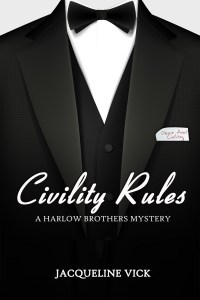
Anywho, I wondered, why couldn’t I use images to spruce up my Pet Psychic books and my new novel, Civility Rules? Maybe paws for the pet psychic and a bow tie for the civility series? First, I needed artwork that I could use. I visited several sites.

Dreamstime 
Can Stock Photo
Shutterstock
123RF 

I finally decided on Dreamstime, which allows me to use the images I purchase at the Standard License level for up to 500,000 print copies of my book. Ebooks aren’t counted. WARNING:  Be sure to read the fine print v-e-r-y carefully to make sure you are purchasing the size you want and that it is available for commercial use. Some images are only available for blogs and other non-commercial use. SECOND WARNING: Make sure you don’t purchase a vector image unless you have the appropriate (and expensive) photo software, such as Adobe Photoshop.

The pricing system can be confusing. Most sites sell their images by points, so you have to purchase points before you download the image. My two images cost 30 points, or $34.99.

I’m not a formatting expert, nor am I a technical wiz (see above photo disasters), but to test it out before I bought the images, I merely inserted clip art and found that it worked, as least in the ebook copy.

Here is the Kindle preview page.

Just this one little step helps with reader perception by giving my books the look of traditionally published novel.

Sometimes, it’s the little things.

Column Writing Pros and Cons 
by Jackie Houchin
Column Writing sounds so, well, so glamorous to me – a daily, weekly, or monthly byline with a headshot. Readers loving me, looking forward to my next article, writing to me… Head swelling stuff for sure.
Unlike the other gals on this blog, I’m not a novelist. I’ve attempted writing short stories and had ONE flash story published, but the whole… character arc, rising and falling action, three act structure, dying-to-self climax… I just can’t get it all to work.  Maybe that’s why I got into the newspaper writing and book reviewing business. Telling someone else’s story – now THAT I can do. 
My first book review was published in a local “rag” (The Foothills Paper) with the greatest of ease.  The editor asked for another review, and then started sending me out as a “cub reporter” covering local events, writing human interest stories, and doing local business profiles.  I loved seeing what was happening around town, “shooting” dignitaries, writing it all up. My favorite was interviewing people and telling their stories. (See my “Interview Techniques” on this blog http://bit.ly/1LKyVvf)
My words and photos, in print every week. It’s a real high. Give me a press card, an assignment, a Wednesday deadline and I was in writer-heaven. I’ll admit, I got a bit “cocky” when I started getting front page and multi-part stories. That’s when I began to wonder…could I segue from a “stringer” into a columnist?  What would it be like to have my own permanent spot on page three?
It was then I happened on *Lydia E. Harris’ article, “Is Column Writing for You?” What I learned from it made me decide to… well, let me share her wisdom first.  She asked NINE questions to consider before taking the leap.  I’ll list them, and show how I came to my “final decision.”
1. Do you have an idea for a column TOPIC?  She told us to consider our profession, hobbies, life experiences.
I had several I could choose from: aspects of writing, photography, horse keeping, Bible commentary. A “Dear Abby” type column would be fun, but who was I to tell other people how to solve their problems? I had to look at each idea closely and see if I could generate an ongoing column from any of them. (Kind of slim, I had to admit.)
2. How will the commitment impact your family? Do you have TIME to take on a new, ongoing writing assignment?
As I chewed on my cheek, I looked at the things in my life that might have to be set aside. Of course that depended on how often my column would appear, wouldn’t it?
3. Is money an issue?
I hadn’t considered money much. Sure I got paid for the stories and photos that ran in the newspaper, but would a column garner more money? Any money? (Note to self: check this out.)
4. Can you accept criticism from readers? If your writing is controversial, you may receive negative feedback.
Eek!  No, I’m not good with criticism.  But wouldn’t my column be “nice” and safe?  I’d been expecting “atta-girl” letters, not confrontations. (I looked over my possible topics list and crossed off Bible commentary.)  I also had to consider the fact that my newspaper editor DID thrive on controversy and heated letters exchanged. Would he allow me a cute little column? (Um… nope.)
5. WHY do you want to write a column? Is it to share your expertise, shape lives, develop credentials? Do you want a built-in writing market? Do you want to gain recognition and build a platform?
These questions were getting harder.  Did I really have “expertise” on any of my topic ideas? How would tips on horse keeping shape people’s lives? How about name recognition? I already had that with my weekly stories and photos.  (Note to self: develop MORE topic ideas!)
6. Are you good at generating ongoing ideas for your topic? (Here she gave a short challenge: Pick a topic that interests you and quickly list 10-20 column ideas.)
Um… how about two?
7. Are you motivated to complete columns regularly and meet deadlines?
Deadlines were not a problem. I did my best writing when I was coming down to the wire on a midnight deadline. But, what if I couldn’t come up with enough ideas on my column topic?  Would I get bored? Get sloppy? Want to quit quickly?  Would I let the editor and the readers – my dear sweet readers – down?  
8. How often would you want to write a column?
The stars in my eyes were quite dim by now. I wasn’t sure I could do this column writing thing.  The vision of a fascinating and well-read weekly column was fading into the mist. Writing it seemed like climbing Mount Everest. Or a prison I’d be locked into for the rest…of…my…life. 
Her last question was a hum-dinger.
9. SHOULD you write a column? It depends on how you answered the above questions. If you have something to say, can say it well, and find a market, then the answer is probably yes.
Sadly disillusioned, I had to admit my answer was “no.” I was a cub reporter, a stringer, for a rag newspaper, in search of that great investigative story that would win me a Pulitzer!  (Okay, maybe not that!)
But she continued with a bit more advice if your answer was “yes.”
1. Carefully select a title for your column. If possible make your title distinctive by including your name in it.
2. To find a market, start with a local publication and prepare several sample columns. Submit them with a proposal and cover letter to introduce yourself and the need for the column. (Don’t discuss pay!)
I retired from newspaper writing when I moved south to Orange County four years ago. I never attempted to write a column, but I did have my own News Website for some years, and now I write on three blogs; THIS ONE, my eclectic “Here’s How it Happened” (http://bit.ly/1Qb9osi) and my “Morning Meditations; Beginning the Day in God’s Word” (http://bit.ly/1oAbZVq ).
Hey… a blog is a column of sorts, right?

* “Is Column Writing for You?” by Lydia E. Harris, Christian Communicator, September, 2011

For Better or Worse – Married to a Writer by GB Pool

For Better or Worse
Before I married my husband, I told him all I wanted to do in life was write. I wanted to make sure he didn’t mind being married to a writer. Richard wouldn’t have cared if I said I wanted to wrestle alligators. He just wanted to get married. Neither one of us was getting any younger.

           So we married. It will be 30 years this coming New Years Eve. And I have written many books. Fifteen have hit the presses and I am doing what I said I wanted, but I also signed on as wife, and that has obligations, too.

It was only six years into our marriage when it became possible for me to retire and write full-time. No longer were we sharing the chores and the cooking after work. Now Richard earned the paycheck; I was “housewife/writer.” No matter what they tell you, writing doesn’t pay all the bills for most of us pen-pushers.
I have to admit, the house was cleaner when I had a full-time job. I also wasn’t doing any writing then. I kept the homestead ship-shape and took pride in a sparkling kitchen and dust-free zones. Now there are dust bunnies the size of gorillashiding under the bed and there are areas of the house I haven’t touched in years.
But I do try to put hot meals on the table, though more than once the center of the re-heated beans is still cold or the three-day-old chicken is a tad tough. I do wash and iron the clothes, even the permanent press. I want to send Richard off to work looking terrific.
I used to do this all on Friday. It was a solid seven or eight hour day. I started to dread Thursday evening knowing what loomed ahead of me the next day.
My brilliant husband suggested I split up the work week. So a few hours Monday, Thursday and Friday gets it all done. I am finished before noon every workday and have two entirely free days in the middle of the week when I am working on a writing project.

The schedule works, though I do dread Wednesday evenings knowing “cleaning day” is coming, but I get over it quicker. And it is the right thing to do. I also make a point of listening when Richard has a bad day or a good day or an average day at the office because he is giving me what I wanted – time to write. If he wants to head off to the hardware store or Big 5 Sporting Goods or Office Depot, he asks me to go with him and I do. The fact he still wants my company means more to me than the hour or two I might lose at the computer.
I have spent these many years not only writing, but building doll houses and making other miniatures and painting. My artwork is everywhere. I tried to leave the living room as strictly his space for his various radios and books. And I give him space to do his own thing in the garage.

My point in writing this blog post is to let other writers know they, too, have an obligation to their spouse or family and pets, even their friends, to give a little of themselves while doing what they want to do. You have to be true to yourself, but you aren’t alone out there and having friends and family to share your dreams and accomplishments is an integral part of life.
Richard and I signed on to that agreement nearly thirty years ago when we said, “I do.” I am thankful every single day that he had no idea what he was getting into. I guess this is sort of a Valentine to my guy. Thanks for believing in me, RJ.

Writing Short Stories: A Mini Course by Kate Thornton Part II

Kate Thornton is a retired US Army officer who enjoys writing both mysteries and science fiction. With over 100 short stories in print, she teaches a short story class and is currently working on a series of romantic suspense novels. She divides her time between Southern California and Tucson, Arizona.

Today, Kate continues with the second part of a mini course on writing short fiction, beginning with marketing.

Marketing your finished work

1. Know your genre. Do you write mystery? Science fiction? Romance? Contemporary literary? I write mostly mystery and science fiction, but I firmly believe that if you can write, you can write anything you want to. Look at your story and figure out where it might belong. Chances are, it could fit into more than one category.

2. Research your markets. Know what they want. Every magazine, anthology or contest has submission guidelines. Read them carefully and give them what they want. If they say under 1000 words, don’t send 1001. If they say snail mail only, get out those envelopes. If they say no vampires, robots, brunettes, or cats, don’t send your epic space opera vampire story about the furry dark robot cats. Keep on looking for a market that fits – or revise your story to fit the market. Either way works.

3. Polish your story again. Give it one more read, made sure it looks great and is in the right format.

4. Submit. Go on, do it. And keep a record of your submissions. A simple Word or handwritten document giving title, market, date of submission and date/type of response is perfect. That way you don’t miss a market or submit the same thing twice to the same market.

A note about cover letters.

Short stories are usually sent with a short cover letter (not a query letter, which is something else entirely.) Cover letters usually say something like this:

Dear Editor,

Attached (or in the body of this email) please find my original 750 word short story, “Lost in the Woods.”

I am an avid reader of your magazine, and have had work published in “Sewage Monthly,” “Cat Lovers USA,” and “Coal Digest” (or leave credits out if don’t have any – it won’t matter if you don’t have any.)

I look forward to hearing from you.

Sincerely,

Avid J. Reader
123 Writer Lane
New York, NY 10000
(212) 555-5555
avidjreader@wtf.com (Your name, address, phone number & email are important!)

Then you wait. But while you are waiting, write something else. Keep on doing that.

Where? Where do I submit?

Here are the links to 2 of my favorite online market guides.

Ralan (look over on the far right for market listings)
Publishing…And Other Forms of Insanity

There are others, of course. And if you post to any writers’ forums (or fora for you linguistic purists) you will also find market info. Here’s one I like:

Absolute Write

Happy writing!

That’s the quick and easy of short stories. Time to write one!