

Bonnie Schroeder started telling stories in the Fifth Grade and never stopped. After escaping from the business world, she began writing full-time and has authored novels, short stories and screenplays, as well as non-fiction articles and a newsletter for an American Red Cross chapter
I’m wrapping up our series of pet-centric posts today and hope everyone has enjoyed reading about the animals in our lives. . . and our writing.
I’ve had pets almost all my life, mostly dogs and cats, but few have had starring roles in my fiction.
My very first “published” short story, however, featured a cow as a main character, and not just any cow. My pet cow.
Here’s how it happened:
As a child, I spent my summers on my grandparents’ farm in northern New Mexico. It was a kid’s paradise, with all sorts of animal life: dogs and cats and chickens and pigs and cows. Being semi-obsessed by Western movies that were all the rage back then (mid-20th-century, that is), I often lamented that there were no horses on the farm.
The reason? Simple economics. My grandparents were not wealthy, and a tractor can do the work of many horses, without the attendant feed bills. My grandfather tired of my yearning for a horse, and he offered me what was, in his opinion, the next-best substitute: a docile milk cow named Brindy.
Brindy and I became fast friends during my summer visits. When I arrived, I’d race out to the pasture, climb over the fence and call to her, and she always came to say hello. I’d tell her how my time in California had gone, share a few confidences, rub her forehead and give her a carrot. When she was lying down, I’d often climb on her bony back and stroke her bristly hide. She was always gentle with me and seemed to enjoy the attention.
My favorite thing, though, was to help with the milking! You need VERY strong fingers to milk a cow, and I wasn’t always successful, but I kept trying. Milk straight from the cow, by the way, is nothing like the stuff you buy at the supermarket. It’s warm and thick and has a distinct, earthy taste.
How did Brindy come to star in my short story? As the product of a “broken marriage”—which was not taken so casually then as now—I was something of an outsider in school; friends did not come easily. But in the 5th grade, I discovered—or rather my teacher discovered—that I had a knack for creative writing. I suppose it came from all the time I spent alone with my books, coupled with a wild imagination. My teacher gave the class an assignment to write a story about an animal, and without my even having to think too hard about it, a story emerged about a cow that wanted to be a horse. The cow in my story, of course, was named Brindy, and although she tried hard to act like a horse, she eventually came to realize horses didn’t have it all that easy: people riding on their backs, hauling heavy wagons, and so on. Brindy decided she was pretty darn happy being a cow.
The ”be yourself” message must have impressed my teacher, because she typed up the story, shared it with the class, and sent a note to my mother that my writing “talent” should be encouraged—which, of course, it was.
That summer when I went to visit Brindy, very full of myself for all the attention my story had received and the friends it had won me, my grandfather cautioned me that Brindy had given birth while I was away. Eager to see the new calf, I hurried to the pasture and climbed the fence. Sure enough, there was Brindy with the cutest little baby standing next to her. I called out to her and ran forward. At this point, Brindy lowered her head, bellowed, and charged. I was threatening her baby.
I turned and fled and barely made it to the fence without being trampled. When I told my grandfather what happened, he shook his head. “I warned you. She’s mighty protective of that calf.”
And so it was that I lost my friend on the farm. Brindy became a mom and had no more interest in me. It made me sad, but then my grandfather brought home a puppy, and when he presented it to me, my disappointment over Brindy melted away. We named the puppy Buck, and he lived a long and happy life, watching over me and protecting me from the many hazards a child encounters on a farm. I decided a dog was a more suitable pet than a cow, after all.
Brindy had abandoned me, true enough, but she was my first muse, and I have always been grateful to her for that. In return, I gave her a kind of immortality, at least on the written page. If cows have emotions—and I think they do—she’d be proud.

 Linda O. Johnston, a former lawyer who is now a full-time writer, writes two mystery series for
 Rosemary wrote her first book when she was ten years old – for her little brother. She also illustrated it herself. It was later rejected by Random House!
 So did Red-eared Sliders. So-called, because they have a narrow red stripe around their ears. The ‘slider’ bit comes from their ability to slide off rocks and such into the water quickly. Then there’s the common Snapping Turtle. I learned to grab them more towards the back of the shell, because they have longer necks and would, of course, snap at me. Hence the name. They can be vicious little what-nots, craning their necks, trying to reach my fingers and glaring at me as if to say, “Leave me alone, I was on my way to the pond up by the crossroads.” Mind you, the Alligator Snapping Turtles can be huge, like some prehistoric creation. Their faces look a bit like E.T. on a bad day. My mother-in-law’s doctor had a collection of these in his garden. Some were as big as 75 lbs. Then, of course, there is the Yellow-Bellied Slider: with a yellow under-belly and sometimes yellow stripes on its’ top shell. Not to be confused with the Eastern River Cooters, who have yellow stripes, too. Here endeth the turtle lesson. See. I used to know my turtles!
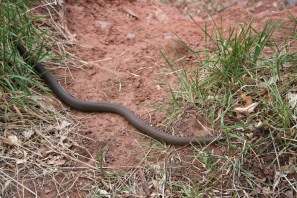 teacher. He loved all living creatures and had the most amazing knowledge, experience and affinity with them. Turtles and snakes were his favorite. We would go snake hunting, too. That’s when I usually stayed in the car. But sometimes I would have to handle the smaller ones. Or, if he found a large, wriggling snake and didn’t have a big sack to put it in, he would hold it gently out of the car-window with one hand, (careful not to injure the delicate vertebrae) while he drove – very slowly – back to the farm. He often promised (or threatened?) to take me to Death Valley in the summer, in search of the striped Rosy Boa!

 “A solid, ginger mutt glanced up from his position on the couch, but he didn’t move his eighty pounds to greet me. I’d rescued Chauncey from a local shelter three months ago. Rescued animals usually brought baggage with them, but Chauncey had an entire set of luggage.”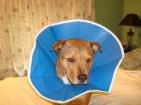
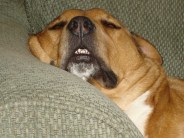 ng in his appointed chair, but his absolute favorite activity is eating, which caused one trainer to nickname him Bear.
 I haven’t met a dog I didn’t like, even the guard dog

 The first home our visiting short term missions team stayed at had Simba and Samson – father and son Great Dane/Rhodesian Ridgeback mix dogs. Their shoulders are at hip joint level. Their massive heads taller. Their shining fur, black as night.
 Their young children – fans of the Lord of the Rings series – named them Samwise and Frodo. They are only eleven months old and have some puppy ways, but let a horn sound at the gate and they are transformed into something like the Hound of the Baskervilles.
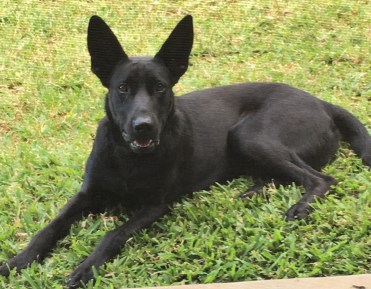 But as you rise and move toward him, a flimsy screen the only barrier separating you, and your eyes meet… he stands and growls deep in his throat and lifts a lip to show long canine teeth. His stiff-legged stance and erect tail warn of horrors to come should you venture closer.
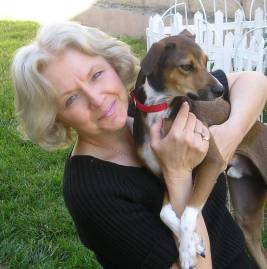 As for me, since I have always had a pet in my house, as a kid and as an adult, I never thought it odd to put a cat or dog in a story. My Ginger Caulfield private detective character has two dogs, Sherlock and Foxtrot. In reality, my husband and I got our two Italian Greyhounds, coincidentally named Sherlock and Foxtrot, from the Los Angeles pound. The two canines don’t solve mysteries in Gin Caulfield novels… yet. Though you never know. But I will tell you one thing… no dead dogs will EVER turn up in my stories.
 The three books in my Christmas series are full of animals even though Santa doesn’t consider them pets. After all, Bearnard, the Polar bear from Bearnard’s Christmas, works in the castle and even helps solve a mystery in the third book, Every Castle Needs a Dragon, coming out at Thanksgiving. Even the dragon, Orville by name, plays a rather large part in the story. (He reads as well as talks!)


 My spy novels reference Sukoshi, the Beagle I had as a kid and up until I was working as a private detective at the age of 21. She is mentioned because the books are loosely based on my dad’s career in the Air Force and Sukoshi went to France with us when my father was stationed there. When we were visiting West Berlin, she had a very long leash that allowed her to wander under the barricade into the no-man’s land that separated West and East Berlin, so she actually got closer to the commie-side than I did.
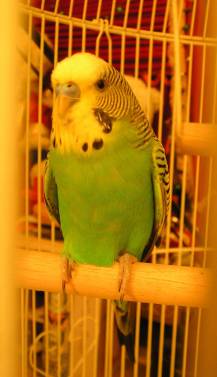 It really wasn’t a coincidence on my part to make these comparisons because, you see, I dedicated the book to Freddy J. Feathers, our beloved parakeet who recently passed away. I found Fred wandering in the backyard about six years ago and he got a “second chance” with us. That fact fit perfectly with this particular book. And the short piece at the end of the book ties my love of pets up with a big ribbon. (You’ll have to read that part for yourself.)


 The Writers in Residence
You must be logged in to post a comment.