STARTING OVER….

by Rosemary Lord

1.08RoseSignCrop

Happy New Year!

It’s time to come out from hiding under that duvet!

This winter is turning out to be tough on so many, with the freezing temperatures and endless rain across much of America and Europe. But I’m in California, where it’s still often sunny during winter, even when it feels to us as if it’s freezing.  My siblings in England ridicule me with our 66-degree “heatwave.” Hey! We’ve had several days of rain – and the ensuing power-cuts and floods. Los Angeles comes to a halt at the first sign of rain…. Enough already! I’m done with winter!


But I digress: Each January is a fresh start. Time to dust off our goals, our dreams, our great plans for life.  

As a teenager I had so many dreams and goals – and many of them I have accomplished. The fourteen-year-old me never questioned that I could not go from a quiet little town in England, far removed from the acting and showbiz worlds, to living in Hollywood, (where I knew no one and was totally ignorant of how things worked), to working as an actress and a writer in Hollywood movies. My dreams, my positive beliefs and my naivete fueled my journey.  I’m not saying it wasn’t very tough at times, frustrating and sometimes heartbreaking. It took a lot longer than I thought. But I was driven by my dreams and never gave up.  


Then a new chapter of my life opened up. My dreams and my goals changed.

Writing was my new focus. I wrote articles about Old Hollywood and Movie Stars from Hollywood’s Golden Era. I wrote about Hollywood history. But I never thought I would be smart enough or talented enough to be a novelist. I was and am still in awe of so many of the great novelists. How could I ever come close to that?


It was shortly after my first non-fiction book Los Angeles Then and Now was published and I was having lunch with fellow British-born writer Jacqueline Winspear. We’d both been honored by the Southern California Book Sellers Association. Jacqui had launched her first amazing Maisie Dobbs novel and I was chosen for my Los Angeles Then and Now. As we chatted about our current and future writing plans, she convinced me that I, too, could write a novel. Even a mystery novel. She explained how Maisie Dobbs came about and the basic method she used. Wow! She opened up a whole new world for me.

A new pathway. She showed me how to look at writing in a totally different way. I will be forever grateful. I subsequently joined Mystery Writers of America and then Sisters-in-Crime. I found a new family of writers.


But even along this writers’ journey, there comes a time when we have to step off into the unknown to get new results, to shake things up.


“This year will be different,” we often promise ourselves on New Year’s Day. But in order for it to be different, we have to do things differently. Maybe it’s a time to take a fresh approach, take another path. I’ve been toying with the idea for a children’s book – taking a break from intense historical research. Another writer friend is inspired to try her hand at poetry this year, after several successful noir thrillers. Perhaps a crack at a movie script?


New Year’s is a great time to plan a do-over. Change writing habits. Shift the energies around. The year ahead is filled with new opportunities, new hopes and wonderful blank pages for us writers to fill.


Perhaps go back to the simple way of doing things – without all the current programs available to us. I sometimes wonder whether our world of social media, immediate access to ‘google’ or ‘duckduckgo’ information is a blessing or a curse.


In days of yore, writers would be found in dusty libraries, surrounded by research books, furiously taking notes. That’s what the Agatha Christies of her day would have done. Jane Austen too. Mary Roberts Rhinehart didn’t use Instagram to tout her The Circular Staircase success. Edgar Alan Poe didn’t have a Facebook page. Charlotte Bronte didn’t Tweet. Raymond Chandler did okay without all that. Hmmm.


But today we have a choice to avail ourselves of those services. And we have Sisters-in-Crime, The Authors Guild and Mystery Writers of America to turn to. We have options.

Writers are storytellers. We’re the ‘wandering minstrels ‘of our time. Minstrels would wander from village to village, singing about the news around the countryside. Today we fictionize the local village stories and don’t have to travel from village to village to share them. We have a flourishing publishing world, movies, television, internet, podcasts and multi-media resources to spread the word. Or we can choose to keep it simple with a yellow pad, pencil and our imagination.


I love the excitement of the New Year options. A chance to start over.

What about you?

Is Handwriting Dead Or Just Dormant?

“The pen is like the needle of a record player held in one’s hand,” Donald Jackson, calligrapher, and scribe to the Late Elizabeth II, once observed. “As it moves across the paper, it releases the music of our innermost selves.”

Wow. I just love that. Sadly if Mr Jackson saw my handwriting he would accurately surmise that I am permanently scattered.  

Mahatma Gandhi declared that a poor hand is “the sign of an imperfect education.” But mine leans more towards P.G. Wodehouse who said his, “resembled the movements of a fly that had fallen into an inkpot, and subsequently taken a little brisk exercise.”

Computer keyboards ruined everything for me.

I had the most perfect handwriting. As a Brit we were not trained to write “cursive” which I think is an American form of script. Here is an excerpt from my Home Economics book circa 1969 – please note the hilarious and dated content.

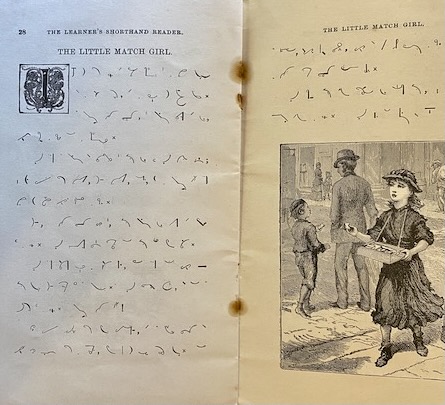
In 1977 I trained as a “shorthand typist” before Dictaphones were invented. In the UK the shorthand was Pitman shorthand;  – in the USA it was “Gregg,” although there are many other forms like Teeline or Fastnotes. I could boast 125 wpm (words-per-minute). I loved it. Here is an example of Pitman shorthand taken from “The Lerner’s Shorthand Reader” circa 1892 and priced at 6d.

Isn’t it pretty? If you’d like me to transcribe, I will …

I could “touch type” i.e. there were no letters on the keyboard so I would type the copy without looking at my hands (for those youngsters out there who have never heard the expression). There was also something immensely satisfying about coming to the end of the line and pushing the lever of the carriage return to be rewarded with a cheerful ting!

With the advent of computers, my typing has speeded up dramatically (I just did a free test) and it’s 75 wpm.  There is no way my handwriting now could keep up with my brain. Unfortunately, I can hardly hold a pen let alone write with one.

But let’s not forget the reality of handwriting of centuries past. It’s tempting to think that 19th century penmanship was beautiful and legible. This was not the case. Paper, ink, and postage was expensive. People wrote as small as they could. Anne Brontë’s famous final letter had the lines criss-crossing each other. So even if 21st century handwriting has deteriorated, in the big scheme of things, that’s nothing new. Sadly, a recent survey found that in the past five years, 12% of Britons have written nothing at all – not even a note. With the demise of the check book here in the UK, signatures are barely needed either. Some people don’t even have a PEN!!! I was at the post office recently using my USA credit card which demanded a signature to find that I was the only person in the store who carried a pen!

“When you type on a screen, the words seem as fleeting as rays of light. When you write, there’s a real physicality to it that adds another dimension to how you experience your own writing. It fosters a deeper engagement with the material you write, makes the writing voice inside your head clearer and louder.” Quote from Omwow blog, https://omwow.com/longhand-writing/

I love that expression “words seem as fleeting as rays of light.”

Handwriting is deliberate and intentional and requires focused attention. It encourages us to be fully present in the moment. Neat and well-formed handwriting can also indicate a level of discipline and organization. It’s also lovely to receive a handwritten note. It feels personal because it is personal. Someone has taken the time to write and not just zip off an email.

In the meantime, I’m just grateful that my appalling handwriting doesn’t get me into the following kind of trouble:

In 1636 an employee of the East India Company in London wrote to a colleague in India asking that he ‘send me by the next ship 2 or 3 apes.’ Unfortunately – his letter ‘r’ in the word OR caused some confusion. As a result, he received 80 monkeys, together with a note saying that the remaining 123 would be with him shortly.

What about your handwriting? Please share and shame mine.

SHADOWS OF THE PAST, Part Two

by Miko Johnson

We may be writers but we’re also observers, and I’ve observed that one picture can be worth a thousand words.

In my previous post, which covered my time in Prague and Poland, I promised to follow up with my trip to France, and how it influenced both my writing, and my life. It began with a trip to Paris ten years earlier, when my husband and I stumbled onto an exhibition at the Musée d’Art et d’Histoire du Judiasme, or MahJ for short. It featured political drawings and prints from Abel Pann, an artist who executed a series of drawings based on the pogroms carried out by soldiers on the Eastern Front during the First World War. His work covered the early 20th century.

Most broke my heart. They showed mothers and little children hiding behind barns, or cowering inside their homes, with captions like Quick, run and hide! One of his later drawings showed an elderly Jewish man hanging from the gallows while Nazi soldiers watch with amusement. The caption: Honoring the brave WWI veteran. It made me think of my grandfather, whom I never met. A German soldier wounded in the Great War, he was taken to Auschwitz and never seen again. That’s when I decided to dedicate my fourth book to him.

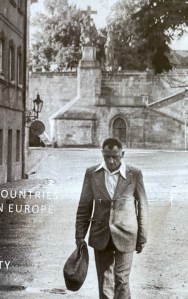
I mentioned in my earlier post the dejection I saw in the people of Bytom, Poland, a former mining town largely ignored by the EU. Images of An Other Europe, another photographic exhibit Allan and I saw in Prague, influenced that observation.

Photographer Constantin Pittas traveled to seventeen countries throughout Europe in the mid- to late-1980s, capturing people in the streets of cities. His stated goal was to “prove that Europe is one entity”.

I believe he failed. Not that his work wasn’t fascinating, but I could tell which side of the Iron Curtain he’d taken photographs by the faces and body language of the people. As in Bytom, I saw desolation throughout the Communist bloc images. In one photo, used for the brochure cover, a middle-aged man walks along a street alone toward the camera at twilight. Bag in hand, his head is tilted down to watch his step, figuratively and literally.

   I don’t see joy, or serenity, or even concern in his face. Only resignation. I’d recognized the Charles Bridge in the background so I knew this had been taken in Prague, but based on the other photographs, I had no doubt the location fell behind the Iron Curtain.

Many more showed similar images of people, their emotions constrained. Women standing on line at the market, an elderly woman sitting on a bench. Don’t ask, don’t tell, at least in places like Romania, Hungary, Armenia. People looked so different in Western Europe, where their faces bore the full range of emotions, whether young folks sunbathing on a Mediterranean beach or an elderly Portuguese woman gazing at a drunk lying in the street with a mixture of pity and disgust.

I kept returning to two images, each showing a different young woman with a little smile playing on her lips. In one, the woman sits at the counter of a Parisian café, enjoying a coffee. In the other, the woman turns to glance at a man she’s with. The pure pleasure behind the smile of the coffee drinker, compared to the sadness in the eyes of the woman presumably in love, was strikingly evident.

A series of photos the photographer had taken at the end of his journey, in Berlin, were especially moving. Pittas fortuitously found himself there in 1989, when the wall fell.

There, past and present collided, and  confusion mixed with elation as people tried to grasp what had happened.

However, the photographic image that has stayed with me the longest came from a different time.

Photograph by Constantine Pittas, from exhibition at Clam Gallasův Palác, Prague

After Eastern Europe we continued to Toulouse, France. One of my goals was to visit the Musee de la Resistance & de la Deportation, where I’d hoped to find background information for my current WIP, which covers the years around the second World War. The museum’s focus should be obvious even if you don’t understand French. Despite going through the museum with the objective eye of a researcher, I found it dark and disturbing, until I found this photograph:

Need I say more?

Photograph from the collection of Musee de la Resistance & de la Deportation, Toulouse, France

After Toulouse we spent the final days of our trip in Paris. We’d last stayed there six months before Notre Dame caught fire, and caught a heartbreaking glimpse of the ruined cathedral in 2022. While meandering through the city we once again found a photographic exposition of the decimation of one neighborhood during the Nazi occupation. Heartbreaking, we thought as we approached the cathedral. What other sad sight awaited us.  We turned the corner and saw this:

Photograph by Miriam Johnston

Progress. And hope. A balm for the soul.

Miko Johnston, a founding member of The Writers in Residence, is the author of the historical fiction series, “A Petal in the Wind”, as well as a contributor to several anthologies including the about-t0-be-released “Whidbey Island: An Insider’s Guide”. Miko lives in Washington (the big one) with her rocket scientist husband. Contact her at mikojohnstonauthor@gmail.com

.This article by M. Johnston was posted by Jackie Houchin

Writers Collaborating: How does it work?

By Jill Amadio

Co-authors, such as the several collaborators who write with bestselling James Patterson, are freely acknowledged by the thriller writer, and he gives them public credit for their work. Is there also an increasing trend for mystery writers to team up? One successful couple, Greg Wands and Elizabeth ‘Liz’ Keenan, are finding their books more and more popular, and sell in twelve languages. Here they explain how their writing process works:

What are your writing backgrounds? Were you published before collaborating?

Greg: Liz and I both wrote short fiction separately for many years, and I tried my hand at screenwriting. While we were early readers and supporters of each other’s work, it wasn’t until our debut, The Woman Inside, in 2019 that either of us became published authors, and it was a real thrill to be able to do it together!

How did you decide to collaborate and why crime?

Greg: We’d been discussing the idea of collaborating on a project together in the abstract for many years when we both suffered separate tragedies: my father passing away from cancer and Liz having a long-term relationship unravel in heartbreaking fashion. While supporting each other through the grief and trauma, we cooked up the seed of the idea that became our debut novel. A crime story seemed like the proper genre, as we were interested in exploring the more clandestine aspects of the human condition and the capacity people have for secrecy and deception.

What system do you use to organize and collaborate?

Greg: We write in Google Docs, which allows both of us to work on the manuscript simultaneously. As a duo, this helps when we’re in the revision or copy edit phases and often need to tackle separate plot points in a complementary fashion.

Which strengths and weaknesses do you each bring to the writing?

Greg: Liz is wonderful at scene setting, character development, and creating a visceral experience for the reader through the use of a specific image, textural description, or the like. And she’s marvelous with a turn of phrase! I enjoy writing dialogue, and would like to think I’m good at creating atmosphere. I think we’re also both skilled at being able to nudge the other in the right direction when one of us starts to lose the thread of the plot or makes a narrative decision that feels untrue to a character.

How have you changed or adjusted your system as you wrote more books?

Greg: We fell into our routine fairly organically, by volleying chapters back and forth with only a loose framework in place. This seemed to give the work an improvisatory energy that kept each of us–and by extension, the reader–on their toes. Thankfully, we’ve been able to keep our formula reasonably intact, which works well for us. With a couple of the books, the publisher has requested a more comprehensive breakdown, but we still find ways to surprise and confound one another on the page, to our mutual delight.

Which obstacles/pitfalls/challenges did you face in the writing of the books? Arguments? Agreements?

Greg: It can be a bit of a challenge having two separate brains tackling one story, mostly from a logistical point of view: keeping timelines straight, having slightly different ideas behind character motivations, and trying to foresee where your writing partner might take the plot of the book. But the uncertainty can also be thrilling, and lend to the feeling of discovery and surprise that makes for an engaging writing experience.

Do you think having two writers can shorten the length it takes to write a book?

Greg: Because we write in a back-and-forth style, with one author penning a chapter and then kicking it over to the other, it takes about the same amount of time to finish a draft as it would a solo writer. The advantage we have is that our method allows for extra time in between chapters to clean up the text and to find places where we may have slipped into some inconsistency or other in the plotting of the story.

Your separate backgrounds appear tailor-made for a collaboration. Have your experiences in publishing and screenwriting helped you write, publish, and market your books?

Liz: Our respective backgrounds have given us several useful tools. Our experiences in the film and publishing industries have informed our understanding of effective storytelling, audience, and the publishing process. For marketing, our past experience has helped us to succinctly pitch our books and connect with influencers and other writers in and out of our genre, as well as our understanding of how much authors have to be entrepreneurial when it comes to marketing their books.

Who does the research?

Liz: Since we typically split up the characters in writing our novels, we research our designated parts and their history, professions, passions, etc. For the broader story elements like forensic and legal procedures, we also split research and share our findings, which often spur new story elements in our plotting. We pick themes and story elements we are interested in learning more about, knowing we’ll spend six months to a year immersing ourselves in these topics.

What is your publishing history?

Liz: Our first novel, The Woman Inside came out in January (2019), and the following year, In Case of Emergency was published (2020), and The Rule of Three was released in 2022. We have a fourth novel publishing in 2024. Our books are all published by Dutton, an imprint of Penguin Random House

Either of you writing other books, fiction or non-fiction,  that are non-collaborative?

 Liz: Yes! We are both working on novels separately in between our collaborative projects. They are in various degrees of completion; Greg is further along than I am!

Which of your books did you have the most enjoyment writing?

Liz: Each of our novels has brought immense joy in the writing process in different ways. If I had to pick one, I think The Woman Inside was the most exhilarating to write since it was the first, the most personally motivated, and we were doing something completely new.

 Most effective marketing strategy?

Liz: This is a hard one since effective marketing is so elusive. However, the approach with the most ‘legs’ is personal recommendations from fellow thriller writers and bookstagrammers of our books when they are released. The trust of readers that these well-read influencers and writers have fostered is priceless and effective in spreading the word about our work, and we are eternally grateful to the people who support us in that way. We aim to do the same with all of the incredible books that are published each month!

Advice for budding collaborators?

 Liz: Like any healthy relationship, creative collaborators should focus on the foundation of the partnership as much (if not more) than the creative output. Communication, trust, and encouragement are vital to keeping momentum when things get creatively challenging. Making the work an extension of the friendship is the core of our collaboration; we write for the amusement and shock of the other, which keeps us motivated. Laughter is essential, too.

###

..

This interview by Jill Amadio was posted by Jackie Houchin.

Wishing You All a Wonderful Holiday Season!

CHRISTMAS CANDLE
a Poem by Kay Hoffman
.
Light a Christmas candle
And let it warmly glow
From out a friendly window
Across new-fallen snow.
Someone lone in passing
Will catch the strong bright beam
To cheer the rugged path ahead
And set the heart to dream.
Let the warm glad light shine
From your own candle’s ray
Glow deep within your loving heart
On each and every day.
Light a Christmas candle
To glow within your heart
And touch the life of someone dear
With blessings to impart.
.
Thank you for reading The Writers In Residence in 2023.
We will be back with new content on Wednesday, January 3, 2024.
.
Jackie
Gayle
Linda
Miko
Madeline
Jill
Hannah
Maggie
Rosemary
#
.

When A Series SPINS OFF: the Maisie Frobisher Mysteries

A Guest Post by Liz Hedgecock

I didn’t so much decide to write the Maisie Frobisher books. It was more that Maisie Frobisher decided she ought to have her own series!

Let me explain.

The Maisie Frobisher books are actually a spinoff series: the series they sprang from is the Caster and Fleet Mysteries. I co-wrote Caster and Fleet with another writer who is now a good friend, Paula Harmon.

When we began writing the books, Paula and I hadn’t actually met in real life – only via a Facebook writing group. We were already online friends, we liked each other’s writing styles, and we both wrote historical mystery (among other things). We’re not sure who first suggested writing a book together, but we’re very glad they did!

Maisie is a very minor character in the Caster and Fleet world until she has more of a starring role in book 4, The Case of the Masquerade Mob, which is a romp involving masked balls and all sorts of skulduggery. At the end of the book, poor Maisie, who has had rather a rough time, decides to travel the world and forget about men for a while. That was my jumping-off point, because I’d grown to like Maisie very much and I didn’t want to let her go.

My friend Paula also has a spinoff series of her own, set in the run-up to World War I, which follows the younger sister of one of our protagonists, Margaret Demeray.

I had many reasons to set the Maisie series abroad. Firstly, at the end of Masquerade Mob Maisie was going travelling, and I couldn’t go back on that! Secondly, in the 1890s, when the series is set, the world was opening up. Bigger and more luxurious cruise ships, faster journeys, and more capacity to travel for pleasure. I chose India because it was a well-known destination, the route was interesting, and also because of the opportunity to look at the British in India in the time of the Raj.

I try not to get too bogged down in historical research, though there are all sorts of opportunities to get lost down research rabbit holes! One advantage is that I have a Master’s degree in Victorian literature, so I’m fairly well grounded in some aspects. While I want to make the stories accurate, I don’t want to spoil a story for the sake of including every historical fact I’ve discovered. Probably a tenth of the things I’ve read about make it into the final book.

I didn’t choose the late Victorian period just because I knew a bit about it, though. It’s also fascinating because of what was going on at the time. Women were fighting for their rights, the ‘New Woman’ had arrived, and inventions like the safety bicycle meant that women’s mobility could increase.

The Maisie books are also special to me because they mark a change in the way I write. Up to that point, I had always written at my computer. With Maisie, I had the urge to try something different. In the first book in the series, All at Sea, Maisie is on a ship which is always moving, and she must solve the mystery before the ship reaches port. With that sense of urgency in mind, I tried an experiment. I took my phone for a walk and dictated the book’s opening: a letter from Maisie to her mother, followed by a rather different diary entry on the same subject. The words seemed to flow. Ever since then, I’ve dictated my fiction rather than writing it. The result needs correction and editing, of course, but it’s a really good way to get into the flow, get that first draft down, and spend time walking rather than sitting.

If you do try the first Maisie book, All at Sea, or indeed, the first in the Caster and Fleet series, The Case of the Black Tulips, I hope you enjoy them!

#

Liz Hedgecock grew up in London, England, did an English degree, and then took forever to start writing.  Now Liz travels between the nineteenth and twenty-first centuries, murdering people. To be fair, she does usually clean up after herself.

Liz lives in Cheshire with her husband and two sons, and when she’s not writing you can usually find her reading, on a walk, messing about on social media or cooing over stuff in museums and art galleries. That’s her story, anyway, and she’s sticking to it.

Website: http://lizhedgecock.wordpress.com

Facebook: http://www.facebook.com/LizHedgecockWrites

Twitter: http://twitter.com/lizhedgecock

Amazon author page (global link): http://author.to/LizH

###

Note from Jackie Houchin: I began the Maisie Frobisher series – All at Sea – while on a cruise. (I could so identify with Maisie!)  But I got so attached to her sense of adventure and fearless deeds of daring, that I bought the second one (Off The Map). Of course I had to buy that third book with the magnificent Leopard on the cover (Gone to Ground). I’m now reading the fourth one and Maisie is back in London, but still involved in mystery and intrigue. (In Plain Sight)

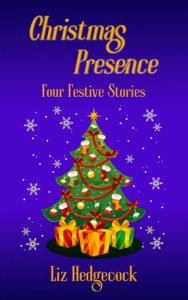
A character from the Maisie books appears in one of the four Christmas short stories in Liz Hedgecock’s Christmas Presence, Four Festive Stories. It’s a perfect way to sample Liz’s work and to gift for the Holidays!

.

This article was posted by member, Jackie Houchin

.

My First Santa

by Gayle Bartos-Pool

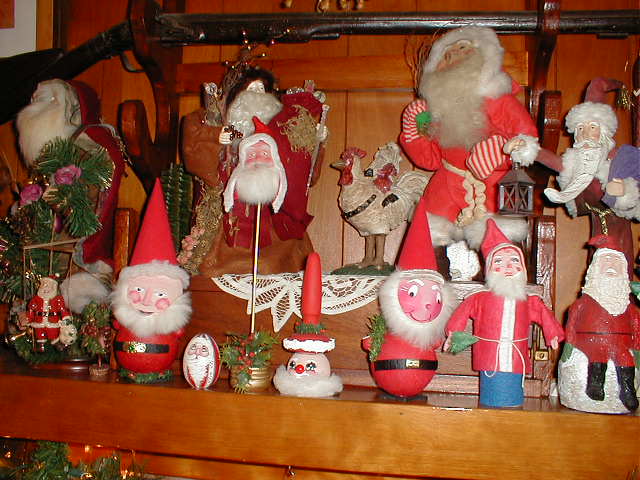
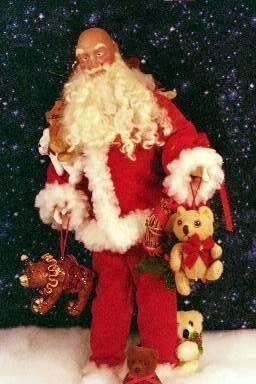
Most people who know me know I love Santa Claus. I have a rather large collection of Santas. About 3000 of them. Some are Christmas cards, old and newer ones, vintage Santa stickers, and assorted paper Santas, but two-thirds are figures, large and small. My basement now houses a good selection of these treasures, set out all year.

OLYMPUS DIGITAL CAMERA

(The Santa with the striped gloves was the first. The others are some I made through the years.)

When my dad was stationed in France when I was in my teens, we went to Germany and I got my first Santa. That was 1963-66. Later, when I had moved to California and started working for a miniature store that sold dollhouses, the owner also had a room dedicated to holiday decorations. She had it open for Easter, Halloween, and especially Christmas. Since I could buy things wholesale, I did just that and added to my growing collection. We would also go to the Rose Bowl Swap Meet in Pasadena every month and I could get small Santas for $.50 to a few dollars. That was great for my limited budget.

My collection started to grow. I saw some really nice Santas and other holiday decorations in magazines. These were for Halloween, Easter, as well as Christmas. Now, I couldn’t afford most of these cool items, but I could make my own version. And I did. This added to my growing holiday decorations collection.

13628_13

This is one of the Santas I made. Jackie Houchin mentioned that most of the ones I crafted had a bald head just like Richard, my beloved husband. Maybe that’s why I did them that way.

OLYMPUS DIGITAL CAMERA

(These I made after seeing ones like them in magazines. Hey, I’m on a budget.)

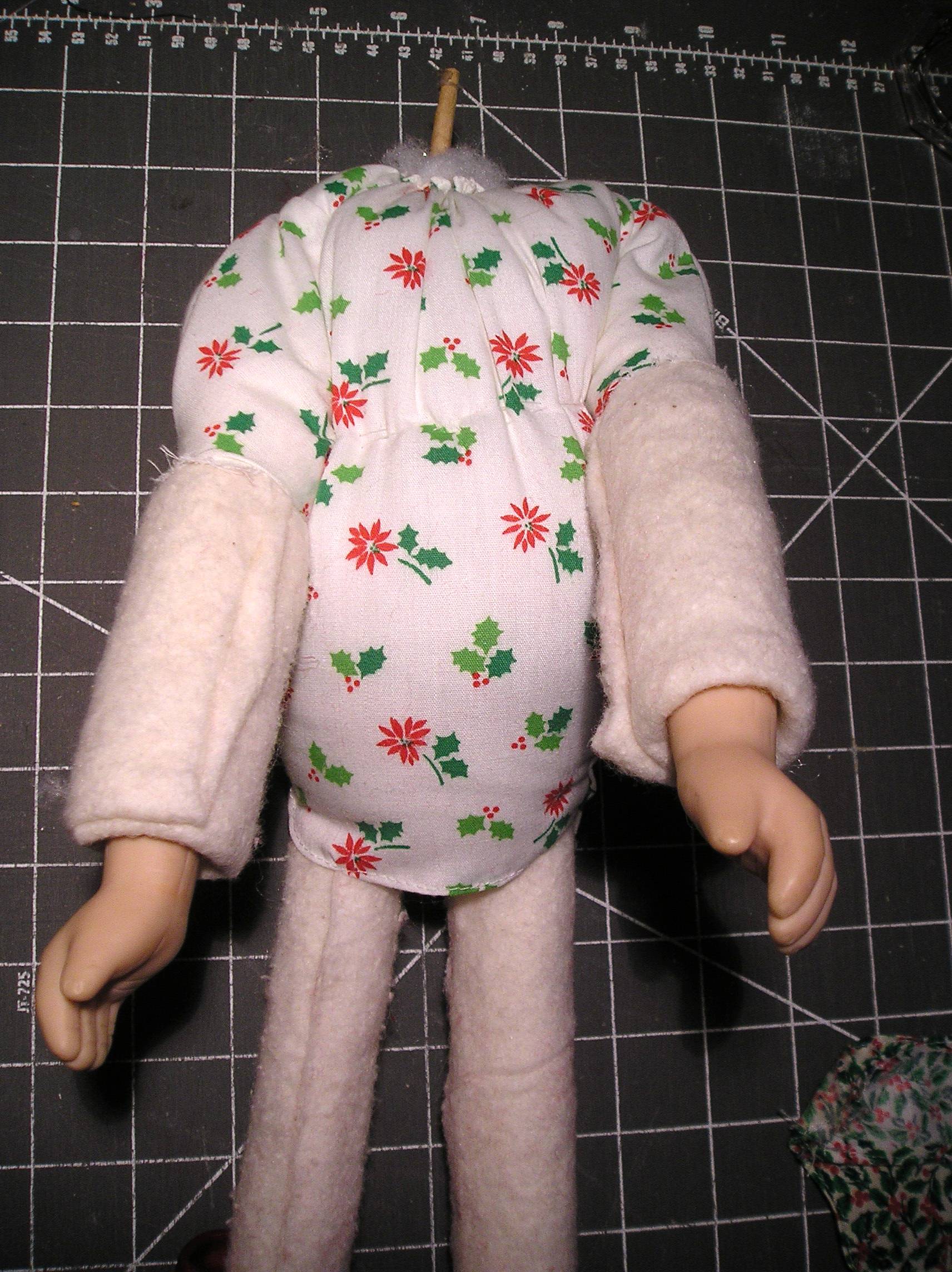
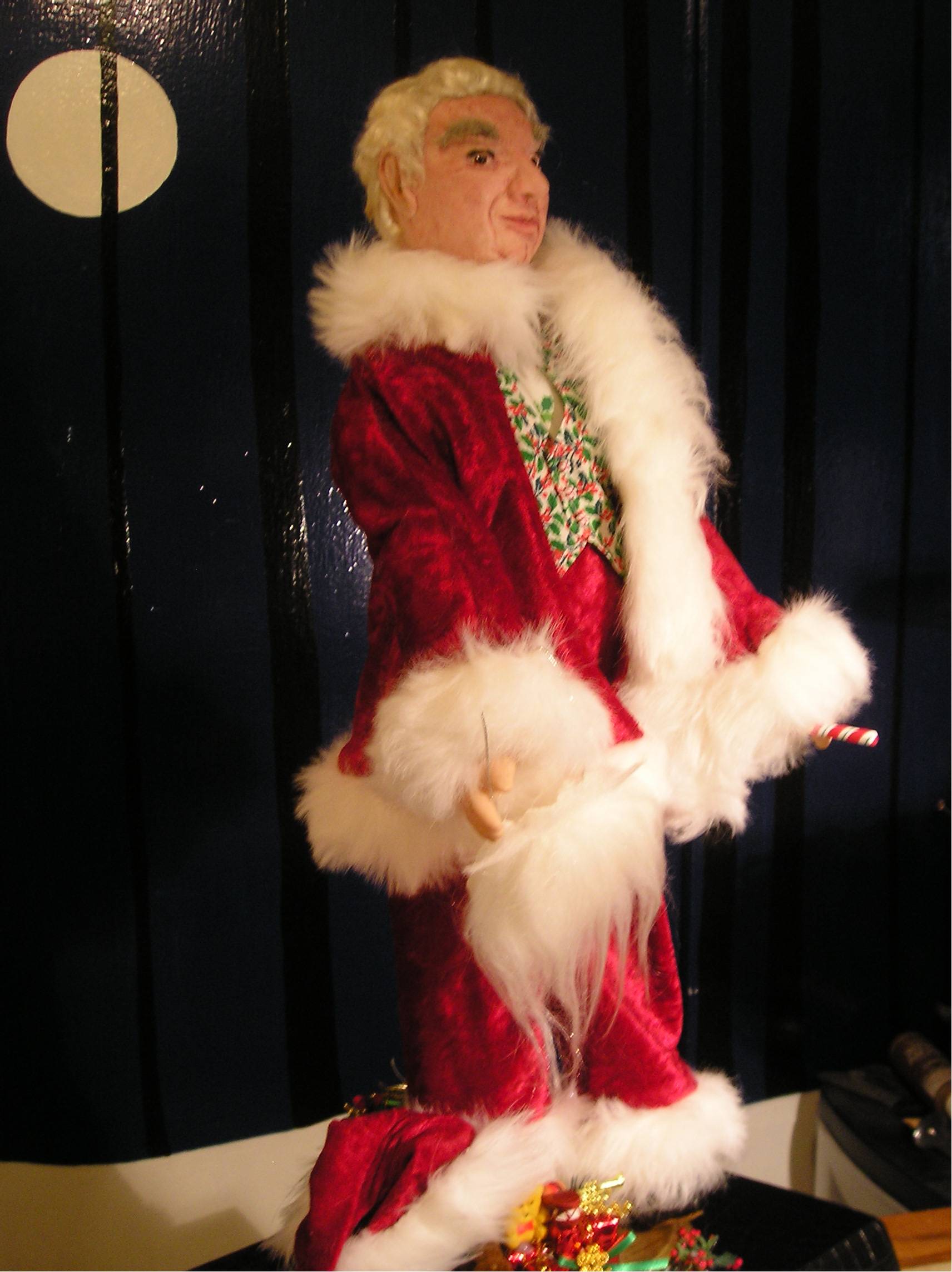
After a while I had a revelation. I actually had an older Santa than the one we got in Germany. That was my dad. He was born on December 6, 1917. That is St. Nicholas Day. So, my dad was my first Santa. To commemorate that event, I made a figure of my dad in a Santa suit. It makes me smile every time I see it amongst the other Santas that I crafted.

Santa Dad (11)

OLYMPUS DIGITAL CAMERA

Santa Dad 27

But my dad being born on St. Nicholas Day doesn’t end there. You see, my dad gave me so much, just like Santa does for kids and us kids at heart. First, he gave me life along with my wonderful mom. That’s just about the greatest gift of all if you think about it. He provided me with a great education and I don’t mean just college. He was there to teach me how to fix things around the house if they got broken. He built a den onto our first house in Memphis with his own hands. I might not have built a house, a large one, but I sure built my share of dollhouses. I even designed and built one from scratch, not from a kit. Just knowing my dad had that skill made me believe I could do the same thing.

When I left their home in Memphis when I was twenty-four and moved to California, my mom was worried about me heading off to this new place, but my dad said that they had raised me well and that I would do just fine. I heard him say that. And by golly, I did manage to make a life for myself in the wilds of Southern California. His faith in me kept me strong.

Dad gave me another gift, the “git ’er done” attitude. If something needed to be done, he always found a way to do it. He was a pilot in the Air Force and many times he did the impossible because something had to be done. I have maintained that attitude in my business and well as personal life. Dad was a great role model.

So when I think of Santa Claus doing nice things for kids and grownups alike, I think of my dad. He was my first Santa and on December 6th I think of him and St. Nicholas. Thanks, Dad, for helping to make me who I am. Being that role model was the greatest gift you could have ever given me. I love you. Happy Birthday.

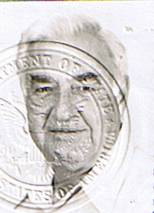
Dad's Passport PicDad and me

(Dad’s passport photo and one with Dad and me when he took me to work one day way before it was done as a regular thing.)

Writing Humor

by Jackie Houchin

How do you make a story funny?

Do you have to be a comedian? If you can’t make it laugh-out-loud-able, how do you make it chuckle-able, or at least grin-able? Or at the VERY least, smirk-able?

Our own Gayle Bartos Pool does it with punny words, double entendre, dialects, and snappy, sometimes tongue-in-cheek dialogue. And… hysterical situations!

You will grin and you will laugh aloud when you read her short story, “Only in Hollywood” in the Sisters-in-Crime collection, LAndmarked for Murder. I mean, can you picture a bunch of thugs pushing a dressed up dead body around in a wheel chair in the Bonaventure Hotel in Hollywood? No Way!

Gayle’s “Glitzville” in her own short story collection From Light to Dark has some hilarious dialogue scenes. They may not be as tangled as Abbott and Costello’s “Who’s on first?” but they sure come close. The back-and-forth conversation between Archie Wright and Sal Cohn is definitely grin-able. Your eyes will dance down the pages as you read it.

Here’s the opening paragraph so you can “taste” the style, before the funny dialogue begins.

“Archie Wright’s the name. Dishing dirt’s the game. My sandbox: Hollywood. The most glamorous and glitzy, vicious, and venomous playground in the world. If you come for a visit, bring your sunscreen and your shark repellant. If you come to stay, let me warn you, Tinsel Town eats up and spits out a hundred just like you every day. Sometimes it isn’t pretty, but it’s my job to chronicle the ebb and flow of the hopeful, the helpless, and the hapless. My best stories come from the dark side of Glitzville.”

And then the whip smart fun begins….

These are two stories in books you can try out for examples of how write comedic.  Perhaps you can recommend others?

If you are an author, how do YOU make scenes funny in your books? Is it by the characters, or some ridiculous premise, or by snappy, punny words and dialogue?  (SHARE YOUR SECRETS!)

##

Okay, as a journalist and book reviewer, I don’t have much talent with humor aside from a pun now and then. So, for the end of this post, I will try to get you to laugh, chuckle, guffaw, grin, or maybe just smirk with a few corny jokes. (from Woman’s Day magazine)

What do you call a snake wearing a hard hat?
A boa constructor.

What do you get when you cross a centipede with a parrot?
A walkie talkie.

How do you make an octopus laugh?
With ten-tickles.

How do you get a country girl’s attention?
A-tractor.

What do you call a beehive without an exit?
Unbelievable.

(You can pause here and come back later if you are grinned out.)

What do you call someone with no body and no nose?
Nobody Knows.

What do you call a blind dinosaur?
A do-you-think-he-saw-us.

Where do pirates get their hooks?
Second hand stores.

What do you call black birds that stick together?
Vel-crows.

(And a few to whet your appetite.)

What do scholars eat when they’re hungry?
Academia nuts.

Why do seagulls fly over the sea?
If they flew over the bay, they’d be called bagels.

Why should you never use “beef stew” as a password?
It’s not stroganoff.

What do you call a pig that does karate?
A pork chop.

(And for our own, Linda Johnston…)

What do lawyers wear to court?
Lawsuits.

What do you call a priest who becomes a lawyer?
A father-in-law.

What’s a lawyer’s favorite drink?
Subpoena colada.

I hope you got some ideas, or at least some laughs.

Remember the Bible verse – “A merry heart does good like medicine.” – Proverbs 17:22.

.

If you can’t find where to comment, click the title of this post at the top (Writing Humor) and you should find Likes & Comments below.

Sadly, the COMMENTS BUTTON seems to be missing. We are working on it with a PC man. Please be patient and keep reading  The Writers In Residence every Wednesday!

.

Podcasts for Writers and Readers

I’ve never been a news hound, but felt a need to keep abreast of what was going on, locally and globally. For the most part, I watched the news while walking nowhere (treadmill). But a couple of months ago, I said “enough” and went on a news fast. I’ve been on many such fasts through the years, but this one’s lasting longer—all because I discovered podcasts!

Even though I’ve been a guest on a few podcasts, I rarely listened to them. They can run quite long, up to an hour and more. But many are much shorter, and I now listen to the long ones in segments.

A few of my favorites:

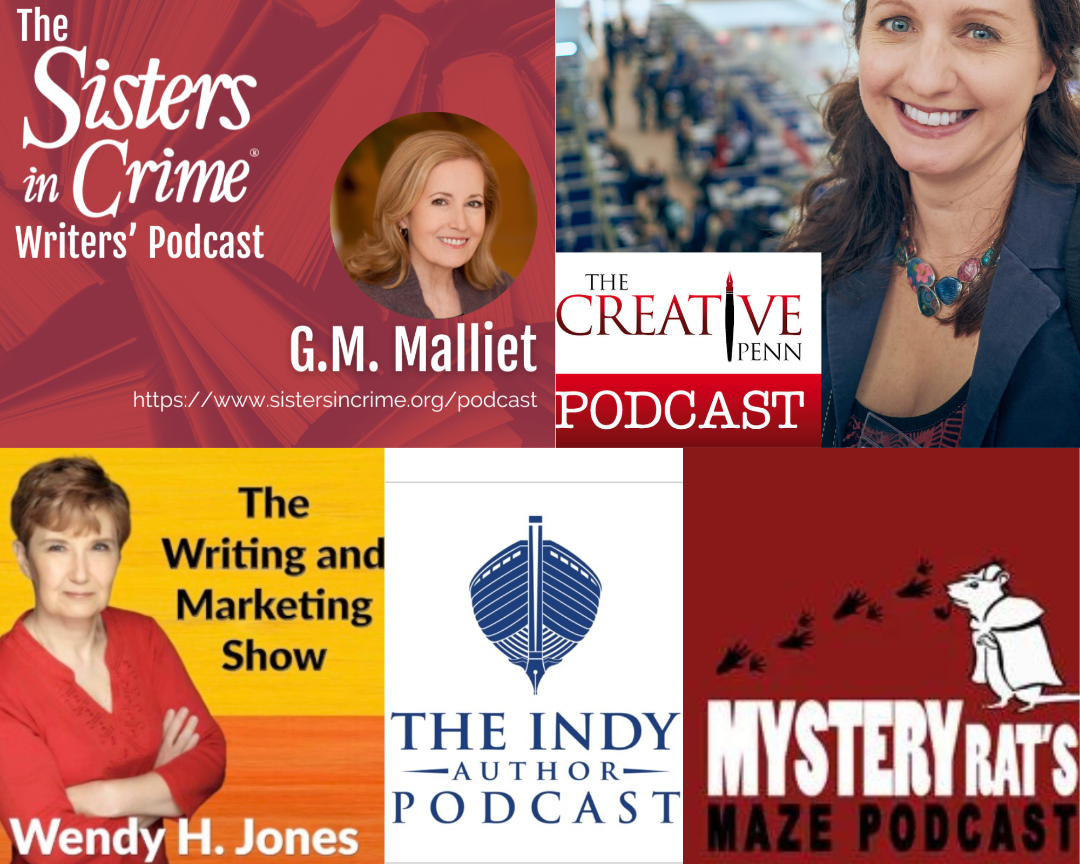
Sisters in Crime. Many of you belong to SinC and Executive Director Julie Hennrikus produces weekly interviews featuring author members discussing  their writing journeys. She kicks off each podcast with the question: “When did you first know you wanted to be a writer?”

Readers get to know more about their favorite authors and discover new ones. View the list of episodes here.

The following three podcasts are educational and offer information, tips, and advice on many writing-related topics, including craft, publishing, marketing, promotion, and social media. The podcast hosts interview writers, editors, and industry experts. Some hosts present the material themselves. Many of the podcasts are accompanied by transcripts.

The Writing and Marketing Show with Wendy H. Jones. Wendy is a Scottish crime writer. In 2022, she visited my Sisters in Crime chapter with a virtual presentation, “Storytelling in Marketing.”

I get that kid-in-a-candy-store feeling when I scroll through Wendy’s long list of podcasts. In “Using AI In Your Writing and Author Business” she presents both sides of the AI controversy. I have my own thoughts and preconceived notions about AI, but I like to make informed decisions, so appreciated her sharing.

Wendy’s podcasts on TikTok are interesting, but I’m NOT embracing that platform. While it’s no longer limited to the young (at least not for writers using BookTok), I don’t see myself producing videos on a regular basis. Still I appreciated Wendy providing information that allowed me to make another informed decision.

Wendy’s many episodes on craft include “Mastering the Art of Crime Story Writing,” “Writing Romantic Suspense,” “Writing for Children,” and “Using Your Own Life Story in Fiction”. View the list of episodes here.

Indy Author Podcast is the brainchild of Matty Dalrymple. As the “Indy” name suggests, this podcast focuses on self-published authors, but the traditionally published can certainly benefit from Matty’s many current and archived episodes.

I had read about auto-narrated audiobooks created by Google Play Books and wondered if I could produce two of my novels as audiobooks without spending thousands. I listened to Matty describe her process in turning out an audiobook for a non-fiction book she had written. It sounds quite challenging—and may be fine for non-fiction, but the monotone doesn’t suit fiction with its variety of voices and accents. Just imagining how my dialogue in the redneck bar scene in Murder at the Moonshine Inn would sound makes me shudder.

Again, a podcast gave me the information I needed to make another—you guessed it—informed decision. View the list of episodes here.

The Creative Penn is produced by Joanna Penn. She spends time at the beginning of each podcast with updates on the publishing industry as well as on her personal news. I’m currently listening to guest Douglas Smith, a Canadian author of speculative fiction who has much knowledge of publishing rights as well as how to sell our work to foreign markets. Where has Mr. Smith been all my writing life! View the list of episodes here.

Mysteryrat’s Maze Podcast, brought to listeners by Kings River Life Magazine, caters to readers. Each episode features a local actor (Fresno, CA) reading a short story or first chapter of a novel. View the list of episodes here.

Recently I learned of these two podcasts, but haven’t listened yet:

Alliance of Independent Authors
View the list of episodes here.

Novel Marketing Podcast
View the list of episodes here.

So I’ve been able to acquire much useful information, and “meet” interesting writers and experts, all while keeping in shape. Multi-tasking at its best, and so much more enjoyable and inspiring than the news. If you think I should know what’s going on in the world, let me assure you that I do. News is in the very air we breathe.

There are lots of podcasts available, on a variety of subjects. Just do a search and you’ll find more than enough choices. Here’s a good resource.

Do you listen to podcasts? Any favorites to recommend?

Leave a comment

  1. Miko Johnston's avatar

    Life can get in the way of writing sometimes. Maggie, I’m glad to hear you’re committing to work on your…

  2. Maggie King's avatar

    I’m resurrecting a number of short stories, so I can certainly fit in this challenge. Thanks for this encouraging idea,…

  3. Miko Johnston's avatar

    We always say writing is writing, so what you describe can be considered responding to the challenge.

  4. lindaojohnston's avatar

    Can’t commit to that, Miko. Sure, I still write every day but some of it involves editing what I’ve done…

  5. Miko Johnston's avatar

    Brava, Gayle. What you’re doing makes sense, and what a perfect way to stay motivated. Can’t wait to see what…

Christmas Stories

By Gayle Bartos-Pool  (G.B. Pool)

Ideas for stories come from everywhere whether it’s a person, a memory, a trip, a news article, an object or a picture. Something triggers a writer’s imagination and a story starts to form. Every short story or novel I ever wrote came from something I came across in my life. My three Christmas novels are no exception.

Bearnard’s Christmas was the first one. Many years ago I worked at a miniature store in California. It was one of the first of its kind in the country and the owner had a great store. She also had a holiday shop in a backroom off the open patio. We did Easter, Halloween, and most of all, Christmas. I could buy Santas for my budding collection wholesale which helped my bank account, but we also went to the Rose Bowl in Pasadena when they had their monthly swap meet. I could get Santas for $.50 to $1.00 way back then.

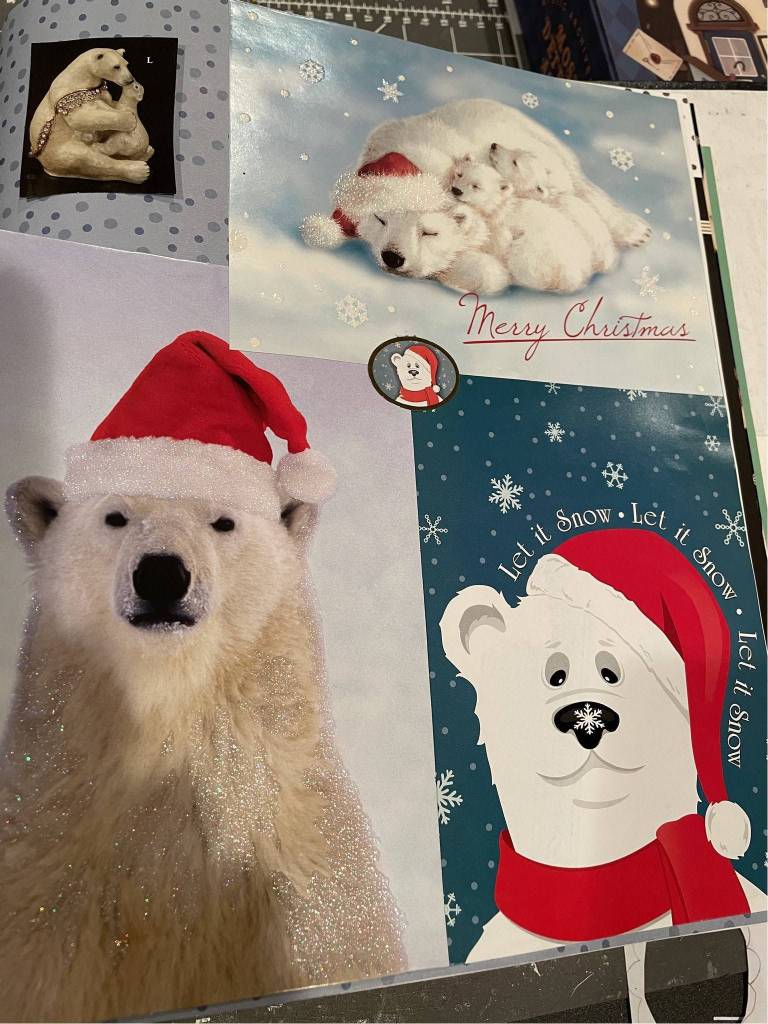
But Kay Kelley also had Christmas cards. I remember seeing one with a Polar bear in a Santa hat. Bing! That got me thinking about a story about this Polar bear who helps Santa and a lady who just happened to collect dollhouses who ends up at the North Pole one Christmas Eve and helps both Santa and Bearnard, the Polar bear.

Now, on my salary, I couldn’t afford to buy a dollhouse, much less a castle, but I could sketch one out that fit my story. Then I started writing that story. A few years later the shop closed and I had to find another job, but I finally found a new one that paid more in salary and I also met and married my wonderful husband, Richard. Within a few years I could buy a dollhouse kit or two, but my story was about a castle.

By then, I had written my story, but I figured I should build the castle to go with it. I did. And I fashioned the characters in the story out of clay and took pictures of everything for my book. Eventually I got the book published.

Then I saw this Christmas card with a mechanical Santa. Bing! Another idea popped into my head. What if Santa had mechanical likenesses of himself made that could be sent around to stores so his favorite stories could be told to children in his own voice? Santa has his elves make a few mechanical Santas, but a bad guy has them reprogrammed to tell kids to demand more and more toys. What is Santa to do? The Santa Claus Machine tells that story.

A few years later I happened to find this dragon ornament at the hardware store. He was just a little guy, but cute. While I was walking one of our dogs one day, I happened to spot one of those stretchy things girls use for their ponytails on the sidewalk. It was sparkly and just fit around the little dragon’s neck like a Christmas wreath. I slipped it on him and then took him upstairs where the Santa Castle was sitting. I placed the dragon on the roof and said: “Every Castle Needs a Dragon.Bing! Guess what the name of the third book is?

A Christmas card or two, an ornament, and some imagination provided me with three story ideas and three books. Ideas do come from those things. But there is another holiday story that I wrote that had its own origin.

After the miniature store closed, I got a job at two stores in the Glendale Galleria before I got the better job at a bank. First, it was in a card store and then a bookstore. Both had their moments, but at the mall during the holidays, they had a Santa Claus. We’ve all seen them at stores as we were growing up. Well this guy was a neat Santa, but when kids weren’t around he sang. He had a microphone and he would entertain us with all kinds of songs. Bing!

I moved my singing Santa to Las Vegas where he started out as a lounge singer in really small places, but his agent, just an employment agency guy, gets him a job as a Santa in a mall during the holidays. He meets this little girl with an illness who needs some help and this Santa has to decide between his career and this kid. A few things pop up to let him know what life is all about and he makes his decision. This book is called The Santa Claus Singer.

(All books are available on Amazon.)

So ideas come from everywhere. It just depends on what you do with those ideas that determines if you get a story out of it. Write On!