A Contrarian View of Cozies

by Miko Johnston

A diva actress infuriates everyone with her demands. A rich businessman takes pride, even joy, out of snookering his customers. A domineering tycoon sets ultimatums for his relatives lest they be cut out of the will. They’re spoiled, stingy, slick, or just plain mean, and the next thing you know, they’ve been murdered. News spreads, often through a small town filled with quirky folks, and soon a person with no experience in criminology (beyond, perhaps, reading or writing mystery novels, or selling them in their charming bookshop) takes an interest in the murder and decides to investigate. They may not have access to the minutiae of crime scene investigations or forensic reports, but thanks to a police force with little skill or interest in solving the mystery, they unmask the perpetrator.

Welcome to the world of cozy mysteries, where life can be pleasant, eccentric, and even humorous in the face of death. Where someone’s humdrum existence can be invigorated by a murder.

A sub-genre of cozies takes crime more seriously, dealing with social issues such as addiction, abuse, homelessness, and trafficking, however peripherally. Others feature amateur sleuths who partner with the real investigators – police detectives – sometimes literally; many have spouses on the force.

Bearing those exceptions in mind, please don’t hate me for what I’m about to say – I do not, and will not, read cozy mysteries that involve murder, for one simple reason: the punishment rarely fits the crime.

People kill or get killed for a variety of reasons.  Some killings are justified, as in self-defense or on the battlefield. And don’t confuse the broader legal term, homicide, with murder, as the former includes the accidental and the justifiable killing of another. The law defines murder as a deliberate act, targeting a person with the “intent to kill,” “cause grievous bodily harm,” or “a depraved indifference to human life”. This does not sound very “cozy” to me. Nor does killing someone simply because they’re not nice, or did something mean-spirited or even ruinous (short of murder) sound justifiable.

Some cozy murders occur “off the page”. I’ll grant the more grisly details of murder can be the exception to the “show, don’t tell” rule,  but even so a murder has been committed. I’ve also heard cozy murders described as bloodless, or even “painless”, but is there such a thing? Any police officer who’s been to a crime scene, or EMT who tried unsuccessfully to save the victim, will tell you NO. Most poisons cause pain, convulsions and organ collapse. And what about other methods, such as strangulation, drowning and suffocation? I feel miserable when I’m congested with a cold. I can’t accept being deprived of oxygen as anything less than cruel and unusual. Even if the crime is violent, such as a gunshot, the description sidesteps the gory details. Really? Please tell me how a gunshot wound wouldn’t be gruesome to an average person. And don’t get me started on humorous murder mysteries. I’ve seen farces that involve a dead body where the death occurred from natural causes, or an accident due to the victim’s stupidity, silly but harmless. However, a murder victim’s body crosses the line for me.

I have two other reasons for not reading cozies. I lived in New York during the crime-riddled seventies. I knew two people who had dear ones murdered. A co-worker’s boyfriend was shot to death in a case of mistaken identity, and a gang of robbers murdered my friend’s nineteen-year-old cousin as he was unloading a delivery truck. Fifty years may have passed, but I still recall the anguish in their faces, the tremble in their voices when they told me what happened. They never witnessed the crime in progress, nor saw the bloody crime scene, but from the moment the police notified them, their lives changed. Forever.

I get it. A mystery can be enjoyable without forensic-level descriptions of crime scenes, as is trying to put the clues together and solve the puzzle. Of course, if that’s what readers want, then there’s no reason to include murder, rape or kidnapping – a non-violent crime would allow the reader to solve the case along with the sleuth. Why does it have to be murder? Apparently, having a cozy revolve around a high crime raises the stakes, and the level of interest, beyond lesser crimes. Making the victim as unsympathetic as possible makes us feel less guilty as we focus on the clues and not on the tragedy.

This is just my opinion, and I don’t expect others to share it. Yet I can’t help but think no matter how horrible, difficult or mean the victim is, and even if the characters in your story aren’t upset by the murder, somewhere in the world beyond your pages is someone who will care, who’ll mourn the loss and be devastated by the cruelty of it.

Miko Johnston, a founding member of The Writers in Residence, is the author of the historical fiction series, “A Petal in the Wind”, as well as a contributor to several anthologies including the recently released “Whidbey Island: An Insider’s Guide”. Miko lives in Washington (the big one) with her rocket scientist husband. Contact her at mikojohnstonauthor@gmail.com


The Case of The Runaway Bride

By Jill Amadio

Outraged at my character deciding to get herself murdered far too early in my mystery, I was also furious that she had the temerity to go out on her own and run off with my carefully organized plot. She wasn’t actually a bride, but she sure was a runaway. And a female.

How dare she!  I had barely sorted out a new setting and spent time researching a lonely location in the UK when this forward young woman opted out of my book. Not only had she escaped from my timeline, but she was also in the wrong place.

Her impulsive decision and demise threw two other characters, one the murderer, into complete confusion. I almost felt them turning to me and saying, “Now what?”

Keeping control of one’s fictional characters is usually a given. Like chess pieces, the author can move them here and there with impunity. We can, and often do, change people and places around but the decision has to be the writer’s.

Something similar happened to me once before. In my second mystery, I knew who the killer was, and I looked forward to her denouement. However, the more I wrote her, the more I came to like her. The upshot was I had to choose a different character as the murderer and thus change his gender and personality, to say nothing of his traits and habits.

However, my runaway person really put me over a barrel with her unexpected death. Should I write her out completely? Force her to stay alive a little longer? What did her early, unplanned demise mean to the rest of the storyline, the remaining characters, and my peace of mind?

It seemed that the best thing to do was to move the chapter in which she wrote herself gone forever to the end of my Word document so that I wouldn’t have to look at that chapter until l I decided where to fit it in, given the new circumstances.

Actually, I knew exactly where and when I wanted her to meet her end, but her decision to die on her own terms threw me into disarray. To say nothing of writer’s block.

I perused my synopsis, wondering if I should wedge her in where she wanted to be, but again, it was clear that her interference meant a lot more work. I would have to rearrange people and places, maybe add a new character and perhaps an extra victim, if any of her shenanigans were to make sense.

Another thought – must I re-think my POV? In order to get her back in line, would she be satisfied with being re-written in first? Her dramatic demise certainly was a plea for help. On the other hand, I had envisioned and written her with poor eyesight and she wore glasses. How did that affect the decision to off herself?  Was she too vain to wish to continue as one of my characters? I saw my authority begin to dissolve.

So, in a heroic effort to re-establish and re-claim my jurisdiction – after all, she was supposedly my creation – I finally decided I needed to be very firm with her. She could not just go around deciding how, when, and where to become the center of the action. What if others followed her lead?

Ah! Maybe that was her problem. She felt like a minor character rather than a major one. She wanted more attention. Still, offing herself hardly seemed the way to go about it since, once she was dead, she had no way to enjoy the fruits of her action. I’d not planned for her to play a prominent part. I guess she realized she was definitely not the important character she thought she deserved to be.

Again, I had a lightbulb moment. Therein lay the danger of a runaway character. They imagine they have a more significant role in the plot or a different personality than the author provides. Writers know that characters make a story. When your fictional book people populate your imagination and come alive their actions determine the story.

Readers want to be swept away into the life of a character. This silly woman ruined that purpose. I was sorely tempted to discard any reference to her and replace her with a male.

As I continued to figure out what to do, I began to question my understanding of human nature. Then I remembered that this runaway lady was not human but a creation—an AI. Perhaps my fellow Residence writers can suggest a solution. Am I being a Pollyanna?

The Secret Books of Poison

by Alan Bradley


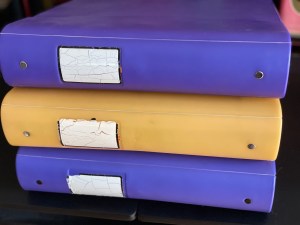
In my library are three slightly repellent books. One is the colour of poisoned custard, and the other two are a poisonous purple.

They look as if they’ve been through a lot. And they have.

These fat volumes, of about 500 pages each, were compiled in a time of disaster, and at the time, I didn’t know what I was doing or why. All I knew was that it needed to be done.

But first, a word of explanation. I am often asked, as are most writers, “Where did your main character come from? How did you go about creating him/her?” The simple answer is “I didn’t”, but the truth lies hidden in the thousand and more pages of these three uneasy books.

We had, at the time, a comfortable home on the edge of a forest – just like in the fairy tales. Until one night, lightning struck, and our forest was ablaze. Although we managed to get out safely with our pets, just ahead of the flames, more than 200 of our neighbours’ homes were reduced to ashes. When we were finally allowed to return, several weeks later, we found ourselves living in a blasted landscape: skeleton trees in a dead landscape of soot and ashes.

Time changed, and everything became different, including ourselves. What were we to do?

Sometime during those long hours and days and weeks that followed, I began compiling a compendium of poisons. The psychologists ought to have a field-day with that! Without knowing why, I had begun collecting and collating everything I could find on poisons and their history, all nicely filed alphabetically and indexed all the way from ‘A is for Arsenic’ to ‘Z is for Zarutin.’

The files grew from a folder, to many, and then to a book, then two, then three.

They contained detailed descriptions of the life and crimes of famous and not-so-famous poisoners, the history of specific poisoners from antiquity until just yesterday, the chemistry of poisons and their medical aspect. Ancient newspaper accounts told many a grim story, all so sadly the same: love gone wrong, ambition gone mad, and cleverness come a cropper.

There were heart-breaking tales of poor children who, in searching for something to eat, had – but enough! You get the idea.

Then, as the world around us restored itself, I put these books away, not knowing if I would ever look at them again. Whatever angel had caused me to compile this stuff had not bothered to leave an explanatory note. When the time came, I would know why.

Several years passed. Five, in fact. And there came a day when I decided that it was time to sit down and write that ‘Golden Age’ mystery novel I had been mulling since my younger days. It was a book that I much looked forward to, a tale that would draw on my years of experience in television broadcasting. Something fresh – something startling.

But it was not to be. I got no farther than the second chapter when, in a scene involving a visit to a crumbling country house in England, an eleven-year-old girl materialised suddenly on the page and would not, in spite of my every effort, be budged. She would not be written out and she would not be ignored. After a time, I realised that she had taken over my book completely. It was her book now, and my role was to sit down, shut up, and write what she told me to write.

And it came as no real surprise that her whole being revolved around a passion for poisons. Her knowledge of the subject was, you might say, voluminous.

Since then, she has more or less dictated ten novels, and has gathered readers around the globe in forty-some countries and forty-some languages. She has been on the New York Times bestseller list.

And that, dear reader, is the origin of Flavia de Luce, as best as I can manage to explain it.

And these three noxious volumes are the only proof I have that all of this is true.

See for yourself!

#


My website is www.flaviadeluce.com  My facebook page is AlanBradleyauthor. My gmail is flaviadeluce@gmail.com
 
Happy to hear from readers.
 
Photo by Jeff Bassett
 
I grew up in a small town in Southern Ontario, and being always fascinated by the magic of light and colored glass, naturally went into television broadcasting, both private and public. After twenty-five years as Director of Television Engineering at the University of Saskatchewan, I took early retirement to write a mystery that never got written. I did manage to write other things, though.
 
Now that I’m retired from retirement, having lived for a while in Malta, my wife and I now live in the Isle of Man, in the shadow of an old castle, where we keep an eye on the sea at our door, which was once frequented by Saint Patrick and the Vikings.


Alan Bradley has written TEN Flavia deLuce books, plus a short story, The Curious Case of the Copper Corpse. His newest novel is The Golden Tresses of the Dead. All the books are available in audiobook form (which I love). 
He also wrote a wonderful ebook memoir, The Shoebox Bible. 


Building a Better Villian by Miko Johnston

Miko Johnston is the author of Petals in the Wind.  
She first first contemplated a writing career as a poet at age six. That notion ended four years later when she found no ‘help wanted’ ads for poets in the Sunday NY Times classified section, but her desire to write persisted. After graduating from NY University, she headed west to pursue a career as a journalist before switching to fiction. Miko lives on Whidbey Island in Washington. You can find out more about her books and follow her for her latest releases at Amazon


BUILDING A BETTER VILLAIN
Call me TINO – tolerant in name only. I recently noticed many of my odious characters share a certain trait, which would be fine if that trait related to being dislikable. However, the similarity my antagonists share is physical – they’re gross in every sense of the word.
It made me wonder if I have a deep-seated bias against those who share this physical attribute. But wait, I’ve read many books with villains who ‘look’ like mine. Does that make me biased, or just lazy?
So that got me thinking – how do you build a better villain, one who is complex and human, who doesn’t fall into the easy prejudice category? It’s one thing to make your villain a classic enemy, like a terrorist or Nazi. They’re no challenge to make despicable; we recognize them as bad from their title. You can say murderers, a staple of mysteries, are easy villains, while action/adventure genres almost demand evil characters bent on destroying the world. But that isn’t enough to create a truly memorable bad guy.
The most fascinating villains are the ones we can relate to on a certain level, no matter how vile their behavior, unconscionable their deeds, or distasteful their appearance. For villains who are pure evil there must be something about them that intrigues us beyond their horrific actions. What draws us to Robert Benchley’s shark in Jaws, or Thomas Harris’ Hannibal Lecter in Red Dragon, is not so much their conduct as their nature. Unlike the hero, it’s not about the villain’s vulnerability, but ours – to the likes of them.
As writers, we must build characters, not caricatures, which means we have to find some redeeming qualities in our villains. That’s not to say the nemesis has to be admirable, but like a protagonist who is purely good is boring, so is an antagonist who is one-dimensional. If we give our heroes some imperfections, we must also balance our villains with enough positive qualities to make them real without making them nice.
To build this kind of villain, think of how many real life villains are smart (Ted Kaczynski), charming and attractive (Ted Bundy), or charismatic (bin Laden). What makes them villains is the way they used those positive qualities in a negative way. This type of villain should present a genuine challenge for your hero by having the power or ability to exploit your protagonist’s weaknesses. Whether a mighty army against a ragtag bunch of freedom fighters or a devoted family man bent on annihilating one segment of society, the greater the task to defeat him the more invested we’ll be in the story.
Villains don’t have to be evil. It surprised me to learn that one synonym for ‘villain’ is ‘antihero’ – I’ve always thought of them as protagonists – flawed people you empathize with, even like, despite their badness. Whether Kurtz from Heart of Darkness, Count Dracula and Frankenstein, Moriarty from Doyle’s Sherlock Holmes books, or Michael Corleone in The Godfather, these antiheroes fascinate us and we often root for them. Even when their actions horrify us. 
It reminds us that villains don’t have to be wicked moustache twirlers, rope in hand. Haven’t we all known good people who’ve had a momentary break and done bad things? Some, like BTK killer Dennis Rader or Susan Smith, go well beyond bad, but what shocked us most about them was their very ordinariness.
To build this kind of villain, write a character biography to create a backstory. Then seek a motivation for the deed, one that readers can relate to, with a believable trigger. That will provide a reason, which is different from an excuse. Bad can never be excused, but if we understand what provoked the bad – fear, shame, anger – we won’t view the character as a really evil person but as a real person who did evil.
It’s a subtle but important difference. It’s what makes them complex and human.