The Business of Busyness

Most of us might name December as the busiest time of year. For me, it’s November, and this year the month is especially chock full of activity. My November actually kicked off on October 20, the first day of Early Voting in Virginia. I worked at an EV site for four ten-hour days, helping voters navigate the democratic process. Last year, I worked at the polls on Election Day itself, an experience I described in this post.

The November Marathon, a Sisters in Crime initiative, helps writers build a daily or monthly writing habit over the course of thirty days. The marathon replaces NaNoWriMo, which SinC sponsored for many years. I serve on SinC’s Social Media Team as manager for the LinkedIN account and post daily in November about the marathon as well as about other events to promote the organization.

As for writing, I’m working on a short story that’s due in early January. That’s coming right up! I have three signing events this month: the Hanover Book Expo happened on November 8; the Local Author Book Fair, put on by the Chesterfield County Library, is scheduled for November 15; and on November 22, members of the Sisters in Crime Central Virginia chapter will meet at Book People, a local Richmond bookstore. I’m looking forward to discussing our recently-published anthology, Crime in the Old Dominion. I love being around readers and writers—we learn so much from each other.

In early November, I enjoyed a Jim Brickman concert and a tour of the Hollywood Cemetery. As a side note, President James Monroe is buried there. On October 23 (just nine days before my tour) his daughter, Eliza Monroe Hay, was reinterred with her family at Hollywood Cemetery after nearly two centuries in an unmarked grave in France.

This is all in addition to the normal busyness of my everyday life: the gym, grocery shopping, walks to admire the fall colors, get-togethers with friends and family, medical appointments. Thanksgiving looms, of course. And we all know how life has a way of “altering” our plans.

It’s all material for our writing.

In contrast, December is relatively quiet in my world. Key word is relatively. I get to enjoy the holiday season with a modicum of fuss and bustle. We’ll see if that holds true this year.

How about you? Is there a particular time of year that’s busiest for you?

Free Write Your Way Out of Writer’s Block

By Maggie King

Writer’s block. Many writers suffer from this condition. I used to scoff at the very idea of writer’s block, regarding it as another way for writers to procrastinate. But the creative slowdown I’ve experienced for several months has humbled me.

I’m not blocked for ideas, I have them by the dozen. The problem lies in creating a story, one people would actually want to read. My writing skills have gone on hiatus.

My solution: free writing. According to Matt Ellis in his post in Grammarly.com, “How Freewriting Can Boost Your Creativity,” freewriting is a technique in which the author writes their thoughts quickly and continuously, without worrying about form, style, or even grammar.

Mr. Ellis extols the benefits of this practice: “The benefits of free writing revolve around organization, brainstorming, and inspiration, as well as beating writer’s block and relieving certain anxieties. Just getting anything written, even if it is imperfect, can jump-start creativity.”

Author Natalie Goldberg also encourages free writing, or “first thoughts” in her parlance. In this excerpt from her classic Writing Down the Bones: Freeing the Writer Within she explains how to write first thoughts (#6 is a tough one!):

  1. Keep your hand moving. Don’t pause to read what you’ve just written.
    That’s stalling and trying to get control of what you’re saying.
  2. Don’t cross out. That is editing as you write. Even if you write something
    you didn’t mean to write, leave it.
  3. Don’t worry about spelling, punctuation, grammar. Don’t even care about
    staying in the margins and lines on the page.
  4. Lose control.
  5. Don’t think. Don’t get logical.
  6. Go for the jugular. If something comes up in your writing that is scary or
    naked, dive right into it. It probably has lots of energy.

Sometimes I write from a prompt (maybe not technically free writing, but who’s nitpicking?); at other times I simply write whatever comes forth. I set a timer on my smart watch for thirty minutes and go, without stopping. At first I went for ten minute sprints, but soon found that half an hour worked best. My thoughts and words flow. When the timer goes off, I pause, then go for another thirty minutes. At that point my hand needs a rest!

My free writing is turning into a memoir. Nothing organized or even chronological—whatever occurs to me ends up on the page. What occurs are often experiences from my past: family, people I’ve known, jobs held, schools attended, challenges faced. I’ve devoted pages and pages to my summers spent with relatives in a rural part of upstate New York.

It’s been an enlightening process, especially as I discover how my perspectives have changed over the years. Frankly, there are memories I’d like to keep buried, but I’ve found it liberating to get them down on paper (See #6 of Natalie Goldberg’s list above).

Since I started this process in July, I now look forward to writing each day. I can’t yet report much creative writing activity, but last week I was invited to submit a short story to an anthology. I have a great idea for a story (remember, I have no dearth of ideas) and now feel up to the challenge of actually writing it.

And now, please excuse me … it’s time to free write!

Handmade Software, Inc. Image Alchemy v1.14

A Writer Wastes Nothing

by Maggie King

“A writer wastes nothing.” This saying is attributed to F. Scott Fitzgerald. The renowned writer mined his college years to create his debut novel, the autobiographical This Side of Paradise.

I recently attended an outdoor event in a local park and feel inspired to write about it—in fiction form.

The crowd at this event was large, the air heavy with humidity. Virginia is a steamy place in the summer! I drank little water as I was unsure if facilities were available or even nearby (they weren’t). After standing for over an hour, the crowd started to leave—slowly.

A feeling of lightheadedness came over me and my vision blurred. To say I was frightened was an understatement. I was with friends and the crowd was friendly, so I wasn’t in danger. But the feeling of losing consciousness is scary and uncomfortable under any circumstances.

One of my friends let me lean on her until we came to a tree where I sank to the ground and sat back. People gave me bottles of cold water to drink and press against my wrists. I ate one of my melted protein bars. In no time I felt revived, grateful that I hadn’t passed out. A couple of EMTs showed up and took my vitals (they pronounced them fine!). I opted not to go to the hospital. Dehydration was named the culprit.

One of my friends left to get the car. The EMTs parted the crowd for me, and one of them stayed with me until the car arrived. While we waited, she asked what I did for work.

“I’m a writer, and I’m already planning to use this experience in a story.”

After all, a writer wastes nothing.

As I know how frightening it is to feel on the verge of losing consciousness, I can bring a visceral feeling to the story. My imagination will ratchet up the danger, raise the stakes. Possibly elements of a Hitchcock film I’ve seen is inspiring me as well.

My preliminary idea is based on a series of what ifs:

  • What if this is a hostile crowd, in addition being a slow moving one?
  • What if my character, a woman, is alone?
  • What if the heat and humidity make her feel lightheaded and make her vision blur?
  • What if she is carrying a quantity of cash and/or jewels that she’s stolen?
  • What if she is being pursued–by law enforcement? Another criminal? Both?

She must stay conscious and she must evade her pursuer.

Yikes!

A writer wastes nothing.

Has a personal experience ever led you to write about it, especially in fiction form? Tell us about it.

Get Those Details Right!

By Maggie King

Recently Linda Johnston posted about where writers set their stories. I commented that the next day I planned to visit Charlottesville, Virginia for a research trip. I had finished the first draft of a short story set there, and needed to verify setting details.

I live in Richmond, but lived in Charlottesville for many years, and visit occasionally. It’s a cool place to spend a day. Lots of bookstores! So I have a fair picture of the place. But how accurate was my memory? And Charlottesville is a growing, dynamic city—what had recently changed and what hadn’t?

Here are the setting details in my first draft:
The story opens at the Jefferson Madison Regional Library in the downtown area of Charlottesville. As my main character stands on the steps under a columned portico, she turns and sees the Market Street Park, scene of 2017’s Unite the Right rally. I provide some information on that rally, formed to protest the proposed removal of the Robert E. Lee statue.

Once inside the library, the character takes a wide staircase to the lower level and locates a meeting room where a writing group is meeting.

After the meeting, she and a woman she just met leave and walk to Charlottesville’s Historic Downtown Mall. As they approach the Mud House, a trendy coffee shop, they decide it would be a good place to chat.

Mud House

Later they drive to a semi-country location, the scene of the crime they cooked up while drinking expensive lattes at the Mud House.

Based on my research, some rewriting is in order.

The character standing on the steps gazing at Market Street Park: she could only see a sliver of the park from where she stood. I could have her walk through the park and see the patch of dirt left behind when the Lee statue was removed in 2021. But neither the park nor the statue are important to the story, they only serve to add color to the setting. To use film parlance, this bit is destined for the “cutting room floor.”

The library interior: for all the times I visited this library, apparently I was never in a meeting room. They are located on the top floor, not the bottom, requiring the character to take the elevator (I didn’t check out stairway access). The rooms were in use, but I got a peek of the interiors through the glass doors. As the library is a real place in my story, being accurate with descriptions is important.

Jefferson Madison Regional Library

The Mud House. It’s a very attractive space with a nice, and pricey, selection of coffee and pastries. But it’s been completely redesigned and not conducive to private conversation. And the conversation my characters have needs to be private. But I can fictionalize a coffee spot, so no problem there.

Then there was the trip to the semi-country, where I once lived. The route, which must be accurate, was pretty much unchanged. I drove past the Earlysville Oak, estimated to be 250 to 300 years old.

Earlysville Oak

My old neighborhood was also unchanged—except for the owners of my previous home not keeping up the grounds. But I digress. I’ll make up the neighborhood based on this one. After all, it’s where the crime takes place, and I don’t want to rile my former neighbors!

I’m grateful I took this trip. It pays to verify aspects of the setting, especially if using real locations. I also took lots of photos, noted sights, sounds, and traffic patterns (lots of traffic!) and made time for those bookstores.

See Linda’s post, “LOCATION, LOCATION, LOCATION!”

My Reading Life in Classics

by Maggie King

My love affair with the classics took off in 1989. Why 1989? That was when I started a job in downtown Los Angeles. One day at lunch a co-worker asked if I wanted to go to the library. Surprised, I said, “Sure!” I’d never worked with anyone who spent her lunch hour at the library.

We walked to the Los Angeles Public Library and I checked out Jane Eyre. I had a vague memory of reading Charlotte Bronte’s tome in high school and decided to try it again. Over the next few years, I read—in many cases revisiting my high school reading list—works by Jane Austen, the Bronte sisters, Willa Cather, Theodore Dreiser, F. Scott Fitzgerald, Gustav Flaubert, Thomas Hardy, Nathaniel Hawthorne, Washington Irving, D. H. Lawrence, Sinclair Lewis, W. Somerset Maugham, Ayn Rand, Robert Lewis Stevenson, Leo Tolstoy, Mark Twain, Edith Wharton, and Virginia Woolf, among others.

Many I loved, with a few being okay. Sad to say, I didn’t like Wuthering Heights any better in the early nineties than I had in high school. Heathcliff was just too dark (funny reaction from a crime writer, but there you have it). For many years, Jane Eyre topped my list of favorite classics. But a year ago, I picked it up for the third time and didn’t even finish it. Jane Eyre was given to monologues! Apparently that didn’t bother me thirty-plus years ago.

In 1993 I joined a mystery group and became obsessed with that genre, classic and contemporary. Up to that point, I’d read many Agatha Christie mysteries, but few by other authors. It wasn’t long before I started penning my own.

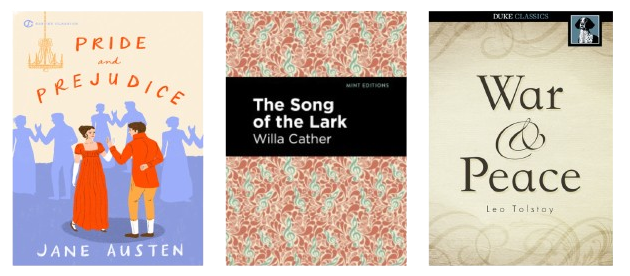
I try to read at least one classic a year, and sometimes it’s a mystery. A favorite is Wilkie Collins’s early example of detective fiction, Woman in White. I read the epics Brothers Karamazov and War and Peace from start to finish and lived to tell it! I finally got to Little Women a few years ago. I had seen countless film versions but never actually read the delightful autobiographical novel by Louisa May Alcott. David Copperfield was wonderful but populated with characters who, like Jane Eyre, spoke at great length.

Why do I love the classics? They have a timeless quality and universal appeal, essential traits that make a classic a classic. Little Women—despite the lack of texting and social media—could be a contemporary coming-of-age novel.

The classics are known for well-drawn characters and compelling storylines. That said, it can take time for a classic story to be compelling. Contemporary books have to grab the reader on page one; classics require more patience, but are worth the wait. My friend who took me to the LAPL and I started Middlemarch together. Several times I was ready to close the book for good but, being a faster reader, my friend assured me that the story would pick up. Sure enough, George Eliot’s masterpiece became a page turner.

What’s my next classic? Many of my author friends rave about The Count of Monte Cristo by Alexandre Dumas. And I’ve had Elizabeth Gaskell’s Wives and Daughters on my TBR list for some time.

Would reading the classics benefit writers? Absolutely! Have they improved my writing? As an optimist, I want to think so—but such a belief is hard to verify. This post on KindredGrace, “5 Reasons Why Every Serious Writer Should Read Classic Literature”, is worth reading. I especially like #4: Classic literature expands our knowledge base for literary allusions.

Renowned author Joyce Carol Oates suggests that writers read Ulysses by James Joyce. According to her, our vocabulary will improve (or, if nothing else, we’ll want our vocabulary to improve). I take Ms. Oates’s point, but will pass on Ulysses (I managed to get through one chapter).

Back to where the classics began for me: here’s a photo of the beautiful and impressive Los Angeles Public Library. During my stint working downtown, this building was closed for renovations due to two fires, and the collection was temporarily housed on South Spring St. By the time the original building reopened in 1993, I was working elsewhere, but occasionally returned to visit this stunning structure. If you can visit, do so, but you can read about it here.

Closing thoughts: what contemporary novels will become classics? Any of our own? Perhaps works by Margaret Atwood, Toni Morrison, and Joyce Carol Oates will stand the test of time. As for contemporary crime novels, would any make the cut? As much as I enjoy them, they lack the timeless quality—even the historical ones. I’d love to be proved wrong. In the meantime, we have Arthur Conan Doyle, Wilkie Collins, Anna Katharine Green, Agatha Christie, Dashiell Hammett, and many others.

A big thanks to Alison, my long ago library pal!

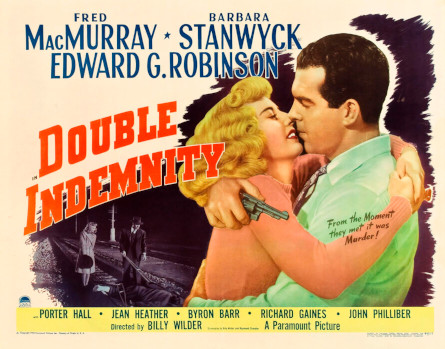
Double Indemnity: A Crime Writers Film

By Maggie King

“How could I have known that murder could sometimes smell like honeysuckle?”

One of many memorable lines from Double Indemnity (1944), a film I never tire of watching—even after the fifth or sixth time! It’s a film I urge all crime writers to study—whether you’re writing cozies or hard-boiled detective stories. The superb dialogue, with its emphasis on double entendres and provocative banter, not only entertains but moves the plot along. The use of light and shadow create a virtual underworld that emphasizes the unsavoriness of the characters and plot. It is film perfection.

Double Indemnity is the ultimate film noir—it’s dark, steamy, loaded with atmosphere, and the characters are sleazy as all get out. In this story, originally penned by James M. Cain and adapted for the silver screen by Billy Wilder and Raymond Chandler, discontented housewife Phyllis Dietrichson (Barbara Stanwyck) bewitches insurance salesman Walter Neff (Fred McMurray) into killing her husband. Together, she promises, they will collect on a double indemnity insurance clause.

Phyllis is film noir’s classic femme fatale, luring a man whose brain goes on hiatus the moment he sees her. Walter seems like a good guy, but he’s no match for the lovely and smoldering Phyllis. She doesn’t even seem good—she’s evil to the core. Since he’s only marginally good, ensnaring him in her web is child’s play. Indeed, Double Indemnity’s best lesson for writers may be its showing how easily someone can be led astray by promises of a lifetime of riches and passion.

Writers are frequently advised to show, not tell. Double Indemnity follows this advice to good effect in its depictions of the life styles of Phyllis and Walter. Phyllis lives in an elegant Spanish house in the hills overlooking the Loz Feliz section of Los Angeles. Walter spends his days selling insurance, operating out of a ubiquitous office building in downtown LA, where the worker bees toil in a pre-cubicle bullpen desk arrangement (I worked in a few bullpen set-ups myself). Evening comes and Walter returns to his cramped apartment not far from his office. The contrast of life styles is stark, but never verbalized, only shown.

When it comes to sex scenes, the censorship of the day forced writers to show without telling, allowing them to achieve higher levels of creativity. Sex was left to the imagination, using suggestive dialogue and longing looks. A scene in Walter’s apartment hints that Walter and Phyllis had just been intimate. You don’t know for sure … but you’re pretty sure.

Elements of Alfred Hitchcock are evident in Double Indemnity. You don’t see the murder but you know it’s happening just out of camera range. Phyllis’s satisfied look and the gleam in her eye are what tell you that her husband is now thoroughly dead.

So … no sex, no violence, no profanity. Sounds like a modern day cozy. Not a chance! Double Indemnity is far from a cozy, and a current version of it would include all three no-nos. Body Heat (1981) is an example.

And there’s the creative way the senses are incorporated into the narration: “How could I have known that murder could sometimes smell like honeysuckle?” and “I couldn’t hear my own footsteps. It was the walk of a dead man.” There are many such quotes in Double Indemnity.

Here’s a quote that sums up the film in a nutshell: “I killed him for money and for a woman. I didn’t get the money. And I didn’t get the woman.”

You can almost feel sorry for Walter—after all, if you go to all the trouble of murdering your lover’s husband, shouldn’t you reap some of the benefits? Perhaps the film’s best lesson for writers is showing how easily someone can be led astray by promises of a lifetime of riches and passion. It makes you wonder how many of us are just a whisper away from evil.

After the murder, things go downhill. For one thing, Walter’s boss, Barton Keyes (Edward G. Robinson), is highly suspicious of Phyllis’s double indemnity claim and investigates it like a dog with ten bones. And Walter and Phyllis grow to distrust each other (no surprise there). By the time Walter realizes that murdering Mr. Dietrichson wasn’t such a good idea, it’s too late. But is he sorry that he killed the man? Or does he only regret that he’s left with nothing to show for his efforts beyond a bullet in his shoulder?

Often when I re-watch a movie, or re-read a book, I start finding flaws and turn critical. Not so with Double Indemnity. But I will notice something new with each viewing. Like how Barton Keyes never has a match, and Walter Neff has to light his cigar. But in the last scene, it’s Mr. Keyes who lights a cigarette for Mr. Neff (there’s that bullet in his shoulder). An unexpected touching moment.


James M. Cain took his inspiration for Double Indemnity from a real life case. In 1927 a New York woman named Ruth Snyder persuaded her lover, a corset salesman named Judd Gray, to kill her husband. She had recently convinced her spouse to take out a $48,000 insurance policy with a double indemnity clause. For more information on the case, read this Wikipedia article.

The Week I Rose Before Dawn to Write

My title is a bit misleading. In the days leading up to Election Day, I did rise in the wee hours and did write. I’m not a morning person, but for years I’ve known writers who worked on their stories before sunrise. There are certainly advantages: it’s quiet, the rest of the (sensible) world sleeps, word counts soar. But it was the election that prompted this deviation from my normal schedule.

In a moment of patriotism, I had volunteered to work at the polls as an Officer of Election (OOE) on Election Day, 5am-7pm and beyond. Yikes! I needed to “train” my system to endure such a radical change to my schedule, and that meant early to bed, early to rise. As long as I was at it, I would write.

Starting on Tuesday, October 29, I rose at 6 am for two days, 5am for two days, and 4 am for three days. I enjoyed coffee, my cat’s companionship, and worked on a short story. I read book on writing, touted as a how-to book on craft (we can always learn about craft); in reality, it was a commentary on writing, delivered in a lofty tone. It required a focus that kept me awake. I did not check my email or anything else on my computer (I wrote in longhand).

Bedtime ranged from 9-10pm, and I had no trouble falling asleep—until the night before the big day when I didn’t get to sleep until 12:30pm. That meant I had three hours and ten minutes of shuteye. Would I be able to make it through the day? As Frank Sinatra crooned, “I’m in the autumn of the year” (in more ways than one).

I did make it through, and enjoyed myself. I worked with a nice group of volunteers and the day was incident-free. The voters were pleasant and cheerful, a diverse group representing a range of ages and cultures. Interesting dress and hair styles as well. A writer’s paradise! I mainly helped them scan their ballots and handed out “I Voted” stickers. Many children accompanied their parents and enjoyed the  “Future  Voter” stickers. I also worked the floor, directing voters to booths, the ballot scanner, and occasionally the restrooms. Voting is at the heart of democracy and I appreciated taking a part in the process.

Would I do it again? Not likely, but it may be too soon to decide. Early voting holds more appeal, as the volunteers work in shifts, a much kinder arrangement. And it would still offer a way to pay tribute to my mother, who worked at the polls for decades.

My feelings about rising early to write: I liked seeing the sun rise and the light growing brighter and brighter. But I found it quite lonely, especially on the 4am days. The quiet was very, well, quiet. I can see the appeal, but it’s not for me.

Happy writing, whenever and wherever you string those words together. And thank you for voting!

Big Words, Bad Words

By Maggie King

Many years ago I read a mystery with so many words I didn’t know that I had to keep my dictionary close at hand. As I enjoy learning new words I liked the experience the popular author provided. But when I mentioned it to a couple of friends, they said, “Not me. I’d have put that book down, and fast. I want to read words I already know.”

I’ve always had a love of words. I fondly remember vocabulary lists in high school: perspicacious, truculent, vapid, loquacious, polemic, specious, logy. With all those big words swirling through my brain, you’d think my SAT scores would have been more impressive than they were.

When I presented my manuscript for Murder at the Book Group (my debut, published in 2014) to a long-ago critique group, the members advised me to ditch the big words. “What big words?” I asked, bewildered. They named a few but the one that stuck with me was “diatribe.” I didn’t consider diatribe a big word and it would surely be understood in context, as in “Arthur ignored his mother and carried on with his diatribe against Evan.”

The upshot was that I kept diatribe, but changed some of the other “big” words.

A word I recall from reading Nancy Drew was “elated,” as in “Nancy was elated by the news.” The context wasn’t clear, so I ran to the dictionary and learned that Nancy was ecstatically happy by the news. Elated is a wonderful word to teach a ten-year-old.

One of my favorite books on writing is On Writing: A Memoir of the Craft by Stephen King. In the book, King says, “Wherever your vocabulary is at today is fine. There’s no need to learn more words or different words. Whatever words you know right now, you use. This will help you develop your voice and sound unique.”

Is using big words in a story a good idea? In my opinion, the answer is yes—as long as the writer chooses words whose meaning and context is easily understood. A thesaurus is a great tool, but don’t use it to come up with words you think sound cool and sophisticated. Readers have a wide range of word knowledge but even those with an impressive vocabulary feel that showing it off is pretentious.

To sum it up: use your best judgment.

In the meantime, I’ll hang on to my precious dog-eared copy of 30 Days to a More Powerful Vocabulary and see how many of the words I learn end up in my writing. Ceraunophobia, anyone?

To swear or not to swear?


Do your characters swear? Do they swear too much? Not enough? Should they swear at all?

Personally, I don’t get exercised over swearing. Let’s face it, people swear—some a little, some a lot, some only when “necessary.” Swearing can add a touch of realism to our writing (after all, what does one say when tripping over a dead body?). We’ve all known colorful folks who liberally season their conversations with salty words. For one story, I created a character loosely based on a former co-worker who never felt the need to censor her speech. Not a word of it.

But my readers object to profanity and I must respect their wishes. There are ways to suggest swearing and author Naomi Hirahara is so skilled at this that you know the exact word she’s not using. Another author, F.M. Meredith, has this to say about the lack of salty language in her Rocky Bluff P.D. series: “Oh, the characters do cuss, I just don’t quote them.”

Here are ways I’ve suggested swearing in my stories: She shrieked a litany of curse words; She continued to scream and curse …; He included a few four-letter words of a sexist nature; Donna slurred a few non-PG13 adjectives to describe her feelings for her ex; Kat cursed a blue streak (I wouldn’t choose this one again, as it’s a cliché that sneaked past me and my editor).

On several occasions I’ve presented a seminar/webinar on dialogue and tackled the question of profanity. This is how I answered the question “To swear or not to swear?”:

• Know your reader and your genre. Cursing and four-letter words are more acceptable in a thriller than in a romance or a cozy mystery.
• Refrain from profanity in narrative, but an occasional expletive in dialogue is acceptable (depending, of course, on genre).
• Realize that profanity is more noticeable in a novel than it is in real-life conversation.

Again, use your best judgment. And ask your beta readers for feedback.

Your thoughts?

Missing Author Found!

Missing Mystery Authors … whatever happened to your favorites? Do you ever ask yourself that question? I sure do. That’s what prompted the “Missing Author” series that I launched several years ago on my blog. It always drew traffic and prompted readers to ask about their own favorites who, for whatever reason, hadn’t published in a while.

While finding information for some authors wasn’t difficult, it was for others. Fortunately, many weren’t technically “missing.” They maintained websites and were active on social media, so I could contact them. Often life circumstances put her or his writing on hold—illness, care giving, changing job responsibilities are a few examples—but some made a comeback with a new series or picked up an old one. Earlene Fowler made things easy: she wrote on her website that she retired from writing when social media started taking over and she didn’t care to participate.

Others stopped writing altogether when publishers dropped their series or their agents retired. Sadly, some passed on.

Others have seemingly vanished. Does that spark story ideas for anyone?

How did the Missing Authors series start? I was a big fan of Rochelle Krich and have read just about everything she ever wrote. In 2003, she came to Richmond, Virginia and I took off work to hear her speak at the local Jewish Community Center. She last published in 2005. I’ve not been able to learn a reason for her retreat from the writing community. I don’t hunt down these authors, I don’t pry, and don’t publish anything without their permission. I had to let Rochelle go.

The same held true for many other authors. But I made some great connections. I found and became email pals with Corinne Holt Sawyer, Connie Archer (I’m interviewing her for my June newsletter), and Judith Van Gieson (sadly, she passed away few years ago). Author and blogger Charlotte Rains Dixon, who was also searching for Gabrielle Kraft, told me about a memorable writing class Ms. Kraft presented years ago in Portland, Oregon. Charlotte details the class here. To date, neither of us has located Ms. Kraft.

Readers of my blog participated with either information on the authors, or with requests about the whereabouts of their own favorites. They introduced me to some great new-to-me authors.

You can visit my blog and read the posts. I’ll list the links below. I started the series featuring one missing author per post. When requests started flooding my inbox, I included several authors per post. But I haven’t pursued this project in recent years (you may have noticed my use of the past tense), so you won’t find current information on the authors–but if you have any, please share.

This brings me to what prompted today’s post about the missing authors: I found one! A couple of weeks ago, author John J. Lamb, who I posted about in 2014, contacted me out of the blue.

John J. Lamb was a homicide detective and hostage negotiator in Southern California before retiring to Virginia’s Shenandoah Valley where he and his wife became teddy bear collectors. John also penned a series of mysteries featuring a homicide detective who retires to Virginia and collects teddy bears.

I met John several times, at book signings, when he led a writers’ workshop, and when he spoke to our local Sisters in Crime chapter. He gave me good advice about realistically depicting an amateur detective interacting with the police. He was kind, funny, irreverent, and loved sharing stories of his law enforcement career.

Then poof—he became one of those vanishing authors. He took down his website, and the email address on the card he had given me bounced.

On April 7, to my surprise and delight, I found the following message from John in my inbox (by the way, I have his permission to publish this exchange):

Good Morning, Maggie,

It’s been a long time and I hope you are well. I was taking a digital stroll down memory lane and came upon an old website posting where you wondered why I’d vanished. The abbreviated answer is:
a) Berkeley didn’t want any more Teddy books and my agent was unable to sell a standalone thriller.

b) Heart attack, from which I fully recovered.
c) Needing health insurance, I returned to work as a civilian evidence custodian at a large Shenandoah Valley PD.
d) My wife is battling Parkinson’s Disease, which takes up a great deal of my time.

I think that covers it. Anyway, I’m glad so see that you are still writing.

Take Care,
John Lamb

Excerpt from the resulting message thread:
I’m writing my memoirs of my life as a cop. I finished the first volume (Entitled: Service With a Sneer) of what I anticipate will be four books. My original intent was to make this anecdotal history available to my grandchildren, but only after they’re adults because this is definitely not cozy mystery territory. But my test readers have convinced me to try once more to get published. So, I’ve been querying agents and have actually received a couple of nice personal rejections.

Another excerpt from the thread:
Service With a Sneer covers my time as a USAF cop and deputy sheriff in the desert near Palm Springs. I’m at work on Beach Blanket Bedlam, which covers my first two years as a patrol cop in Oceanside. Next comes Bring Out Your Dead, recounting my history as a homicide detective. The final volume will be Three Stripes, Yer Out, which alludes to my terminal rank of sergeant. Not that I wanted to promote to a higher rank. I was always worried about surgical scars from the frontal lobotomy required for collar brass.

John’s books, including his standalones, are available on Amazon and at libraries.

The Missing Authors series has been fun and, as you can see, often rewarding. If there’s an author you’ve been missing, let me know in the comments. I could be persuaded to resurrect the series.

Here are the links to the series:

Missing Rochelle Krich

Discovering a Lost Author: John J. Lamb

Whatever Happened to Gabrielle Kraft?

Whatever Happened to (Name an Author)?

In Memory of My Favorite Mystery Authors (And Maybe Yours)

Those Missing Authors: An Update

Missing Author Found!

Missing Authors: Update 2

“Missing Authors: Update 3”

“Missing Authors: Update 4”

“Missing Authors: Update 5”

“Missing Authors: Update 6”

“Missing Authors: Update 7”