Christmas in Bangkok & Hong Kong

by Jill Amadio

I looked forward to spending Christmas in Bangkok, Thailand. We’d moved there four months earlier when my husband was posted to Saigon, and I landed a job as a reporter for the Bangkok Post.

Writing about an Asian Christmas energized me, and I eagerly looked around the local shopping districts for gifts, decorations, and seasonal goodies for the kitchen. Writing features and pointing out the differences between our holiday in England and America and our current home seemed like endless discovery.

Alas, none of these visions came to a realization. Thailand, like most other Southeast Asian countries, does not celebrate Christmas because it is Buddhist. With three children expecting to wake up early on The Big Day and rush downstairs to open their gifts, what to do?

Ah! Got it! We’d spend the holiday in Hong Kong, just an hour’s flight away. At the time, the colony was highly attuned to British customs, and the big hotels, I was assured, displayed a splendid farang (foreign) Christmas that would enthrall any Westerner. In addition to enjoying the holiday, I planned to interview hotel guests, locals, market stall owners, and tourists. Among the latter I encountered, were Swiss, German, Swedish, and Australians.

I’d visited Hong Kong several times due to assignments and visited the island of Macau to cover auto racing. There were always a plethora of stories worth reporting for the newspaper in Bangkok but I was eager to experience how stupendous this Christmas adventure would surely prove to be.

My husband and I decided it would be silly to take wrapped gifts with us, so we planned to take the kids shopping to choose their own. My editor agreed that I would write about the trip, sending in daily reports and photos taken with my Polaroid camera before we skipped New Year’s Eve and returned to Bangkok. As our last day drew near and we were anxious to return home, we booked an earlier flight.

Big mistake.

It turned out that December 31 was always a massive celebration for both Brits and Chinese, a richness of reporting I decided to cover, even though I had plenty of stories of our own excursions in Hong Kong. Besides, who wanted to miss the turn of a century in this historic city at the southern tip of China?

Our children had never been in a toy store because two were born in Spain, where Christmas was essentially a religious holiday. Our third child was born in the U.S. during a quick turnaround trip to New York and back to Thailand to ensure her American citizenship by being born in the States. My son was already pledged to fight, at 18, in any war that Spain became involved in because he was born in Madrid, but his second sister was registered as American, as by then, I had received my own U.S. citizenship.

Our shopping trip was a great success with many changes of mind as we, as parents, pointed out the mounting cost of their decisions. Finally, having selected their toys and new clothes, and I had talked to several shoppers from various countries, we returned to our hotel. It was my turn to choose a gift. My husband wanted to go out alone and buy me a watch. I told him I’d like a Patek Phillipe, please. Off he went but returned rather quickly.

“Are you insane?” he asked. “Do you know what those watches cost? No way. You’re going to have to settle for a Rolex.”

At the time, Hong Kong was turning out fake Rolexes by the thousands. Most had wristbands that looked like gold but were, in fact, made from anything but that precious metal. Aha! Another good story! In fact, the bona fide Rolex dealer pointed out our mistake when we showed him the watch we’d bought elsewhere. Never mind. The band looked authentic, and the watch itself was confirmed as the real McCoy.

The festive air in the colony extended everywhere we went through the perpetually crowded streets. I knew that more than 7 million people lived in the small British enclave, and they invaded every restaurant, bar, and all the shopping districts in sight. Antique stores added red ribbons to their vintage wares, and the buildings were ablaze with Christmas lights. Even the hotel’s small office for guest use had a small Christmas tree. Laptops didn’t exist back then, but the electric typewriters fit the bill for typing up my interviews.

After a great New Year’s Eve, the hotel manager asked if we planned to stay on for January 6, the Chinese New Year, but by then, we’d had our fill of festivities.

I returned to Bangkok with a new satchel filled with notes and an extra suitcase for the kids’ toys and outfits. In Bangkok, we had to have our clothes tailor-made as there were no ready-made stores. The upside was that a dressmaker charged $5 or $6 to create a dress, a blouse, or a skirt. I’d simply bring in the fabric, show her a Chanel photo in Vogue or another magazine, and she’d copy it.

We left Hong Kong after two glorious weeks and enough material for several follow-up feature stories in the Bangkok Post.

Now, permanently living in America, with stores brimming with seasonal cheer, I wish my dear friends and readers at The Writers in Residence a Happy Hanukah, a Merry Christmas, and a Happy New Year!
A LOOK INSIDE IN-PERSON SELLING

By Bonnie Schroeder.

When I moved from California to Idaho in 2018, I also transitioned to being a self-published author. Until then, I’d had the benefit of a wonderful publisher, Champlain Avenue Books, behind me.

Alas, they closed their doors soon after my relocation, and I went solo. I’d done a handful of in-person selling events in SoCal, but I confess to being a lazy self-marketer. In SoCal my experience with those events mostly took place in libraries, and all I had to do was show up with my books and hope readers would buy them.

In Idaho, however, with three self-published books on my resumé, I realized I needed to be more proactive in getting those books into readers’ hands. One way to sell books in person is through trade shows known variously as craft fairs, book festivals, holiday bazaars, and a few other names (some of which I shall not print here.)

There are many book fairs in libraries here in Idaho, but there are also a lot of general craft fairs, big and small, all over—in parks, high schools, even specialty grocery stores. And many of those events take place outdoors—which, in Idaho, means contending with weather extremes. I’ve done festivals where I had to pull my luggage cart full of books through snow, and others in a field where the daytime temperatures grazed 108 degrees.

Weather conditions are only part of the fun. I also learned that I needed to supply my own “equipment”—i.e. tables, chairs, signs, decorations, and, in summer, canopies, shade walls, and a battery-powered fan. Another essential is a means of transporting my supplies—a sturdy folding hand truck for use on pavement, and a collapsible fabric wagon for other terrain.

I had the good fortune of connecting with two other “local authors,” Laura Jenski and Julie Howard who are pros at this, and they generously let me learn from them and shared tables and chairs with me as I began selling my books in person.

Laura has often recruited her husband to help transport tables and chairs to some events. She and Julie have also provided canopies for many events, and even when I brought the canopy, they assembled it while I parked my car.

I’ve done a few solo events as well, and I finally figured out I needed a checklist of supplies to bring, rather than searching through my memory every time:

  • Water (!) and food (!!)
  • Credit card reader (e.g., Square)
  • A supply of small bills to make change
  • Pens to sign books
  • Price list
  • Bookmarks, postcards, or other promotional material
  • The aforementioned decorations and/or a bowl of candy to lure potential buyers to our “booth.”
  • And oh yes—in Idaho (as in many states, including California,) one must secure a sellers’ permit to track, report, and pay sales tax to the state. Ironically, I learned that Idaho’s sales tax process is way more complicated than California’s.
  • Following Laura’s and Julie’s lead, I also realized I needed a large-ish poster with a picture of me and my books. My website and book designer Paula Johnson created the artwork, and my local Staples made the sign. I confess to feeling a surge of legitimacy at the result.

You know that saying, “It takes a village ….?” It is so true! In addition to help from the folks mentioned above, I send a thank-you to Heather Ames, a powerhouse on the festival circuit in Oregon. She sends me critiques of my table layouts, along with encouragement and examples, and I emulate her as much as I can without committing outright piracy.

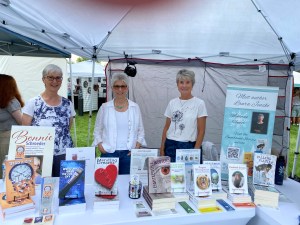
This photo shows my comrades Laura and Julie with me at one of our events, and it truly is crucial to have a support network at these things. Some writers, me included, are not especially outgoing, and it’s a challenge to attract and engage with visitors at the festivals.

Some are interested and kind, while others are dismissive—masters at avoiding eye contact. Now and then, however, a visitor will show up who bought one of our books at a previous event and liked it well enough to seek out the author and buy more. This truly makes our day when it happens.

What the photo doesn’t show is all the hours, days, weeks, even months of prep work involved in getting us to this smiling display—things like replenishing our inventory, posting on social media, packing supplies, hauling boxes of those books to the venue, and showing up sometimes before sunrise to set up the tables and arrange the display.

There are still festivals happening in Idaho, but I’m done for the year—saving my energy for the spring. I just registered for a book fair at a nearby library in April. Library events are the best, because you have a built-in audience, and this one is no exception.

So all you authors out there, whether traditionally or indie published, I hope you get a few ideas from this post. Get out and show the world your books, because—especially for indie authors—that’s an important way to grow your readership. Best of luck to you all.

What’s The Point of Resistance?

by Guest Blogger, Renee Le Verrier, E-RYT*

When the writing gets tough, the tough stay in the chair.

When the writing gets tough, I slide off the chair onto a yoga mat.

I begin a class with a short reading once everyone gets settled on their mats. On one particular morning, Greta, an eighty-something with a sunny smile who never missed a session, cleared her throat.

She leaned closer to me. “May I ask you something?”

I nodded.

“If you could define yoga in one word, what would it be?”

I didn’t hesitate.

“Awareness,” I said

Greta sat upright and seemed to be considering my response. “That could apply to nearly everything, that awareness thing,” she said.

That’s the day I went home and unrolled a mat beside my writing desk. So closely related, I wanted to practice each near the other.

Yoga, in a longer definition, is more a meditation in motion than it is bending into poses. Similarly, writing is more than the number of words on a page on any given day. The craft moves characters forward or back, into twists in a kind of motion of imaginative meditation. When my mind is with me, not off planning what’s for dinner, present with my pose or in a scene, both my yoga and my writing deepen.

The word yoga derives from Sanskrit meaning ‘linking together’—as in yoking—the mind and body. Awareness connects the two. When I take notice, the continuous chatter in my brain—that’s busy, busy making mental remember-to lists—fades. What’s opened up makes room to be attentive.

In writing, I focus on how and where the words affect me physically. If my typing resembles an air drum solo, I’m on a roll. If I’m in the middle of crafting a fight between two characters I’m breathing easy and my toes aren’t curled, something is off. It might not tell me what is awry but I’m aware I need to edit.

If I can’t connect with my body, I pause and take a detour to my face to take inventory there. Are my jaws clenched? Lips squeezed tight like a zipper?  Eyebrows furled?

Toggling from body to expression has revealed an assortment of secrets. In yoga, I may believe that I’m relaxed while my cheeks and lips form a frowny face.  In writing, I’ve been delighted with myself for a stellar phrase, yet the computer screen reflecting back at me is unsmiling. These scowls indicate dissatisfaction and point me to a needed revision.

Awareness isn’t skin deep, recognizing only pain or pleasure. In yoga, my mind is reading my body and reporting back, yes. But stretching only to the first sense of pushback doesn’t allow much room for lengthening or release. I instruct the class to go as far into the pose that they get to the point of ooh, ow, ow.  But don’t stay there. Know where that point is, then ease back to where the stretch first meets resistance, to just ooh.. From there, try to coax the line of opposition into backing away.

In writing, we reach points of resistance in our plotlines, our narrators, our characters—fictional or non. The story arc banks on opposition—without it, there’d be no conflict, no resolution, no growth. I look for the far edge of that resistance. It may be too intense, unbearable, so I take it back to the point where it feels right. Just like when I’m on the mat.

Greta was right about that awareness thing.

* An E-RYT (Experienced Registered Yoga Teacher) has documented over 2,000 teaching hours and attended at least 500 hours of training as a student.

.

BIO for Renee Le Verrier

Renee Le Verrier enjoys being surrounded by books, painting supplies, dog toys and yoga. The author of Yoga for Movement Disorders and Travels with Tommy (featuring a very special Great Dane), she has been awarded Best in Show in local juried art shows but mostly fills up the walls in her office. She has been teaching and presenting on yoga throughout the US and UK for eighteen years. She writes from an island off the coast of Washington where she lives with her husband and another Great Dane. She’s currently working on a YA novel, which also means she’s practicing yoga regularly. Visit her at http://www.leverrier.com