
While Jackie Houchin is on vacation (in Spain or France now) we have another Guest Author. (Thank-you, Elaine!) Jackie hopes to return with her next scheduled post of June 8, 2022.
by Elaine L. Orr
Like most writers, I put words on paper because if they don’t get out that way I risk screaming on a street corner. I get those words into print because I think others would enjoy them.
When readers like the characters, they may clamor for more. Even if they don’t initially, we think they will. I consider several things when I start a new mystery series.
- Is the setting or main topic interesting enough to keep exploring? My first series (the now twelve-book Jolie Gentil series) is set at the Jersey shore because I love small, east coast beach towns.
- Can I connect to the characters enough that readers can too? This doesn’t mean does an author like the characters. Some of the most relatable ones are the evil ones.
- Is the life of the main character part of a profession or hobby that makes discovering a lot of big problems (or bodies) realistic? Jolie is a real estate appraiser and runs a food pantry, both things that bring her into contact with many people in varied settings.
- Is there a plan to have the characters evolve over time? If lead characters have the same strength and foibles in every book, they become predictable. That sameness can lead to reader (and writer) boredom.
- Is the plan to write a certain number of books, culminating in a big event or life transition? Or can stories continue as long as the author has ideas?
 I’ve used the Jolie Gentil Series as the example, so I’ll do it one more time. I envisioned three books, with the third being called Justice for Scoobie, a childhood friend she reconnects with as an adult. Wrong. He’s the favorite character. Couldn’t bump him off and have Jolie solve that crime!
My primary hobby is researching family history, a natural one seeing that I like U.S. history and finding my families’ links to it. Why did I never make that an important focus of a series? Beats me. It is now.
The Family History Mystery Series has the fourth book underway. And that tells me something. My other two series (River’s Edge and Logland) have three books each. I may start fourth books, but why not jump into them immediately after the third?
Did I not think through the first four questions above? I did, and I have more ideas. What was missing? Passion. Hard to define, but it’s another key component of writing. You have to REALLY want those characters’ lives to continue if they appear in a series.
Have you noticed I didn’t use the word plot once in this piece? All good stories need more than a beginning, middle and end. They need a compelling story and conflict, which doesn’t necessarily mean action. In mysteries, there are a myriad of criteria. For example, if the villain pops up at the end with very little role or foreshadowing, reviews may not be kind.
As in all books, plot matters in a series. But the characters (and their evolution) matter most. Main and even ancillary characters need to contribute to the story and have a clear purpose.
Reader reactions matter, but they can’t determine how your characters develop. They can, however, inform what you do after book one. Take them seriously, but don’t make them your guide.
Finally, enjoy writing the series. If you don’t, the series could meet an untimely demise.
###
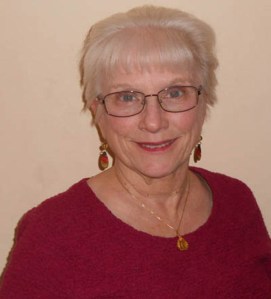 Elaine L. Orr writes four mystery series, blogs, keeps in touch with lots of family and friends, and tromps cemeteries looking for long-dead ancestors.
To learn more, visit https://www.elaineorr.com.
…




 My historical stories are all set in Imperial China, specifically (at this point) in the late 1300s, the beginning of the Ming Dynasty. The first three—Hidden, Warned, and Trapped—is a young adult trilogy that I had been thinking about and working on for many years. My educational background is anthropology with an interest in Chinese culture and traditions. Of course, that was long before I retired from jobs that did not specifically involve much of this training.
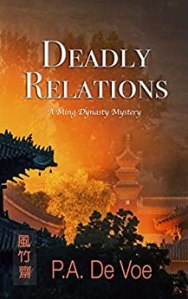 Also, research is needed to get a realistic picture of what’s happening at the local level, beyond the Emperor’s court. In my newest series, A Ming Dynasty Mystery (Deadly Relations and No Way to Die), I wanted to show life from both a male and female perspective. The male character, Shu-chang, was easy to develop. He’s an amalgamation of striving young men struggling to achieve social and economic success through the long-standing Chinese merit system which was based on an examination process. There are many, many examples of such young men.
 The female character, however, was more difficult because I wanted her to be educated and to have freedom to act outside of her home. At the same time, she had to be realistic. I couldn’t simply give her a contemporary mindset in order to create an interesting story. After all, she lived in a period and culture with a different set of expectations for men and women. Fortunately, while reading broadly, I ran across an account of a learned woman who had trained as a professional women’s doctor under her own grandmother. I was able to use her as a model on which to build my character Xiang-hua. I now had a strong female protagonist that I felt was also true to her time and place.

 I had mixed emotions about some of it. We’d been to that resort before, and they have a couple of large pools containing dolphins that appear to be well treated considering where they are, but having such smart animals that are originally from vast sea environments contained like that… Well, I’ve researched dolphins. They’re wonderful beings. As smart as humans in their environment. Am I inspired to write about them? I’ve always been inspired to write about them, but definitely not in situations like that—unless they can find a way out and get revenge!
 The Writers in Residence
You must be logged in to post a comment.