
By Maggie King
Many years ago I read a mystery with so many words I didn’t know that I had to keep my dictionary close at hand. As I enjoy learning new words I liked the experience the popular author provided. But when I mentioned it to a couple of friends, they said, “Not me. I’d have put that book down, and fast. I want to read words I already know.”
I’ve always had a love of words. I fondly remember vocabulary lists in high school: perspicacious, truculent, vapid, loquacious, polemic, specious, logy. With all those big words swirling through my brain, you’d think my SAT scores would have been more impressive than they were.
When I presented my manuscript for Murder at the Book Group (my debut, published in 2014) to a long-ago critique group, the members advised me to ditch the big words. “What big words?” I asked, bewildered. They named a few but the one that stuck with me was “diatribe.” I didn’t consider diatribe a big word and it would surely be understood in context, as in “Arthur ignored his mother and carried on with his diatribe against Evan.”
The upshot was that I kept diatribe, but changed some of the other “big” words.
A word I recall from reading Nancy Drew was “elated,” as in “Nancy was elated by the news.” The context wasn’t clear, so I ran to the dictionary and learned that Nancy was ecstatically happy by the news. Elated is a wonderful word to teach a ten-year-old.
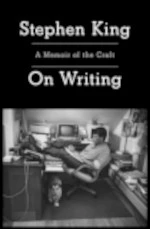
One of my favorite books on writing is On Writing: A Memoir of the Craft by Stephen King. In the book, King says, “Wherever your vocabulary is at today is fine. There’s no need to learn more words or different words. Whatever words you know right now, you use. This will help you develop your voice and sound unique.”
Is using big words in a story a good idea? In my opinion, the answer is yes—as long as the writer chooses words whose meaning and context is easily understood. A thesaurus is a great tool, but don’t use it to come up with words you think sound cool and sophisticated. Readers have a wide range of word knowledge but even those with an impressive vocabulary feel that showing it off is pretentious.
To sum it up: use your best judgment.
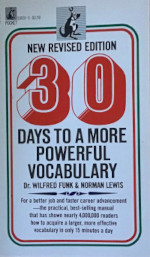
In the meantime, I’ll hang on to my precious dog-eared copy of 30 Days to a More Powerful Vocabulary and see how many of the words I learn end up in my writing. Ceraunophobia, anyone?
To swear or not to swear?

Do your characters swear? Do they swear too much? Not enough? Should they swear at all?
Personally, I don’t get exercised over swearing. Let’s face it, people swear—some a little, some a lot, some only when “necessary.” Swearing can add a touch of realism to our writing (after all, what does one say when tripping over a dead body?). We’ve all known colorful folks who liberally season their conversations with salty words. For one story, I created a character loosely based on a former co-worker who never felt the need to censor her speech. Not a word of it.
But my readers object to profanity and I must respect their wishes. There are ways to suggest swearing and author Naomi Hirahara is so skilled at this that you know the exact word she’s not using. Another author, F.M. Meredith, has this to say about the lack of salty language in her Rocky Bluff P.D. series: “Oh, the characters do cuss, I just don’t quote them.”
Here are ways I’ve suggested swearing in my stories: She shrieked a litany of curse words; She continued to scream and curse …; He included a few four-letter words of a sexist nature; Donna slurred a few non-PG13 adjectives to describe her feelings for her ex; Kat cursed a blue streak (I wouldn’t choose this one again, as it’s a cliché that sneaked past me and my editor).
On several occasions I’ve presented a seminar/webinar on dialogue and tackled the question of profanity. This is how I answered the question “To swear or not to swear?”:
• Know your reader and your genre. Cursing and four-letter words are more acceptable in a thriller than in a romance or a cozy mystery.
• Refrain from profanity in narrative, but an occasional expletive in dialogue is acceptable (depending, of course, on genre).
• Realize that profanity is more noticeable in a novel than it is in real-life conversation.
Again, use your best judgment. And ask your beta readers for feedback.
Your thoughts?


 The Writers in Residence
You must be logged in to post a comment.