A LOOK INSIDE IN-PERSON SELLING

By Bonnie Schroeder.

When I moved from California to Idaho in 2018, I also transitioned to being a self-published author. Until then, I’d had the benefit of a wonderful publisher, Champlain Avenue Books, behind me.

Alas, they closed their doors soon after my relocation, and I went solo. I’d done a handful of in-person selling events in SoCal, but I confess to being a lazy self-marketer. In SoCal my experience with those events mostly took place in libraries, and all I had to do was show up with my books and hope readers would buy them.

In Idaho, however, with three self-published books on my resumé, I realized I needed to be more proactive in getting those books into readers’ hands. One way to sell books in person is through trade shows known variously as craft fairs, book festivals, holiday bazaars, and a few other names (some of which I shall not print here.)

There are many book fairs in libraries here in Idaho, but there are also a lot of general craft fairs, big and small, all over—in parks, high schools, even specialty grocery stores. And many of those events take place outdoors—which, in Idaho, means contending with weather extremes. I’ve done festivals where I had to pull my luggage cart full of books through snow, and others in a field where the daytime temperatures grazed 108 degrees.

Weather conditions are only part of the fun. I also learned that I needed to supply my own “equipment”—i.e. tables, chairs, signs, decorations, and, in summer, canopies, shade walls, and a battery-powered fan. Another essential is a means of transporting my supplies—a sturdy folding hand truck for use on pavement, and a collapsible fabric wagon for other terrain.

I had the good fortune of connecting with two other “local authors,” Laura Jenski and Julie Howard who are pros at this, and they generously let me learn from them and shared tables and chairs with me as I began selling my books in person.

Laura has often recruited her husband to help transport tables and chairs to some events. She and Julie have also provided canopies for many events, and even when I brought the canopy, they assembled it while I parked my car.

I’ve done a few solo events as well, and I finally figured out I needed a checklist of supplies to bring, rather than searching through my memory every time:

  • Water (!) and food (!!)
  • Credit card reader (e.g., Square)
  • A supply of small bills to make change
  • Pens to sign books
  • Price list
  • Bookmarks, postcards, or other promotional material
  • The aforementioned decorations and/or a bowl of candy to lure potential buyers to our “booth.”
  • And oh yes—in Idaho (as in many states, including California,) one must secure a sellers’ permit to track, report, and pay sales tax to the state. Ironically, I learned that Idaho’s sales tax process is way more complicated than California’s.
  • Following Laura’s and Julie’s lead, I also realized I needed a large-ish poster with a picture of me and my books. My website and book designer Paula Johnson created the artwork, and my local Staples made the sign. I confess to feeling a surge of legitimacy at the result.

You know that saying, “It takes a village ….?” It is so true! In addition to help from the folks mentioned above, I send a thank-you to Heather Ames, a powerhouse on the festival circuit in Oregon. She sends me critiques of my table layouts, along with encouragement and examples, and I emulate her as much as I can without committing outright piracy.
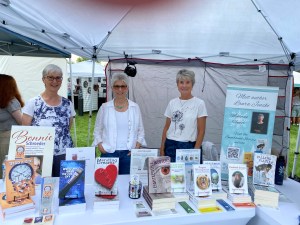
This photo shows my comrades Laura and Julie with me at one of our events, and it truly is crucial to have a support network at these things. Some writers, me included, are not especially outgoing, and it’s a challenge to attract and engage with visitors at the festivals.

Some are interested and kind, while others are dismissive—masters at avoiding eye contact. Now and then, however, a visitor will show up who bought one of our books at a previous event and liked it well enough to seek out the author and buy more. This truly makes our day when it happens.

What the photo doesn’t show is all the hours, days, weeks, even months of prep work involved in getting us to this smiling display—things like replenishing our inventory, posting on social media, packing supplies, hauling boxes of those books to the venue, and showing up sometimes before sunrise to set up the tables and arrange the display.

There are still festivals happening in Idaho, but I’m done for the year—saving my energy for the spring. I just registered for a book fair at a nearby library in April. Library events are the best, because you have a built-in audience, and this one is no exception.

So all you authors out there, whether traditionally or indie published, I hope you get a few ideas from this post. Get out and show the world your books, because—especially for indie authors—that’s an important way to grow your readership. Best of luck to you all.

Holy Cow! by Bonnie Schroeder

Bonnie_Schroeder-McCarthy-Photo-Studio-Los-Angeles-7187

Bonnie Schroeder started telling stories in the Fifth Grade and never stopped. After escaping from the business world, she began writing full-time and has authored novels, short stories and screenplays, as well as non-fiction articles and a newsletter for an American Red Cross chapter


I’m wrapping up our series of pet-centric posts today and hope everyone has enjoyed reading about the animals in our lives. . . and our writing.

I’ve had pets almost all my life, mostly dogs and cats, but few have had starring roles in my fiction.

My very first “published” short story, however, featured a cow as a main character, and not just any cow. My pet cow.

Here’s how it happened:

As a child, I spent my summers on my grandparents’ farm in northern New Mexico. It was a kid’s paradise, with all sorts of animal life: dogs and cats and chickens and pigs and cows. Being semi-obsessed by Western movies that were all the rage back then (mid-20th-century, that is), I often lamented that there were no horses on the farm.

The reason? Simple economics. My grandparents were not wealthy, and a tractor can do the work of many horses, without the attendant feed bills. My grandfather tired of my yearning for a horse, and he offered me what was, in his opinion, the next-best substitute: a docile milk cow named Brindy.

Brindy and I became fast friends during my summer visits. When I arrived, I’d race out to the pasture, climb over the fence and call to her, and she always came to say hello. I’d tell her how my time in California had gone, share a few confidences, rub her forehead and give her a carrot. When she was lying down, I’d often climb on her bony back and stroke her bristly hide. She was always gentle with me and seemed to enjoy the attention.Brindy

My favorite thing, though, was to help with the milking! You need VERY strong fingers to milk a cow, and I wasn’t always successful, but I kept trying. Milk straight from the cow, by the way, is nothing like the stuff you buy at the supermarket. It’s warm and thick and has a distinct, earthy taste.

How did Brindy come to star in my short story? As the product of a “broken marriage”—which was not taken so casually then as now—I was something of an outsider in school; friends did not come easily. But in the 5th grade, I discovered—or rather my teacher discovered—that I had a knack for creative writing. I suppose it came from all the time I spent alone with my books, coupled with a wild imagination. My teacher gave the class an assignment to write a story about an animal, and without my even having to think too hard about it, a story emerged about a cow that wanted to be a horse. The cow in my story, of course, was named Brindy, and although she tried hard to act like a horse, she eventually came to realize horses didn’t have it all that easy: people riding on their backs, hauling heavy wagons, and so on. Brindy decided she was pretty darn happy being a cow.

The ”be yourself” message must have impressed my teacher, because she typed up the story, shared it with the class, and sent a note to my mother that my writing “talent” should be encouraged—which, of course, it was.

That summer when I went to visit Brindy, very full of myself for all the attention my story had received and the friends it had won me, my grandfather cautioned me that Brindy had given birth while I was away. Eager to see the new calf, I hurried to the pasture and climbed the fence. Sure enough, there was Brindy with the cutest little baby standing next to her. I called out to her and ran forward. At this point, Brindy lowered her head, bellowed, and charged. I was threatening her baby.

I turned and fled and barely made it to the fence without being trampled. When I told my grandfather what happened, he shook his head. “I warned you. She’s mighty protective of that calf.”

And so it was that I lost my friend on the farm. Brindy became a mom and had no more interest in me. It made me sad, but then my grandfather brought home a puppy, and when he presented it to me, my disappointment over Brindy melted away. We named the puppy Buck, and he lived a long and happy life, watching over me and protecting me from the many hazards a child encounters on a farm. I decided a dog was a more suitable pet than a cow, after all.

Brindy had abandoned me, true enough, but she was my first muse, and I have always been grateful to her for that. In return, I gave her a kind of immortality, at least on the written page. If cows have emotions—and I think they do—she’d be proud.

Respecting the Muse by Bonnie Schroeder

Bonnie_Schroeder-McCarthy-Photo-Studio-Los-Angeles-7077-Edit-web


Bonnie Schroeder started telling stories in the Fifth Grade and never stopped. After escaping from the business world, she began writing full-time and has authored novels, short stories and screenplays, as well as non-fiction articles and a newsletter for an American Red Cross chapter.


Most writers inevitably encounter the question, “Where do you get your ideas?” I’ve been on the receiving end more times than I can count, and I often wonder aLife after Lifebout other writers, too.

Where, for example, does Stephen King come up with all his intricate storylines? Where did Kate Atkinson get the idea for Life After Life? 

Actually, ideas are everywhere, and they’re often triggered by those magic words, “What if . . ..?”

In my experience, however, the initial spark tends to morph into something quite different when I begin to work on a story. My first novel, Mending Dreams, came about because I knew a woman whose husband did the same thing my protagonist’s husband did: came home one day and told her he was leaving her because he was in love. . . with another man. “What if,” I wondered, “that had happened to me? How would I react?” The eventual premise turned into something quite different than I expected, as themes of love and courage emerged from the mess I created in those first pages.

I was married to an artist in the 60s and 70s, and as I was looking over old photos from those days, I asked myself, “What if my husband had become really famous?” This led to Write My Name on the Sky, which will be published this summer. The story changed tremendously in the execution, but that first flash of inspiration arose from those old pictures.

A couple of years ago, during my annual physical exam, my doctor remarked that both my hearing and breathing capacity had improved in the past year. Hmmm. What if I was growing younger? That idea became the cornerstone of the novel I’m currently writing, and it’s become more than a case of mere wish fulfillment.

Webster’s New World Dictionary defines “Muse” as “a source of genius or inspiration,” but I have other names for her. She is quite a trickster, and if I don’t pay attention to her whispered ideas, they vanish like smoke. That’s why I am almost never without pen and paper—or in today’s world, without my trusty iPhone, which I use to record the Muse’s suggestions and sometimes even to photograph the source of them.

Yes, ideas are everywhere, but writers need to respect them when they appear; don’t squander them; nurture them and preserve them.

I believe the writing process is at least one part voodoo. Inspire

For me, it seems that once I set my intent to write about a particular topic, the creative universe springs into action. For my woman-getting-younger novel, even while I was sketching out the premise, articles started appearing in newspapers and magazines I read, about “age disruption” and “life extension.” My research file on the subject is over six inches thick!

I would love to hear from my fellow writers and readers about this subject. What inspires you? Where do you get your ideas? And how do you hang onto them when they appear? What do you do with them? Please share!