
I went to a gathering of local writers from Devon and Cornwall last week. Although I have been living back in the UK for five years, I have been a bit of a recluse. A lot had to do with Covid and the self-enforced isolation that seemed not only to curb my freedom, but my confidence too. It’s only now that I am slowly putting out feelers and making new writer friends.
Anyway, about twenty of us met in a lovely restaurant in Exeter and I found I was sitting next to a writer who epitomizes the word “prolific.” I won’t list the number of books of all genres (from Sci-Fi to Romance and non-fiction to ghost writing), that she churns out annually but what stopped me in my tracks (actually, I almost choked on my Halloumi fries) was her goal to write HALF A MILLION WORDS a year. And she casually said she usually comes close.
My first thought was that she had to be a robot. My second, maybe she uses ChatGPT, or maybe she’s a “first line writer.” I use that phrase because my former husband wrote for a TV show and was once accused of being a “first line writer” which upset him greatly. For those unfamiliar with the term, it’s an insult literally saying, “writing the first thing that comes to mind.” I did ask my new writer friend (who was also very nice which made it hard to dislike her) her process. Was she a Pantzer? Did rewriting, editing, and proofreading count towards the magic 500,000 words but nope, I was assured her words were all brand new.
So what’s wrong with me? If I’m lucky, on a good day, I could write nine hundred new words. I’ll probably go back and rewrite them a few times. My books under contract ask for 70,000 to 75,000 words (relatively small if you are used to 80,000 and above). Once, I wrote two books in one year so that topped at 140,000. I never used to be obsessed with my word count until that lunch.
To make myself feel better, I did a bit of research. In my defence, I still have a full-time job, a sick mother, two demanding dogs and – fanfare of trumpets – I’ve just become a grandmother for the first time … so I’m a little busy.
Even so – here are a few famous authors and their daily word counts.
- Tom Wolfe: 135 words. As you can imagine, each book takes a very long time to write.
- Ernest Hemingway: 500.
- Graham Greene: 500. He said that when he has written his 500 words, he stops – even if it’s in the middle of a scene.
- Ian McEwan: 600.
- W. Somerset Maugham: 1,000. Maugham said there was no set formula on writing. “There are three rules for writing a novel,” he said. “Unfortunately, no one knows what they are.”
- Peter James: 1,000. Once you start writing a book, make time to write every single day. Find a comfortable number of words for you to write each day and stick to that number. I am comfortable with 1000 words.
- Margaret Attwood: 1,000-2,000.
- Mark Twain: 1,400 to 1,800. Twain believed that location was important to his word count. I write very well on transatlantic flights, so I think he has a point.
- Lee Child: 1,800. He says it takes him about six months from the first blank screen until the end.
- Stephen King: 2,000. As a side note, if you haven’t read his book On Writing: A Memoir of the Craft, or you haven’t read it for a while, it’s worth revisiting. Stephen says that following this would add up to about 180,000 words in three months … well on track for the annual 500,000 goal but what about rewriting? Speaking of Ernest Hemingway, he famously said that “All writing is rewriting.”
- Nicholas Sparks: 2,000. He says his is a daily goal which takes him about five or six hours to write.
- Anne Rice: 3,000.
- Arthur Conan Doyle: 3,000.
- Michael Crichton: 10,000. Okay, this one got my attention. He’s up there with my new writer friend.
POSTSCRIPT: Okay … yesterday I was part of an event at the Torquay Museum called Crime at the Coast – sitting next to me was another prolific author who writes four, 70,000-word cozies a year, screenplays for her TV job and a standalone. I didn’t have the courage to ask her if she topped half a million words a year but one thing is certain, I’m just desperately slow.
So … what about you? Do you write to a daily word count?

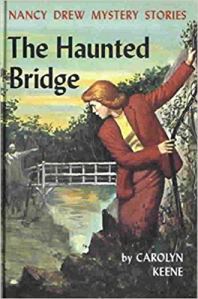 The only physical description we have of Nancy Drew is her “titian hair” and “blue eyes.” However, we hear a lot about her chic wardrobe and apparently endless clothes closet. Beyond her stylish threads, Nancy often dresses in costumes and old garments found in attic trunks. When the books were originally released in the 1930s, low-income readers could imagine wearing Nancy’s pretty outfits for themselves.
 The books are set in 1967, an era of vibrant and varied clothes. Poodle skirts and bobby socks gave way to miniskirts and pillbox hats. East Indian garments were in style. The “British invasion” of roc
 Destiny King is an African American agent who takes Noelle on her spy missions. Destiny sports a trimmed Afro and frequently wears jumpsuits. Her clothes are functional in more ways than one way. For example, she has a pair of earrings that are really plastic explosives.
 Sally Carpenter is native Hoosier living in southern California. She has a master’s degree in theater, a Master of Divinity and a black belt in tae kwon do.
 The Writers in Residence
You must be logged in to post a comment.