An Interview with Author, Maureen Jennings

By Jill Amadio

It hasn’t yet run as long as Agatha Christie’s “Mousetrap” in the West End, the theater district of London, U.K.,  but Maureen Jennings’ Detective Murdoch television series is well on its way to a record fourteenth year for the mystery author. A “Brummie” from Birmingham in the north of  England who emigrated to Canada as a 17-year-old and now lives in Toronto, she lends her British roots to one of her three series, the World War II DCI Tom Tyler cases, setting the books in the market town of Ludlow, in the Shropshires, U.K.

“I visit Ludlow annually”, she said a few days after being honored at the 2019 Left Coast Crime conference in Vancouver, British Columbia. “I love being in Ludlow. I wanted to write the Tyler series there because of the war years, which affected people so deeply.”

Her first foray into creative writing was three stage plays, all of which were produced, although she says, at very small theaters. She then turned to books.

As one of the top and most popular mystery authors in Canada, the Jennings’ Murdoch Mysteries (titled The Artful Detective in the US) was brought to the viewing public first as three Movies of the Week and then as a television series. Set in Toronto in Victorian days, ‘When people tended to be much more aware of good manners and polite behavior,’ the crime novels number eight so far, although the TV episodes number many more. A team of six writers creates the scripts, with Maureen writing one show a season and acting as creative consultant for the others.

After ensuring that the Murdoch books were pretty well established, but still writing a couple more later, Maureen launched the private investigator Christine Morris series. Although its future as a film is currently in limbo, she notes.

Another project, a drama titled  ‘Bomb Girls,’ was a concept derived from a Tom Tyler mystery and has become a TV series, written by Maureen with a partner. Thus, Maureen successfully mixes stage, screen, and literature. Indeed, she is regarded as a national treasure in Canada and has won so many literary awards in North America and in other countries, that it staggers the mind. The Toronto Star newspaper named her as one of 180 people who have influenced the history of their city through her mysteries.

So who is Maureen Jennings?

Married to photographer Iden Ford, who is also her literary agent, she has a constant reminder (at her feet) of her fictional Toronto detective. A dog called Murdoch. ‘He requires a daily morning walk, and that sets me up beautifully. I come back and can get going. In the evenings, I have less energy and usually use that time to read and do research.

As regards the books, I wanted to commune with ghosts of the past in Toronto, which has largely disappeared, and [back then] it was easier to include forensics, which was not as advanced as it is now.’

All the Brits from the Golden Age were and still are her inspiration, especially Arthur Conan Doyle and John Le Carré.  ‘I have always loved reading mysteries. Fell in love with Sherlock, still am. I like the notion of two-for-one, that is, you get a good story and learn something at the same time. For me, that’s typically history, which I love,’ she said.

Maureen calls getting her first book published a stroke of luck when Ruth Calvin at St Martin’s Press took a look at her manuscript at the urging of a friend, and bought it. Since then, she has mastered just about every writing discipline: books, scripts, short stories, and poetry. Yet this woman who streams so many, many words didn’t start out to be a writer. She studied psychology and philosophy at the University of Windsor and received an M.A. in English Literature at the University of Toronto.

She turned to teaching at Ryerson Polytechnic Institute, then practiced as a psychotherapist. Maureen believes that her expertise in that field has helped her create characters that are believable and their motives credible, although keeping them straight requires making careful notes. Her latest is the PI Charlotte Frayne series, starting with ‘The Heat Wave,’ which launched in March 2019 and brings the character into contact with Murdoch’s police detective son.

Her writing process involves outlining in detail. ‘That might change in small ways as the book grows, but I have found that if I don’t do that, I waste a terrible amount of time. I know some writers say they just start off, but I couldn’t imagine that. It would be like getting in the car and saying I’m going to drive somewhere now, but I don’t know where exactly. I’m not that kind of traveler. I have to have the hotel booked.’

A lover of history and a meticulous researcher, Maureen delves into primary sources, including newspapers and Coroner and Chief Constable reports, bringing her skills in particular to one of her latest mysteries, ‘A Journeyman to Grief,’ a recounting of life in the small black community in 19th century Toronto, much of it unknown to most of the city’s present residents.

Maureen’s biggest challenge?

‘Making sure Tyler didn’t look and sound like Murdoch. As for themes, they sort of come to me unbidden as I am researching. For instance, I was recently reading about Safety in the Workplace and how late that was in being established. That immediately became the focus of my next book, which is set in 1936.’

Any advice for first-time writers?

‘Oh dear. I know how hard it can be and how easy it is to get discouraged. But I absolutely believe that passion plus preparation leads to opportunity. I love horse racing and often think of it as a metaphor. Most of the horses and jockeys are more or less of equal ability, but the ones that win do so because they seize the opportunity when the gap opens up ahead of them and they gallop through. They’re ready. They’ve done their homework.

Also, I don’t think you should ever stop studying the craft, whether it be novels or theatre or film.’

An Interview with Wendy Walker

by Jill Amadio

Sometimes, as writers, we flounder around seeking ideas, whether from our own lives, others’, and from the daily grind we read about in the media. One author I greatly admire is Wendy Walker. I interviewed her recently, and am sharing her impressive insights here. Her multi-faceted career has included commercial litigation, investment banking, and world business. She lives in Connecticut and writes novels, thrillers, and audio originals.

  What is your background? Has it provided material for you?

I’ve worn many hats in my life! Once an aspiring figure skater, I redirected that energy to get a job at Goldman Sachs in mergers and acquisitions just after college. At the time, I never thought about being a writer. From there, I went to law school and worked in corporate litigation, and later family law. I was a stay at home mom for several years, and it was then I started to write. It took seventeen years to make this a sustainable career, and I have been a full time writer ever since! I use all of my experiences in my work – from legal knowledge, to finance, to parenting, and especially the psychology I learned while being a family law attorney.

Any characters based on you, as your alter ego

I think there are parts of me in all my characters. But the one I drew most closely for is Molly from “Don’t Look For Me.” While the character was eventually given some very difficult situations, including the loss off a child, which I do share, the initial spark for her and the book came from a moment I had one afternoon when I felt overwhelmed by life and my responsibilities as a mother. Her love for her children and the heartache that love can bring, are deeply explored in the book.

When did you decide to become a suspense writer, and why?

After publishing two novels that were general fiction I almost gave up on writing. The books didn’t do very well and I was no longer able to juggle writing, being a lawyer, and a single mother with three children. I asked my agent at the time what I could write that would be more marketable and she said, “the next ‘Gone Girl’.” I had heard of the book but didn’t really know what was different about it. When I looked at the genre of psychological suspense, I knew I had found the perfect home for my interest, skills, and knowledge.’’

Where do you get your inspiration?

Book idea comes from everywhere. I think once you know you need to find them, you begin to see them in every aspect of life. From news stories, to things I hear about people, and experience myself, ideas are sparked. My philosophy is this – if something catches my eye ad makes me curious, then it will probably be the same for others. I make a mental note of it and then ask questions about what made me take notice and what could be the story behind it. Not all of these moments lead to as book idea, but many do.

What is your writing process, routine, if any?

I have to write first thing in the morning. Staring at a blank page is very difficult for me. I find that I will do almost anything to avoid it. Even tasks that I normally would not look forward to will pull me away from sitting down to write. I will usually find a place away from my desk that feels less like doing work. I like to put my feet up, I have my laptop on my lap over a blanket, with a cup of coffee and some little treats nearby. That way, I feel like I’m not working, but having a luxurious morning.

How important are minor characters?

All characters in a book are important. I think of them as scaffolding for the main characters and the plot. Through minor characters, I can challenge, explore, and deeply develop the other characters that are more central to the book. Sometimes, the minor characters will become so interesting to me that I will bump them up to major characters and give them more page space.

How do you do your research?

I rely very heavily on the Internet and also specialists in different fields for my research. I will usually start online to get a rough idea of the topic and then find someone who works in the field or has personal knowledge of the aspect of the book that I’m researching.  People are remarkably generous with their knowledge  and time. I always feel a little bit nervous when I reach out to them and explain my plots. Sometimes they will just laugh, and other times they will come up with plot twists that they have thought of themselves. It’s fascinating!

How did you become editor of some of the Chicken of the Soul books?

After my first two novels were published and I realized that I had not established a financially sustainable career, I began to look for all kinds of work as a writer. At the time I had not practiced law for several years while I was staying home with my kids. I still wanted flexibility to be with them after school, so I was reluctant to go back into that field. As it turned out a local business group had purchased the business of Chicken Soup for the Soul. They asked me to edit a book about being a stay-at-home mom, I ended up doing three books with them and it was a wonderful experience.

Do any suspense authors inspire you? If so, why?

I find inspiration in almost every book that I read in this genre. Whether it’s a particular plot twist that took my breath away or the depth of a character, or a writing style, each book is unique and has something to offer in terms of learning to be a better writer myself. I look at writing as both creative and technical. I need to have idea and character, but I also need a box of tools that I can use to tell the story. It’s wonderful to have so many talented people in the field to draw inspiration from.

Favorite settings?

Most of my books are not dependent on the setting. I like to explore my characters’ minds. For me, that is the setting hat I like to be in when I’m writing. Some of my books do not even give the names of the towns where they take place. Of course, it’s important to have some context for the characters in the world they live in. I make sure to sketch those out, but many books tend to be very light on setting and deep on the emotional lives of my characters.

Are you an outliner or seat-of-pants?

 I outline everything. In fact, I have a lot of trouble writing without a very detailed outline for every chapter. This is because my books tend to have complex plots  where many pieces that need to fit together. I start with a basic plot sketch, and then I make a list of disclosures that have to be made throughout the story so that the reader will be intrigued and the twists can be developed properly. From there, I create a detailed plot outline where each disclosure is added. This make it much easier for me to dive into the more creative aspects of the process, because I know that the technical pieces have been taken care of.

If your characters ‘talk’ to you, what is the experience like?

I’ve never noticed a particular moment when a character is ‘talking’ to me. But I definitely try to get into the head of my characters when writing their internal thoughts and dialogue. I tend to write in the point of view of the character and I love writing in first person. This allows me to really become the character while I’m writing, and live vicariously through them. From detectives to criminals to mothers and daughters, it’s a lot of fun to be different people every day.

Which is the most difficult part of writing suspense for you?

The hardest part about writing crime suspense is coming up with a plot twist that hasn’t been done, or that a reader  won’t see coming. The genre of psychological suspense is known for its twists that are not just the reveal of the good guys and bad guys. They are twists that are more based on assumptions made by the readers about timeline and characters’ intentions. Readers have become very savvy. And coming up with twists is not something that can be forced. All of mine have come when I have been doing other things away from my computer. But when they do come, it’s really extraordinary.

Publishing history?

In 2008 and 2009 I published books that were in general fiction. They were stories about women in the suburbs. I was interested in exploring the dynamics that exist between husbands and wives and also the impact of wealth on communities. When those books did not establish my career, I went back to practicing law. At the time, I found work as a family law attorney. I kept writing and eventually found my way to the genre of psychological suspense. I was going to write one last book before giving up altogether and I wanted to make it as practical as I could from a business standpoint. I got the great  advice to write a thriller and it turned out to be the perfect home for me. I wrote “All Is Not Forgotten” in the spring of 2015 and it sold in July at a five-way auction! Since then I have written five more thrillers, plus three audio originals. I am very grateful for this career.

Your marketing plan, or does the publisher handle it all?

More and more authors need to be their own publicist. While the publishing houses do a great job at promoting books, so much is done on social media now. I had a book coming out in June (2023) and I spend most of my time these days organizing my event schedule, creating content for social media, posting to social media, and providing content for blogs and other media outlets. Every author will tell you that this is now a central part of our career.

Which book was the most enjoyable to write?

Every book I’ve written has been enjoyable and in different ways. If I had to choose one, it would be my first thriller, “All Is Not Forgotten”. Because the book was not under contract, and because it was my first time writing a psychological thriller, I had a freedom in writing that was really wonderful. I was able to put on the page whatever I felt was relevant and important to the story. Ad I was also able to create a plot and characters that I felt attached to. There’s a purity to the process that is impossible to re-create when others are weighing in on every aspect of the book from a marketing standpoint. And I am grateful for that because it’s so important to having continuing success in this career. But I will always cherish that experience.
Do you scare yourself with your plots/characters/settings?

That’s a great question! The only time I was scared was after writing a plot for a book that’s coming out in 2024. It involves a serial killer and I wrote one point of view that takes the reader through the attempted murder of a woman in her house. I ended up using the layout of my own house because it was just easier to visualize as I was writing. I wasn’t scared at the time but about a month, after I finished the book, my house alarm went off in the middle of the night. It turned out to be a door that swung open but in that moment my mind was turning to those chapters. It was very embarrassing when the people showed up!

Any tips for first-time crime writers?

My best advice is to gather as many tools as you can. Many people come up with great plot ideas and characters. But being able to put that story onto the page requires a lot of skill that has to be learned. When I wrote my first novel I did not have the skills. It was a legal thriller that was never published and probably never will be. I had a great idea and thought that my writing skill as a lawyer would be sufficient. I read a lot of books in the genre and tried to understand how they were written. It was not until I worked with a writing professor that I realized the specific tools that are utilized in this process. It was a big mistake that I made and I wish I had taken a class or worked with a professional before I sat down to write my novel.

Your current WIP?

I am now writing two pieces of work every year. One is a traditional printed novel of psychological suspense. The second is an audio original that is fully scripted. At the moment I am about to begin drafting another audio play that will likely be out in 2025. I also have the audio play that I just finished coming out in 2024 that is called “Mad Love”. So I am very busy! But I love it.

Welcome Cozy Mystery Writer Hannah Dennison from the UK!

 Today, we are introducing one of our two NEW members – Hannah Dennison. Several of us have known her for quite a while, so it’s a treat to have her join us.
Welcome to The Writers in Residence, Hannah!

Q: We know you live on the other side of the world from most of us, so tell us just where DO you live now. What’s your house like?  And what’s the weather like there right now?

HANNAH: “I live in a tiny hamlet called East Leigh which is about three miles from the ancient market town of Totnes  I’ve included a link here in case anyone is interested. It’s such a beautiful part of the UK. I feel very fortunate and of course, I am close to my family here too. I live in a small barn conversion on what would have been a working farm fifty years ago. As I type this – the sun is shining and it’s cold. We’ve had torrential rain however and many of the fields are still water-logged which reminds me, my Wellies are leaking.”

Q: From your website/blog bio we learn you were born in a little village called Old Basing in Hampshire, England. Its claim to fame was the siege of Old Basing House during the “very bloody” English Civil War.

HANNAH: “Yes. as children, my sister and I used to play among the ruins and in the secret tunnels. I dreamed of musketeers and knights in shining armor and I’m quite sure it was there that I first discovered a passion for telling stories. My mother said I told fibs but I just liked to embellish my version of events because they seemed more interesting.”

Q: Ah, fibs and embellishments – the makings of a good fiction writing!  Okay, let’s get personal. What is your favorite chocolate! You do like chocolate, right?

HANNAH: “Not like, LOVE. Slabs of Bourneville and tubes of Smarties – those are my favorites.”

Q: What about coffee? Fave brew or style?

HANNAH: “I have a Keurig machine with k-cups. I’m a dark French Roast fan.”

Q: We know you have a daughter, is she a writer too?

HANNAH: “She’s not a writer but she’s got a very sharp eye and often proofs my newsletters. Sarah is a buyer for house and homeware and before Covid-19, traveled all over the world. I’m very proud of her.”

Q: Vizslas? What are these, and tell us about yours? Pets or Protection?

HANNAH: “Ah … the Hungarian Vizslas. Vizlsa, is the Hungarian word for ‘pointer.’ They make excellent alarm dogs but they are also very affectionate and are nicknamed “Velcro Dogs.” They must be touching you at all times which can often be a challenge when you want to take a shower.

Q: They are beautiful! Writers love to read, so who are your favorite fiction authors?

HANNAH: “So many! It depends on my mood. Barbara Pym, Agatha Christie (of course), Dodie Smith, Carolyn Hart, Jilly Cooper, Barbara Erskine, Jane Austen, the Brontës, Dennis Lehane, Frederick Forsythe, Ken Follett., Samantha Ford. You did ask.

Q: Yes, I did. Great choices! If you could travel to any place around the world right now, where would it be?

HANNAH: “Africa. 100%. In another lifetime I worked for Coca-Cola Africa on the company jet (I was a flight attendant). I traveled all over the continent. It was magical.”

Q: Do you still teach UCLA Workshops?  If someone wanted to attend or apply, what would they do?

HANNAH: “I do but I won’t be teaching until next Fall since I am feverishly writing the tenth Honeychurch book. Here is the link for the amazing workshops on offer. https://www.uclaextension.edu/writers-studio  I know I would never have been published had I not taken classes there myself.”

Q: Have you ever considered writing a book on ‘how to write a mystery’? I know many would love to buy it.

HANNAH: “Well … it’s funny you should say that because I have thought about it. I’ve also thought about creating online writing workshops too. I think it’s finding the mental space to do it – life seems to get in the way of all my best intentions!”

Q: Besides a mystery writer with three cozy series published, you’ve had a LOT of amazing jobs and interests.  Here are a few. WOW!

  1. A disastrous stint in the British Royal Navy
  2. Avid supporter of the Society for the Protection of Ancient Buildings
  3. Cub reporter at a local weekly newspaper
  4. Secretary to a Formula One World Champion
  5. A job with a French antique dealer
  6. Flight attendant for private jet charters where you met Steven Spielberg
  7. A job with various film studios, reading scripts
  8. A job with an advertising agency in Los Angeles 
  9. Teacher of a mystery-writing Workshop at the UCLA Extension Writer’s Program

HANNAH: “Well … I think I stumbled into each one with no clear plan in mind at the time. The Navy was so embarrassing. I desperately wanted to travel and back in those days, Wrens (as they were called) didn’t go to sea. If I’d stuck it out, I might have been an Admiral by now – ha ha. Looking back, it all SOUNDS exciting but I was always in a state of panic. I was/am a single mum and so much of it was trying to make ends meet and survive. Little did I know that all these experiences would serve me perfectly as a mystery writer (or fictional murderess!)”

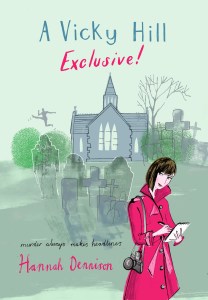
 And serve you they did!  The VICKY HILL MYSTERIES (6 books) are where you started.

Q: What should we know about Vicky?

HANNAH: “I love Vicky Hill. Of course, she is based on my experiences as an obituary writer for the local paper. Just like Vicky I was desperate for a front-page scoop … ANYTHING other than covering funerals and weddings. I was able to live out that fantasy on the page. It was also fun to incorporate some of the crazy British customs and traditions. Snail racing? Who knew!”

Q: What “family secret” does she have?

HANNAH: “Vicky’s parents are on the run. Her father is a famous silver thief known as The Fog. I must point out that neither of my parents ever broke the law (at least, if they did, I never knew).”

I love this aspect about her story. They don’t appear in most of the series, but I recently read TRAPPED, the Christmas Novelette from 2021, and was excited to meet them again!

Q: Is Gipping-on-Plym a real village? And if not, how did you come up with that name?

HANNAH: “Ah … what’s in a name. I agonized over that for weeks. I found the River Plym and then googled quirky place names in England and hey presto! Gipping-on-Plym was born.

Q: Who are the protagonists in your ISLAND SISTERS MYSTERIES? (2 books)
HANNAH: “The sisters are both in their mid-to-late thirties. Evie Mead, an amateur photographer, has just been widowed so her sister Margot Chandler, races to be by her side. Margot is a Hollywood producer and at the beginning of the series, she lives in Los Angeles (I know, I know … sound familiar?) They are both starting new chapters in their lives. Starting over seems to be a theme in many of my books.

Q: How did you come to set the series on this little island?

HANNAH: ”My sister Lesley introduced me to her friend Gill Knight who had worked as the HR manager on a tiny island called Tresco in the Isles of Scilly, an archipelago twenty-eight miles off the southwest tip of the Cornish coast. Gill said that those who came to work on the island were either hiding or running away from something or someone. I couldn’t think of a better place to set a mystery!”

Q: Wow, he really handed you that a perfect plot point! Will there be a third in the series?

HANNAH: “I am hoping there will be. I can’t leave the sisters hanging … Watch this space, as they say.”

Q: The HONEYCHURCH HALL MYSTERIES (9 books). What inspired you to begin this series?

HANNAH: “My mother.  Basically, when my dad passed away, Mum impulsively (and secretly) bought the wing of a country house. She was 72 at the time and my sister and I were horrified! The expense! The practicality of it all – it was on three floors, the roof was leaking, it was miles from anywhere but she was happy. It was her dream house. I’ve also always been interested in old buildings so this gave me an opportunity to highlight the fading glory of grand old country houses and the struggles to keep them afloat.

Q: Who are the two protagonists?

HANNAH: “Kat Stanford is the daughter (not based on me I may add, but my very practical daughter), and Iris who is definitely based on my mother – although Mum doesn’t write bodice-ripper romance books. I have to thank Rhys Bowen for that suggestion and it’s one that’s worked really well. The series also explores the intricacies of mother-daughter relationships.

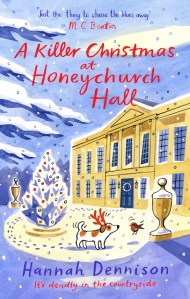
Q: Very cool! And finally, I hear there is a sweet white donkey named Hannah who has a cameo in your new Christmas book, A KILLER CHRISTMAS. Do you want to tell us how that came about?

HANNAH: “Oh dearest little Hannah the donkey. My best friend sponsored Hannah for my Christmas gift last year. I loved watching Hannah on the webcam – it was my daily reward after I’d done my wordcount. Poor Hannah died a few weeks ago – so sad. Her best friend Drizzle was bereft so of course I now have Drizzle. Here is the link to The Donkey Sanctuary if you feel the urge to take a peek.

#

Readers can purchase A KILLER CHRISTMAS AT HONEYCHURCH HALL as an e-book from Amazon right now.  Amazon Buy Link

Or they can order a PRINT copy from BLACKWELLS BOOKSTORE UK. Shipping is free. (I ordered a copy and it came within a week.)

#

Hannah, we feel so fortunate to have you as a part of The Writers In Residence.  And we will be waiting eagerly for your first post on January 18th, 2023.

Q: Do you have a closing thought for our readers?

HANNAH: “I know, without a shadow of a doubt, that if you say, “Yes” to whatever life has to offer, no matter how daunting, the most extraordinary things really can and do happen. After all, they happened to me.”

#

Readers: if you have anything else you are dying to ask Hannah, put it in the comments below. (If you don’t see “Reply” click once on the title, “Welcome Hannah Dennison” and it should come up.)