
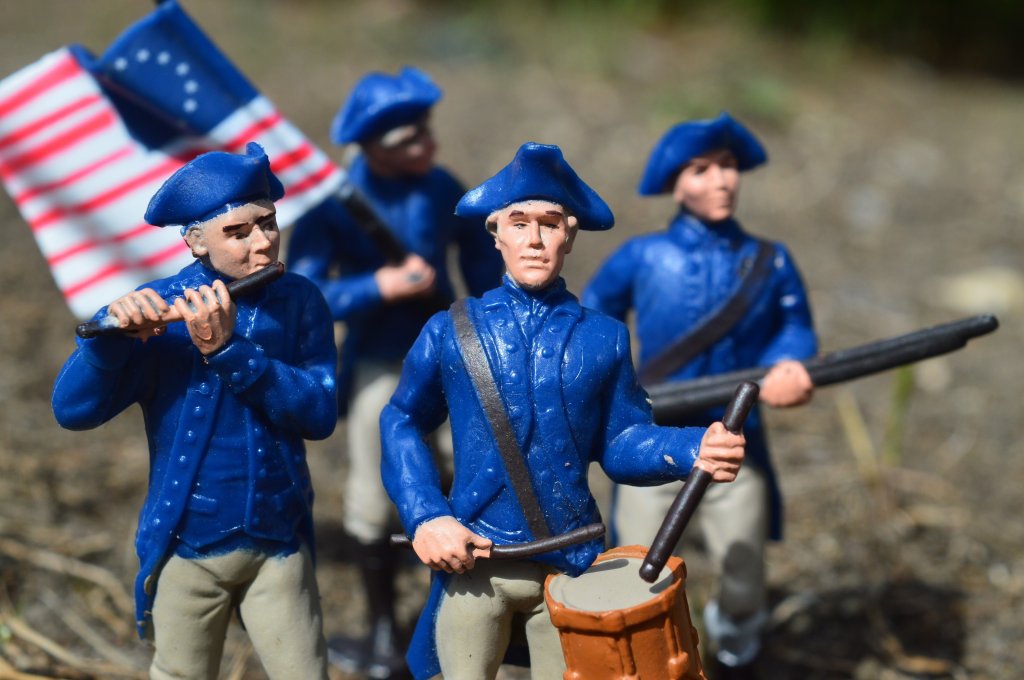
While I was researching my latest pet psychic mystery, Giddy Up for Murder, I discovered a few fun facts about the events surrounding the Revolutionary War that might change the way you remember these exciting events.
For instance, how would you like your Stars and Stripes with six-pointed stars?

When a group of men including George Washington visited Betsy Ross to ask her to create a flag to represent our new country, Washington suggested the six-pointed star used by his Mason Lodge. Betsy showed the general how much easier it was to cut out a five-pointed star. So, our current flag may have come to us because the original seamstress was tired.
How do we know the story told by Betsy’s children is true? We don’t, but several factors support this version.
- Several family members signed affidavits swearing her story was true.
- Paperwork exists that shows the Ross’s did work for George Washington
- Her late husband’s uncle was on the Flag Committee
- On May 29, 1777, the Pennsylvania State Navy Board paid Betsy for making flags, and on June 14, 1777, Congress adopted the Stars and Stripes as our official national flag.
I’m going with yes, it’s true.
How about the story of Paul Revere shouting, “The British are coming! The British are coming!” True? Or false?
While Henry Wadsworth Longfellow made Paul famous in his 1860 poem “Paul Revere’s Ride,” in reality, our hero rode into the night with two other men, William Dawes, and Samuel Prescott. Paul was detained by a British patrol in Charleston, while Prescott made it to Concord.
“Listen, my children, and you will here
Of the midnight ride of Samuel Prescott,”
Admittedly, this does not rhyme, so I understand Longfellow’s creative choice.
Two other riders are rarely mentioned: Isreal Bissel and Sybil Ludington, but theirs is a story for another day.
Much of the research an author does winds up in a file for possible future use. The Betsy Ross episode made it into my book; Paul Revere’s ride did not.
In Giddy Up for Murder, pet psychic Frankie Chandler attends a Revolutionary War reenactment. When a man dies, the only witness to what really took place is a horse with a vendetta against a person who could not possibly have committed the crime.
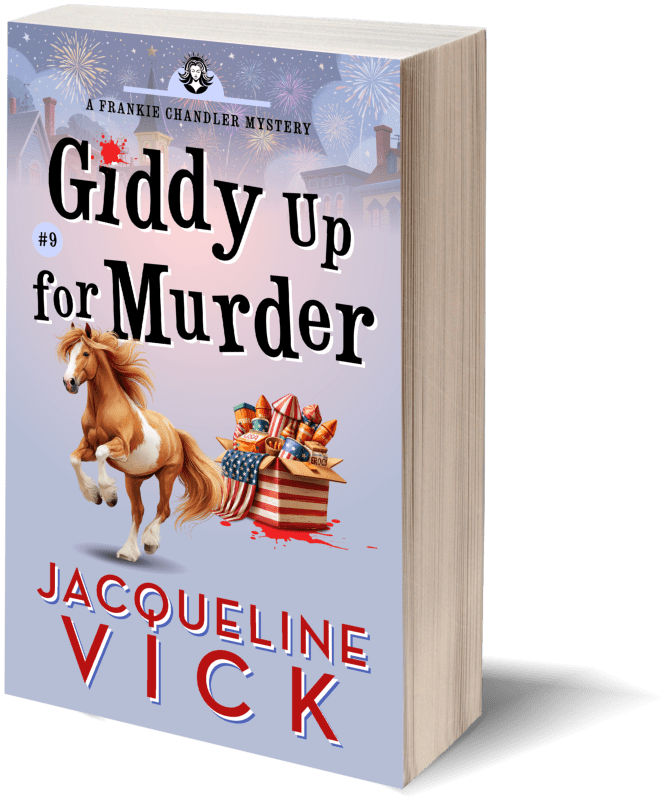
If you’d like to check out the book, the preorder is available now.
So, while you’re celebrating America’s semiquincentennial this year, why not dig into the patriotic tales you remember from childhood. What you find may surprise you.
Material on Betsy Ross gathered from Historic Philadelphia, Inc. article “Did She or Didn’t She?”
Material on Paul Revere’s ride gathered from Constitutional Facts article “The Five Riders.”


Adding a few historical facts to a fictional story is always fun. As I say in my three spy novels: “The facts are true…I made up the rest.” By adding those facts, the writer can educate as well as entertain the reader. I think that’s part of our job.
LikeLiked by 1 person
I gathered so much information for the reenactment that the first time I read through, I had to decide if it was a mystery or a history book. (Always so tempting to use those tidbits we find, isn’t it?)
LikeLiked by 1 person
Love your focus on American history. Will definitely need to read. We’re of like mind on Betsy Ross. I have a tongue in cheek post coming up (prior to Flag Day) on Betsy Ross where I come to the same conclusion that she most certainly convinced Washington and company to go with five versus six points. As a small business owner … she had to be busy, needed to shave some time. Plus, what did Washington or Robert Morris or her husband’s uncle know about flags. It was Betsy all the way. Ha ha.
LikeLiked by 1 person
It’s usually the person doing the work who has the best insights. 🙂 I’ll look for your post before Flag Day.
LikeLiked by 1 person
It’s a different take. A very light hearted take. Ha, ha. Rocky doesn’t make an appearance, but I can’t say the same about a few other Philadelphia cultural traditions. Ha, ha.
LikeLiked by 1 person
I hope you don’t mind but I gave your book a shout out in my post today. My whimsical look at Betsy’s role in our independence. Hope it helps. Congratulations again on the book release. Best wishes.
LikeLike
I learned the story about Betsy Ross in school, back when they taught true history, but not Paul Revere. Thanks for the entertaining post on the importance of fact checking, a necessity for the author of historical fiction novels. But regarding of the genre, adding historical facts gives credibility to a story and grounds it in reality.
LikeLiked by 1 person
I don’t remember hearing much about either of them in school. Then again, my memory has developed a few holes as I’ve grown older. The Paul Revere story was a surprise to me, as was the addition of a teenage girl. And I certainly don’t have to research as deeply as you do for your books!
LikeLiked by 1 person
Fun and interesting post! Now I need to find out more about the Revolutionary War, and this is certainly a good time to do so.
LikeLiked by 1 person
I’m betting you’ll do one search and be overwhelmed by posts and blogs on the subject. 🙂 Now, if only I could find an article on the dogs involved, right?
LikeLiked by 1 person
Thank you so much for having me on Writers in Residence!
LikeLike
Always love historical facts, Jackie!
Fascinating – thank you!
LikeLike
I like to think of them as “best possible scenarios based on supporting evidence.” 🙂
LikeLike