
by Jill Amadio
Sometimes, as writers, we flounder around seeking ideas, whether from our own lives, others’, and from the daily grind we read about in the media. One author I greatly admire is Wendy Walker. I interviewed her recently, and am sharing her impressive insights here. Her multi-faceted career has included commercial litigation, investment banking, and world business. She lives in Connecticut and writes novels, thrillers, and audio originals.
What is your background? Has it provided material for you?
I’ve worn many hats in my life! Once an aspiring figure skater, I redirected that energy to get a job at Goldman Sachs in mergers and acquisitions just after college. At the time, I never thought about being a writer. From there, I went to law school and worked in corporate litigation, and later family law. I was a stay at home mom for several years, and it was then I started to write. It took seventeen years to make this a sustainable career, and I have been a full time writer ever since! I use all of my experiences in my work – from legal knowledge, to finance, to parenting, and especially the psychology I learned while being a family law attorney.
Any characters based on you, as your alter ego
I think there are parts of me in all my characters. But the one I drew most closely for is Molly from “Don’t Look For Me.” While the character was eventually given some very difficult situations, including the loss off a child, which I do share, the initial spark for her and the book came from a moment I had one afternoon when I felt overwhelmed by life and my responsibilities as a mother. Her love for her children and the heartache that love can bring, are deeply explored in the book.
When did you decide to become a suspense writer, and why?
After publishing two novels that were general fiction I almost gave up on writing. The books didn’t do very well and I was no longer able to juggle writing, being a lawyer, and a single mother with three children. I asked my agent at the time what I could write that would be more marketable and she said, “the next ‘Gone Girl’.” I had heard of the book but didn’t really know what was different about it. When I looked at the genre of psychological suspense, I knew I had found the perfect home for my interest, skills, and knowledge.’’
Where do you get your inspiration?
Book idea comes from everywhere. I think once you know you need to find them, you begin to see them in every aspect of life. From news stories, to things I hear about people, and experience myself, ideas are sparked. My philosophy is this – if something catches my eye ad makes me curious, then it will probably be the same for others. I make a mental note of it and then ask questions about what made me take notice and what could be the story behind it. Not all of these moments lead to as book idea, but many do.
What is your writing process, routine, if any?
I have to write first thing in the morning. Staring at a blank page is very difficult for me. I find that I will do almost anything to avoid it. Even tasks that I normally would not look forward to will pull me away from sitting down to write. I will usually find a place away from my desk that feels less like doing work. I like to put my feet up, I have my laptop on my lap over a blanket, with a cup of coffee and some little treats nearby. That way, I feel like I’m not working, but having a luxurious morning.
How important are minor characters?
All characters in a book are important. I think of them as scaffolding for the main characters and the plot. Through minor characters, I can challenge, explore, and deeply develop the other characters that are more central to the book. Sometimes, the minor characters will become so interesting to me that I will bump them up to major characters and give them more page space.
How do you do your research?
I rely very heavily on the Internet and also specialists in different fields for my research. I will usually start online to get a rough idea of the topic and then find someone who works in the field or has personal knowledge of the aspect of the book that I’m researching. People are remarkably generous with their knowledge and time. I always feel a little bit nervous when I reach out to them and explain my plots. Sometimes they will just laugh, and other times they will come up with plot twists that they have thought of themselves. It’s fascinating!
How did you become editor of some of the Chicken of the Soul books?
After my first two novels were published and I realized that I had not established a financially sustainable career, I began to look for all kinds of work as a writer. At the time I had not practiced law for several years while I was staying home with my kids. I still wanted flexibility to be with them after school, so I was reluctant to go back into that field. As it turned out a local business group had purchased the business of Chicken Soup for the Soul. They asked me to edit a book about being a stay-at-home mom, I ended up doing three books with them and it was a wonderful experience.
Do any suspense authors inspire you? If so, why?
I find inspiration in almost every book that I read in this genre. Whether it’s a particular plot twist that took my breath away or the depth of a character, or a writing style, each book is unique and has something to offer in terms of learning to be a better writer myself. I look at writing as both creative and technical. I need to have idea and character, but I also need a box of tools that I can use to tell the story. It’s wonderful to have so many talented people in the field to draw inspiration from.
Favorite settings?
Most of my books are not dependent on the setting. I like to explore my characters’ minds. For me, that is the setting hat I like to be in when I’m writing. Some of my books do not even give the names of the towns where they take place. Of course, it’s important to have some context for the characters in the world they live in. I make sure to sketch those out, but many books tend to be very light on setting and deep on the emotional lives of my characters.
Are you an outliner or seat-of-pants?
I outline everything. In fact, I have a lot of trouble writing without a very detailed outline for every chapter. This is because my books tend to have complex plots where many pieces that need to fit together. I start with a basic plot sketch, and then I make a list of disclosures that have to be made throughout the story so that the reader will be intrigued and the twists can be developed properly. From there, I create a detailed plot outline where each disclosure is added. This make it much easier for me to dive into the more creative aspects of the process, because I know that the technical pieces have been taken care of.
If your characters ‘talk’ to you, what is the experience like?
I’ve never noticed a particular moment when a character is ‘talking’ to me. But I definitely try to get into the head of my characters when writing their internal thoughts and dialogue. I tend to write in the point of view of the character and I love writing in first person. This allows me to really become the character while I’m writing, and live vicariously through them. From detectives to criminals to mothers and daughters, it’s a lot of fun to be different people every day.
Which is the most difficult part of writing suspense for you?
The hardest part about writing crime suspense is coming up with a plot twist that hasn’t been done, or that a reader won’t see coming. The genre of psychological suspense is known for its twists that are not just the reveal of the good guys and bad guys. They are twists that are more based on assumptions made by the readers about timeline and characters’ intentions. Readers have become very savvy. And coming up with twists is not something that can be forced. All of mine have come when I have been doing other things away from my computer. But when they do come, it’s really extraordinary.
Publishing history?
In 2008 and 2009 I published books that were in general fiction. They were stories about women in the suburbs. I was interested in exploring the dynamics that exist between husbands and wives and also the impact of wealth on communities. When those books did not establish my career, I went back to practicing law. At the time, I found work as a family law attorney. I kept writing and eventually found my way to the genre of psychological suspense. I was going to write one last book before giving up altogether and I wanted to make it as practical as I could from a business standpoint. I got the great advice to write a thriller and it turned out to be the perfect home for me. I wrote “All Is Not Forgotten” in the spring of 2015 and it sold in July at a five-way auction! Since then I have written five more thrillers, plus three audio originals. I am very grateful for this career.
Your marketing plan, or does the publisher handle it all?
More and more authors need to be their own publicist. While the publishing houses do a great job at promoting books, so much is done on social media now. I had a book coming out in June (2023) and I spend most of my time these days organizing my event schedule, creating content for social media, posting to social media, and providing content for blogs and other media outlets. Every author will tell you that this is now a central part of our career.
Which book was the most enjoyable to write?
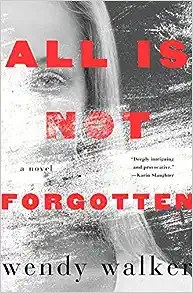 Every book I’ve written has been enjoyable and in different ways. If I had to choose one, it would be my first thriller, “All Is Not Forgotten”. Because the book was not under contract, and because it was my first time writing a psychological thriller, I had a freedom in writing that was really wonderful. I was able to put on the page whatever I felt was relevant and important to the story. Ad I was also able to create a plot and characters that I felt attached to. There’s a purity to the process that is impossible to re-create when others are weighing in on every aspect of the book from a marketing standpoint. And I am grateful for that because it’s so important to having continuing success in this career. But I will always cherish that experience.
Do you scare yourself with your plots/characters/settings?
That’s a great question! The only time I was scared was after writing a plot for a book that’s coming out in 2024. It involves a serial killer and I wrote one point of view that takes the reader through the attempted murder of a woman in her house. I ended up using the layout of my own house because it was just easier to visualize as I was writing. I wasn’t scared at the time but about a month, after I finished the book, my house alarm went off in the middle of the night. It turned out to be a door that swung open but in that moment my mind was turning to those chapters. It was very embarrassing when the people showed up!
Any tips for first-time crime writers?
My best advice is to gather as many tools as you can. Many people come up with great plot ideas and characters. But being able to put that story onto the page requires a lot of skill that has to be learned. When I wrote my first novel I did not have the skills. It was a legal thriller that was never published and probably never will be. I had a great idea and thought that my writing skill as a lawyer would be sufficient. I read a lot of books in the genre and tried to understand how they were written. It was not until I worked with a writing professor that I realized the specific tools that are utilized in this process. It was a big mistake that I made and I wish I had taken a class or worked with a professional before I sat down to write my novel.
Your current WIP?
I am now writing two pieces of work every year. One is a traditional printed novel of psychological suspense. The second is an audio original that is fully scripted. At the moment I am about to begin drafting another audio play that will likely be out in 2025. I also have the audio play that I just finished coming out in 2024 that is called “Mad Love”. So I am very busy! But I love it.


 The Writers in Residence
You must be logged in to post a comment.