Do You Really Want to Be a Writer?

by Jacqueline Vick

Lots of people dream about writing. And writing for yourself and your family is great. Recording memories. Journaling for fun and self-awareness. These are all wonderful, creative pastimes that I encourage. In fact, if you write, you are a writer.

I suspect what most people mean when they say they want to be writers is that they want to make a lot of money doing something they enjoy. And that’s an honorable goal. But there will be challenges.

One thing that stands out from my time with the Sisters in Crime Los Angeles Speakers Bureau is the number of people in the audience who asked published writers for tips and then rejected them.

Audience Member: How do you find time to write a book?

Writer: You need to write every chance to get. On the train or bus if you commute. During your lunch hour. Or get up early.

AM: I drive to work. My lunch hour is too short. I have enough trouble getting up for work. I have no time.

Audience Member 2: How do I sell my book?

Writer: You have to put yourself out there to meet other writers and readers. Meet with book clubs. Do library or bookstore events.

AM2: I’m too shy. And I don’t have a car.

Writer: If in-person events are a problem, there are many online opportunities available.

AM2: I don’t have internet access.

Writer: You could do paid advertising.

AM2: I have no money.

Based on those conversations, I thought I’d give aspiring writers a reality check in the most loving way possible.

If you want to write for a living, you will run into obstacles. You will either find a way over them or around them, but, if you’re serious, you will move forward.

There are many paths to publication.

Online zines publish short stories, and some of them pay. Competition is high.

Traditional publishers will most likely require you to have an agent submit your book, which means having a clean, edited copy of your manuscript along with a polished query letter. Check with each agent for their requirements. (Or the publishers, for those who accept direct submissions.)

Self-publishing. You will need to have a professionally edited book and a professionally designed cover. After that, everything falls under your responsibility: submission to the markets, marketing the book, and handling all business decisions and finances.

My point is not to scare you but to prepare you.

I spend my typical day writing AND marketing. At this point, probably 40% of my time is working on marketing, whether that is appearances on websites or blogs, testing creatives for ads, testing headlines for ads, testing primary text for ads, keeping up with trends, watching my ads and making adjustments, such as killing the ones that aren’t working and adding ones I hope will work better. And so on.

I also spend hours each week in marketing groups as well as writer’s groups.

Part of my budget is spent on tools that help make me a better writer and marketer. ProWritingAid for grammar. Fictionary for story development. Unbounce, Mouseflow, and Shopify for marketing and direct sales. And the plugins to make Shopify perform better. Not to mention the thousands of dollars I spend on ads each month.

Usually, I come out ahead, but there are no guarantees. Some months, especially when Facebook makes a change that affects the algorithms, I don’t. But it’s a growing and learning process. You need to hang in there.

If that sounds like something that interests you, I suggest you join a writer’s group that focuses on your genre. Sisters in Crime, Romance Writers of America, and Society of Children’s Book Writers and Illustrators are a few. They often have great resources.

Follow authors you like, especially those who write in the same genre, on social media. See what they’re doing. Study their Amazon book pages, author pages, or, more popular now, their direct sales shops.

And don’t expect overnight success.

If that sounds appealing to you—or at least it doesn’t scare you—good luck. May you have a long and fruitful career ahead of you.

###


A LOOK INSIDE IN-PERSON SELLING

By Bonnie Schroeder.

When I moved from California to Idaho in 2018, I also transitioned to being a self-published author. Until then, I’d had the benefit of a wonderful publisher, Champlain Avenue Books, behind me.

Alas, they closed their doors soon after my relocation, and I went solo. I’d done a handful of in-person selling events in SoCal, but I confess to being a lazy self-marketer. In SoCal my experience with those events mostly took place in libraries, and all I had to do was show up with my books and hope readers would buy them.

In Idaho, however, with three self-published books on my resumé, I realized I needed to be more proactive in getting those books into readers’ hands. One way to sell books in person is through trade shows known variously as craft fairs, book festivals, holiday bazaars, and a few other names (some of which I shall not print here.)

There are many book fairs in libraries here in Idaho, but there are also a lot of general craft fairs, big and small, all over—in parks, high schools, even specialty grocery stores. And many of those events take place outdoors—which, in Idaho, means contending with weather extremes. I’ve done festivals where I had to pull my luggage cart full of books through snow, and others in a field where the daytime temperatures grazed 108 degrees.

Weather conditions are only part of the fun. I also learned that I needed to supply my own “equipment”—i.e. tables, chairs, signs, decorations, and, in summer, canopies, shade walls, and a battery-powered fan. Another essential is a means of transporting my supplies—a sturdy folding hand truck for use on pavement, and a collapsible fabric wagon for other terrain.

I had the good fortune of connecting with two other “local authors,” Laura Jenski and Julie Howard who are pros at this, and they generously let me learn from them and shared tables and chairs with me as I began selling my books in person.

Laura has often recruited her husband to help transport tables and chairs to some events. She and Julie have also provided canopies for many events, and even when I brought the canopy, they assembled it while I parked my car.

I’ve done a few solo events as well, and I finally figured out I needed a checklist of supplies to bring, rather than searching through my memory every time:

  • Water (!) and food (!!)
  • Credit card reader (e.g., Square)
  • A supply of small bills to make change
  • Pens to sign books
  • Price list
  • Bookmarks, postcards, or other promotional material
  • The aforementioned decorations and/or a bowl of candy to lure potential buyers to our “booth.”
  • And oh yes—in Idaho (as in many states, including California,) one must secure a sellers’ permit to track, report, and pay sales tax to the state. Ironically, I learned that Idaho’s sales tax process is way more complicated than California’s.
  • Following Laura’s and Julie’s lead, I also realized I needed a large-ish poster with a picture of me and my books. My website and book designer Paula Johnson created the artwork, and my local Staples made the sign. I confess to feeling a surge of legitimacy at the result.

You know that saying, “It takes a village ….?” It is so true! In addition to help from the folks mentioned above, I send a thank-you to Heather Ames, a powerhouse on the festival circuit in Oregon. She sends me critiques of my table layouts, along with encouragement and examples, and I emulate her as much as I can without committing outright piracy.

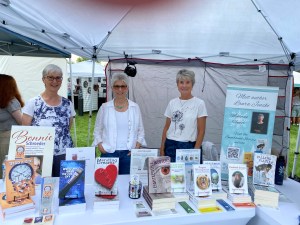
This photo shows my comrades Laura and Julie with me at one of our events, and it truly is crucial to have a support network at these things. Some writers, me included, are not especially outgoing, and it’s a challenge to attract and engage with visitors at the festivals.

Some are interested and kind, while others are dismissive—masters at avoiding eye contact. Now and then, however, a visitor will show up who bought one of our books at a previous event and liked it well enough to seek out the author and buy more. This truly makes our day when it happens.

What the photo doesn’t show is all the hours, days, weeks, even months of prep work involved in getting us to this smiling display—things like replenishing our inventory, posting on social media, packing supplies, hauling boxes of those books to the venue, and showing up sometimes before sunrise to set up the tables and arrange the display.

There are still festivals happening in Idaho, but I’m done for the year—saving my energy for the spring. I just registered for a book fair at a nearby library in April. Library events are the best, because you have a built-in audience, and this one is no exception.

So all you authors out there, whether traditionally or indie published, I hope you get a few ideas from this post. Get out and show the world your books, because—especially for indie authors—that’s an important way to grow your readership. Best of luck to you all.

Getting Out There

by Linda O. Johnston

Writers write. But to help sell what we write, we need to do promotion not only online, but also in person. So, we have to get out there.

Okay, I admit I’m doing it less than I used to before the pandemic. Not that I’m terrified about getting sick, but I kind of got used to not going to as many conferences as I used to. I previously attended Malice Domestic, Left Coast Crime and Bouchercon and the Romance Writers of America conferences often, as well as local meetings.

Now—well, I did go to Bouchercon and an RWA conference last year. This year, I’ve mostly just gone to meetings of local chapters of Sisters in Crime, Mystery Writers of America and Orange County Romance Writers, sometimes on Zoom.

Oh, and coming up will be the Los Angeles Times Festival of Books, and I’ll be signing at the local SinC and MWA booths there on Sunday, April 21.

Enjoyable? Yes. It’s always fun to see other writers in person, and to sell as many books as possible and get to autograph them for the buyers.

And I have to admit I miss the frequent lunches I used to attend with other Writers in Residence members. But some have moved away and it’s become more difficult to get together with any of them.

More conferences in the future? I hope to.

So—well, how do you get together with other writers these days? With readers? Only online, or do you see them in person too?