The Right Writing Space by Bonnie Schroeder


Bonnie Schroeder started telling stories in the Fifth Grade and never stopped. After escaping from the business world, she began writing full-time and has authored novels, short stories and screenplays, as well as non-fiction articles and a newsletter for an American Red Cross chapter.


THE RIGHT WRITING SPACE

Do you believe in magic? Do you have a special space where your creativity blossoms?
When I first started writing fiction, at age ten, I had a vision in mind: me, in a cozy office lit by Tiffany lamps, tapping away on a typewriter (remember, I said I was ten) and producing page after page of flawless prose, destined for publication and awards. Nowhere in my vision did reality intrude.
A few years later, my mom gave me that typewriter: a big black Remington. I thought I was really on my way to becoming A Writer then. Since no office was available, I put the Remington on a metal stand in a corner of my bedroom, taught myself touch typewriting from a book, and churned out story after story about misunderstood adolescents searching for . . . well, I’m not sure what they were seeking except my recycled versions of popular television shows.
Fast forward a few decades. The Remington gave way to a Smith Corona electric. More paper was sacrificed in my quest for publication. Still my writing didn’t catch fire—with me or anyone else. I plodded, and it showed.
In young adulthood, I bought myself a big old oak roll-top desk. Maybe that would help, I thought.
It didn’t. I still have the desk; it’s a lovely piece of furniture, and I sit at it to pay bills, make phone calls, and write shopping lists. But I don’t write stories there. The desk gives me claustrophobia, with its high sweeping sides and cubbyholes that block the light.
Besides, my computer won’t fit on that desk.
Yep, the Smith Corona is long-gone, replaced first by a Dell desktop and eventually by a sleek little laptop. I bought a cheap metal table at Office Depot and it barely holds the laptop, a tiny printer, and all the electric cords and connectors. There’s not much room for paper or anything else.
And I find it really, really hard to sit at that computer table and write fiction. Ideas refuse to come.
It’s not like I need perfect conditions in order to “create.” I wrote the first draft of Mending Dreams on a 14-passenger commuter van (on the days I wasn’t driving it.) And for a while I wrote at a local bookstore. That actually worked pretty well; the soft white noise around me drowned out the omnipresent Critic who lurked behind me at home.
Then the bookstore remodeled. They expanded and added a “café” to replace their tiny little coffee bar. The clientele expanded, too, and with it the white noise turned harsh and distracting.
Finally, I re-thought my work space. Years ago, I shared a fairly large house with a roommate. The house had three bedrooms plus an office: a wood-paneled room with a built-in desk and tons of cupboards and shelves. My roommate generously forfeited the office to me, and she put her metal office-surplus desk in the third bedroom. Ironically, in the luxury of that genuine office space, I had trouble writing. The wood paneling seemed to swallow light. I found myself gravitating to my roommate’s metal desk when she wasn’t around, because there I felt able to breathe.
Maybe I needed the space and the light because what I was doing—making up stories and creating characters, only to plunge them into emotional pain and despair before they could emerge changed for the better—was such a dark art that it had to be practiced in as much daylight as possible.
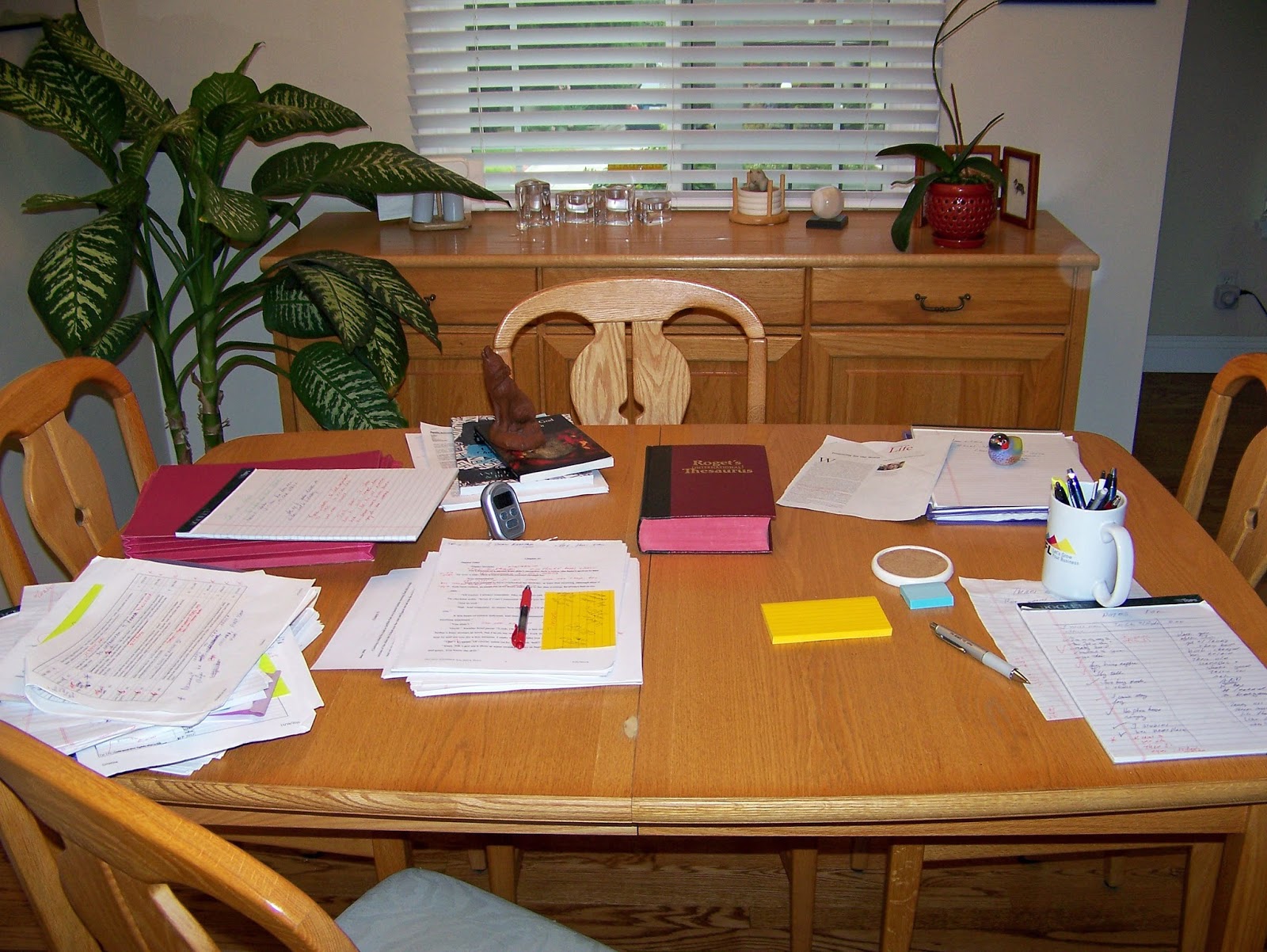
I finally found my magic spot in my current home: my dining table, a clunky slab of pine on skinny legs, from Ikea no less. But you know what? It works for me. I can see the street in front of my house, but not enough to distract me. I have room for my stacks of folders, my drafts and notes and thesaurus, and they’re all within arm’s reach. I have a couple of little good-luck tchotchkes there too, and the chair is uncomfortable enough to force stretch breaks now and then. The laptop comes and goes, depending on which phase of writing I’m in.
The downside is that, yes, it’s the dining table, and it actually gets used for dining a few times a year. Mostly we hang out at the breakfast bar in the kitchen, but on birthdays and holidays, I have to move all my paraphernalia somewhere else. But that only takes a few minutes, and the trade-off is worth it.
Light and space and breathing room. For me that’s the answer. But what about the rest of you? Do you have a special place that makes you feel safe and creative? Was it what you expected it to be at the beginning of this crazy journey? Please don’t tell me I’m the only one re-purposing my furniture!


Another Kind of Journalism by Bonnie Schroeder

Bonnie Schroeder is the author of Mending Dreams as well as published short fiction. Find out more about Bonnie at her website.


ANOTHER KIND OF JOURNALISM

I came of age in the 1960’s, the era of Hippies and anti-war protests, the Summer of Love and psychedelia. Dropped out of college to marry an art student. Lived in a loft in Downtown Los Angeles before it became the fashionable Arts District.
A lot of good writing material there—if only I’d taken better notes.
I didn’t start keeping a journal, however, until 1974. Here’s the first entry, from January of that year, scribbled in a blue-vinyl-covered spiral-bound notebook: “This journal was a gift from John, who will soon be my ex-husband.”
I didn’t consciously craft that sentence as a story opening; it just came out that way, from my brain to my fingers to the pen on the page. And at least I was able to write authentically about the ups and downs of a no-fault divorce in California.
I’ve become a devoted journal-writer since then and have lost track of the number of notebooks I’ve filled. It’s become a need, a way to preserve and (maybe) make sense of what goes on in my life.
Those lost years in the 60’s? I can research in libraries and online until the cows come home, but it won’t reveal what I personally was thinking and feeling and experiencing in those days. My journal is a repository for all life’s oddball experiences, good and bad, beautiful and ugly—all waiting to spring to life again.
But journal-writing has another, even more valuable application: it’s great writing practice.
For years I worried that I wasn’t doing my journal writing the “right way,” not filling pages with long, elaborate, lyrical descriptions and all that. Then I realized, that’s not necessarily what it’s all about. Journaling is simply practice in putting words on the page and building up those writing muscles.
Whether you intend to or not, once you keep a journal, you do start to notice the world around you more carefully as you strive to record and interpret your experiences, in as much interesting detail as possible. The challenge presents itself without your even trying.
And remember this: nobody’s looking (unless you want them to) so you free yourself to experiment with phrasing and structure, to invent whatever and whoever you want, to create fiction as well as re-create fact.

There are a ton of how-to books on journaling out there. I have two favorites that are especially relevant to me. When I’m feeling stuck or just need a break from my current project, I sometimes turn to them to jump-start my writing in unexpected directions.

·       The CreativeJournal by Lucia Capacchione
·      The NewDiary by Tristine Rainer
As for all those notebooks stashed away in my garage? I finally wised up and started keeping my journals on the computer, using MS Word (and a password protected file.) This has several advantages: my handwriting is horrid (the only D I ever got in school was in penmanship), I don’t have to make room in the file cabinet for yet another notebook, and the entries are searchable in case I want to look something up quickly. I confess, however, that sometimes only the scratch of the pen on paper will quell the writing itch, so I succumb and then in my OCD fashion retype the entry into the digital file “for future reference.”
I didn’t inventjournaling, of course. A lot of writers, better and more well-known than I (hello, Anaïs Nin) have even published their journals. Some have written novels in journal format (one of my personal favorites is Doris Lessing’s The Golden Notebook.) It seems a fairly common trait among writers, this deep-rooted urge to put words on paper, to capture and describe (or invent) their experiences, even if/when their words aren’t meant to be read by anyone else.
So let me ask: do YOU keep a journal? Does it add value to your writing life? If you haven’t been journaling, did this post make you want to consider it?


THE DOG ATE MY . . . [FILL IN THE BLANK]
 
Novelist Bonnie Schroeder shares some of her favorite excuses for not writing. Visit her Author’s Page on Amazon.


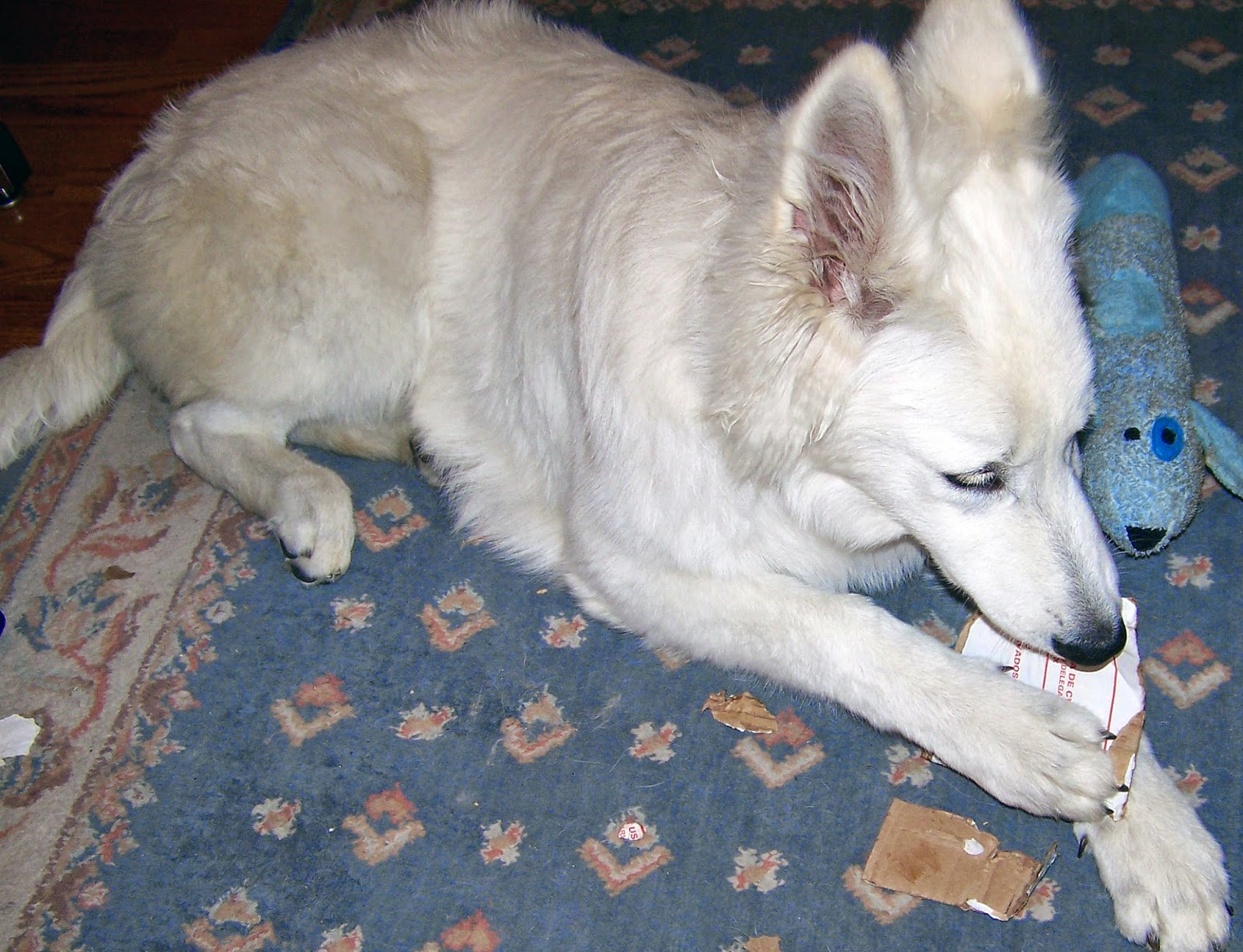
Meet Thunder, the newest addition to my family. She is a Swiss shepherd, close cousin of the German shepherd. She blasted into my life on November 1, 2014. As it happened, I was working on the final act of my new novel, and I was stuck. I didn’t have a satisfactory, or satisfying, ending.
So I shoved the manuscript aside, having been handed the best excuse in the world: I had a new puppy. Housebreaking. Crate training. Socializing. Bonding. And generally enjoying the fun, excitement and disruption a new baby, human or animal, introduces to one’s life.
The trouble was, three months later I hadn’t picked up the threads of my novel, and by then Thunder had fairly well merged into the household routine. But, somehow, I still “didn’t have time” to work on my novel.
Normally, I am pretty adept at squeezing maximum usage out of my time. I wrote the first few drafts of Mending Dreams while working ten-hour days with an hour-long commute tacked on both ends of the workday.
So what was up? I avoided thinking about it as we started obedience school and I focused on training my puppy. Thunder, however, did some teaching of her own. Among other things, she made me realize I needed to curb my perfectionist tendencies. A six-month-old puppy will not and should not become an obedience champion overnight. She’s a work in progress.
That got me to thinking about my unfinished manuscript, and—duh! I finally figured it out. I did not have the perfect ending for the book. I was stumped. It wasn’t lack of time that kept me from working; it was lack of direction.
Somewhere along the line I’d forgotten a crucial fact about being a writer: you can’t fix what isn’t on the page. I’ve made enough false starts over the years that this lesson should have been permanently engraved in my brain. But it wasn’t.
So I took a deep breath and dived into the chilly waters of revision, crafting a new ending, better than the one that had left me stuck. Well, maybe “better” is an overstatement. It was different.
And something very weird happened, although I should have seen it coming. As I typed up my hand-scribbled draft, ideas began to float around in my brain. Hey, maybe instead of ABC, let’s try XYZ. Yeah, not bad. But maybe MNOPQ would make more sense? Try it. And try again, until you have something that kinda sorta approximates the vision in your head.
That’s how I did it, bit by bit, while Thunder was taking naps. Puppies sleep a lot, so I had many half-hours and hours to do what I thought I “didn’t have time” for.
Another thing Thunder taught me is that imperfections aren’t fatal. My puppy was born with a stubby tail, which some might consider a flaw. But to me she’s unique and special, and that little metronome tail is always wagging. Likewise, no piece of writing is perfect, and often it’s the flaws that give it depth and worth.
Thunder is flunking novice obedience—well, I’m flunking, and I’m taking her with me, but we’re learning a little. Next time around, or the time after that, we’ll do better. But if we didn’t start somewhere. . . Well, you know how it goes.
As I worked through all this angst, I came face to face with some truths about myself: I’m lazy. I like excuses. But underneath all that, writing is in my DNA. I may not be the world’s best dog trainer, but I am nothing if not persistent (some would say “stubborn”.) And, most important, I am a writer, and always will be.
So let me ask: what’s yourfavorite excuse for avoiding stumbling blocks in your writing? And how did you overcome it?


AN ALMOST PERFECT NOVEL
 

“As God is my witness, I’m never going to be hungry again.”

That’s not a Weight Watchers commercial: it’s a line midway through Margaret Mitchell’s magnificent historical novel, Gone with the Wind.
 
GWTW, as many abbreviate it, is one of my favorite novels, and I have plenty of company. According to a recent Harris poll, GWTW is second only to the Bible in popularity among Americans. And there are a lot of reasons for that: it’s a great story, an easily-digested history lesson, and, for writers, it’s like a master class in storytelling.
First off, consider the storyline and the clear, linear structure: it’s not just a story about a spoiled Southern Belle, or the devastation of war, or the hardships of Reconstruction after the Civil War, or a woman struggling to preserve her family’s legacy. It’s all that—and more.
GWTW carries a timeless theme. In Margaret Mitchell’s own words, “If the novel has a theme it is that of survival. What makes some people able to come through catastrophes and others, apparently just as able, strong and brave, go under? It happens in every upheaval. Some people survive; others don’t. What qualities are in those who fight their way through triumphantly that are lacking in those who go under…? I only know that the survivors used to call that quality ‘gumption.’ So I wrote about the people who had gumption and the people who didn’t.”
And did she ever write about people with gumption! Not only that, she created a cast of complex, fascinating characters. When we first meet main character Scarlett O’Hara, we’re told right off the bat that she’s not beautiful, but “men seldom realized it when caught by her charm. . .” What a way to introduce a character! Scarlett is a study in contradictions: she’s vain, foolish and selfish, but she’s also smart, strong and brave.
Her counterpart, Rhett Butler, comes on the scene as a scalawag, a scoundrel and a cynic. However, as we get to know him, we learn he’s also an idealist, a romantic, and—who’d have guessed it?—a patriot.
GWTW is also a superb history lesson, and Ms. Mitchell delivers it in small, vivid bites, full of specific sensory detail. Writers are advised to “show, don’t tell,” and Ms. Mitchell demonstrates that repeatedly. Readers can almost feel the heat of the flames as Atlanta burns and the clench of starvation that Scarlett endures. The details feel authentic, and they probably are. Margaret Mitchell was born in 1900, and her family lived in Atlanta. Her parents and grandparents probably witnessed the Civil War firsthand and no doubt shared stories with young Margaret.
GWTW is also a spectacular model of what a love story can be. It doesn’t just have a romantic triangle; it has trapezoids and rectangles all over the place, and these are played out in a fascinating narrative.
GWTW is also the model for a modern ending. Not every complication is resolved and tied up with a tidy little bow. Ms. Mitchell left plenty of room for audience participation and interpretation. Did Rhett really not “give a damn?” Will Scarlett get him back? Theories abound.
The novel has a few flaws, of course. The language and style seem out of sync with today’s writing, and some of the dialogue is overblown and even clunky. When Sidney Howard wrote the screenplay, he shortened that famous line I quoted at the start; he removed two words, and Vivien Leigh vowed, “As God is my witness, I’ll never be hungry again.” Much more punch in that one.


But none of this detracts from the novel’s power to cast a spell. Almost 80 years later, people still care about the book and its characters, and the ambiguous ending sparks many a spirited discussion. What more could an author hope for?

Catching Up with Bonnie Schroeder


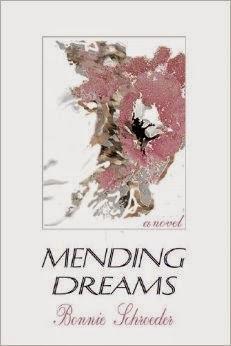
On September 30, 2013, my life changed forever, but in a good way. That was the day I got an email from Champlain Avenue Books, telling me that they wanted to publish my novel, Mending Dreams. It’s been a wild ride since. 


On the glorious day I held an honest-to-God copy of my novel, I barely had time to savor the moment before launching into my first-ever marketing campaign, which has become a never-ending process. 

The best thing about being published? Hands down, it’s connecting with readers, listening to their take on the novel, answering (or trying to answer) their questions. I have been so gratified by the response to Mending Dreams. My writer friends and colleagues have really come through for me, too: they’ve written reviews, told their friends to buy it, and so on. I’ve said it before, but it bears repeating: the writing community is one of the most generous in the world, and I feel blessed to be a part of this wacky but wonderful profession. 

So, 2013 ended on a high note, and January 2014 saw the actual release of my novel. I tell you, typing my name in the Amazon search box and seeing my novel come up was one of the highlights of my life. I just stared at the computer screen for a while as reality sank in. I felt so validated. 

Things went downhill from there for a while. In February, I lost one of my best friends, my 12-year-old German shepherd, Echo, to bone cancer. It was a rough ending to her life, and my beauty endured it with more courage and grace than I did. Reeling from that loss, I faced another: my 15-year-old kitty, Elvie, succumbed to squamous cell carcinoma, and suddenly my animal family was cut in half.  

I was grateful for the distraction of my writing career as I immersed myself in marketing Mending Dreams; getting my website up and running, meeting with book club members and participating in “local author” events, approaching librarians and bookstore managers about carrying my book and letting me do a talk in their venue.  Meanwhile, I finished a solid draft of my next novel, with the help of my online critique group, and once it “cools”, I’m ready to clean it up and start the dance all over again. 

And last September–almost a year to the day since that exhilarating email from Champlain Avenue Books–I found my new best friend, a little whirlwind of white fur and puppy teeth: Thunder, a Swiss shepherd who has all the makings of a great dog if I don’t mess up her training completely.  She has definitely halted my writing process for the moment, but the pages are sitting in plain sight, calling my name, and any day now, while Thunder’s taking a rare nap, I’ll sit down at the table and dive back into the fictional world I’ve been building. 

Stay tuned…

Jacqueline Vick’s Blog: A Writer’s Jumble: Bonnie Schroeder Lives Her Dream with "Mending Dre…

Jacqueline Vick’s Blog: A Writer’s Jumble: Bonnie Schroeder Lives Her Dream with “Mending Dre…: Bonnie Schroeder started telling stories in the 5th grade and never stopped. After escaping from the business world, she began writing f…

Interview with WinR Bonnie Schroeder

We are very excited to introduce you to WinR Bonnie Schroeder. An author of women’s fiction and short stories, Bonnie can effortlessly move her readers from tears to spine-tingling chills. She can also make you laugh while you squirm, recognizing yourself in her characters. You can read a sample of her fiction on The Rose City Sisters blog by clicking here.

Bonnie, you are one of the most positive people I know. Good fiction includes tension, but it surprises me how well you are able to show pain and anger and frustration in your characters. How do you access these “darker” places without bringing yourself down?

Therapy, and years of practice! Seriously, it’s kind of cathartic for me, to let all that dark stuff out, transfer my own bad feelings and experiences onto the page and give them to someone else. I learned in writing classes that you have to “let your characters get dirty.” And after dragging my protagonist through the mud, I can look at my own life and think, “Heck, it’s not so bad.” And when all else fails, I hug my sweet Elvie cat; it is impossible to feel down when a cat is purring in your ear.

I’ve heard speakers dismiss writing groups as a waste of time. You belong to several as well as a book club. What would you say are the benefits offered by both types of groups?

Each has its own advantages. From my writing groups I get support, encouragement and specific suggestions on how to improve my craft. Seeing my fellow writers struggle with language, plot, characterization, internal logic, etc., is priceless reassurance that I’m not alone on this weird journey.

And I’m very blessed to have found some amazing, insightful, sensitive writers whose work I admire and who have mastered the art of the critique: first tell the writer what worked, so he or she doesn’t want to give up and knows what strengths to build on. Then move on to what didn’t work, without rewriting the story from the ground up.

There are not that many writing groups around who can pull this off. But don’t give up until you find one, or build one yourself. Trust me: it’s worth the struggle.

My book club also contains several writers – fortunately none are in direct competition! The club introduces me to work by writers I might otherwise have overlooked and suggests new directions for my own fiction. The members are all intelligent, perceptive people with strong and specific opinions on the books we read. Their comments and reactions give me a ton of insight into what appeals to readers, and what turns them off.

You read a wide range of subjects. Can you tell us what your favorite type of fiction is?

I have a lot of faves. I like well done suspense thrillers like Michael Connelly’s Harry Bosch series, and then again I’m a sucker for anything by Alice Hoffman or Anne Tyler, those sweetly incisive, literary, relationship-type novels.

I also enjoy well-written fiction that involves animals, such as Spencer Quinn’s “Chet and Bernie” mystery series, or The Art of Racing in the Rain – a two-hankie novel if ever there was one!!!

I’m a huge fan of Stieg Larsson’s Millennium Trilogy (The Girl with the Dragon Tattoo, etc.) with all its violence and gore. I know, go figure. . .

Actually, my favorite book is one that doesn’t cheat the reader, that delivers on its initial promise. I can tolerate a few technical errors if the book meets that mark.

I know how to plot a murder mystery, but how do you plot a literary novel or women’s fiction? Do you start with a character? An inciting incident? A character goal?

It’s weird, because they come to me in different ways. Sometimes it’s a “situation”: for example in my novel Remember to Breathe, it started out as an idea involving a woman whose husband had left her for another man. What if. . . . what if she learned he was dying? How would she feel? What would she do? What kind of woman would she be? And the story evolved from that.

My latest project is mostly character-driven. I started by seeing the two main characters and am in the process of following them around and trying to figure out who they are and what they want. I know the beginning and the very end, but everything in between is still a mystery to me.

Can you tell us anything about your current project?

I’m kind of superstitious in that I think telling the story dissipates its energy. . . and other such whoo-whoo beliefs. But it’s (I hope) a literary/commercial novel about a woman who marries an artist. Starts in 1966 and ends in 2000-something. Famous artists romp through the pages, along with pot-smoking hippies, corporate pirates, and a folksinger/rock star. All of which is subject to change, of course.

My main challenge is that I was actually married to an artist in the swinging 60’s, and although the story is purely the product of my imagination, I worry people will think, “Oh, that’s all about her and John.” Take my word for it: it’s not. If only my life had been that interesting!