We are a group of published writers who come here weekly to entertain, inform, and encourage you in your writing and your reading journey. Grab a cup of coffee, get comfortable, and join us.
I love in-person book events. I love connecting with readers. I love signing my books and adding names to my mailing list. I love the benefits: new readers, learning of future book-related opportunities, networking with other authors (and we’re readers as well.)
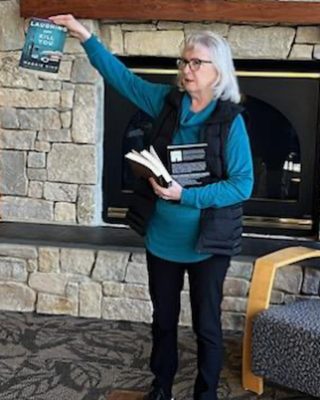
“Hawking” my books at the Powhatan Library Authors Roundup
I learn much from the people I meet at these events. An author shared her enthusiasm for an AI tool she used to successfully create sales copy. A reader recommended Le Ventre de Paris by Emile Zola for its vivid descriptive passages of the tastes and smells of a central market in 19th century Paris. The book made it to my TBR list and I hope to get to it this year. I like hearing what readers like to read, and what they don’t.
Even if I don’t sell a lot of books on a given day, I still might make valuable connections. And word of mouth is definitely at work: one person tells someone about me and my books, that someone tells yet another someone, and so on.
Many festivals include author talks and panel discussions (perhaps a topic for another post), readings (can be tiresome for the audience), and, of course, book signings.
Attending an in-person author event lets me meet writers and readers I’ve only met online. I no longer travel, so my options for events are limited to ones that are local or a short drive from my home. Fortunately, bookish gatherings abound in Virginia, home to many authors. In 2025, I participated in five book events. I have four scheduled for this year and expect to add a few. My favorites are the Chesterfield County Local Author Book Fair, the Hanover Book Festival, and the Powhatan Library Authors Roundup.
Tell us about your experiences with book events, whether as an author or reader.
In the class I teach on writing, I point out three things in the form of a question that can help you write a good story:
Does it advance the story?
Does it enhance the story?
Is it redundant?
We did the first point in my last post. This is the second point.
Enhancements are the little descriptions you add that make the story feel real. Things like describing the setting. In a movie, the director and set/scenic designer will place the action in the perfect setting whether it’s in the ramshackle house or majestic castle, or maybe a coastline with the waves crashing against the rugged rocks. The camera can go anywhere.
In a play, the set designer and director can add just enough props and background scenery to literally “set the stage” for the scene to be acted out for the audience. They might be limited to the size and budget of the theater, but a suitable set will enhance the action while the actors “trod the boards.”
But on the printed page, the writer has to “paint” that picture and decorate that set with words. It doesn’t have to be so much description that the reader loses track of the story being told. “Less is more” is really something to consider. But do give the reader a taste of the place where the action is taking place. After all, a reader usually has a pretty good imagination or else they wouldn’t be reading a book. They’d wait for the movie if they want the visuals to be handed to them on a platter without using their own imagination.
I’m being sarcastic here, but people aren’t reading as much anymore. They are letting somebody else create the scene in the movie, sometimes with AI or cartoon animations, and literally leave nothing to the viewer’s imagination. That might be okay in the movie, but not in a book.
A good writer will provide “a visual with words.” Wonderful words that let readers use their own minds to finish that painting. It lets the reader become part of the journey.
As for the words to use, the writer will see the visual in their own mind and put it down on paper. Golden sunsets, ice forests, a pristine palace, a squalid dump. A character dressed in rags, or a gossamer gown. Words describe the scene and the characters.
It doesn’t take a lot of words, but sometimes a few more will set the stage even better… She strolled into the glittering ballroom lit by a dozen crystal chandeliers with the attitude of a prizefighter. Instead of a gossamer gown and expensive jewels around her neck and wrists like those worn by the other ladies whose individual bank accounts would choke any horse, this gal had on blue jeans, a torn flannel shirt and a pair of boots covered with muck she must have picked up from some of those fancy horses…
That sets the stage for the action to come. Not a lot of words, just a paragraph, but the reader gets the idea that all hell is probably gonna break loose. Isn’t that the job of the writer? Set the stage for the reader and let them enjoy the scene as it unfolds…adjective by adjective.
The opening of your story should do the most to bring the reader in. “It was a dark and stormy night…” was famous for grabbing readers’ attention. If you’re writing a mystery, stumbling over “another” dead body on the first page just might interest the reader. Then “What If” this wasn’t the first one the protagonist had seen in her life… Everybody loves another “here we go again” whodunnit. The reader keeps turning the pages until the killer is nailed.
Even if you don’t start with “a corpse in the hot tub,” at least begin with something that makes the reader want to keep reading. That’s the job of the writer. Setting the stage on the page and making that journey both visual and real is how the writer gets the reader to enjoy the trip.
So, enhance those bits and pieces that help tell your story. Write On!
No, I’m not talking about traffic. I’m talking about writing. And I think all writers experience stop-and-go in their writing at various times. Maybe all the time.
The “go” is the best part. We figure out what we’re writing about, plan it, plot it, and do it. Go for it. With me, that’s most of my writing life. I’m always writing something, or planning in my mind what’s coming next. Telling the computer what’s on my mind, via my typing fingers, always helps too.
But then there’s the “stop.” That’s when you at least slow down, have other things in your life that get in the way, maybe (shudder!) even have some writing issues that slow you, then maybe let you grind to a halt—hopefully only for a short while. But the interruption can definitely matter.
I’ve recently been having more slowdowns and stops than I’m happy with. Breaking my arm, which slowed my ability to type, is certainly among them. So is receiving extensive edits and questions about a manuscript I recently submitted. That’s what I primarily need to focus on now. Is it stopping the rest of my writing? No, but it’s not allowing it to go as fast as I’d like. But I do concentrate on figuring it out so I can get back to what I was already working on, and more.
How about you other writers? Do you always get to focus on what you want to write, move forward, and enjoy it? Or have you also had some issues that slow you down, maybe stop you for a while?
But the great thing about being a writer is that we’ll deal with it and go forward with our writing. Right? Write!




 The Writers in Residence
You must be logged in to post a comment.