Listening to Stories: Why I Love Audiobooks

By Jackie Houchin

The first audiobook I ever listened to was Robinson Crusoe, from Books On Tape, way back in the 1970s. I was cleaning multiple horse stalls twice a day back then, and I needed an escape!  An adventure on a deserted island with a guy named Friday had me hooked. I rented hundreds more.

Then I found Audible and began cautiously buying digitally recorded books. Currently, I have an account that allows me to buy 25 books per year for a nicely discounted price. Others are available through Amazon/Audible.

Later, I discovered Chirp, a deeply discounted audiobook seller. Sometimes I can get a book for as little as $0.99!

Libby is a library app that allows you to rent books and audiobooks at no cost. But friends tell me they usually have to WAIT for books to become available.

*****

  • For this post, I decided to try Libby.  The app is free, but you need a library card.  I put in my Mission Viejo Library card number & pin. Thousands of book titles appeared. 
  • I narrowed my choices to “audiobooks,” “available,” and “juvenile” to get a list of 4th-6th grade books. (Quick to read for this blog post.)  I selected “The Sherlock Files: The 100 Year Old Secret” and pressed “Borrow.”  And there it was, with cover, synopsis, reading time, volume, and speed controls.  I could keep it for 21 days.  FREE.  Okay, not bad. 
  • I finished the 3-hour book. It was fun, and the narration was good.  When it was over, I simply pressed “Send Back,” and the book was gone.  Easy-peasy.
  • I did search for other books, and of the three that I wanted, none were stocked at my library.  So that’s a bummer.  But I will definitely go back to Libby.

*****

Yes, I am addicted to listening to books.  Here’s why.

  • AVAILABILITY.  I can listen to books anytime and anywhere. I have Bluetooth, so I do not wear clunky headphones. No one can tell if I am on a spaceship to Mars, helping Lane Winslow solve a murder in 1941 British Columbia, or learning about Extra Virgin Olive Oil. While I walk, drive, wait for appointments, wash clothes (or floors), and cook, I can be entertained or educated. 
  • NARRATORS.  Good narrators transport you to times and places far away. (It is the next best thing to travelling.) In a series, a repeat narrator immediately puts you into the familiar setting with people whose voices you already know.
  • NO EYE STRAIN. Audiobooks don’t stress your eyes. These days, my eyes become blurry and sting when I read print too long.

Okay, there are downsides too, and you have probably guessed the first big one.

  • COST.  A newly published audio bestseller can cost $25.00 or more. Yes, you own it, but you cannot share it with a friend, give it away, or sell it.
  •  The annual fee at Audible averages $9.15 per book, so I usually save these credits for new, popular (expensive)  books throughout the year.  
  • Chirp is far more reasonable, but their books are not as new, and often are a genre I do not want to read.  
  • But now, of course, I’ve found the Libby lending library.  I suspect the choices are limited.  But I’ll give it a try.  After all — FREE!
  • NARRATORS.  Some are horrible. Sorry, but it has to be said.  I will not buy or rent a book narrated by Scott Brick.  And there is a woman too…  Audible is good about that and will refund the cost if you return the book quickly.
  • BOOK REVIEWING.  If you are a book reviewer like me, audiobooks make it harder to pick out quotable lines or memorable details. With print books, you can bookmark, highlight, or pencil in notes. But, unless you want to immediately jot down a note, it is difficult to find details you missed (or forgot) in an audiobook. 
  • When reviewing one, I usually write out a rough draft immediately after finishing the book. Then, to ensure I am spelling characters and place names correctly, I will often check them on the website. 
  • Unfortunately, “hearing” something doesn’t stick in your mind the way “seeing” it does. 

Yes, I still read print books.  I have to; not all books are recorded!  But I try to avoid fine print and extra-long tomes. Hence, the middle-grade books. (HEY! Some of them are fantastic!!)

I also read digital Kindle or Book Funnel books, where I can adjust the font size. However, on my phone, that means flipping pages quite often. (I don’t have an e-reader.)

###

So, do you prefer audio, print, or digital books for your reading? What are your reasons?  Do you have a favorite audiobook you can recommend?  How about a favorite narrator?

***By the way, CHIRP now has THREE audiobooks by our own Linda O. Johnston on sale for just $3.99!    “3 Pet Rescue Mysteries”

###

PS: I know it’s difficult to comment on this website, so if you like, you can respond to me via my email at Photojaq@aol.com, and I’ll post your comment here.


A Writer Wastes Nothing

by Maggie King

“A writer wastes nothing.” This saying is attributed to F. Scott Fitzgerald. The renowned writer mined his college years to create his debut novel, the autobiographical This Side of Paradise.

I recently attended an outdoor event in a local park and feel inspired to write about it—in fiction form.

The crowd at this event was large, the air heavy with humidity. Virginia is a steamy place in the summer! I drank little water as I was unsure if facilities were available or even nearby (they weren’t). After standing for over an hour, the crowd started to leave—slowly.

A feeling of lightheadedness came over me and my vision blurred. To say I was frightened was an understatement. I was with friends and the crowd was friendly, so I wasn’t in danger. But the feeling of losing consciousness is scary and uncomfortable under any circumstances.

One of my friends let me lean on her until we came to a tree where I sank to the ground and sat back. People gave me bottles of cold water to drink and press against my wrists. I ate one of my melted protein bars. In no time I felt revived, grateful that I hadn’t passed out. A couple of EMTs showed up and took my vitals (they pronounced them fine!). I opted not to go to the hospital. Dehydration was named the culprit.

One of my friends left to get the car. The EMTs parted the crowd for me, and one of them stayed with me until the car arrived. While we waited, she asked what I did for work.

“I’m a writer, and I’m already planning to use this experience in a story.”

After all, a writer wastes nothing.

As I know how frightening it is to feel on the verge of losing consciousness, I can bring a visceral feeling to the story. My imagination will ratchet up the danger, raise the stakes. Possibly elements of a Hitchcock film I’ve seen is inspiring me as well.

My preliminary idea is based on a series of what ifs:

  • What if this is a hostile crowd, in addition being a slow moving one?
  • What if my character, a woman, is alone?
  • What if the heat and humidity make her feel lightheaded and make her vision blur?
  • What if she is carrying a quantity of cash and/or jewels that she’s stolen?
  • What if she is being pursued–by law enforcement? Another criminal? Both?

She must stay conscious and she must evade her pursuer.

Yikes!

A writer wastes nothing.

Has a personal experience ever led you to write about it, especially in fiction form? Tell us about it.

Telling Your Story

by Gayle Bartos-Pool

Whether you’re self-published or have the backing of a big publisher, a writer still needs to get a short version of their own life story in shape for that occasional interview they might do for publication or even a live broadcast. If the person doing the interview knows his job, he will have handed the author a set of questions ahead of time, so the writer isn’t blindsided by a question. That’s professional. Sometimes the person doing the interview will ask if there are questions the writer wants asked because often the writer has a story to tell that the person doing the interview will have no idea exists. This will make the interview unique. That’s good for everybody, even the audience who will get to meet somebody with an interesting story. For the writer, that doesn’t mean only the story in the book he just wrote.

Recently I had the opportunity to do both a written interview and a live talk for a local show where I live in Ohio. The first interview was done by a fellow writer, Jill Amadio, who started out as a journalist for a British magazine before she wrote her first mystery featuring a gal who was a gossip columnist back in Britain who has to leave the country because she did too good of a job digging up dirt only to trip over a body or two here in the States. Obviously, Jill knows a lot about writing for a magazine. That book is Digging Too Deep. A great read.

https://promotingcrime.blogspot.com/2025/06/jill-amadio-in-conversation-with-gayle.html

She asked if she could interview me for a mystery magazine, Mystery People, published in the United Kingdom.  This was fun. Working with the questions she first provided and adding a few of my own in order to tell my story, we came up with a good interview.

As writers, we need to get out in front of people and tell them not only about the book we wrote, but also a little bit about ourselves to let our potential readers know where we came from and maybe how we got the idea for our novel.

I have been doing this for a while, but it was only recently that I wrote my autobiography to tell people who I am. I learned a lot about myself. That’s why I recommend that everyone write their own story whether you write novels or do something normal…Sorry, I digress.

Having gotten to know myself doing my autobiography sure helped when I did these two new interviews. Not that I didn’t know who I was, but I needed to get organized. First, I wrote out basically what I wanted to say about my life and writing career. Then I wrote out a script like doing a movie. I had taken acting classes back in California when I wanted to write for television and/or the movies because I thought knowing what the actor needed from the writer would be a good idea. It was.

I wrote a script. I cut out stuff and added stuff until I had a fairly clear idea where I came from and how I got to be who I am. Then I rehearsed it. Two or three times a day. Even when I got into bed at night, I went over the script. As I walked around the house, I timed it. The televised event would be no longer than an hour. I made sure I could do all the aspects I wanted to cover in those sixty minutes. Then I rehearsed it a few more times.

The 54 minute interview is on the Avon Lake Library website: https://www.avonlake.org/communications-technology/videos?action=show&video=MjkwNg==

It was a challenge, but writers have to try new things in order to get our name out there so people know who we are and what we do. And, frankly, this was fun.

The written version for the British interview covered the highlights. The televised version was longer with some hand gestures thrown in to make a point and even photographs to add to the story. Those acting lessons allowed me to do the event without standing there like the Scarecrow in The Wizard of Oz before Dorothy came around. You cannot imagine the confidence those acting lessons gave me.

So, you writers might want to work on several versions of your story in case you’re asked to do an interview. Short ones and longer ones. It gives you a head start. And something else, it might get you interested in writing your own autobiography. You do have a story to tell.

Continue reading “Telling Your Story”

LIFE IS RESEARCH


by Linda O. Johnston

At the moment, I’m continuing to write enjoyable stories in my new series for Harlequin Romantic Suspense, about K-9s and PIs. Have I had to do research? Of course,  even more than I’ve done before about K-9s and their commands. 

But my entire life tends to be research. I love to read and write about animals, especially dogs, so whenever I can, I investigate pets and wildlife in different areas, and how they act, interact, and do their means of communication. I read books, newspaper articles, and more. 

And then I look out my front and back doors and windows. I see murders of crows, individual mockingbirds and other birds, lots of squirrels getting into trouble with my husband since they like to eat the fruit he grows, people and dogs going by on walks, vehicles that turn or park in the wrong places…all could be fodder for stories. Yes, even the people who drive those vehicles. I’d never get near them or hurt them in person…but my characters in a mystery just might approach and commit murder or whatever. 

Yes, my mind is always at work. Researching…and plotting. That happens when I go shopping. When I see events at the nearby Hollywood Bowl or other fun locations in my area—and when I travel too. Flying, riding Ubers and Lyfts and otherwise. What’s around—buildings? Waterways? My mind keeps watching and waiting and plotting. Lots of photos and notes! And my dogs also keep telling me what to do and when and what to write. 

And you, if you’re a writer? Where do you get your ideas? How do you research them? What do you look for moment by moment, hour by hour, day by day, or more?

LONDON’S WORLD OF WORDS AND STORIES ….

  By ROSEMARY LORD

“London Bridge is falling down…” so the song goes. Well, it’s not. It is thriving, bustling with people, merchants, tourists and local inhabitants who love this very special part of London.

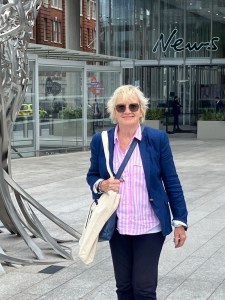
I was there recently visiting my family in England. I had a meeting with my new Editor at Harper Collins Publishing offices (I still get a kick being able to say that: “My publishers, my editor”!) at London Bridge. Many of the major publishers and newspapers are housed in this towering building that is right next to London Bridge tube station.

Security was very tight. As I approached the main entrance to the office tower, security guards stopped me, ready to turn me away. But I had an appointment and had to show my ID, which was checked against the computer appointments records before I could walk through those hallowed doors. Once inside the lobby, I was checked again by security and ushered through a metal detector. Just like at the airports. I had to wait until someone came to escort me upstairs. And when I left, I was chaperoned back through the same security system. So, this is what it’s like working in London today! Not quite the fun, easy-going offices I recall from my days of writing for the teenage magazine Jackie and the host of women’s magazines in Fleet Street.

My brother Ted had accompanied me and waited patiently nearby until my meeting was done. We had decided to explore the area of London Bridge and Borough Market – the new Hot Spot in London.  The hip, cool place where the young hangout. Pop-up food stalls proliferate; vintage clothing stalls, cosmetics, tattoos, stacks of vintage records for sale, ‘Bubble Tea’ adverts and music from all over the globe wafted through the crowds. I never did find out what ‘Bubble Tea’ was. But it seemed very popular. The market was wall-to-wall students and young entrepreneurs in their eye-catching, colorful attire. Creativity and innovative ideas abounded.

One of the reasons for the throngs of young people in the vicinity selling and buying was, I realized, because the market was so close to the medical colleges and universities. Lots of medical students.

I also learned that this market began life in 1756 as a cluster of stalls at the foot of London Bridge. It’s come a long way, baby!

The tall, grim buildings on St. Thomas Street are a focal point of the medical world. The famous Guy’s Hospital, founded in 1721 by philanthropist Thomas Guy, stands cheek-by-jowl with St. Thomas’ Teaching Hospital – where Florence Nightingale trained her dedicated nurses. This hospital was named for St. Thomas Becket and founded in the Middle Ages but located here in Lambeth since 1871. These are part of the Kings College, London Medical Education programs.

Just across the road is the tiny Operating Theatre Museum, in the Herb Garret at the top of the narrow 17th century brick building. A museum of surgical history housed in the old apothecary.  Herbs and flowers used in those days are displayed, with mortar-and-pestle and hand-written notes on their efficacy.  Completed in 1822 is the operating theatre is the oldest surviving operating theatre in Europe for surgeries that predated anesthetics and antiseptics.   

What fun! It offers learning experiences for all ages. I especially loved the large yellow rubber ducks placed around the exhibits. They were each painted with some dreadful disease: blobs of green goo representing gangrene, or drooling, lumpy additions depicting small-pox, syphilis, or the black plague. Symptoms were written on a card next to the duck. You had to guess what they represented. The answer was found underneath the duck. I noticed medical student visitors taking great delight in guessing the correct answers.  The enormous, black all-encompassing metal head gear with the long snout, for the brave doctors during the plague in 1660 London was there. Various operating tools were displayed, including the large hacksaw next to the operating table that was labeled “for the removal of legs and arms”.

There were rows of seats where the medical students sat to observe the operations by doctors who had no awareness of cleanliness, let alone surgical gowns, masks or even handwashing. Hand-written notes, instructions and explanations of the various implements (of torture?) used, as well as reports of individuals’ surgical successes – or traumas!

Today’s root-canals are easy-peasy by comparison!

This part of London shared so many stories, characters, tragedies and successes. I made copious notes, as Ted and I later stopped for a delicious cake and coffee in a little corner French café. A quiet haven amidst the noise and bustle.

Everywhere I looked were stories, historic revelations and wonderful new ideas and a revitalized energy.

Charles Dickens strolled through these London streets at night when he couldn’t sleep, and claimed this was where he found inspiration for his timeless novels. Incidentally, did you know that in 1847 Dickens founded a ‘Home for Homeless Women’ in London?

We walked down to the water’s edge and followed the River Thames as it snakes its way through London, past Shakespeare’s Globe Theatre towards Charing Cross, watching such a polyglot of people of all ages – “a seething mass of humanity” moving on its way through lives humdrum, urgent, desperate, happy, exciting. Who knows?

There is so much written about London through thousands of years. It’s difficult for a writer not to come away with a myriad of story ideas, a cacophony of images and circus of characters. Painters and artists of all fields must be similarly affected.

As Dr. Samuel Johnson wrote in 1777, “When a man is tired of London, he is tired of life. For there is in London all that life can be.”

What is your favorite source of inspiration?