We are a group of published writers who come here weekly to entertain, inform, and encourage you in your writing and your reading journey. Grab a cup of coffee, get comfortable, and join us.
In responding to a wonderful post a couple weeks back by Gayle Bartos-Pool, I said I write what I like to read. Not a new statement or thought from me. But then, as I finally started working on my latest, I said to myself, you’re not writing what you like to read (or even writing similar stuff to dramatizations of what you like to read). At a minimum, what I was flippantly saying/repeating was “off-handed;” and at a maximum, I was deluding myself, and probably to my writing detriment.
I’ve also commented in my own blog posts more than once in the past, about what I like to read, what authors I admire, and characters I like. Then Maggie King so thoughtfully talked about short stories and I remembered Hector Hoggs my first ever protagonist, and then Jackie Houchin talked about character names—and Eureka!The essence of this post came together.
Also, as an aside, I sometimes believe in channeling from the past—i.e. channeling Agatha Christie in particular. I would have loved to know her. Indeed, her writing is what I like to read…smart, quirky, protagonists who pull the murderer “out of the bag of all the clues that have trickily/sneakily been presented.” Hercule Poirot and Miss Marple are my prime examples. When I look back, these are not the protagonists I attempt to write. Truth is of course, there’s no way I can approach Queen Agatha. But the process of trying to is the motivator. (wonder where she got the name Hercule! And where/why/how come I chose the name Hector Hoggs(good grief))
Well, this last weekend I finally came up with major character names! I even have a name—there’s a third person narrator who is also a character who speaks to you at beginning and end. In my mind, that’s me calling myself Margo. My hubby picked my alter-ego name. (better than Lucretia his other choice!)
My intent in this post is to once again highlight a side trip on the trickily winding writing-road. Nonetheless, I can’t imagine life these days without writing. And consequently all this thinking stuff—starting with a negative revelation has led me to a new enthusiasm for writing. Writer, or “want to be writer”—the winding road I’m always jabbering about is tricky, but well worth it. And for me, writing what I like to read is definitely going to be an uphill challenge! Though so glad to have actually started my latest.
I would love to hear what you think. Is writing a true love? Stumbling blocks? What would you do instead (I’d love to have been a tv star(famous of course) but don’t have the stamina or the “put myself out there part to my personality,” nor the Talent! Another problem, I can only work with what I’ve got!
NAMES in stories are important in that they have to “fit” the characters, the era, the country, and even class in which they live. You wouldn’t name a society woman, Buster. (Well, unless there was a right good reason for it.) Also, a native seamstress of New Delhi probably wouldn’t be called Manuela. So how do you find those perfectly fitting monikers?
It used to be you could use telephone books, but who even has seen one of those in the last 15 years?? There are websites that offer names for babies and their meanings. Some even suggest names that were popular in different years. (See below) Maybe you will name your heroine or villain after someone you love, or love to hate.
SUGGESTION One – A couple years ago I came up with an idea for a short story in a contest. I liked the name Autumn (the story had to be set in the fall). She would be a painter. I know how I wanted her to look – long, wavy auburn hair, green eyes. And she would be the quiet type.
Boy, did I get a shock when I asked my friends on Facebook what a character with the name Autumn Gold would look like and what she might do for a living. Nearly all of them said she would be a sexy night club dancer or even a street walker. Yikes! I changed her name to Audrey Gould. But I titled the story, and named the fantastical woodland painting her boyfriend made with her hidden image in the colors, “Autumn Gold.”
I got honorable mention out of 400 entries. Asking around might be a way to check out that clever name you’ve chosen.
SUGGESTION Two – I also wrote a middle grade mystery titled “The Bible Thief” set in a church much like the one we attend. For some weird reason 4 or 5 people (including myself) lost their Bibles at some church event. Some were found, others not.
Hmm. I pondered, and immediately thought of a clever gang of kids who would “investigate” and discover the remarkable solution to this mystery. Because I wanted to share the story with the kids in the 4th-6th grade class I was teaching, I minimally disguised their own names as the gang, their parents, and a few other easily recognizable people (by description) in the congregation.
That was easy! And maybe YOU have used names of people you know but changing Sheryl to Sherry, or Garrett to Darren.
SUGGESTION Three – And lastly, I also wrote a series of related short stories for the same age children, set in Africa. There were seven kids (one set of twins, and one who passed away at a week old), and they all had names that coordinated in some way with the month they were born in.
The youngest boy, born near Christmas (and since his father was a mission pastor) got named Deacon. “Deek” for short.
There was a girl, April (yeah, I know, too easy) and the twin girls were named Melody May and Charity June. (Know why twins have two months?)
A younger boy was named August, nicknamed “Gus.” The oldest boy was Marshall (can you guess his month?).
A sensitive girl born in July I named Julie Joy. And the little guy that didn’t make it very long was Freddie, born just after Valentine’s Day.
So, that is how I sometimes choose character names. How do YOU come up with yours?
##
Baby names from Social Security lists by popularity, the top 5 by year, by decade, state, and US Territory – https://www.ssa.gov/oact/babynames/
In my July post, I discussed short stories from the point of view of readers. You can read it here. But what about the writers? Why do they write short stories? Why do some not write them?
If you exclusively write short stories, or want to, there are several good reasons why you’re making a good choice:
There’s a tremendous satisfaction in completing a story in days, a few weeks at the most.
Short stories can be sold over and over, as long as the market accepts reprints. Reprints don’t pay as much as an original story (I can attest to that!)—still, it’s another publishing credit, and the work’s already done. I understand that reprints often pay well if included in an annual best-of anthology.
Writing short stories trains you to write with tightness and economy of words. This is great preparation for other kinds of writing, fiction and nonfiction alike.
For short stories, you don’t need an agent.
That muddy (aka sagging) middle of a story, so challenging to novelists, may still challenge short story writers–but the middles are, well, short.
But be aware of the pitfalls. John Floyd, author of over a thousand short stories, has this to say: “Now, what’s the downside of writing only short stories? I can think of only one: as a short-story writer you will probably not become famous or make a zillion bucks from your writing. But here’s another newsflash: neither will most novelists.”
Another pitfall short story writers may encounter is the Rodney Dangerfield syndrome: “I don’t get no respect.” There are any number of short story writers who are respected for their work: the aforementioned John Floyd, Barb Goffman, Art Taylor, Eve Fisher, and Michael Bracken are just a few. But short story writing in general is frequently discounted. Anything from “So when’s she going to write a novel?” to “I don’t read short stories” are comments authors often hear. I know a gifted writer of short stories who won’t create a website until she publishes a novel.
Art Taylor, winner of many awards for his short stories, says, “I’ve had people hear me say I’m a short story writer and then tell me straight out that oh, they don’t read those. (I try not to be insulted.)”
My former agent scowled when I mentioned writing short stories. “Write the real stuff,” he advised.
If you primarily write novels, writing short stories can offer a different experience:
After struggling with your novel, writing short can give you a feeling of accomplishment.
It helps you to hone your writing skills.
Writing short is a challenge like any good writing (you need to develop a compelling plot and characters); but as you’re dealing with a minimum of scenes and characters, the process is simpler.
It gives you fresh material to promote while you’re working on your novel, keeping your readers engaged.
In a short piece, you can resurrect scenes and characters that were edited out of your novel.
You can further develop a minor character from your novel in a short piece.
You can experiment with new genres.
And you will have respect!
I’m a big fan of writing short stories. To date, I’ve published seven and have several others in various stages of completion. This fall I’m writing two for anthology submissions.
You may be a pro at writing short stories, or you may be getting started (or at least thinking about it), but we can always learn about craft. Read and study the works of the greats, like Agatha Christie, Arthur Conan Doyle, Edgar Allan Poe, Ruth Rendell, and many others. Note that these are crime writers, but the basic principles apply to all genres.
On a final note, consider this advice from the late, great Ray Bradbury: “The best hygiene for beginning writers or intermediate writers is to write a hell of a lot of short stories. If you can write one short story a week—it doesn’t matter what the quality is to start, but at least you’re practicing, and at the end of the year you have 52 short stories, and I defy you to write 52 bad ones. Can’t be done. At the end of 30 weeks or 40 weeks or at the end of the year, all of a sudden a story will come that’s just wonderful.”
For more information on writing short stories, check these resources:
We’ve all done it… Time Travel, in a book. Or maybe in a flight of fancy or even in a dream. But it’s that journey we get from a novel that interests me as a writer. I wouldn’t have thought about it had I not been reading a book by a favorite author. It was published in 1992. The title of the book and the author aren’t necessary to mention because I like him too much and obviously the publisher and booksellers and fans at the time weren’t thinking about how the book would be received in the future more than thirty years later. But I’m thinking about it now after I had finished some eight chapters of the best seller.
On almost every page there was a reference to a political figure of the time, a current joke going around, or a character in a popular television show or movie. I knew what the author was talking about, but I can bet quite a few of the people in the generation right behind mine wouldn’t understand half of the comments and people in Gens X, Y, Z or whatever young people are calling their particular era now wouldn’t have a clue to what was being said.
I personally can testify that 90% of the current actors, movies, on-line places one would go to be “entertained” or God forbid, enlightened, don’t mean anything to me today. I haven’t read a book written by the younger generations, at least those in their 30s or 40s, if they have ever written a book. Since many high school and even college graduates aren’t exactly proficient in writing our language or maybe even their contemporary slang, maybe there is nothing to read from their generation anyway.
Am I cynical? Yes. Should I be? Yes… and No. I have to be cynical when I see news stories that show some areas of the country have entire school systems with zero kids graduating who can read or do math. And No, it’s not cynical to want the country to do a better job educating our kids so they can write a book, much less read one and to know that 2 and 2 equals four, not five. (There’s a reference there if you care to look it up.)
But there have been books written by older contemporary authors who do a great job writing about bygone eras. How do they do it? They give the reader a nice history lesson along with the story. Their research lets us see what Jolly Old England looked like over two hundred years ago or other places in history. If they do a good job, the reader can “figuratively” walk down a street in London during Sherlock Holmes’ time or Berlin during World War II and see how people lived back then. The scenes are as much of the story as the plot and the characters and the reader gets to learn a little something along the way. Even in science fiction novels we can see the “future” through the writer’s eyes. That’s always fun.
But in a contemporary novel, what if every humorous or “ripped from the headlines” comment mentioned is so obscure the reader thirty-forty years hence won’t understand any of it? When I wrote my three spy novels covering the time from the Second World War up until the early Nineties, I understood the eras, but I had seen a lot of movies made during the war, read quite a few history books on the topics I was covering, and lived through the fifty-plus years after the war. I have to hope they still show some of those great movies made during that time period so future readers have a chance of understanding parts of that history in my books.
But what does a writer do now? Continue dropping current events into their stories just for current readers? How did Arthur Conan Doyle manage to write a story that has lasted through the ages? Even if you never saw the dozens of movies and television series based on his Sherlock Holmes character, the stories are still totally understandable. One thing I can say, he didn’t drop tons of humorous quips into the mix.
When I write a story told in the First Person, the character, if it’s a male, doesn’t have the opportunity to wax eloquently about the surroundings other than a casual mention. Perhaps a woman would comment about the furniture or wallpaper in a room or the fabric in a dress someone wore, but guys usually don’t do that if the story is in First Person. The book I was reading by that famous author wrote in Third Person and did drop in lots of references about everything: clothes, gadgets, politics, movie stars and other current events. My characters, whether it’s a guy or a gal, will often drop a clever remark about something reminding them of a television show or movie, but after reading the book that opened this article, I might not do it as much unless I give a few more details about the show I’m referencing.
I have actually watched reruns of a few television shows done maybe ten years earlier from this current time, but ones I had not watched when they were new, and even in those shows there were one or two references that I didn’t understand. Maybe that’s because I stopped watching television about twenty years ago and haven’t been to a movie in about thirty years. I can’t say it’s my loss, because when I have tried watching a few TV series that I missed when they were new, but was watching them in reruns, they weren’t very good and I stopped watching. To be honest, there have been a few movies and TV series I have watched on television done over these past 20-30 years that weren’t bad. Mostly science fiction or adventure: Galaxy Quest, Star Wars, The Mummy.
But if I want my books readable for a younger audience even when they get into their forties, what do I need to do? Watch contemporary stuff and try to mimic it? I don’t think that’s going to happen. But I will cut down the clever references to favorite television shows and old movies because a whole lot of those particular shows might never be shown again. The future’s loss. Or, perhaps, I will try to explain the reference to the show so even a space alien would understand it. That might work.
As often happens when I’m writing an article or even a book, I will have watched a movie that is pertinent. In this case it was Demolition Man starring Sylvester Stallone and Wesley Snipes. The movie was made in 1993, but the opening scene is supposed to be in 1996, when two guys, a rogue cop and a psychopath, lock horns, cause chaos, and as punishment are frozen for over thirty years for their deeds, but when Snipes is thawed out in 2032, he escapes and starts causing mayhem, but since the “new world” is supposedly crime free, they need to thaw out Stallone so he can catch the bad guy since nobody in this “future” knows how to deal with a criminal.
It’s a fun plot. But in the future, 2032, which is only ten years from the time of this writing, 2023, things are different from the world back in 1993 when the movie was made. But even though the writers of this movie were making up what the future would look like, they hit a few nails on the head. Nobody used cash anymore. Everything was credit card so your every move was watched by “Big Brother.” Another thing that hit me was a word one of the characters used: TikTok. That app didn’t raise its head until 2021. The new society around Los Angeles where the movie takes place had been devastated by an earthquake and this new, non-violent society, emerged where they banned everything and controlled everybody except for the underground rebels who try to get the world back to reality.
Even though the plot was eerily reminiscent of books like 1984 and Brave New World and Fahrenheit 451, most all of the references were familiar to me, but I wonder if younger folks will get the joke about the Arnold Schwarzenegger Presidential Library or even the underlying theme of Big Brother.
So what words or themes or references do writers use that will make it into the future? Should we care? As for caring, of course we should care. Books are what people use to learn things and understand what happened in the past. Movies are those same words in picture form. Are you familiar with the phrase: A picture is worth a thousand words?
But maybe when we write those words we should make sure we don’t overdo it. The book I read by that very famous author had way too many references to current events of his time and they got to be problematic after a while because I was wondering if folks in the future would understand any of them. But since we do have the Internet that allows readers to look up a name or TV show from the past or a fun quote from somewhere in history, maybe the readers in the future will look up a few of them if they want to be enlightened. Maybe they won’t call it the Internet in the future, but if there is a way to learn things, writers might use a few fun facts. Now we just have to make sure people in the future can read…
WRITE ON!
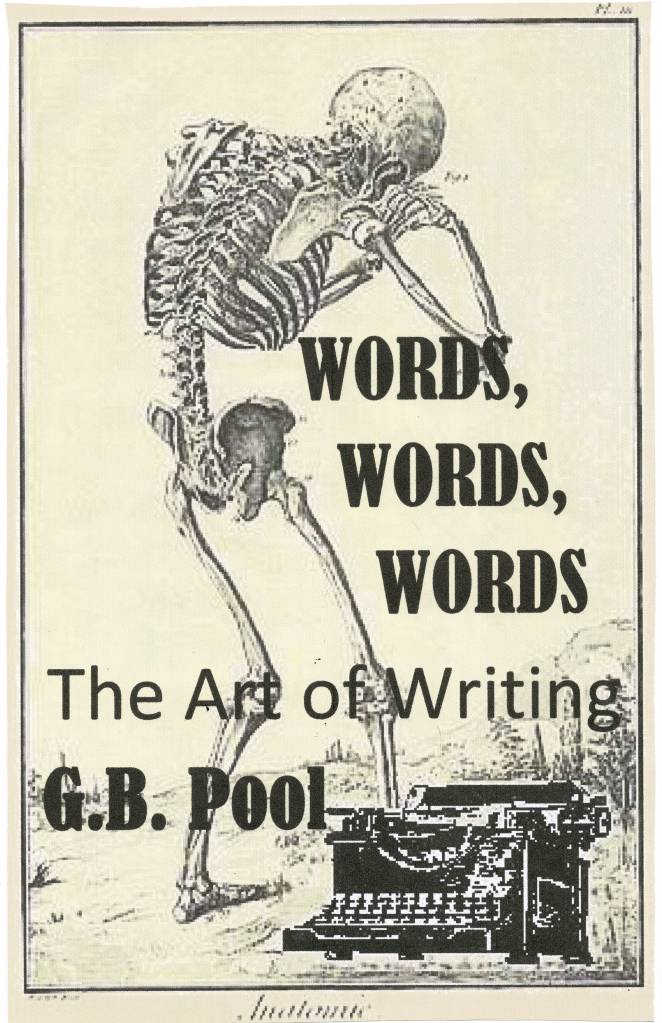
(This article and several others from The Writers-in-Residence blog written by G.B. Pool are in her latest book, Words, Words, Words – The Art of Writing, available on Amazon.)

 My intent in this post is to once again highlight a side trip on the trickily winding writing-road. Nonetheless, I can’t imagine life these days without writing. And consequently all this thinking stuff—starting with a negative revelation has led me to a new enthusiasm for writing. Writer, or “want to be writer”—the winding road I’m always jabbering about is tricky, but well worth it. And for me, writing what I like to read is definitely going to be an uphill challenge! Though so glad to have actually started my latest.
 NAMES in stories are important in that they have to “fit” the characters, the era, the country, and even class in which they live. You wouldn’t name a society woman, Buster. (Well, unless there was a right good reason for it.) Also, a native seamstress of New Delhi probably wouldn’t be called Manuela. So how do you find those perfectly fitting monikers?



 The Writers in Residence
You must be logged in to post a comment.