
by Gayle Bartos-Pool
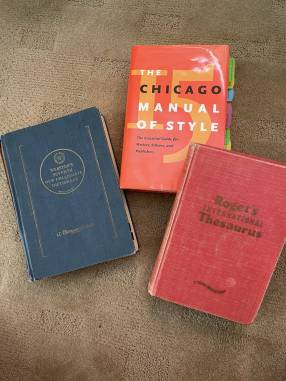
This is a Follow-Up to Jill Amadio’s post about words used by younger folk that might need a new dictionary to understand them because they aren’t in my old Webster’s Seventh New Collegiate 1965 edition. We hear slang on TV shows geared to a younger audience and from young folk in our daily life, some of which needs to be defined by the user because the listener has no clue what they mean. But what will books in the not so distant future be like? Here’s a sobering take on this subject.
I was in a writers’ group years before we formed the Writers-in-Residence blog that consisted of aspiring novelists of all ages. The majority of us were older, but the young folks wanted to be writers and this was a good way to have their work critiqued and maybe improved. Each month one person in the group would submit 30-60 pages and the others would read them and make notes and suggestions about that sample. The pages were usually part of a novel-in-progress. None of the younger people had published work, though most of us older folk did have one or two books in print or wrote for a newspaper. We still wanted our work read and have the group toss around ideas to make the WIP (Work in Progress) better.
That was basically wishful thinking on most of our parts. First, the younger folks didn’t understand sarcasm and how it was used in writing. In other words, they couldn’t understand a good joke about life in general. They also didn’t understand references to anything more than a few years older than they were. A sense of humor was foreign to them, as were the names of famous movies or actors or World History or… Anyway, much of the color and character in our work went over their “collective” heads.
As for their work, I remember reading the first few pages of one person’s novel. The lousy spelling and total lack of punctuation made the pages unreadable. I felt like a Fifth Grade teacher grading a kid’s paper who would definitely be getting an “F.” I had to tell the person why I didn’t finish reading his work. He wasn’t happy and didn’t stay in the group much longer. But every one of those younger people wrote the same way: badly.
I have heard that schools aren’t teaching little things like grammar or spelling or punctuation or math or science that you might find in a school book back in the last half of the last century. I’m not talking about the 1800s. I’m talking about 1950-1999. But remember: Gravity still exists. 2 plus 2 still equals 4… so far. A dictionary from that earlier era should still be relevant. We can add words, but not change their spelling or eliminate their original meaning. Or can we…?
If a word can mean anything you want it to mean or its spelling can be whatever you key into your handheld device with your thumbs or if World War Two was won by space aliens and not the Allied Forces, “Houston, we have a problem.”

But if this Brave New World is what the future holds, the only hope we have is that the people who use these new words can’t spell them, much less understand how to use a pen and write them, so there won’t be any new books out there to read containing these odd words with nebulous meanings. But folks in the future will still have Shakespeare and Agatha Christie and a few books by some of us who still write in a readable language… but that of course does depend on a hope that kids are taught to read in school and right now that doesn’t look too promising. And of course some people are removing great books from schools and libraries or are rewriting them to suit a new generation’s feelings, so that is problematic. Ray Bradbury wrote about a dark future like this in Fahrenheit 451. Orwell saw this coming in his book, 1984. I actually made references to the books 1984 and Brave New World in this post, if you caught the sarcasm. (Look up the meaning of the word if it’s unfamiliar. Use a Webster’s…) So folks, keep copies of these great books in your home library and other books that you have in your collection so future generations can see what people wrote about a century earlier, though you might have to read the book to these younger folk if they weren’t taught in school…
Do I think this is a problem? What part of “Yes” don’t you understand? (Oh, by the way, that’s sarcasm…)

This is Ray Bradbury and me.
Share this:


 The Writers in Residence
Goodness, Gayle, how timely your words are, as usual. And how sad, not to add, frightening. I am constantly reminded of Orwell’s 1984 almost every day, it seems. When will the world wake up from its repressive woke demands and commands? Bradbury was already sounding the alarm before his death, as you point out, in F. 51. What is the answer aside from secreting books in their original form? Happily the few new mysteries I am reading lack almost all wokeness – if that is now a word.
LikeLiked by 1 person
I am definitely keeping tangible books on my shelves just in case they disappear in stores and libraries. And just like you, I am writing books to be added to those shelves. Everybody can have their own opinion, but I don’t want mine outlawed because somebody doesn’t like what I think.
LikeLike
Oh Gayle, this sounds so depressing! I think it’s the younger generation in the Big Cities (such as L.A.) – where they come to get rich and famous overnight, without ‘doing their homework’ – that scream the loudest…. and have no sense of humor!
I choose to believe that there are younger writers and readers today who still understand and value our great English language and our literary heritage. They, like us, are just quietly getting on with their lives.
LikeLiked by 1 person
Maybe we shouldn’t be too quiet. Sometimes praising someone who is writing real words needs our encouragement.
LikeLike
An excellent post, Gayle–very scary, but unfortunately potentially very true. Maybe one good thing is that those of us who remember the world the way it used to be won’t necessarily be around to see the worst of the changes–or write about them!
LikeLiked by 1 person
Or we can write the truth and let folks see what this particular world looks like. It doesn’t have to be harsh, just tell it like it is in a way that opens their eyes.
LikeLiked by 1 person
Miko here. I recall that group vividly, including the (mostly) younger participants’ shock and dismay when the other members didn’t heap praise upon their work. How many of them, when presenting pages filled with grammatical, punctuation and spelling errors, contended they could “hire someone to do that”. If we questioned something unclear or missing in their writing, they would argue that what they meant was entirely different than what they wrote, as if they expected to stand alongside everyone who’d read their novel and explain what was missing on the page. You could always tell the serious writers from the dabblers. The former listened and heeded advice. And eventually got published. The rest dropped out.
LikeLiked by 2 people
They were memorable. But I learned a lot from them… Mostly what not to do.
LikeLiked by 1 person
A particularly pungent post!
Pungent typically describes things that have a strong, sharp taste or smell. It can also describe communication that has a strong effect on the mind because of being clever and direct.
Things described as “pungent”—be they on the plate or on the page—have a bite to them, just as the word’s Latin forbear suggests: the verb pungere means “to prick or sting.” Some early uses of pungent described things that literally pricked, such as plants like holly.
The word is also frequently applied to verbal prickings, in which sharp and incisive language brings a biting quality to satires, critiques, and the like.
Ouch, Gayle.
But you sure got me to thinking.
LikeLiked by 1 person
We writers deal with words everyday. We don’t want them gutted so nothing means anything anymore. Ouch is right… or should I say WRITE.
LikeLiked by 1 person
Thanks for your thought-provoking post, Gayle. I haven’t been in a critique group with younger writers, but have been in two with older ones, mostly aspiring. I was as amazed at their grammatical, punctuation and spelling errors as I was with their la-di-da attitude toward their errors.
I’m taking a course in banned books with our local Lifelong Learning Institute. Yesterday we had a lively discussion of Animal Farm, and next month we tackle Brave New World. 1984 was included in the discussion of AF, but thankfully we didn’t have to read, or re-read, it. I shudder at the mere memory of it.
LikeLiked by 2 people
Fahrenheit 451 is another book that will make you think it was written yesterday. Brave New World is rather scary in its overall theme. It makes you wonder if those writers had a glimpse into our future or they were just good guessers. I have a T-shirt that reads: 1984 Was Not Supposed to be an Instruction Manual. Getting more people to read these books might not be a bad idea.
LikeLiked by 1 person
Unfortunately … everything in this post and in the comments rings true. Those three titles – Brave New World, 1984 and Animal Farm still give me nightmares. Although Terminator: Judgement Day is not in the same league (!) the theme of the world being taken over by Skynet – i.e. A.I., seems as if it could be around the corner – it was filmed in 1991 but the year it is set in … guess what … 2029! But I digress. I was talking to a 16 year old who was sitting his GCSE’s – they are all allowed to use A.I. in their essays. I was also told that the more similes used the better, no matter the context. Grammar? Sentence construction? I just got a blank look.
LikeLiked by 1 person
The only way young people will know what they are missing is if we tell them, either in our books or when speaking to them. Sometimes relating a tale or two from these old books and showing the youth of today the similarities between then and now is the only way to reach them.
LikeLike
You are so right! You are also very positive whereas I often feel despair.
LikeLiked by 1 person