
by Miko Johnston
My first book, A Petal in the Wind, begins a family saga that encompasses a half century. As each subsequent entry in the series carries a subtitle, my fifth and last book, which I’m writing now, will be called Shadows of the Past.
That phrase took on new meaning recently when my husband Allan and I traveled to Europe.
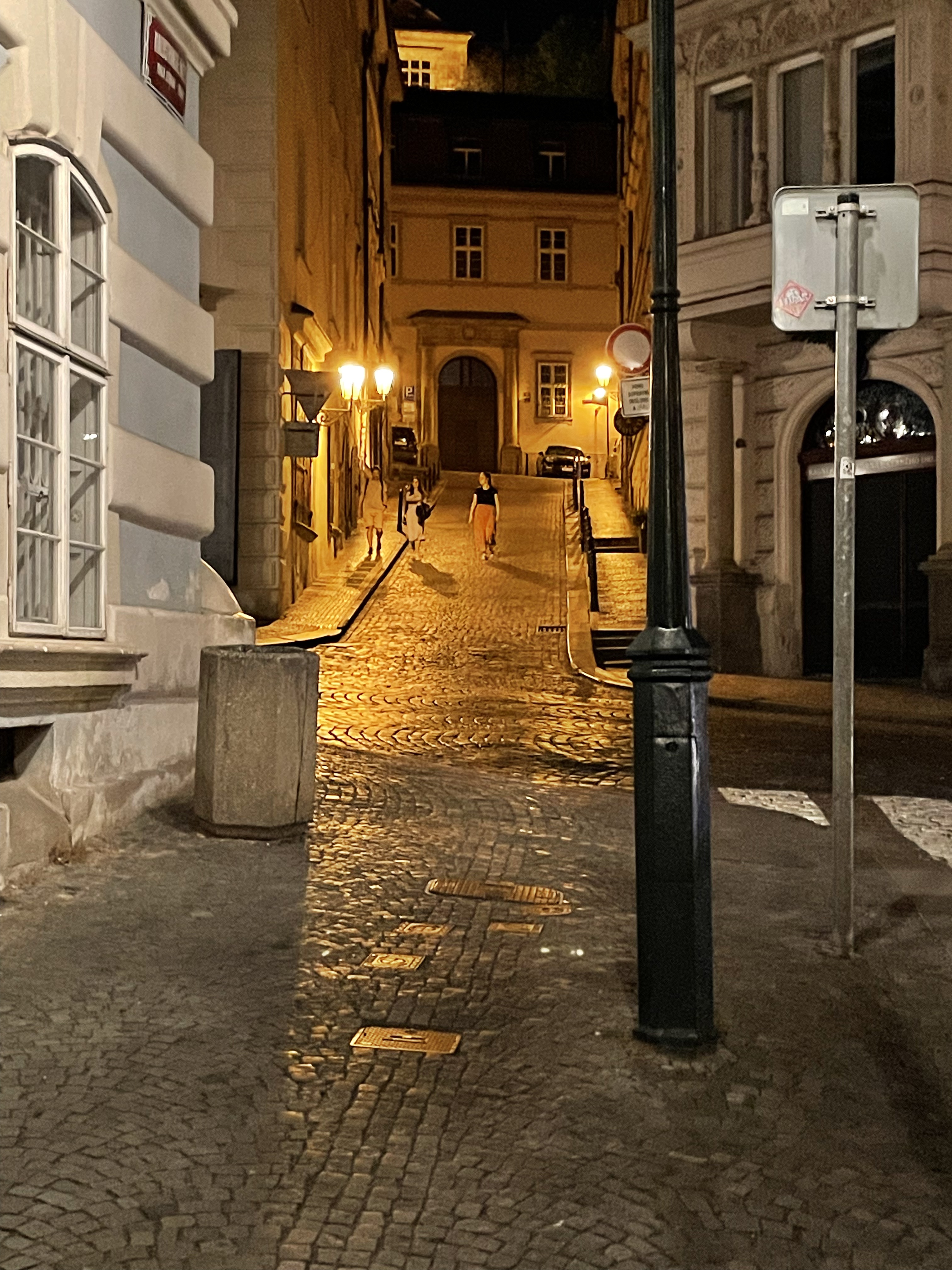 Our trip began in Prague, where much of my series takes place. I spent a day walking in the footsteps of my characters, visiting their homes, businesses and the landmarks mentioned throughout the pages. I’d selected most of the locations on Google Maps, so seeing them for real was, shall we say, enlightening. It took an hour to find U Seminaire, the location of the bachelor pad I’d used for the man who eventually marries my protagonist, Lala. I’d chosen it because it seemed like a quick walk from the Charles Bridge. In actuality it sits underneath the bridge, entangled in a labyrinth of short blocks and alleys. Somehow the building’s image got reversed on Maps – it’s on the opposite side of the street. Ouch. The little greenbelt across from Lala’s mother’s apartment, where ladies sat on benches underneath the shade trees and gossiped, actually sits below street level, though trees do line the sidewalk and there are benches. And the “gentle slope” of the street where Lala’s family lived for twenty years turned out to be a heart-pounding climb on a good day, and treacherous during inclement weather. Sigh. Still, as I stood in front of the building, seeing it for real, I felt thrilled.
In my fourth book, Lala launches her design career by converting a series of buildings into a world-class hotel. Ironically, the palace (the Czech term for a fine home), which I’d chosen for the location is now an actual hotel, and we decided to book it for our visit. It turned out the be the finest hotel I’ve ever stayed in, and although I have no right to take pride in that, I can’t help but feel delighted. On a slow afternoon I cornered the hotel staff and peppered them with questions about the building’s history, particularly during the Second World War. What began as a brief history lesson turned out to be a wild series of stories and gossip, which will inevitably solve some plot issues.
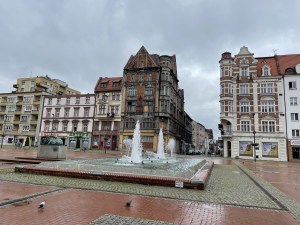 Three days later Allan and I bid ahoj to Prague and boarded a train bound for Poland. After an overnight stop in Katowice, the largest city in the region known as Upper Silesia, we took a cab to the nearby city of Bytom, the hometown of my father and his entire family. Back then Upper Silesia was part of Germany, the city known as Beuthen. As I walked along the streets, I tried to picture what his life must have been like. I gazed at the people who passed, wondering if I’d see any signs of familiarity in their faces.
The picturesque parts of the town – with some remarkable architecture and a delightful town square, partially rebuilt after being bombed in WWII – surprised me, but other areas wore the hard reality of over a half-century of decline. I saw it in the run-down buildings left to rot and the pervasive trash, especially cigarette butts, in the street. I also saw it in the faces and the body language of so many, but most strikingly in the older folks, who’d lived through Nazi occupation, followed by decades of Soviet rule, only to be largely ignored by the European Union. They bore a sense of quiet despair, of resignation to the bleakness in their existence. The only signs of joy were in little children interacting with pigeons in the town square, swarming with them, chasing them or karate-kicking them away. I saw no faces that resembled mine, nor any signs of my past in the city. It had been wiped clean.
Our next stop in Poland was Krakow, a city Allan has always wanted to visit. Rich in history, it has a beautiful castle on a hill overlooking the Vistula River, and the largest town square in Europe. I went for a different reason. On our second day there we boarded a bus to tour the two largest and most infamous Nazi-era concentration camps, Auschwitz and Birkenau.
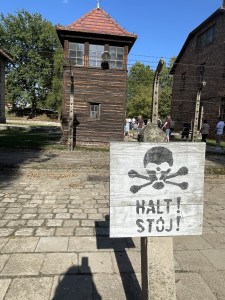 Entering into the first camp, with its ARBEIT MACHT FREI (“Work sets you free”) sign over the entrance gate, I wondered how I would react, or feel. I’m still not sure, to be honest, other than the eerie familiarity of what I heard and saw – from decades of studying photographs accompanied by written accounts, of documentaries and movies filmed on location, and stories I’d heard from survivors, including my father. For many, the trip was a history lesson. For me, it was akin to visiting the cemetery; I lost an estimated ninety members of my family there.
 After a brief break, the tour continued to nearby Birkenau. Unlike Auschwitz, which to me felt small and claustrophobic, Birkenau is huge. You’ve seen it in many movies: a long low building with railroad tracks leading to a central tower, open at the bottom to allow trains to enter with their human cargo, like a gaping maw ready to devour all who arrive. Alongside and beyond the entrance, what seems like miles and miles of barbed wire fencing surrounds a huge open area interspersed with low barracks and guard towers. In the distance I could see different tour groups traversing the grounds, and for one brief moment I pictured them in the striped uniforms and hats of prisoners.
 Prior to abandoning the camp in January 1945, days ahead of the advancing Russian forces, the Nazis burned the meticulous records they’d kept of all who were brought to the camps and blew up the gas chambers. Only piles of rubble remain. Many, many piles. They left behind the prisoners too weak to continue; the rest (including my father) went on a forced march from one concentration camp to the next, always trying to stay ahead of the Russians, whom they rightfully feared more than the other Allies. It took several more months until my father was liberated, but at least the Americans freed him. Had he stayed behind in Auschwitz, he would have lived the rest of his life under the thumb of the Soviets. After what I saw in Bytom, I’m grateful he had the strength to wait.
The entire tour took seven hours and, although it allowed for a few bathroom breaks, it did not include a meal. The irony was not lost on me.
We left Poland and continued our travels, with France the next destination. There I stumbled upon traces of history that will influence my writing, and my life, but I’ll save that for a future post.
I can’t say these experiences will enrich the final chapter in my saga, but I can say I truly feel as though I’ve walked in the shadows of the past, both my characters’, and mine.
Miko Johnston, a founding member of The Writers in Residence, is the author of the historical fiction series, “A Petal in the Wind”, as well as a contributor to several anthologies including the about-t0-be-released “Whidbey Island: An Insider’s Guide”. Miko lives in Washington (the big one) with her rocket scientist husband. Contact her at mikojohnstonauthor@gmail.com

 Petal in the Wind Book IV: Lala Smetana
 The Writers in Residence
You must be logged in to post a comment.