What’s The Point of Resistance?

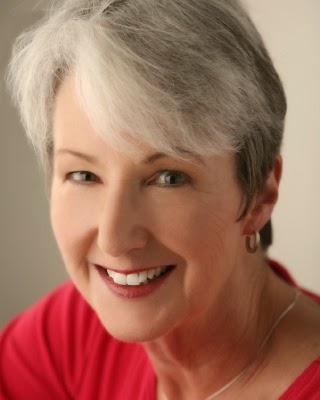
by Guest Blogger, Renee Le Verrier, E-RYT*

When the writing gets tough, the tough stay in the chair.

When the writing gets tough, I slide off the chair onto a yoga mat.

I begin a class with a short reading once everyone gets settled on their mats. On one particular morning, Greta, an eighty-something with a sunny smile who never missed a session, cleared her throat.

She leaned closer to me. “May I ask you something?”

I nodded.

“If you could define yoga in one word, what would it be?”

I didn’t hesitate.

“Awareness,” I said

Greta sat upright and seemed to be considering my response. “That could apply to nearly everything, that awareness thing,” she said.

That’s the day I went home and unrolled a mat beside my writing desk. So closely related, I wanted to practice each near the other.

Yoga, in a longer definition, is more a meditation in motion than it is bending into poses. Similarly, writing is more than the number of words on a page on any given day. The craft moves characters forward or back, into twists in a kind of motion of imaginative meditation. When my mind is with me, not off planning what’s for dinner, present with my pose or in a scene, both my yoga and my writing deepen.

The word yoga derives from Sanskrit meaning ‘linking together’—as in yoking—the mind and body. Awareness connects the two. When I take notice, the continuous chatter in my brain—that’s busy, busy making mental remember-to lists—fades. What’s opened up makes room to be attentive.

In writing, I focus on how and where the words affect me physically. If my typing resembles an air drum solo, I’m on a roll. If I’m in the middle of crafting a fight between two characters I’m breathing easy and my toes aren’t curled, something is off. It might not tell me what is awry but I’m aware I need to edit.

If I can’t connect with my body, I pause and take a detour to my face to take inventory there. Are my jaws clenched? Lips squeezed tight like a zipper?  Eyebrows furled?

Toggling from body to expression has revealed an assortment of secrets. In yoga, I may believe that I’m relaxed while my cheeks and lips form a frowny face.  In writing, I’ve been delighted with myself for a stellar phrase, yet the computer screen reflecting back at me is unsmiling. These scowls indicate dissatisfaction and point me to a needed revision.

Awareness isn’t skin deep, recognizing only pain or pleasure. In yoga, my mind is reading my body and reporting back, yes. But stretching only to the first sense of pushback doesn’t allow much room for lengthening or release. I instruct the class to go as far into the pose that they get to the point of ooh, ow, ow.  But don’t stay there. Know where that point is, then ease back to where the stretch first meets resistance, to just ooh.. From there, try to coax the line of opposition into backing away.

In writing, we reach points of resistance in our plotlines, our narrators, our characters—fictional or non. The story arc banks on opposition—without it, there’d be no conflict, no resolution, no growth. I look for the far edge of that resistance. It may be too intense, unbearable, so I take it back to the point where it feels right. Just like when I’m on the mat.

Greta was right about that awareness thing.

* An E-RYT (Experienced Registered Yoga Teacher) has documented over 2,000 teaching hours and attended at least 500 hours of training as a student.

.

BIO for Renee Le Verrier

Renee Le Verrier enjoys being surrounded by books, painting supplies, dog toys and yoga. The author of Yoga for Movement Disorders and Travels with Tommy (featuring a very special Great Dane), she has been awarded Best in Show in local juried art shows but mostly fills up the walls in her office. She has been teaching and presenting on yoga throughout the US and UK for eighteen years. She writes from an island off the coast of Washington where she lives with her husband and another Great Dane. She’s currently working on a YA novel, which also means she’s practicing yoga regularly. Visit her at http://www.leverrier.com

I GOTTA NEW GIG!

by ROSEMARY LORD

It’s about twenty years since I was hired to write my first non-fiction book, Los Angeles Then and Now. Hollywood Then and Now followed. It was for a small London publisher. Both books were a huge success and on the Best Sellers’ list. Great for the publishers; however, as I was a writer-for-hire and they had the copyright on all the Then and Now books, I don’t receive royalties. But it was a tremendous boost for my writing career and a good ‘calling card.’ I did a lot of publicity and promotion, so I learned a lot on the publishers’ dime.

It got my name out there.

Over the years, after the first flush of success, I did the occasional book signing and promotional appearance. I continued to lecture on the history of Hollywood and attend charity events, so it kept my name out there. These books really have ‘legs’! Like the Energizer Bunny, they go on and on. Every so often, the publishers would ask me to write updates and additions for the new editions.

But then, a couple of weeks ago, I received an email from Harper Collins, one of the ‘Big Five’ publishers in London. They had bought Pavilion Publishing and bought my Then and Now books.  “Would you be interested,” they wrote, “in writing a completely new updated version of Los Angeles Then and Now?”

Let me think… um…er….   “Yes!” I cooly responded: “I’ll move my schedule around.”

And so, my fiction writing and novels will be cast aside for a while as I focus on this enormous task. I won’t totally abandon them, but for a while, they will take a back seat.

The original contract was quite daunting: selecting 77 sites representing Los Angeles. Because it is such a sprawling city in search of an identity, I started downtown at its origins in Olvera Street, then drew a line going west to the beach at Malibu, illuminating sites along the way. That was (and is) my plot line. The money was not great, but the opportunity was.

Over the next year, I will be updating the existing 77 sites throughout Los Angeles, giving a fresh view of the history. I will be changing about 15 of them, removing sites that may not be of such great interest and adding those I consider more fascinating. I get to select new sites with greater appeal for today’s readers. As well as researching new, previously hidden facts to give each history a new look, I will be sourcing archive photos and new, updated photos of all the sites. I will also take a new approach to writing the main history of Los Angeles that comes at the front of the book.

There is so much history to write about, examining different aspects of what went before, and the myriad of characters and how they built up this amazing city from scrubland in the desert with no water and very few people. The main challenge is to condense it all, keeping the most salient points. The publishers have very strict word counts on every page.

It’s very easy for me to wax lyrical about each place’s history and the colorful individuals involved, and if I’m not careful, I can write on forever. The skill with this assignment is to give “Just the facts, ma’am,” but keep it interesting.

And I really do have to rearrange my life to focus on this job. I always seem to have several writing things on the go at once, with research books, clippings, and files everywhere – as well as the Woman’s Club work that still lingers. My workspace is always busy. But this task is large, so everything else must be put away for now.

I’m Yack Shaving again! (That’s when you get sidetracked and taken on a circuitous route, with multiple small tasks that need to be completed before you can accomplish your main, original goal.)

I have a couple of mesh-sided carts on wheels that hold hanging files that I use for specific projects. I’ve cleaned these out of copious miscellaneous papers, ready for the 77 separate new files for each of the Los Angeles sites, plus the main history and archive photographs.

I’m going through boxes of old research files, culling as needed, making room for new information. I can’t wait to get back into investigating at some of the old libraries and hidden private collections to discover newly unearthed tidbits of history that so often get overlooked. Research is where I can spend far too much distracted time.

Many of my handwritten notes have faded, and as I struggle to read the pencil-scribbled file tags, I realize I need to dig out my label maker – and borrow a five-year-old to show me how to use it!

Lately, I’m getting really good at organizing my files. I recall the late Professor Randy Pausch complaining that his wife thought he was way too compulsive, filing everything alphabetically and neatly. “Because,” he decided, “that was so much better than searching for something in a panic, saying, “I know it was blue, and I was eating something when I had it.”

And of course, I’ll be driving all over Los Angeles to check on old and new sites, taking copious photographs and notes along the way. So, I have to fit that into my schedule.

But now, I have a stack of new notepads and pencils, a pencil sharpener and erasers, my Thesaurus, and OED at the ready. A clean, empty desk awaits.

I’m ready for my next literary adventure.…

How do you prepare for your next big writing project?

The Right Writing Space by Bonnie Schroeder


Bonnie Schroeder started telling stories in the Fifth Grade and never stopped. After escaping from the business world, she began writing full-time and has authored novels, short stories and screenplays, as well as non-fiction articles and a newsletter for an American Red Cross chapter.


THE RIGHT WRITING SPACE

Do you believe in magic? Do you have a special space where your creativity blossoms?
When I first started writing fiction, at age ten, I had a vision in mind: me, in a cozy office lit by Tiffany lamps, tapping away on a typewriter (remember, I said I was ten) and producing page after page of flawless prose, destined for publication and awards. Nowhere in my vision did reality intrude.
A few years later, my mom gave me that typewriter: a big black Remington. I thought I was really on my way to becoming A Writer then. Since no office was available, I put the Remington on a metal stand in a corner of my bedroom, taught myself touch typewriting from a book, and churned out story after story about misunderstood adolescents searching for . . . well, I’m not sure what they were seeking except my recycled versions of popular television shows.
Fast forward a few decades. The Remington gave way to a Smith Corona electric. More paper was sacrificed in my quest for publication. Still my writing didn’t catch fire—with me or anyone else. I plodded, and it showed.
In young adulthood, I bought myself a big old oak roll-top desk. Maybe that would help, I thought.
It didn’t. I still have the desk; it’s a lovely piece of furniture, and I sit at it to pay bills, make phone calls, and write shopping lists. But I don’t write stories there. The desk gives me claustrophobia, with its high sweeping sides and cubbyholes that block the light.
Besides, my computer won’t fit on that desk.
Yep, the Smith Corona is long-gone, replaced first by a Dell desktop and eventually by a sleek little laptop. I bought a cheap metal table at Office Depot and it barely holds the laptop, a tiny printer, and all the electric cords and connectors. There’s not much room for paper or anything else.
And I find it really, really hard to sit at that computer table and write fiction. Ideas refuse to come.
It’s not like I need perfect conditions in order to “create.” I wrote the first draft of Mending Dreams on a 14-passenger commuter van (on the days I wasn’t driving it.) And for a while I wrote at a local bookstore. That actually worked pretty well; the soft white noise around me drowned out the omnipresent Critic who lurked behind me at home.
Then the bookstore remodeled. They expanded and added a “café” to replace their tiny little coffee bar. The clientele expanded, too, and with it the white noise turned harsh and distracting.
Finally, I re-thought my work space. Years ago, I shared a fairly large house with a roommate. The house had three bedrooms plus an office: a wood-paneled room with a built-in desk and tons of cupboards and shelves. My roommate generously forfeited the office to me, and she put her metal office-surplus desk in the third bedroom. Ironically, in the luxury of that genuine office space, I had trouble writing. The wood paneling seemed to swallow light. I found myself gravitating to my roommate’s metal desk when she wasn’t around, because there I felt able to breathe.
Maybe I needed the space and the light because what I was doing—making up stories and creating characters, only to plunge them into emotional pain and despair before they could emerge changed for the better—was such a dark art that it had to be practiced in as much daylight as possible.
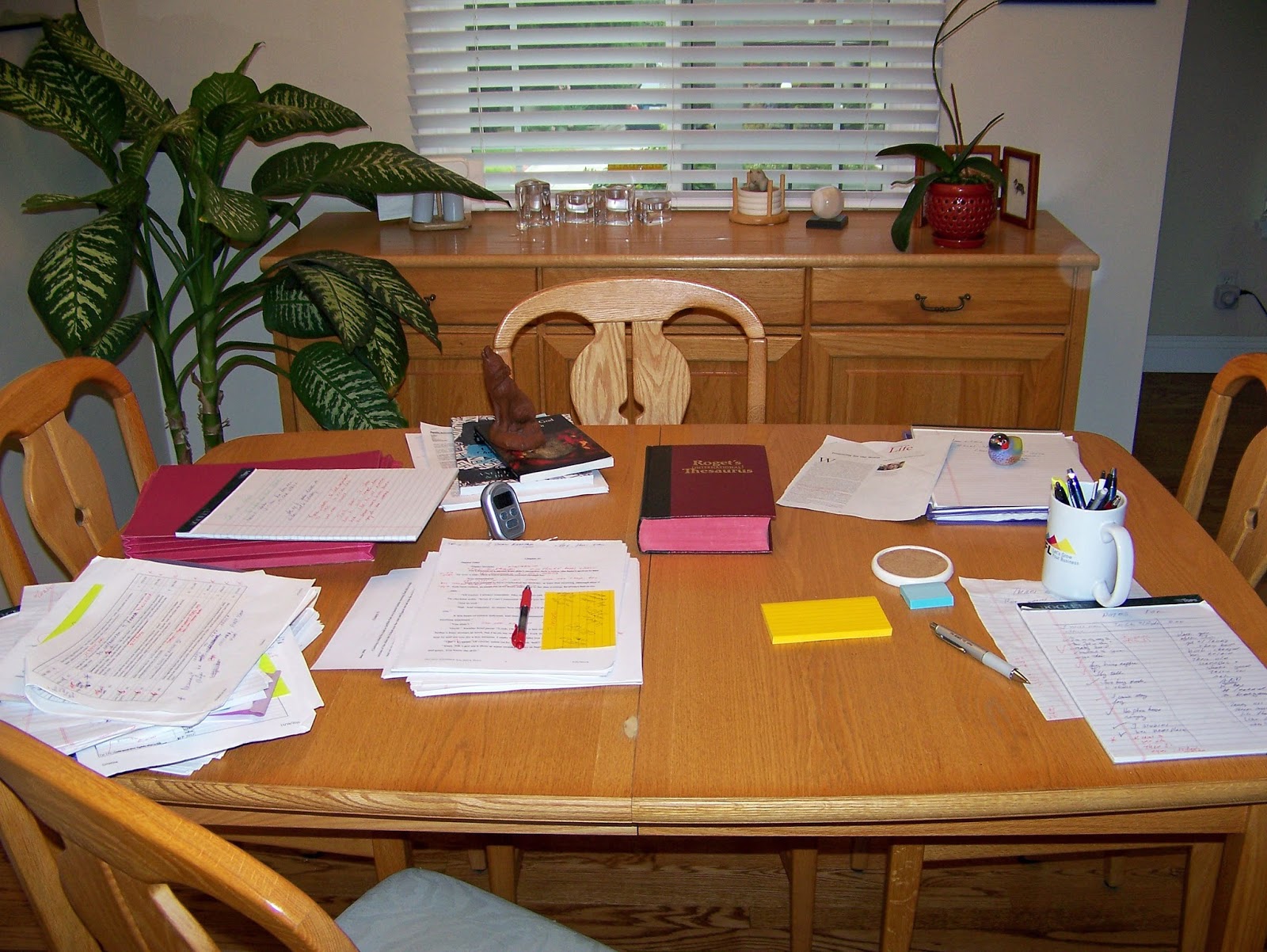
I finally found my magic spot in my current home: my dining table, a clunky slab of pine on skinny legs, from Ikea no less. But you know what? It works for me. I can see the street in front of my house, but not enough to distract me. I have room for my stacks of folders, my drafts and notes and thesaurus, and they’re all within arm’s reach. I have a couple of little good-luck tchotchkes there too, and the chair is uncomfortable enough to force stretch breaks now and then. The laptop comes and goes, depending on which phase of writing I’m in.
The downside is that, yes, it’s the dining table, and it actually gets used for dining a few times a year. Mostly we hang out at the breakfast bar in the kitchen, but on birthdays and holidays, I have to move all my paraphernalia somewhere else. But that only takes a few minutes, and the trade-off is worth it.
Light and space and breathing room. For me that’s the answer. But what about the rest of you? Do you have a special place that makes you feel safe and creative? Was it what you expected it to be at the beginning of this crazy journey? Please don’t tell me I’m the only one re-purposing my furniture!