We are a group of published writers who come here weekly to entertain, inform, and encourage you in your writing and your reading journey. Grab a cup of coffee, get comfortable, and join us.
Most of us might name December as the busiest time of year. For me, it’s November, and this year the month is especially chock full of activity. My November actually kicked off on October 20, the first day of Early Voting in Virginia. I worked at an EV site for four ten-hour days, helping voters navigate the democratic process. Last year, I worked at the polls on Election Day itself, an experience I described in this post.
The November Marathon, a Sisters in Crime initiative, helps writers build a daily or monthly writing habit over the course of thirty days. The marathon replaces NaNoWriMo, which SinC sponsored for many years. I serve on SinC’s Social Media Team as manager for the LinkedIN account and post daily in November about the marathon as well as about other events to promote the organization.
As for writing, I’m working on a short story that’s due in early January. That’s coming right up! I have three signing events this month: the Hanover Book Expo happened on November 8; the Local Author Book Fair, put on by the Chesterfield County Library, is scheduled for November 15; and on November 22, members of the Sisters in Crime Central Virginia chapter will meet at Book People, a local Richmond bookstore. I’m looking forward to discussing our recently-published anthology, Crime in the Old Dominion. I love being around readers and writers—we learn so much from each other.
In early November, I enjoyed a Jim Brickman concert and a tour of the Hollywood Cemetery. As a side note, President James Monroe is buried there. On October 23 (just nine days before my tour) his daughter, Eliza Monroe Hay, was reinterred with her family at Hollywood Cemetery after nearly two centuries in an unmarked grave in France.
This is all in addition to the normal busyness of my everyday life: the gym, grocery shopping, walks to admire the fall colors, get-togethers with friends and family, medical appointments. Thanksgiving looms, of course. And we all know how life has a way of “altering” our plans.
It’s all material for our writing.
In contrast, December is relatively quiet in my world. Key word is relatively. I get to enjoy the holiday season with a modicum of fuss and bustle. We’ll see if that holds true this year.
How about you? Is there a particular time of year that’s busiest for you?
“A writer wastes nothing.” This saying is attributed to F. Scott Fitzgerald. The renowned writer mined his college years to create his debut novel, the autobiographical This Side of Paradise.
I recently attended an outdoor event in a local park and feel inspired to write about it—in fiction form.
The crowd at this event was large, the air heavy with humidity. Virginia is a steamy place in the summer! I drank little water as I was unsure if facilities were available or even nearby (they weren’t). After standing for over an hour, the crowd started to leave—slowly.
A feeling of lightheadedness came over me and my vision blurred. To say I was frightened was an understatement. I was with friends and the crowd was friendly, so I wasn’t in danger. But the feeling of losing consciousness is scary and uncomfortable under any circumstances.
One of my friends let me lean on her until we came to a tree where I sank to the ground and sat back. People gave me bottles of cold water to drink and press against my wrists. I ate one of my melted protein bars. In no time I felt revived, grateful that I hadn’t passed out. A couple of EMTs showed up and took my vitals (they pronounced them fine!). I opted not to go to the hospital. Dehydration was named the culprit.
One of my friends left to get the car. The EMTs parted the crowd for me, and one of them stayed with me until the car arrived. While we waited, she asked what I did for work.
“I’m a writer, and I’m already planning to use this experience in a story.”
After all, a writer wastes nothing.
As I know how frightening it is to feel on the verge of losing consciousness, I can bring a visceral feeling to the story. My imagination will ratchet up the danger, raise the stakes. Possibly elements of a Hitchcock film I’ve seen is inspiring me as well.
My preliminary idea is based on a series of what ifs:
What if this is a hostile crowd, in addition being a slow moving one?
What if my character, a woman, is alone?
What if the heat and humidity make her feel lightheaded and make her vision blur?
What if she is carrying a quantity of cash and/or jewels that she’s stolen?
What if she is being pursued–by law enforcement? Another criminal? Both?
She must stay conscious and she must evade her pursuer.
Yikes!
A writer wastes nothing.
Has a personal experience ever led you to write about it, especially in fiction form? Tell us about it.
Recently Linda Johnston posted about where writers set their stories. I commented that the next day I planned to visit Charlottesville, Virginia for a research trip. I had finished the first draft of a short story set there, and needed to verify setting details.
I live in Richmond, but lived in Charlottesville for many years, and visit occasionally. It’s a cool place to spend a day. Lots of bookstores! So I have a fair picture of the place. But how accurate was my memory? And Charlottesville is a growing, dynamic city—what had recently changed and what hadn’t?
Here are the setting details in my first draft: The story opens at the Jefferson Madison Regional Library in the downtown area of Charlottesville. As my main character stands on the steps under a columned portico, she turns and sees the Market Street Park, scene of 2017’s Unite the Right rally. I provide some information on that rally, formed to protest the proposed removal of the Robert E. Lee statue.
Once inside the library, the character takes a wide staircase to the lower level and locates a meeting room where a writing group is meeting.
After the meeting, she and a woman she just met leave and walk to Charlottesville’s Historic Downtown Mall. As they approach the Mud House, a trendy coffee shop, they decide it would be a good place to chat.
Mud House
Later they drive to a semi-country location, the scene of the crime they cooked up while drinking expensive lattes at the Mud House.
Based on my research, some rewriting is in order.
The character standing on the steps gazing at Market Street Park: she could only see a sliver of the park from where she stood. I could have her walk through the park and see the patch of dirt left behind when the Lee statue was removed in 2021. But neither the park nor the statue are important to the story, they only serve to add color to the setting. To use film parlance, this bit is destined for the “cutting room floor.”
The library interior: for all the times I visited this library, apparently I was never in a meeting room. They are located on the top floor, not the bottom, requiring the character to take the elevator (I didn’t check out stairway access). The rooms were in use, but I got a peek of the interiors through the glass doors. As the library is a real place in my story, being accurate with descriptions is important.
Jefferson Madison Regional Library
The Mud House. It’s a very attractive space with a nice, and pricey, selection of coffee and pastries. But it’s been completely redesigned and not conducive to private conversation. And the conversation my characters have needs to be private. But I can fictionalize a coffee spot, so no problem there.
Then there was the trip to the semi-country, where I once lived. The route, which must be accurate, was pretty much unchanged. I drove past the Earlysville Oak, estimated to be 250 to 300 years old.
Earlysville Oak
My old neighborhood was also unchanged—except for the owners of my previous home not keeping up the grounds. But I digress. I’ll make up the neighborhood based on this one. After all, it’s where the crime takes place, and I don’t want to rile my former neighbors!
I’m grateful I took this trip. It pays to verify aspects of the setting, especially if using real locations. I also took lots of photos, noted sights, sounds, and traffic patterns (lots of traffic!) and made time for those bookstores.
My love affair with the classics took off in 1989. Why 1989? That was when I started a job in downtown Los Angeles. One day at lunch a co-worker asked if I wanted to go to the library. Surprised, I said, “Sure!” I’d never worked with anyone who spent her lunch hour at the library.
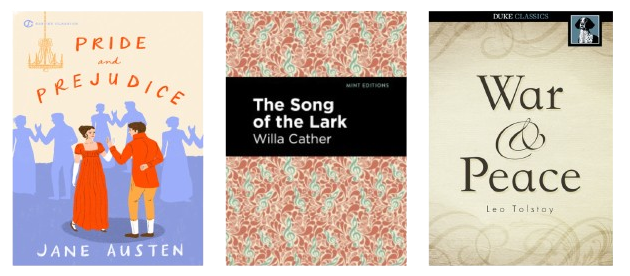
We walked to the Los Angeles Public Library and I checked out Jane Eyre. I had a vague memory of reading Charlotte Bronte’s tome in high school and decided to try it again. Over the next few years, I read—in many cases revisiting my high school reading list—works by Jane Austen, the Bronte sisters, Willa Cather, Theodore Dreiser, F. Scott Fitzgerald, Gustav Flaubert, Thomas Hardy, Nathaniel Hawthorne, Washington Irving, D. H. Lawrence, Sinclair Lewis, W. Somerset Maugham, Ayn Rand, Robert Lewis Stevenson, Leo Tolstoy, Mark Twain, Edith Wharton, and Virginia Woolf, among others.
Many I loved, with a few being okay. Sad to say, I didn’t like Wuthering Heights any better in the early nineties than I had in high school. Heathcliff was just too dark (funny reaction from a crime writer, but there you have it). For many years, Jane Eyre topped my list of favorite classics. But a year ago, I picked it up for the third time and didn’t even finish it. Jane Eyre was given to monologues! Apparently that didn’t bother me thirty-plus years ago.
In 1993 I joined a mystery group and became obsessed with that genre, classic and contemporary. Up to that point, I’d read many Agatha Christie mysteries, but few by other authors. It wasn’t long before I started penning my own.
I try to read at least one classic a year, and sometimes it’s a mystery. A favorite is Wilkie Collins’s early example of detective fiction, Woman in White. I read the epics Brothers Karamazov and War and Peace from start to finish and lived to tell it! I finally got to Little Women a few years ago. I had seen countless film versions but never actually read the delightful autobiographical novel by Louisa May Alcott. David Copperfield was wonderful but populated with characters who, like Jane Eyre, spoke at great length.
Why do I love the classics? They have a timeless quality and universal appeal, essential traits that make a classic a classic. Little Women—despite the lack of texting and social media—could be a contemporary coming-of-age novel.
The classics are known for well-drawn characters and compelling storylines. That said, it can take time for a classic story to be compelling. Contemporary books have to grab the reader on page one; classics require more patience, but are worth the wait. My friend who took me to the LAPL and I started Middlemarch together. Several times I was ready to close the book for good but, being a faster reader, my friend assured me that the story would pick up. Sure enough, George Eliot’s masterpiece became a page turner.
What’s my next classic? Many of my author friends rave about The Count of Monte Cristo by Alexandre Dumas. And I’ve had Elizabeth Gaskell’s Wives and Daughters on my TBR list for some time.
Would reading the classics benefit writers? Absolutely! Have they improved my writing? As an optimist, I want to think so—but such a belief is hard to verify. This post on KindredGrace, “5 Reasons Why Every Serious Writer Should Read Classic Literature”, is worth reading. I especially like #4: Classic literature expands our knowledge base for literary allusions.
Renowned author Joyce Carol Oates suggests that writers read Ulysses by James Joyce. According to her, our vocabulary will improve (or, if nothing else, we’ll want our vocabulary to improve). I take Ms. Oates’s point, but will pass on Ulysses (I managed to get through one chapter).
Back to where the classics began for me: here’s a photo of the beautiful and impressive Los Angeles Public Library. During my stint working downtown, this building was closed for renovations due to two fires, and the collection was temporarily housed on South Spring St. By the time the original building reopened in 1993, I was working elsewhere, but occasionally returned to visit this stunning structure. If you can visit, do so, but you can read about it here.
Closing thoughts: what contemporary novels will become classics? Any of our own? Perhaps works by Margaret Atwood, Toni Morrison, and Joyce Carol Oates will stand the test of time. As for contemporary crime novels, would any make the cut? As much as I enjoy them, they lack the timeless quality—even the historical ones. I’d love to be proved wrong. In the meantime, we have Arthur Conan Doyle, Wilkie Collins, Anna Katharine Green, Agatha Christie, Dashiell Hammett, and many others.
My title is a bit misleading. In the days leading up to Election Day, I did rise in the wee hours and did write. I’m not a morning person, but for years I’ve known writers who worked on their stories before sunrise. There are certainly advantages: it’s quiet, the rest of the (sensible) world sleeps, word counts soar. But it was the election that prompted this deviation from my normal schedule.
In a moment of patriotism, I had volunteered to work at the polls as an Officer of Election (OOE) on Election Day, 5am-7pm and beyond. Yikes! I needed to “train” my system to endure such a radical change to my schedule, and that meant early to bed, early to rise. As long as I was at it, I would write.
Starting on Tuesday, October 29, I rose at 6 am for two days, 5am for two days, and 4 am for three days. I enjoyed coffee, my cat’s companionship, and worked on a short story. I read book on writing, touted as a how-to book on craft (we can always learn about craft); in reality, it was a commentary on writing, delivered in a lofty tone. It required a focus that kept me awake. I did not check my email or anything else on my computer (I wrote in longhand).
Bedtime ranged from 9-10pm, and I had no trouble falling asleep—until the night before the big day when I didn’t get to sleep until 12:30pm. That meant I had three hours and ten minutes of shuteye. Would I be able to make it through the day? As Frank Sinatra crooned, “I’m in the autumn of the year” (in more ways than one).
I did make it through, and enjoyed myself. I worked with a nice group of volunteers and the day was incident-free. The voters were pleasant and cheerful, a diverse group representing a range of ages and cultures. Interesting dress and hair styles as well. A writer’s paradise! I mainly helped them scan their ballots and handed out “I Voted” stickers. Many children accompanied their parents and enjoyed the “Future Voter” stickers. I also worked the floor, directing voters to booths, the ballot scanner, and occasionally the restrooms. Voting is at the heart of democracy and I appreciated taking a part in the process.
Would I do it again? Not likely, but it may be too soon to decide. Early voting holds more appeal, as the volunteers work in shifts, a much kinder arrangement. And it would still offer a way to pay tribute to my mother, who worked at the polls for decades.
My feelings about rising early to write: I liked seeing the sun rise and the light growing brighter and brighter. But I found it quite lonely, especially on the 4am days. The quiet was very, well, quiet. I can see the appeal, but it’s not for me.
Happy writing, whenever and wherever you string those words together. And thank you for voting!




 The Writers in Residence
You must be logged in to post a comment.