
It was a shock. How could they?
I’m talking about Denmark’s announcement to discontinue its PostNord postal service as of January 1, 2026 (after 400 years of continual service) and to remove all its 1,500 letterboxes.
Think of that! No friendly postmen. No possibility of letters from family. Or Christmas greetings. Or bills and solicitations. (Well, I wouldn’t miss those!)
Maybe not having snail mail wouldn’t bother you. (Tell me how you feel in a comment.)
And yes, yes. I know about email! I use it. But it’s not thick envelopes, colorful stamps, and paper “delight” in your hand.
Anyway…
This news made me aware of a writing phenomenon that has begun in earnest this year. If you are on Facebook at all, you will have noticed. It is the many opportunities we have to sign up for story-letters: snail-mail fiction divvied out twice a month for a fee.
A while ago, I interviewed the creator of “Letters from Afar,” Shawnee Mills. She researches (and sometimes visits) places around the world. Her fictional character tells readers about them in letters. She sends field notes, a map showing its location on the globe, and a “find me” game where she hides objects in her hand-painted illustrations. The Afar article.
Shortly after the “Afar” letters, I signed up for the “Flower letters,” where an actual story – romantic/adventure/mystery – was told through correspondence (and inserts and artifacts).
But now. Wow! In a short time, I discovered a baker’s dozen opportunities for you to receive bi-weekly story letters via snail mail. I’ve listed some. You can find them on Facebook by typing the titles into the search bar.
- The Moonlit Letters – a cozy mystery where a young woman inherits her grandma’s cottage on Ocracoke Island and discovers/solves a mystery. Postcards, recipes, and a map are included.
- The Lost Letters Society – four choices of historical-fiction war correspondence, most including romance. Authentic-looking letters.
- Letters by Lanternlight – a choice of three small town cozy whodunnits (all include a cat)
- Storyville Letters – mystery, romance, adventure. Two choices: one is from the 1920’s, the other is 1874, Victorian London. The creator of these is a filmmaker, so they are bound to be atmospheric.
- P.S. (PostScript) Letters – These are original historical fiction, in “the imagined voice” of women you may know. Not biographies, just private, human letters. You will read letters by Emily Dickinson, Jane Austin, Helen Keller, Amelia Earhart, Eleanor Roosevelt, etc.
- Letter Joy – letters for history buffs. Produced by the same people that create the PS Letters. You’ll read everyday correspondence from authors like Fyodor Dostoevsky, Arthur Conan Doyle, Mark Twain, etc.
- Epistolary – “Letters, Lattes, and Lies,” a cozy mystery told in letters of observations and evidence by a retired librarian, to a reclusive homicide detective.
- The Heart Letters – a more serious “novel” told in letters. The creator calls this 24-letter series “therapy through storytelling.” It is designed as “a gift experience for women navigating transition, healing, heartbreak, empty nest, divorce, or loss.”
- The Romantasy Letters – Bold, daring, fiery, spicy, romantic fantasy with passion, intrigue, and magic. (Not my cup of tea.)
- The Titanic Letters – Passengers tell their secrets in correspondence. “An illicit affair and a gripping mystery.” The creator rates the letters PG-13.
- The Asylum Letters – psychological suspense set in the Danvers Asylum in 1926: a secret correspondence between a female inmate with amnesia and a new doctor. By the creator of #10, rated PG-13.
- The Salem Letters – correspondence by an herbalist held in prison for the witch trials. Dark mystery/romance. Rated PG-13.
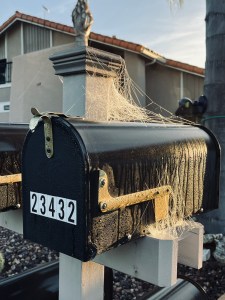
- Scaremail – a “terrifying, unfolding horror saga told through personal correspondence between characters. (The ocre envelopes are splotched with black dripping stuff! EEEEKKK!)
And there are more of these letter-stories available, like: The Max Letters, Writings from the Wild (animals), and The Cozy Letter Club (a farmyard mystery) for kids. (There are also fictional Pen Pal stories to interact with.)
Most of the serialized stories span 12 months of biweekly letters and cost $99-$149. It’s a bit expensive, but it’s fun to find them in your mailbox!
There is a series I didn’t mention above, because it was only available briefly. It is Mysteries in the Mail, written by mystery writer Sara Rossett. I signed up for the series and have received 3 letters so far. It’s different in that the “letters” seem like chapters in a cozy mystery book written in 1st-person POV. There are some lovely hand-drawn, colored illustrations among the text, but no other inserts.
Have YOU ever done or thought of writing and mailing serialized fiction? It would mean some creativity, a bit of postage, and of course a mailing list – but some of YOU have that already. What do you say?
Now is the time to jump on the bandwagon, especially if you have something unique. Any of the writers on this Writers in Residence blog could do what Sara Rossett has done.
And, who knows when the US Postal Service may discontinue!!! Yikes!
But… if you don’t want to go through all the rigamarole of sending out prescribed letters, you can always do what these authors have done. Write your story in a series of letters. It’s called an Epistolary Novel.
Lee Smith did it with “Fair and Tender Ladies.” Helen Hanff did it with “84, Charing Cross Road.” Annie Barrows wrote “The Guernsey Literary and Potato Peel Pie Society.” And one more by Virginia Even, the new, highly touted “The Correspondent.” Go for it, girls! (And guys.)
.
Me? I’ve written (and illustrated) several serialized letter stories in the past. They are fun. I wrote mysteries for each of my three elementary-aged granddaughters via letters in snail mail.
I also wrote a series of twelve letter-stories for the same-age kids at our church, about life in Africa. (These were actually email story-letters.)
If I can do it, so can you. Why not give it a try… while you still have time…. AND MAILBOXES!!!


 The Writers in Residence
You must be logged in to post a comment.