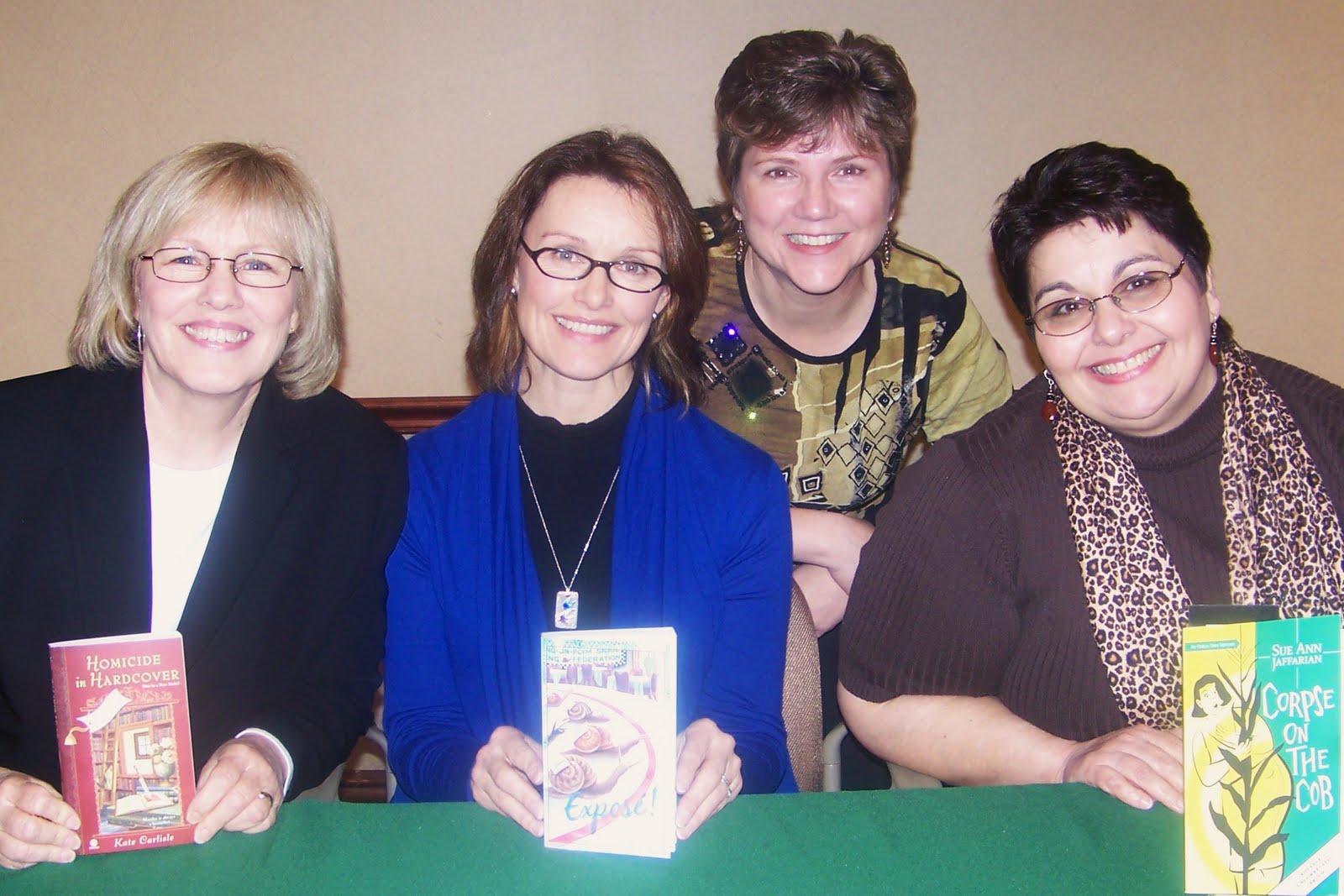
Catching Up with Bonnie Schroeder


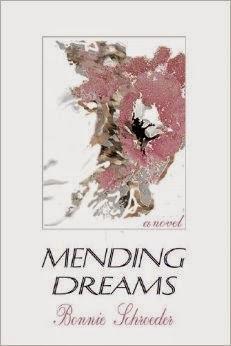
On September 30, 2013, my life changed forever, but in a good way. That was the day I got an email from Champlain Avenue Books, telling me that they wanted to publish my novel, Mending Dreams. It’s been a wild ride since. 


On the glorious day I held an honest-to-God copy of my novel, I barely had time to savor the moment before launching into my first-ever marketing campaign, which has become a never-ending process. 

The best thing about being published? Hands down, it’s connecting with readers, listening to their take on the novel, answering (or trying to answer) their questions. I have been so gratified by the response to Mending Dreams. My writer friends and colleagues have really come through for me, too: they’ve written reviews, told their friends to buy it, and so on. I’ve said it before, but it bears repeating: the writing community is one of the most generous in the world, and I feel blessed to be a part of this wacky but wonderful profession. 

So, 2013 ended on a high note, and January 2014 saw the actual release of my novel. I tell you, typing my name in the Amazon search box and seeing my novel come up was one of the highlights of my life. I just stared at the computer screen for a while as reality sank in. I felt so validated. 

Things went downhill from there for a while. In February, I lost one of my best friends, my 12-year-old German shepherd, Echo, to bone cancer. It was a rough ending to her life, and my beauty endured it with more courage and grace than I did. Reeling from that loss, I faced another: my 15-year-old kitty, Elvie, succumbed to squamous cell carcinoma, and suddenly my animal family was cut in half.  

I was grateful for the distraction of my writing career as I immersed myself in marketing Mending Dreams; getting my website up and running, meeting with book club members and participating in “local author” events, approaching librarians and bookstore managers about carrying my book and letting me do a talk in their venue.  Meanwhile, I finished a solid draft of my next novel, with the help of my online critique group, and once it “cools”, I’m ready to clean it up and start the dance all over again. 

And last September–almost a year to the day since that exhilarating email from Champlain Avenue Books–I found my new best friend, a little whirlwind of white fur and puppy teeth: Thunder, a Swiss shepherd who has all the makings of a great dog if I don’t mess up her training completely.  She has definitely halted my writing process for the moment, but the pages are sitting in plain sight, calling my name, and any day now, while Thunder’s taking a rare nap, I’ll sit down at the table and dive back into the fictional world I’ve been building. 

Stay tuned…

Jackie Houchin Went South

In June, 2012 we sold our horse ranch in Sun Valley, packed up our four cats, and moved to South Orange County. We’ve never looked back or regretted our escape from LA County, not even once. (Apologies to those of you still living there.)
My hair is gray now. Such freedom! No more pale roots and horrible dye jobs. Moving to a new community was the time to do it too. 
Since we moved, I’ve been to Africa (Malawi) twice with short-term mission teams from our new church. I hope to go again this spring. I wrote a dozen journal posts on my website about that first trip.
Unfortunately, six months later my website was hacked beyond repair and I took it down permanently. It was a traumatic experience; a lot of publishing history gone in a flash.  I eventually realized it was time to let it go and move on.
I’m thankful for the journalism experience I got writing for newspapers in LA, and while I’ve posted a few articles on the Mission Viejo Patch and considered a story for the OC Register, I think I’ve pitched my last newspaper.
So, you ask, what are you doing in the WRITERS in Residence blog?  Because I’m still writing! 
I have two other blogs. “Here’s How it Happened” is a mini-website, with a variety of articles. Check out the recipe for homemade Snickers. Yum!  “Morning Meditations” is a more serious journal blog of my early morning quiet times in the Bible and prayer.
I do proof-reading and copy-editing, which is SO appropriate for a perfectionist nit-picker like me!  I’ve worked on a couple mystery book manuscripts, a doctorate thesis, a “how-to” craft manual, and an African children’s novel translated from Dutch.  And I still review books for Mystery Scene Magazine!  
Look for my future posts on WinR about “The Agonies of Book Reviewing: A 12-step plan” “How Lillian Jackson Braun’s ‘Cat Who’s’ Inspire Me” and “Start Writing Cereals…er…Serials!” 

Interview with Author Pam Ripling

Pam Ripling as Anne Carter

While romantic mystery and suspense are her favorites, Anne has written middle grade mysteries, literary shorts, poetry and non-fiction. Long a lighthouse fanatic, it was only a matter of time before her obsessions intersected and a series of lighthouse novels emerged. Paranormal elements abound in both POINT SURRENDER and CAPE SEDUCTION, where mystery, romance and troubled ghosts provide hauntingly entertaining tales set in California lighthouses. A member of Sisters in Crime/Los Angeles, her short story Just Like Jay (written under author name Pam Ripling) appears in their newest anthology, MURDER IN LA LA LAND.

When she is not writing, editing or promoting, Anne enjoys time with her husband and children, two happy dogs and a psychotic cat. She is a skilled photo editor and loves restoring old snapshots and creating digital slideshows. Watch for the third paranormal lighthouse mystery, ANGEL’S GATE, coming soon!


For more about Anne Carter and to read excerpts, visit www. BeaconStreetBooks.com or write AnneCarter@BeaconStreetBooks.com.

Cape Seduction is your most recent romantic suspense released under the pseudonym of Anne Carter. Can you tell us a little about the plot?

How’s this:

1948. Post war, recovery. Hollywood was wooing back the public with blockbusters like The Treasure of the Sierra Madre, Key Largo and The Three Musketeers. The beautiful people were “seen” at the Brown Derby and held their not-so-secret trysts at Chateau Marmont. They drove fishtail-finned Caddies and flew in the luxurious Douglas DC-6.

Darla Foster wanted to be in pictures. Just 21, she worked the circles, attached herself to the arm of any available actor with connections. On this night, March 20, 1948, one of her dreams came true as she sat at Sid Grauman’s Chinese Theatre watching Hollywood’s brightest accept their coveted Oscar statuettes. Later, at the Derby with her date, she met one of Tinsel Town’s favorite sons: the suave, slick headliner, Jordan Kent.

Darla’s life was about to take a sudden left turn as she found herself cast in Jordan’s next big film, about star-crossed lovers, a lighthouse and murder. Exciting fantasy or true life?

In 2008, photojournalist Rebecca Burke can’t just walk away after experiencing the lingering pain and heartache surrounding the abandoned, off-short beacon on Dragon Rock.

In Cape Seduction, you travel back and forth between present day and 1948, and the latter includes a lot of authentic detail. Where did you go for your research on forties Hollywood?
I grew up in North Hollywood, California – just a short drive from the studios that made Hollywood famous. I hung out, with my girlfriends, anxiously hoping to glimpse a famous face now and then. So I was already a movie buff by the time I started writing books. Of course, the internet is a tremendous resource for any author. Finding out what it was like to be a person of affluence during the post-war years was lots of fun. Many, if not most, of the locales mentioned in the book are still in existence. The trick is to embed those details without committing the sin of an “info dump.” The reader has to experience the era, not be inundated with impressive but useless facts. The aura of 1940’s Hollywood can be subtly created through bits of character dialogue, nuances of setting, recognizable events, etc.

Once again, the story revolves around a Lighthouse. Could you give us some background on the story’s Dragon Rock Lighthouse? And what makes you choose a particular lighthouse for each book?

Dragon Rock is a fictional name, but the lighthouse that inspired the setting for CAPE SEDUCTION is St. George Reef Lighthouse, located off the coast of Crescent City, California. I could write volumes about this intriguing beacon. When I first discovered its remote, lonely existence, I immediately went into author-mode. I thought about how scary it would be out there, surrounded by angry seas, all alone and fearful that no one would ever come back. I read everything I could get my hands on, interviewing others who had actually been to St. George Reef (including one of the last Coast Guard lighthouse keepers ), hoping to authenticate my story.

My previous lighthouse story, POINT SURRENDER, deals with a completely fictional lighthouse I placed somewhere near Big Sur, California. But in my mind, I saw it as looking much like Heceta Head Lighthouse near Yachats, Oregon, a classically beautiful, cliff-hugging sentinel that has a rich history and is said to be haunted.

Were you passionate about lighthouses before you started including them in your stories?

Absolutely. In fact, I don’t know why it took me so long to incorporate them into my work! I’ve loved them forever, visited many, and collected numerous knick-knacks and all sorts of lighthouse memorabilia. I am also a member of the United States Lighthouse Society.

Congratulations are in order! Your short story, Just Like Jay, is in the newly released Murder in La-La Land anthology by Sisters in Crime. How much time do you dedicate to short stories?

None, actually. When I heard the criteria for this submission, it sounded like fun—a murder mystery that involves nuances specific to Los Angeles. I did it as a lark, didn’t really expect to be chosen, and I was. I started out writing short stories many years ago but stopped in favor of full-length fiction. The anthology has sparked new interest, however, and I’m thinking of revisiting this fun form of fiction.

You write Young Adult fiction under Pam Ripling. Do you have any new Pam Ripling books in the works?
I have one middle grade reader published, titled LOCKER SHOCK!, about a boy and the gun he finds in his middle school locker. I wrote a second, OLD ENOUGH, that involves the same group of friends. I have not submitted it, however. I’ve found it extremely difficult to support two personas, two very different genres, simultaneously. I’m not sure at the moment what I will do about that!

Could you tell us what’s next for Anne Carter?

I’ve just begun the third lighthouse mystery. This one will center on Los Angeles Harbor Lighthouse, also known as “Angel’s Gate,” and the portion that deals with the past will probably concern the California coast during World War II. This will be the first time I write about a real lighthouse using its real name. Angel’s Gate is set to begin a $1.8 million dollar restoration project, and I’m hoping to get the opportunity to visit this not-open-to-the-public beacon that sits at the end of the breakwater in our harbor. (See my lighthouse blog for a stunning photo of this lighthouse.)

Thank you so much for stopping by!

My pleasure! Thank you for having me. I so enjoy this blog and am thrilled with the opportunity to stop over.

Note that Pam will appear on “A Writer’s Jumble” on September 10th.

Interview with WinR Jackie Houchin

Most people know Jackie Houchin as that lady who shows up with pen, paper and camera and churns out articles that make the rest of us look good, whether she’s covering an author event or a play. She has her own blog at Jackie Houchin’s News & Reviews and writes regularly for Sisters in Crime and local newspapers. Her book reviews can be see in magazines such as CrimeSpree and Mystery Scene.

Welcome, Jackie!

You’re a photojournalist, a children’s book writer, a book reviewer and a theater critic. What’s your favorite type of writing and why?

I really, really enjoyed writing the serialized stories for my three granddaughters (a different one for each of them). It was fun making up the characters, plotting the story lines, and seeing the girls eagerly awaiting the next installments. Sometimes I drew simple illustrations to make them more fun. When I wrote the two “Kinko-published” children’s books for them, I also included simple line drawings in each chapter. However, my “Drawing Muse” isn’t always so cooperative!
The reviews and articles I write for my “News & Reviews” website and the various local newspapers and newsletters are ways to use my “teaching gift” if you want to call it that. (Yes, I’ve always been sort of bossy and “know it all.” Ha-ha) I enjoy meeting all the interesting people I interview. I use photography instead of drawing in this genre.
I also love seeing theatre plays (for free!) and reading books before they’re published. But lately this writing angle is becoming stressful for me. Call it writer’s block, but I seem to approach each new review with trepidation, even dread! Help!
How does someone with so much to do plan her writing time?
Funny you should ask! For one who enjoys everything organized and in order (some would call me OCD – ha-ha!), I don’t plan my writing time well. Usually it’s a looming deadline that gets me in the chair in front of the computer, frantically pounding the keys, while guzzling an entire pot of coffee.
Of course I have to be responsible about dates & times for the events I cover and the people I interview (these are faithfully marked on my calendar), but the actual writing is usually a last minute scramble. (Does it show?)
As a book reviewer, what mistakes do you find repeated, and what brings joy to your work?
Mistakes in the BOOKS, or MY mistakes? In books, I often see typos, of course. They are less evident with big-name authors and publishers. Occasionally I’ve seen name changes mid book, and even sex changes. (Yikes, I didn’t mean it THAT way!)
As for MY reviews, sometimes when they are printed – and I cringe here – I see a typo I’ve forgotten to correct, or two words remaining where I changed one and forgot to take out the other. Gulp!
The joy comes from seeing my work in print, and in the feedback I sometimes get from authors (or actors in the case of theatre reviews).
What’s your favorite type of book to read?
Absolutely my favorite reads are mysteries – strongly plotted ones without too much grit, grizzle or gore. I also enjoy “adult” women’s fiction (not chick lit) and historic novels. I will listen to audio books on history and biography, IF the author gives his information in “story” form. And, surprisingly, lately I’ve enjoyed a few Westerns. Go figure!
Christian fiction is a huge and growing market. Have you thought about writing either fiction or non-fiction for that market?
I’m a Christian, and ALL my writing is influence by that. My children’s stories always have a moral to them (be it vague or bold), and often use Bible passages, proverbs, or parables as a foundation. (Don’t worry! They aren’t “preachy.”)
I try to keep all my writing clean, and as positive as possible. (Even the newspaper events I cover.) I also won’t review books or plays that are offensive to me (sacrilegious, sexually explicit, or with overt violence or language). And, while I’m no academic, I did write curriculum for a 10-year Bible study I taught.
Are there any fiction projects in the works for you?
Fiction…. hmm. Do I dare share my secret?
I have a women’s fiction novel started and languishing in my files. It’s an ambitious work (or so I’ve been told) and tracks the stories of three sisters, each in a potentially life or lifestyle-threatening dilemma. I’ve been told I should tell each story separately, like Nora Lofts does in her trilogy books. But these women’s lives and problems are inexorably entwined, as are the eventual solutions, each dependent on what the other does.
So will “Sister Secrets” ever see the light of day and be at least “e” or self-published?
Your guess is as good as mine!
Thank you, Jackie.
Just a note: I’ve read Jackie’s books and they are some of the most entertaining, well-written children’s fiction I’ve ever read. Please get them published!!!

Interview with WinR Bonnie Schroeder

We are very excited to introduce you to WinR Bonnie Schroeder. An author of women’s fiction and short stories, Bonnie can effortlessly move her readers from tears to spine-tingling chills. She can also make you laugh while you squirm, recognizing yourself in her characters. You can read a sample of her fiction on The Rose City Sisters blog by clicking here.

Bonnie, you are one of the most positive people I know. Good fiction includes tension, but it surprises me how well you are able to show pain and anger and frustration in your characters. How do you access these “darker” places without bringing yourself down?

Therapy, and years of practice! Seriously, it’s kind of cathartic for me, to let all that dark stuff out, transfer my own bad feelings and experiences onto the page and give them to someone else. I learned in writing classes that you have to “let your characters get dirty.” And after dragging my protagonist through the mud, I can look at my own life and think, “Heck, it’s not so bad.” And when all else fails, I hug my sweet Elvie cat; it is impossible to feel down when a cat is purring in your ear.

I’ve heard speakers dismiss writing groups as a waste of time. You belong to several as well as a book club. What would you say are the benefits offered by both types of groups?

Each has its own advantages. From my writing groups I get support, encouragement and specific suggestions on how to improve my craft. Seeing my fellow writers struggle with language, plot, characterization, internal logic, etc., is priceless reassurance that I’m not alone on this weird journey.

And I’m very blessed to have found some amazing, insightful, sensitive writers whose work I admire and who have mastered the art of the critique: first tell the writer what worked, so he or she doesn’t want to give up and knows what strengths to build on. Then move on to what didn’t work, without rewriting the story from the ground up.

There are not that many writing groups around who can pull this off. But don’t give up until you find one, or build one yourself. Trust me: it’s worth the struggle.

My book club also contains several writers – fortunately none are in direct competition! The club introduces me to work by writers I might otherwise have overlooked and suggests new directions for my own fiction. The members are all intelligent, perceptive people with strong and specific opinions on the books we read. Their comments and reactions give me a ton of insight into what appeals to readers, and what turns them off.

You read a wide range of subjects. Can you tell us what your favorite type of fiction is?

I have a lot of faves. I like well done suspense thrillers like Michael Connelly’s Harry Bosch series, and then again I’m a sucker for anything by Alice Hoffman or Anne Tyler, those sweetly incisive, literary, relationship-type novels.

I also enjoy well-written fiction that involves animals, such as Spencer Quinn’s “Chet and Bernie” mystery series, or The Art of Racing in the Rain – a two-hankie novel if ever there was one!!!

I’m a huge fan of Stieg Larsson’s Millennium Trilogy (The Girl with the Dragon Tattoo, etc.) with all its violence and gore. I know, go figure. . .

Actually, my favorite book is one that doesn’t cheat the reader, that delivers on its initial promise. I can tolerate a few technical errors if the book meets that mark.

I know how to plot a murder mystery, but how do you plot a literary novel or women’s fiction? Do you start with a character? An inciting incident? A character goal?

It’s weird, because they come to me in different ways. Sometimes it’s a “situation”: for example in my novel Remember to Breathe, it started out as an idea involving a woman whose husband had left her for another man. What if. . . . what if she learned he was dying? How would she feel? What would she do? What kind of woman would she be? And the story evolved from that.

My latest project is mostly character-driven. I started by seeing the two main characters and am in the process of following them around and trying to figure out who they are and what they want. I know the beginning and the very end, but everything in between is still a mystery to me.

Can you tell us anything about your current project?

I’m kind of superstitious in that I think telling the story dissipates its energy. . . and other such whoo-whoo beliefs. But it’s (I hope) a literary/commercial novel about a woman who marries an artist. Starts in 1966 and ends in 2000-something. Famous artists romp through the pages, along with pot-smoking hippies, corporate pirates, and a folksinger/rock star. All of which is subject to change, of course.

My main challenge is that I was actually married to an artist in the swinging 60’s, and although the story is purely the product of my imagination, I worry people will think, “Oh, that’s all about her and John.” Take my word for it: it’s not. If only my life had been that interesting!

My Tried (and sometimes True) Interview Techniques

Last time, I wrote about where I got my ideas for the articles and profiles I write. I started out by getting the assignments from my editor.

Then I began seeing possibilities for my own stories everywhere i.e. in Starbucks, at bookstores, or on the street. I followed up on referrals from friends and information I found in newspapers, newsletters, or around my neighborhood. I let my curiosity lead me to hobbyists, collectors, and folks with unusual occupations.

So many people: so many interesting stories! Next I needed to to pick their brains, pry out their deepest secrets, find out how and why they do what they do! I had to interview them.

There are three main steps (or methods to my madness) in how I interview folks.

Before the interview

I first decide why I want to interview the person, what I hope to learn, what kind of story I want to write. (A lot of this will depend on where I hope to place or sell the story.) Will it be informative, inspiring, promotional, or…simply someone I personally want to know more about. (Having my own News & Reviews website, helps with that last one.)

I contact the person (on the spot or by phone) and set up a time and date. I let them know who I am, who I write for, and the general topic I want to cover.

Then I do a little research on the person or their specialty, occupation or craft. From my “research” I make a list of questions I want to ask.

I make sure I have a notebook, pens, MY CAMERA, and a tape recorder if it’s going to be a fact-heavy interview. (Fresh or recharged batteries are a given, of course)

During the Interview

I try to establish a conversational mood by commenting or complimenting (depending on where we meet) on our surroundings. I thank them for letting me interview them, tell them what I hope to write about, and get a bit of basic info from them (correct spelling of name, title if any, etc.)

Then I pick up my notebook and pen, turn on the recorder if using it, and dig right in with the first (and easiest) questions. I never stick strictly to my written questions. If something more interesting (or tantalizing) comes up in their answers, I will follow it like a vein of silver in a Colorado mine. And – confession-time here – sometimes I will ask a question I have no intention of using in my story, just because I want to know.

I mostly listen and add questions as promptings to keep them talking. I smile and encourage them with nods or soft, sympathetic sounds. I haven’t mastered the “silence strategy” yet, but I’m told that if you can simply remain silent, your subject will begin to fill it with more info. It’s usually too uncomfortable for me to do that.

I take “off the record” seriously and will never write something I’m asked not to. That doesn’t mean I don’t want to hear it, however. Secret confessions sometimes help me to understand where the person is coming from. I’ll take notes, and I might use the revelation to shade or slant the story, but not even that, if it is too sensitive.

If I get behind on my note taking, I ask them to repeat, slow down, or clarify what they said, especially if I plan to quote it in the story. (Quotes must be 100% accurate!) If they are showing me objects they’ve collected or made, I will ask if I can photograph them. Always at the end of the interview I will get several shots of them with something meaningful to the story. (Projects, pets, creations, gardens, workplace, etc.)

When the interview is winding down, I quickly look over my questions to see if I got everything I need, then I’ll ask if they want to tell me anything I didn’t ask about. (Great stuff sometimes comes out this way.)

I thank them, give them my card with contact info, and offer to send them a hard copy of the finished story (or the link, if it appears in an online magazine).

After the Interview

I review my notes (it’s easier to decipher my scribbling if I do this right away), underlining key words and looking for a really cool approach to the story. I also try to come up with a good strong opening statement – whether it’s dramatic, provocative, humorous, or teasing. What I want is something that will suck in the reader. Wait, that’s called a “hook” right?

I also look for facts that I might need clarified or explained. If I find any, I’ll do a brief call-back by phone.

And, the rule is to never show the interviewee the piece before it is published. But on occasion, under special circumstances, I have been known to do that.

(I’m such a softie!)

Next time: How I Edit or “Weight-watching for Writers”

Interview with Kay Mouradian

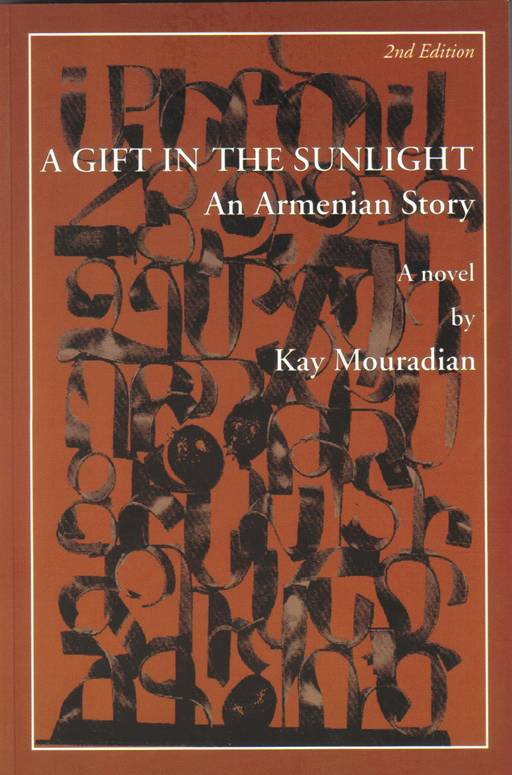
Kay Mouradian, Ed.D, is an author and educator whose writing, until recently, focused primarily on yoga and meditation. When her mother, a survivor of the 1915 Armenian genocide, predicted, “You’re going to write a book about my life,” Kay began an odyssey into her family’s past. The result was her novel, A Gift in the Sunlight.


You can find out more about Kay and her work at http://www.agiftinthesunlight.com


Welcome, Kay.

A Gift in the Sunlight was inspired by actual events that happened to your mother. How were you able to distance yourself emotionally from that traumatic history and craft a novel out of historical fact?

It was tough at times. I went through a lot of Kleenex and wrote a lot in a meditative state where the scenes would just come to me so I could write them. The driving force for me was a sense of responsibility to history. Some say I was too easy on the Turks in my novel, but that was intentional. I did not want to write something inflammatory or too painful to read. I just wanted to educate people about what really happened.

What sparked your interest in writing this book? You’ve remarked that you used to be uninterested in the story; what changed your attitude?

In the last five years of my mother’s life, she made some remarkable recoveries from death’s door, and her entire attitude and personality transformed. Her life until then had understandably been affected by the Armenian tragedy, and she held much anger and self-pity. However, in a series of miraculous physical recoveries, she also became more loving and appeared to have released her hatred of the Turks. In witnessing these changes in my mother, I became curious about the events that had shaped her life. Of course, she’d often told me stories about her childhood in Turkey, but I’d dismissed them as not relevant to me. However, my interest in my family’s history grew as I started reading about events that happened in the Ottoman Empire during World War I, and this research really opened my eyes.

You manage to avoid stereotypes in the characters of this novel; for example Captain Khourshid, who leads the Turkish soldiers enforcing the deportation order, is shown as a kind and honorable man. How did you manage to create such well-rounded characters?

Many of the characters are based on real people, so that helped. For example, the Captain really existed, and he did break his leg in my family’s village before the war. My mother’s aunt was actually the healer who treated him, but I needed to fictionalize some parts of the real story, to keep number of characters manageable, so she isn’t included. Some of the other characters were based on stories my mother told me.

Miss Webb, the missionary, was also based on a real person (in fact one of the translators I consulted regarding my family’s documents happened to know her.) I wanted readers to know she existed, as she was a very noble human being who made huge sacrifices to help the Armenians.

Your book is full of authentic details about life in that era and environment. Can you tell us a bit about how you went about your research?

There’s a saying: “If you want to know the facts, read the newspaper. If you want to know the truth, read a novel.” I kept that in mind as I became overwhelmed by the amount of material that confronted me.

I went to Turkey four times, and visited the village of Hadjin, where my family’s journey began. I followed their route into Syria, although I had to make two separates trips – you couldn’t just cross the border because of the political situation. I’d heard Hadjin described as a beautiful place, and it was – but also something of a letdown in comparison to some of the other scenery I encountered; it’s fairly isolated, as there aren’t many roads going there. In my family’s day, there were 20,000 to 30,000 people living there, but the number had dwindled to about 5,000 by the time of my visit, and these were mostly Kurds. Many Armenians, of course, didn’t survive the massacre.

I also read a lot of my family’s letters, although they were in Old Arabic and Turkish so I had to find translators.

And I did a lot of reading. I read books by diplomats, missionaries, and journalists. At Bart’s Books in Ojai, I looked at all their histories and memoirs, and if I saw “Constantinople” in the table of contents, I bought the book. At the UCLA Library, I researched Turkey during World War I. I contacted the Library of Congress and ordered ten reels of microfilmed documents written by Henry Morgenthau [who was the U.S. Ambassador to the Ottoman Empire during the First World War and the most prominent American to speak out against the genocide.]

I also contacted the Franklin Delano Roosevelt Library and got copies of Morgenthau’s “letters to his brother” which were essentially his typewritten diaries from that era.

Overall, I spent about three years doing the research.

You faced another set of challenges in getting published. How many times did you submit the novel to agents/publishers? How did you ultimately find your publisher?

My novel was rejected by 60 agents. One told me, “Only Armenians will read it.” I then located a small London publisher who specialized in historical works and emailed him the first chapter. He called me from London and said, “I want it.” It turned out that his family came from the same town as my grandparents.

You’ve written nonfiction books on yoga and meditation, as well as newspaper and magazine articles. What prompted the move into fiction?

I would’ve been too limited if I’d stuck to just the facts. I wanted to tell the whole story, not just pieces I knew to be facts. I wanted to be able to amplify the story, make it more emotional.

Because most of my writing until then had been academic, I had to learn how to write a different way. I enrolled in a class at Pasadena City College on getting published, and it led me into library research where I studied books on how to write a novel and began to understand principles like point of view and character development.

Have you been able to incorporate any of your experiences as an educator into your writing?

Yes, since so much of the studying for my Doctorate was research-oriented. And one of the real skills I learned in the process was determination. My social life, however, has never recovered!

You’ve “taken your show on the road” with presentations at libraries and other venues to explain the background to A Gift in the Sunlight. How has that worked out for you?

I’ve had to do most of my own publicity for the book. I started by phoning libraries and asking about speaking engagements. Persistence paid off at the Pasadena Library, and they asked me to speak to one of their book groups. After I created a Power Point presentation, the head librarian gave me advice on it. One of my tennis partners belonged to a book club, so I had an “in” there.

Some recent exciting developments are that Congressman Adam’s Schiff’s Deputy Director saw my Power Point presentation and requested a copy to Fed Ex to Washington DC. I also sent copies of my book to President Obama and Secretary of State Clinton; when I contacted Congressman Schiff’s office for the mailing addresses, they suggested I also send a copy to Michelle Obama – which of course I did.

Is there anything else you’d like our readers to know about you and/or your work?

My objective is to fulfill my responsibility to history. I have a strong desire to educate and a sense that there’s more for me to do. The Armenian story still feels like it hasn’t released me. Every time I think about releasing myself from it, something comes up to pull me back in. I have to see where it all leads me.

What’s up next in your writing agenda?

No more novels! You have to have a story. With A Gift in the Sunlight, I knew I had a story, and a structural understanding of how novels are written, but that’s it for me. I want to work on my yoga stuff, to rewrite my original book Reflective Meditation. It’s hard to find the time to do it all.

Interview with Jacquee T

Jacquée Thomas is an authoress, poetess, lyricist and columnist. Miss Thomas’s background includes extensive Western European travel, knowledge of the Spanish language and involvement in Chicago’s Rockabilly scene. She was a computer instructor at Wright College and a freelance writer for the “Chicago Sun-Times” and “New City” magazine before she became columnist for “Letter from Chicago.”

She established Detour Productions as an outlet for her published works, events, and videos.
Welcome Jacquee!

When I think of Jacquee T. and Detour Productions, I think Romance. You mastered the branding process long before writers were talking about it. How did you go about deciding on the image you wanted to project, and what steps do you take to ensure that image remains clear?

I hadn’t set out with intention to “brand” myself; I set out to build a writing career. I needed to express my passions and perspectives – through creative and expository writing. Eventually, I realized I lived life as passionately as I wrote about it.

For example my writing helped me realize how much I loved being a woman, and how much that was a part of my identity – so that, I referred to myself as an authoress instead of an author, an actress, not an actor. And, true to form, when writing poetry I was a poetess.

Over the years, I realized and asserted my feminine side, which happened to be most of me. And the fellas had no worries, because I averred that a gal could not love being a woman without loving the fellas. Out of this attitude, I believe, resonated a voice that appeals to both women and men.

In knowing myself, and allowing myself, I’d honed a voice that resounded across mediums – newspaper, books, theater and radio – and I realized that my overall message was romance.

I’d already established my image with my readership. Now I needed to guard it as I appealed to wider audiences. How would I introduce myself to them?

The biggest draw, and the biggest deterrent, was the word “romance.” Everyone had their interpretation. Folks who heard “romance” might think of steamy formula novels, or of fluffy-puffy analogies, or they might think this was something for couples only.

While here I was, knowing that romance could be earthy, gritty, profound, heavy, airy, or soaring, and that it’s a part of our nature. How could I, ‘Jacquee T.,’ communicate romance?

I founded the company Detour Productions publishing and entertainment, to represent me and my products. The company message is “Slow Down” to taste life. The Detour web site, products and events, inspire to do so.

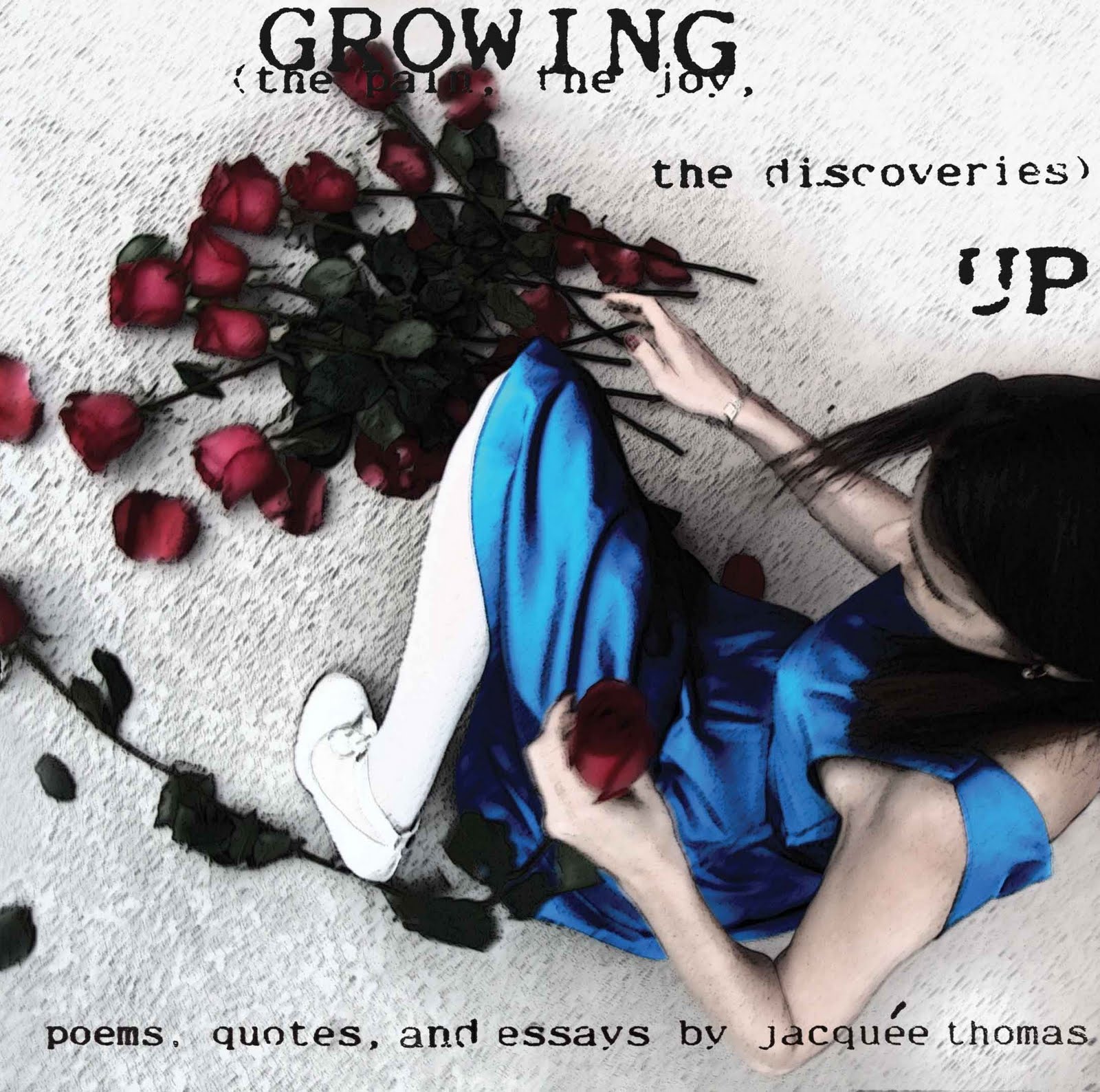
Please tell us about your book, Growing Up (the pain, the joy, the discoveries).

This is the first book printed under Detour Productions. It’s designed as a keepsake.

Growing Up is an 7″x7″ book, with a cloth hardcover and a silk screen title and spine. It has a beautiful dust jacket, and a red ribbon bookmark. It’s perfect to display on the coffee table or nightstand.

Inside is a collection of poems, quotes and essays I wrote throughout various stages of my life. The moods range from somberness to a sense of humor.

I call it “accessible poetry.” Usually when folks hear “poetry,” they anticipate needing to concentrate and de-code the meanings. With Growing Up, I’ve found that people draw their own meanings from my poetry. Both men and women respond passionately.

The retail price is $20. This is a great price for a book of this unique design and quality.

It makes an elegant gift, and adds a little romance to those who receive it.

You regularly hold events that promote your book of poetry, evoke romance, and serve as fund raisers for worthy charities. Would you share with us some of your more unique events?


Detour events promote that “romance is accessible.” The venues are carefully selected; they provide a romantic backdrop.

Two milestone events were the Detour Productions launching party, and the “unveiling” party for Growing Up (the pain, the joy, the discoveries). Both included live music, and a “romantic raffle” to benefit a select charity.

In the Detour launching party, I sang the company namesake song, “Detour Romance.” Among the “Romantic Raffle” prizes were an Odyssey dinner cruise, “Chicago Chocolate Tours” tickets, a bottle of premium champagne, and an overnight suite in Chicago’s Amalfi hotel. Proceeds benefitted Alliance for the Great Lakes

At the “Growing Up” poetry book launching party, I signed copies of the newly “unveiled” books, and read some of the poetry. The Chicago WineStyles on Belmont hosted a tasting of “wines from romantic countries.” The event was titled “Roses for Mozart,” in fond memory of my cat Mozart who had recently passed on. Organic roses were part of the decor. Among “Romantic Raffle” prizes were a Winestyles-Belmont private wine tasting, dinner for two at the famous Pump Room, and tickets for Noble Horse Theatre, Proceeds benefitted Treehouse Humane Society, a cage-less shelter for cats.

Another event was a “Pink Champagne and Poetry” book signing and celebration at the historical Chicago Drake Hotel. This was celebrated in conjunction with the Swing band, The Flat Cats. They performed the song “Pink Champagne” in honor of the occasion. I took the mic regularly during the night, spoke about romance, and read poems from Growing Up. Per the Drake, all “Pink Champagne” purchases benefitted The Lynn Sage Cancer Research Foundation.

Those are some of the larger events hosted under Detour, and there are more like them in the works. They will be posted on the Detour web site once the dates and details are set.

How would an author or authoress go about setting up an event in conjunction with fund raising and then publicizing that event?

If you plan to host an event, plan to work hard. You’ll need to utilize both sides of your brain to make it successful. Set it up to make money, but of course, yet also to cause a buzz about who you are and what message you offer.

Firstly, be creative in choosing a theme to your event, a select venue, and a select charity. These will help you come up with the event title.

For example, if your book is “My Ski Adventures: the Good, the Bad, and the Human Snowball,” consider a snow theme. If it’s summertime, perhaps title the event “Snowy in July: author John Smith’s ‘Ski Adventures’ will give you chills!” Select an establishment with an outdoor terrace. Bring in a snow cone vendor. What else? Popsicles®, Slushies, and for those who want a potable – ice wine.

If it’s winter, select an establishment that has a fireplace and that serves hot drinks – some of them spiked. Potential event title: “Snow Lodge at Ike’s Tavern: author John Smith tells the ‘don’ts’ of skiing.”

In selecting a charity, perhaps one that protects Polar Bears, to go with the snow theme. Or perhaps you have a personal reason for benefitting a different charity.

Secondly, now that you have a focused title and theme, approach the people who can support this event, and whom you can support per the event publicity.

For example, if you approach Ike’s Tavern about donating his fireplace room, explain why his establishment fits perfectly with the theme. Offer to find a date and time that works for both of you. If Ike passes, try Irma’s Fireside Lounge, and so on.

Be prepared to send them in writing a description of the event, the benefitting charity, how you intend to publicize the event and to publicize the supporting establishment, how you expect them to publicize the event. Also, exactly what proceeds will benefit the select charity. A percentage of book sales? A raffle drawing? Sometimes folks like Ike and Irma opt to offer a percentage of bar sales to the charity. If so, be sure to publicize their added altruism – and to announce it during the event.

More details: Provided the drinks, appetizers they provide, what’s complimentary and what’s ‘available?’ Is there a cover price for the event? If so, how would you divide it with Ike or Irma?

Make sure everything is understood and agreed verbally, iterated via e-mail, and if need be, per signed agreement. This with the select venue manager, with the charity, and anyone else contributing to the event.

Thirdly, publicize! The moment you confirmed the event date, title, and location, post a “Save the Date!” on your web site and social media profiles, and send a note to your e-mail list. Offer updates and reminders, in moderation. Once details are confirmed, submit press releases to print and radio sources. Print announcements to distribute to friends, and to people you meet at networking events.

Check with the event venue folks, and the benefitting charity folks, on how they’re publicizing – before you sign them on, and as the event draws near. Offer to deliver fliers, or to send text they could use in blast e-mails or on their web sites.

In all publicity, you need the grabber title, and to assure all is clear to potential guests. For example:

You’re invited to

‘Snow Lodge at Ike’s Tavern’
book signing and benefit for Protect Polar Bears
5 East Elm Road, Paw Paw Michigan
7 p.m. November 1, 2010
John Smith, author of My Ski Adventures: the Good, the Bad, and the Human Snowball
tells the ‘don’ts’ of skiing.

That’s an informative grabber. It also gives Ike’s Tavern and Protect Polar Bears reason to make the same announcement, or to use the announcements you send them.

For the ensuing info, provide more reasons folks would want to attend, the cover price, if any, etc.

As a poetess and authoress, how do you determine which format is best for what you want to say?

An inspiration comes to me, and I write it down. A poem comes as a poem, a song as a song. With the song, I must find a recording device to sing into to make it complete, and that’s usually via calling my own voice mail before I find a musician to transcribe the tune.

Sometimes a character’s action comes to mind, and I write it down, or their dialog with another, and I write it down. When this happens, it’s an excerpt, that may fit into a poem book. Yet later I may get another action or monolog, and realize it’s connected with something I wrote before, and I put those notes together; as notes accumulate I realize this is a short story … (or) this is a novelette …. (or) this is a novel!

Sometimes the dialog is so dominating, I write the inspiration as a screenplay or play. The initial format I put it in remains the medium in telling the story.

Sometimes my thoughts are purely expository. They are released on my Internet outlets.

If I were to offer advice on inspiration, I’d say, allow it raw, don’t force it in any form, record it and make room for it. Do that, and the idea will manifest in its own form.

It was from your website that I discovered the recipe for perfect mashed potatoes! I’ve also read movie and wine recommendations, learned how to take care of my Shamrock plant, and through the “A Romantic in Chicago” link, vicariously enjoyed my favorite city. Where do you look for the content on your site?

Thank you. You’re referring to my Vignettes weblog, on the Detour site, and the new web site under Detour Productions, A Romantic’s Perspective.

Vignettes is a “tip of the fingers” outlet, as I may have an inspiration and be informal about sharing it. A la “Perfect Mashed Potatoes.” It’s not a recipe, it’s a depiction of my experiences that led to a Eureka! that potato lovers would appreciate – especially as they prepare to sit down for a holiday feast.

A Romantic’s Perspective (.com) has a section titled, “The Wine Corner,” where suggestions on wines and wine places are featured. The web site also has “The Green Romantic” section that covers earthy and sustainable subjects. This web site offers features by the month.

March 2010 featured Ireland, and included “wines to go with Irish fare” under “The Wine Corner,” and “Shamrocks, the Wild Irish Clover” under “The Green Romantic.”

As a former columnist for “Letter from Chicago,” it behooved me to include my knowledge about Chicago as a separate entity under A Romantic’s Perspective – “A Romantic in Chicago.” It’s a sub-site under A Romantic’s Perspective (.com), and has the same categories: “The Wine Corner,” The Green Romantic,” with Chicago-based features.

Where do I look for content? I cannot keep up with my ideas. A Romantic’s Perspective was designed to tame them – under categories like “The Wine Corner,” etc. At the same time, those categories spawned new angles.

For example, I anticipated that the March A Romantic’s Perspective to include a splash of Irish among the categories – until I attended a “Flavors of Ireland” event that I thought would merely enhance the “splash.” I left the event with more article ideas than I had categories, and ended up covering all Romantic’s categories with an Irish flair, plus adding a special “Claddagh Ring” page.

These all- Irish subjects knocked out previous features I’d planned. Not only because they were conjoining in the “St. Patrick’s” gaiety, but also because my contacts were prompt to provide requested photos, and to answer questions in rich detail.

All my contacts, I realized, were Irish, with the exception of an Irish American, a few generations removed, who hosted Ireland trips and spoke of them like poetry. It behooved me to let go my previous plans to fill the Romantic’s categories, and to take on the wild Irish subjects.

The previous plans were shelved for later months.

This process keeps me on my toes and excited. At the same time, as a professional writer, I respond to sources who are timely in responding to my information and photo requests.

Do you have any final thoughts you’d like to share with our readers?

If you have a conviction for a writing career, start putting out your writing. Assure your grammar skills are intact, but of course. Yet the most important thing is giving of yourself. Spill into your writing, be it first person or third person; write from your core, not your surface. Readers will sense the difference and respond accordingly, whether or not you hear from them.

And, dress well. Dress as if you respect yourself, and your writing, and the people you meet.

Where to get Article Ideas?

Ideas for Articles and Profiles by Jackie Houchin

I’m not a fiction writer, but I still get asked the question, “Where do you get your ideas?” Of course they mean, where do I find interesting people and events to write about, but that’s okay, I know what they mean.

Editor Assignments

When I first started writing for a local newspaper, the editor sent me out on specific story assignments – a quadriplegic who’d lived 20 years on life support (that actually turned out to be his mom’s story), a man who built model airplanes, a woman injured at a car repair shop, a sculptress who made marble look sensual, a market-window muralist, an orchestra conductor, a trailer park scandal, a middle school with security issues, burglaries at a church and a neighborhood market, and my recent 3-part story on Women in the LAPD.

He also assigned profiles on local businesses, including several restaurant reviews (yum and yech!), and a calendar of community events. Easy, right? Just go where I’m told. Yes, that’s true, and I did get some “spin-off” stories from those assignments.

Observation

But what is interesting is that I began to “see” my own stories everywhere. A man in the Starbucks line in front of me had a crossword puzzle on his T-shirt. I commented on it and we started talking. I learned that he created personalized puzzles for businesses, individuals and magazines. (One job was for a young man who used the puzzle to propose to his girlfriend.) He and his business made a great story!

Driving from Costco one day I saw a man walking a giant Tortoise. A slammed on the brakes and pulled to the curb, utterly fascinated. I set up an interview and photo shoot and after spending a delightful morning with the two friends, wrote, “Walking Newman.” It made it into the Los Angeles Daily News – front page!

Browsing in the Flintridge Bookstore one morning, I noticed their barista making a latte for a customer. He showed an unusual amount of pride as he handed over the cup. Turns out, he was a “latte artist.” He (and the bookstore) allowed me to take notes (and photos) on each step of his creative process, including the foam artwork atop the brew. They still have a faded copy of the newspaper story in a frame on their counter.

While pumping gas one afternoon, I noticed a small faded sign across the boulevard that read “Adventure in Postcards”. When I finished, I investigated, and found a little shop crammed full of antique and collectible postcards. Thousands of them all categorized and labeled in shoeboxes and shelves. The reclusive (for health reasons) woman gave me a fascinating interview, photo and resulting story.

Friends & Family Referrals

Friends are also great sources for story ideas. I wrote a series on a local Toastmasters chapter at one friend’s suggestion; two stories on a Pet Detective who, with her bloodhounds, finds lost pets (another friend’s idea), and the exciting experience of a young swimmer in the “Escape from Alcatraz” competition (my granddaughter’s friend). And from the elderly neighbors of another friend, I got a tender story and some wise observations on life.

Collectors & Hobbyists

“Crafty” people always make good subjects. I discovered a woman who sews winter blanket-coats for dogs, and vintage (1920’s) dresses for women. Another woman has a vast collection of Santa Claus figures.

My hubby is a hot-rod enthusiast. His contacts netted me stories about car owners and clubs (one donates to the City of Hope, another collects toys for needy kids at Christmas). A man stopped by to admire our flashy-red Roadster in the driveway and began talking about the vintage airplanes he restores. I got some terrific photos and a story about his current plane (and the ones he’s crashed).

Unusual Occupations

I’ve written several stories on a local Alpaca rancher, one on a magician who teaches kids about books, another on a man who drives a cesspool pumper truck (oh the things they find in those portable potties!). A tour of a beachside lifeguard station – with a few true life rescue-stories – made another fine story.

A family-owned Art Glass company promised to be an interesting profile in itself, and then I heard the grandfather tell how he earned his apprenticeship restoring the ancient glass in England’s Canterbury Cathedral after WW II. (It still gives me shivers.)

My farrier (horseshoer) and my large animal vet were fodder for interesting equine stories. The artsy photo I took of the farrier ended up in Country Magazine, the equine dentistry shots on the Vet’s website. Note: it helps to be able to “shoot” your subjects.)

Event Notices

Pay attention to those banners in your neighborhood announcing upcoming events or shows. I’ve written several stories about festivals, breakfasts, and shows at a local institution for the developmentally handicapped. The American Legion once hosted an official “flag-burning” ceremony I wrote about. An elementary school drama club and a new horse trail dedication got ink too.

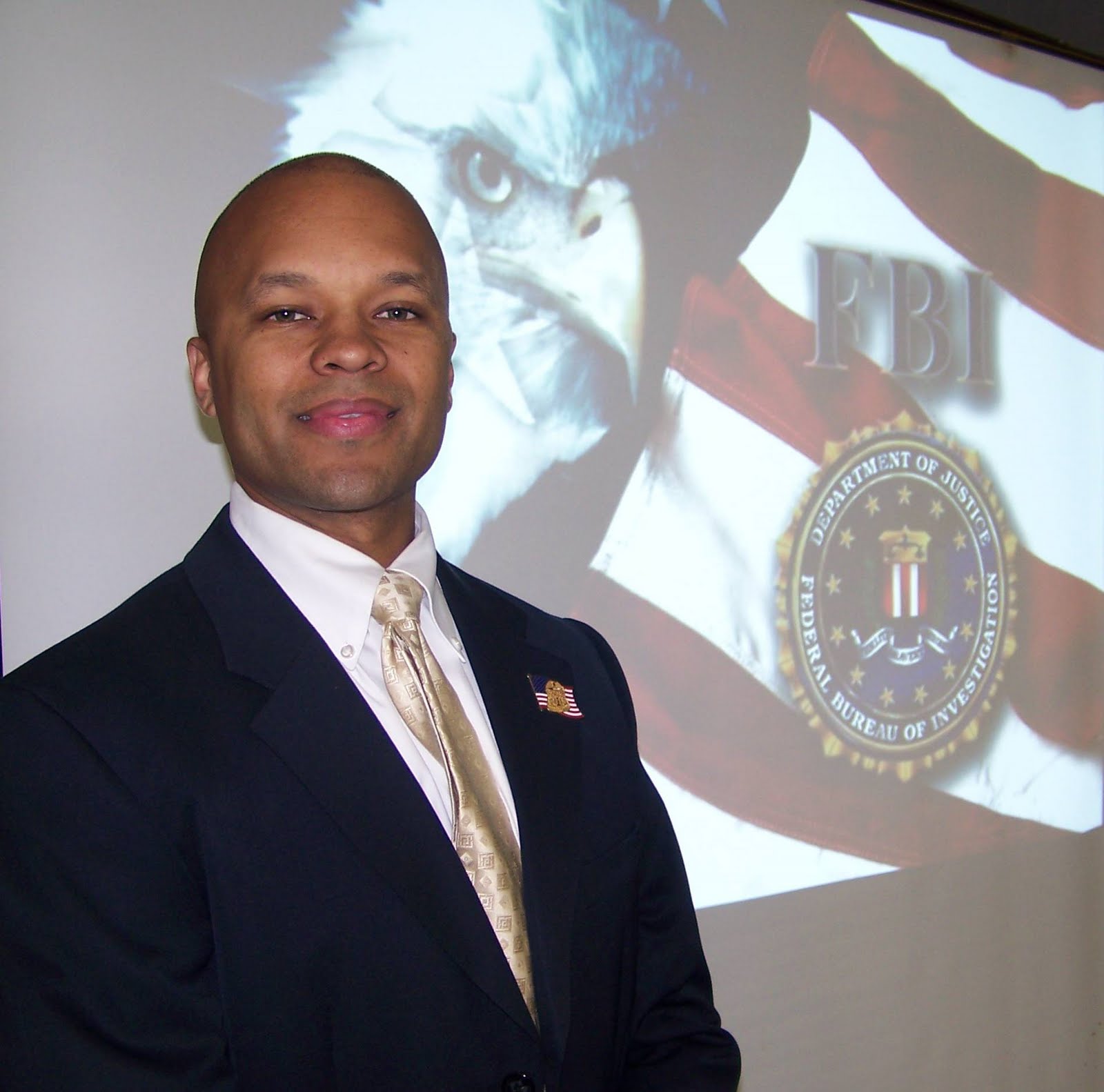
I also scope the morning newspapers and group newsletters for upcoming events that sound fun or informative. (Art exhibits, author signings, workshops, expos.) From local pet announcements, I wrote stories on Pet Scanners and Protecting Pets in Hot Weather. An announcement about an FBI Agent speaking Identity Theft made another story.

Organizations

There are always things to write about the organizations you belong to. The speaker’s bureau of our local Sisters in Crime has set up many author panels and workshops that I’ve written about (or at least blurbed). THIS Writers In Residence group has gone on “outings” that were fun to write about (A class on hand-gun safety at a local firing range, and a trip to the famous Greystone Manor for a reenactment of a murder – see them archived in this blog).

These are only some of the places you can find story ideas. Use you natural curiosity, your observation skills, your contacts, and various announcements/notices. Soon you will have more stories than you have time to write.
Next Time: My tried and (sometimes) true interview techniques.

Why Writers Should Join Book Clubs

What inspired you to become a writer? If you’re anything like me, your love of writing has its roots in a love of reading. Some of my most treasured childhood memories are of weekend mornings curled up on the sofa with my mom while she read to me. We started with the L.A. Times comic section: Brenda Starr, Little Lulu, Nancy and Sluggo. Before long, we moved into books.

I yearned for the day I could read on my own, and once I learned to make sense of all those letters on the page, I never lost my love of reading. From Black Beauty and Jane Eyre, to Hemingway and Fitzgerald and . . . well, you get the idea.

Over the years, my taste in fiction narrowed, and I realized I was limiting myself to a couple of categories: women’s fiction, because that’s mainly what I write, and mysteries/thrillers because they’re so darn interesting and fun to read. Nothing wrong with that, of course, but a writer-reader really should diversify.

Writers need to read, not just the kind of writing they do or want to do, but all kinds of writing. Reading the work of other writers broadens your horizons and makes you think. It expands your perceptions. It feeds the muse and keeps her interested in you.

But how to choose what to read from the endless choices of good books out there? Publishers Weekly tempts me every week, and friends are always recommending their own favorites and often foisting them on me.

And that’s where the book club comes in. When I had a chance to join a local reading group, I jumped in and have not regretted it for a moment.

The “Brown Bag Book Club” (so named because it meets mid-day) is sponsored by Flintridge Bookstore & Coffeehouse, a delightful independent bookstore in La Canada, California. We’ve read current bestsellers and lesser-known novels, and without exception they’ve been wonderful reads. Most have been books I would never have chosen on my own but am ever so glad the book club selected them. I’ve entered worlds I never imagined and discovered the work of some amazing novelists. The experience has only strengthened my commitment to my craft and left me in awe of the writing; it’s made me want to write even more, and to do it better.

It sure doesn’t hurt that Sandy Willardson, one of our book club moderators, is a fantastic cook who brings a delectable dessert to each meeting. We’ve sampled a pumpkin mousse, gingerbread, a chocolate truffle tart topped with strawberry soufflé. . . yikes, this is making me hungry. Not all book clubs are blessed with this little extra, but it sure helps break the ice!

An important side benefit of belonging to a book club: when we meet to discuss the month’s selection, and I hear the other members’ reactions, it gives me priceless insight into what they found compelling in the book, and what turned them off. It makes me think about my own values, and what I consider a successful novel. Does my writing measure up to my own standards? Probably not as much as it could, but the book club discussions are a significant wake-up call.

We live in a hectic world, and it’s usually hard to find time to work on our own projects, to write our stories and novels and to study our craft. It’s easy to forget that big old world of fiction out there, and belonging to a book club is a wonderful way of reminding oneself that writers need to be readers.