by Rosemary Lord
There I was, puffing and panting in the 90-degree sun, lugging box after box of books out to the car….
But I’m getting ahead of myself.
I have always felt that one can tell a dedicated writer by the books with which they surround themselves. Although I know that nowadays, if you’re technically and digitally proficient, you can do and find everything on your computer or even on your phone.
But it’s not the same. Not for real writers! You need to READ books to be able to WRITE books. Real, actual books, that is – with carefully designed crisp paper pages, glued and sewn together – or however they do the spines now. Enticingly designed covers, beautifully matched colors, and perfect fonts. There’s a lot of work that goes into every book.
Many of those who dedicate themselves to the magical world of writing have fascinating, eclectic book collections.
I recently culled 432 books from my overwhelming assortment. And I still have many left!
How did it ever come to this?
In my defense, as a book lover, I began with just a few small (only 6”x4”) volumes I brought with me when I moved here from England: ‘Poetical Works of Tennyson,’ some Edgar Allan Poe tales, Poems of Elizabeth Barrett Browning, and a worn 1915 printing of Gene Stratton Porter’s Girl of the Limberlost, that I knew would not take up much space.
Over the years of attending so many writers’ conferences all over North America, I kept those heavy bags filled with the new books publishers gave us.
To support my fellow writers, I loyally bought the latest book by the authors I knew.
I’m a sucker for an appealing jacket cover, too – especially when Amazon made special offers so affordable, as a way to discover new writers.
I still buy books for my writing research. I have a great collection of books on Old Hollywood. And then there was my late husband, Rick’s, assortment of books on motor racing, motorbikes, animals, snakes (don’t ask!), music, finances, and the Stock Market.
And so my library grew.
But my small apartment didn’t.
I had seven tall bookcases crammed, with more books stacked on the floor in front of them.
Time for a serious cull.
I kept books that fellow writers had inscribed to me. I boxed up Rick’s books. I found several duplicate copies of paperback mysteries and ‘cozies.’ Out they go.
Of course, I kept my rare and special Hollywood books. But I was strong in my intent.
No, it’s not: ‘make room for more books,’ I tell myself!
But then, knee deep in book piles, I realized they had to go somewhere. Most of the charity shops where I donate clothes or household items are not taking any more books.
Hmmm. Where?…
Then I remembered The Last Bookstore. Years ago, my brother and I had schlepped half a dozen bags of books there to donate. It is downtown Los Angeles, at 453 Spring Street in an old bank building with marble columns and vaults filled with vintage books. Owner Josh Spenser has created an intriguing world of not just shelves and stacks of books, but enthralling shapes – a tunnel of books, higgledy-piggledy towers of hardbacks and paperbacks, with comfy armchairs and leather couches to sit and gaze and get inspired by the fantastical displays of books, vinyl records, gargoyles, and dolls.
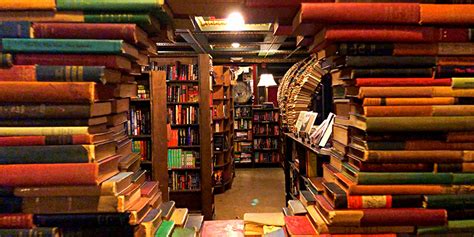
The Last Bookstore has a free community service called Re-Book It: to ensure that books don’t end up in landfills. They will pick up your unwanted books and find new homes for them, dispersing books to schools, charities, hospitals, and retirement homes. Currently, they’re focusing on getting books into the hands of children and families who lost homes in the L.A. fires.
“Hooray!” I had found such a great solution. Then came the fun task of packing the books in boxes and bags, counting and labeling them. Of course, lots of lifting is involved, squatting and bending, too. Quite tough on the knees and the back! But I reminded myself that I was getting a free workout! And lots of empty apartment space.
The 432 books packed into 24 boxes and bags were amassed by the front door, ready for collection. Then, I learned that Re-Book It was short-staffed and could not complete the pick-up that day.
“Why don’t you bring it to our store on Lankersham?”
“Okay,” I foolishly agreed, anxious to complete this project.
It was about 8 boxes in that I began to regret my fervor of “I can do this!” The books were VERY heavy to carry across the patio, to the front lobby, and then outside to my car. What was I thinking? And it was the hottest day of the year – of course. Over 90 degrees.
I had to stop every so often, sit down with a large glass of water, and cool off in front of a fan.
But once my car was overstuffed with boxes and bags of books, I made it safely to the Valley location of The Last Bookstore on Lankersham Boulevard, just past Universal Studios.
Just as the Downtown store was a magical, mystical store – so is this one. Odd, beautiful old doors, parts of wonderful, vintage walls surrounded by an eclectic mix of books and, well, just fascinating ‘things’ to look at, curios to examine. And, of course, books: from best sellers to first editions. A book-lover’s treasure hunt. Had I not been so exhausted carrying all those books earlier, I could have easily spent an hour or three browsing there.
I was very happy that my books were going to such a lovely new home. And I returned to my apartment happy I had made more space, promising myself not to fill it back up with more books. I wonder how long that promise will last!
So, this is where we came in. My exhausting but therapeutic adventures in book culling ….
Have you ever tried culling your book collections?
…………………….




 The Writers in Residence
You must be logged in to post a comment.