
by Maggie King
My love affair with the classics took off in 1989. Why 1989? That was when I started a job in downtown Los Angeles. One day at lunch a co-worker asked if I wanted to go to the library. Surprised, I said, “Sure!” I’d never worked with anyone who spent her lunch hour at the library.
We walked to the Los Angeles Public Library and I checked out Jane Eyre. I had a vague memory of reading Charlotte Bronte’s tome in high school and decided to try it again. Over the next few years, I read—in many cases revisiting my high school reading list—works by Jane Austen, the Bronte sisters, Willa Cather, Theodore Dreiser, F. Scott Fitzgerald, Gustav Flaubert, Thomas Hardy, Nathaniel Hawthorne, Washington Irving, D. H. Lawrence, Sinclair Lewis, W. Somerset Maugham, Ayn Rand, Robert Lewis Stevenson, Leo Tolstoy, Mark Twain, Edith Wharton, and Virginia Woolf, among others.
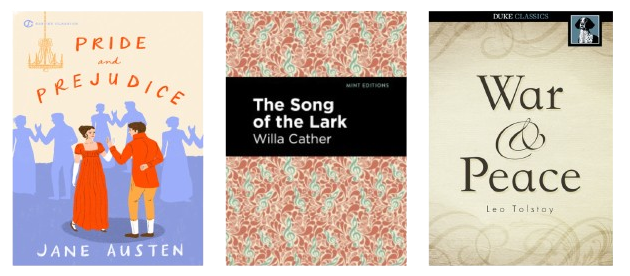
Many I loved, with a few being okay. Sad to say, I didn’t like Wuthering Heights any better in the early nineties than I had in high school. Heathcliff was just too dark (funny reaction from a crime writer, but there you have it). For many years, Jane Eyre topped my list of favorite classics. But a year ago, I picked it up for the third time and didn’t even finish it. Jane Eyre was given to monologues! Apparently that didn’t bother me thirty-plus years ago.
In 1993 I joined a mystery group and became obsessed with that genre, classic and contemporary. Up to that point, I’d read many Agatha Christie mysteries, but few by other authors. It wasn’t long before I started penning my own.
I try to read at least one classic a year, and sometimes it’s a mystery. A favorite is Wilkie Collins’s early example of detective fiction, Woman in White. I read the epics Brothers Karamazov and War and Peace from start to finish and lived to tell it! I finally got to Little Women a few years ago. I had seen countless film versions but never actually read the delightful autobiographical novel by Louisa May Alcott. David Copperfield was wonderful but populated with characters who, like Jane Eyre, spoke at great length.
Why do I love the classics? They have a timeless quality and universal appeal, essential traits that make a classic a classic. Little Women—despite the lack of texting and social media—could be a contemporary coming-of-age novel.
The classics are known for well-drawn characters and compelling storylines. That said, it can take time for a classic story to be compelling. Contemporary books have to grab the reader on page one; classics require more patience, but are worth the wait. My friend who took me to the LAPL and I started Middlemarch together. Several times I was ready to close the book for good but, being a faster reader, my friend assured me that the story would pick up. Sure enough, George Eliot’s masterpiece became a page turner.
What’s my next classic? Many of my author friends rave about The Count of Monte Cristo by Alexandre Dumas. And I’ve had Elizabeth Gaskell’s Wives and Daughters on my TBR list for some time.
Would reading the classics benefit writers? Absolutely! Have they improved my writing? As an optimist, I want to think so—but such a belief is hard to verify. This post on KindredGrace, “5 Reasons Why Every Serious Writer Should Read Classic Literature”, is worth reading. I especially like #4: Classic literature expands our knowledge base for literary allusions.
Renowned author Joyce Carol Oates suggests that writers read Ulysses by James Joyce. According to her, our vocabulary will improve (or, if nothing else, we’ll want our vocabulary to improve). I take Ms. Oates’s point, but will pass on Ulysses (I managed to get through one chapter).
Back to where the classics began for me: here’s a photo of the beautiful and impressive Los Angeles Public Library. During my stint working downtown, this building was closed for renovations due to two fires, and the collection was temporarily housed on South Spring St. By the time the original building reopened in 1993, I was working elsewhere, but occasionally returned to visit this stunning structure. If you can visit, do so, but you can read about it here.

Closing thoughts: what contemporary novels will become classics? Any of our own? Perhaps works by Margaret Atwood, Toni Morrison, and Joyce Carol Oates will stand the test of time. As for contemporary crime novels, would any make the cut? As much as I enjoy them, they lack the timeless quality—even the historical ones. I’d love to be proved wrong. In the meantime, we have Arthur Conan Doyle, Wilkie Collins, Anna Katharine Green, Agatha Christie, Dashiell Hammett, and many others.
A big thanks to Alison, my long ago library pal!
Share this:


 The Writers in Residence
I have read many of the classics. Quite often I’ll watch an old movie made from one of those tomes and then read the book. The book always had more to it, but often the movie was a good enough and the actors ended up being how I saw the characters in the book. I know Hollywood can’t do a twenty hour movie to get everything on the screen. As for the lasting quality of those older books, I’m glad they are still around. And maybe a few more contemporary books will have something in them, like maybe a solid character or two and a plot with a meaning behind it. How many books have we read that we asked ourselves when we closed it: what was that about? A good plot, great characters and a point to the whole story will always be memorable…and a classic.
LikeLiked by 2 people
I find it more satisfying to see the movie first, as the book will add detail and nuance, making the story more satisfying. But I often reverse the movie/book order—I wonder how the Woman in White movie will compare to the book.
LikeLiked by 1 person
I read quite a few classics when I was younger, Maggie, but don’t really get into them much these days. But I admire the writers who have achieved classic status, especially before these days when books can be found in so many places. You did get my mind churning with your interesting post, Maggie. Maybe I’ll go back and read another classic someday soon!
LikeLiked by 1 person
Linda, let us know which classic you pick. Thanks for commenting.
LikeLike
I’ve found the key to enjoying the classics is discovering them at the right time. I recall reading Steinbeck’s The Pearl in high school and not appreciating it, although years later he became one of my favorite authors. I also read a few high-minded novels as an adult and found I couldn’t appreciate their youthful outlook on life as much as if I’d read them in my youth. As much as I admire the writing, some books seem to take miles of prose to move the story an inch. Not for me.
LikeLiked by 1 person
Steinbeck is an author I neglected to include in this post. I can’t say the Pearl was a favorite, but loved East of Eden and Grapes of Wrath.
LikeLiked by 1 person
Of course living with a husband for 61 years who has a love for “Classics” (okay, classic cars), I have to admit I haven’t read a whole lot of them. Usually too long, and Maggie, I guess I don’t have your patience. These days, most of the books I “read” are audiobooks because glaucoma makes my eyes sting after reading too long. I do read short books (authors send ARCs to review).
I liked The Moonstone by Wilkie Collins (Is that a classic?) and The Count of Monti Cristo. And recently I’ve had the urge to read the political Advise and Consent by Allen Drury. (The audiobook is 33+ hours long!!!) Anyway, thanks for the walk through “good books.”
PS: I did visit the LA Public Library with several of the Writers In Residence a while back.
LikeLiked by 1 person
They do tend to be long and take a while to get into (like Middlemarch), but when they were written, people didn’t have the vast number of writers we have today. Some 20th century authors, like Steinbeck, write short.
LikeLiked by 1 person