
“The pen is like the needle of a record player held in one’s hand,” Donald Jackson, calligrapher, and scribe to the Late Elizabeth II, once observed. “As it moves across the paper, it releases the music of our innermost selves.”
Wow. I just love that. Sadly if Mr Jackson saw my handwriting he would accurately surmise that I am permanently scattered.
Mahatma Gandhi declared that a poor hand is “the sign of an imperfect education.” But mine leans more towards P.G. Wodehouse who said his, “resembled the movements of a fly that had fallen into an inkpot, and subsequently taken a little brisk exercise.”
Computer keyboards ruined everything for me.
I had the most perfect handwriting. As a Brit we were not trained to write “cursive” which I think is an American form of script. Here is an excerpt from my Home Economics book circa 1969 – please note the hilarious and dated content.

In 1977 I trained as a “shorthand typist” before Dictaphones were invented. In the UK the shorthand was Pitman shorthand; – in the USA it was “Gregg,” although there are many other forms like Teeline or Fastnotes. I could boast 125 wpm (words-per-minute). I loved it. Here is an example of Pitman shorthand taken from “The Lerner’s Shorthand Reader” circa 1892 and priced at 6d.
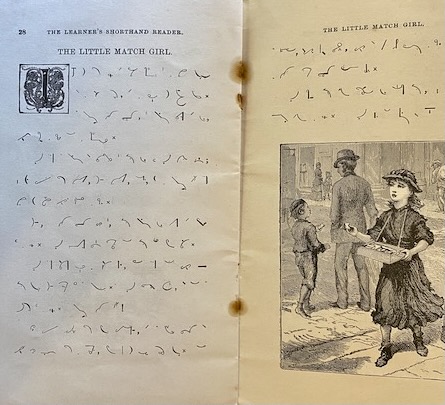
Isn’t it pretty? If you’d like me to transcribe, I will …
I could “touch type” i.e. there were no letters on the keyboard so I would type the copy without looking at my hands (for those youngsters out there who have never heard the expression). There was also something immensely satisfying about coming to the end of the line and pushing the lever of the carriage return to be rewarded with a cheerful ting!
With the advent of computers, my typing has speeded up dramatically (I just did a free test) and it’s 75 wpm. There is no way my handwriting now could keep up with my brain. Unfortunately, I can hardly hold a pen let alone write with one.
But let’s not forget the reality of handwriting of centuries past. It’s tempting to think that 19th century penmanship was beautiful and legible. This was not the case. Paper, ink, and postage was expensive. People wrote as small as they could. Anne Brontë’s famous final letter had the lines criss-crossing each other. So even if 21st century handwriting has deteriorated, in the big scheme of things, that’s nothing new. Sadly, a recent survey found that in the past five years, 12% of Britons have written nothing at all – not even a note. With the demise of the check book here in the UK, signatures are barely needed either. Some people don’t even have a PEN!!! I was at the post office recently using my USA credit card which demanded a signature to find that I was the only person in the store who carried a pen!
“When you type on a screen, the words seem as fleeting as rays of light. When you write, there’s a real physicality to it that adds another dimension to how you experience your own writing. It fosters a deeper engagement with the material you write, makes the writing voice inside your head clearer and louder.” Quote from Omwow blog, https://omwow.com/longhand-writing/
I love that expression “words seem as fleeting as rays of light.”
Handwriting is deliberate and intentional and requires focused attention. It encourages us to be fully present in the moment. Neat and well-formed handwriting can also indicate a level of discipline and organization. It’s also lovely to receive a handwritten note. It feels personal because it is personal. Someone has taken the time to write and not just zip off an email.
In the meantime, I’m just grateful that my appalling handwriting doesn’t get me into the following kind of trouble:
In 1636 an employee of the East India Company in London wrote to a colleague in India asking that he ‘send me by the next ship 2 or 3 apes.’ Unfortunately – his letter ‘r’ in the word OR caused some confusion. As a result, he received 80 monkeys, together with a note saying that the remaining 123 would be with him shortly.
What about your handwriting? Please share and shame mine.
Share this:


 The Writers in Residence
Thanks for that fascinating history of handwriting, Hannah. I am currently teaching how to write a memoir and encourage journaling in a notebook as opposed to recording a word or two on their phone or digital recorder. So true that the act of writing something down, I tell my students -all seniors – gives them clear and instant status as writers rather than talkers. Cheers!
jill
LikeLiked by 2 people
I remember you mentioning the memoir class – such a good exercise to journal with a pen because it really does make a difference. The words are more likely to stay on the paper since there isn’t a delete button and perhaps that could be seen as authentic writing – straight from the heart.
LikeLiked by 1 person
I’ve used my own form of speedwriting since I was a child, Hannah, and it doesn’t really make my bad cursive handwriting more legible to anyone else. But I’ve developed some abbreviations and symbols and I really like it. And maybe I enjoy being mysterious since other people can probably distinguish a lot of the words, but not all of them. Love your post–it got my mind moving to my handwriting!
LikeLiked by 1 person
Actually … I dug out my old Waterman fountain pen this morning and thought perhaps it was time I started to write by hand again!!
LikeLiked by 1 person
When I was ten years old back in 1957, I decided I would only print. Nobody was doing that for schoolwork. Everybody else used cursive handwriting, though not everybody’s writing was all that legible. I told my teachers that I wanted to make sure people could read what I wrote because I wanted to be a writer. Even my legal signature is printed, though it does have its own style. I print to this day, but I can do a very fancy handwriting, but that’s because I’m a bit of an artist as well as a writer of books. But people do need to know how to write with a pen because a computer or hand-held device can crash and all the data will be lost, but a piece of paper or a book can still be read. Libraries are full of them…
LikeLiked by 1 person
I didn’t even realize my style of writing was called “print.” I’d love to be able to learn calligraphy but I fear I just wouldn’t have the patience. I totally agree with your comment that people absolutely need to know how to write with a pen!!
LikeLiked by 1 person
I just read author KT Blakemore’s newsletter and she writes her stories by hand: “I begin every book by hand (I wrote the entirety of The Companion by fountain pen), as it is my method for connecting with the characters and the story.”
I also write by hand, at least when I’m in creative mode (not with a fountain pen, though). I can’t fathom sitting at a computer and banging out a story!
My mother had beautiful handwriting, Palmer method. She didn’t pass the skill to her children, but we do know how to write—and we own pens.
LikeLiked by 1 person
My mother also had excellent handwriting (a bit spidery now at her advanced age of 94). I thought a lot about this process of writing a book by hand first – I just don’t have the luxury of time to do it plus as I write, I change the sentence constructions and wordings all the time so I think it would hold me up. Perhaps one day I will – it would be interesting to see how different the experience will be!
LikeLike
Maggie, C. S. Lewis also wrote all the Chronicles of Narnia by hand, pen on paper. His brother is the one who typed them all up for him.
Sometimes I get impatient writing stories by hand, I can’t write as fast as my mind is thinking, so I like typing for that reason. Plus I can close my eyes, go into my imagination with a story, and my fingers are still flying over the keys.
But I do think kids should LEARN to handwrite. I know several youth in their twenties who CANNOT READ cursive handwriting. (!!!) I saw recently that seniors might have a “secret code” eventually, with no one under 30 being able to read their writing. HAHAHA
LikeLiked by 1 person
I like the idea of a secret code!
LikeLiked by 1 person
I did not know about C.S. Lewis. OR the code! I meant to add that typing accurately is another thing altogether. When I worked for the newspaper in 1977 on an old Imperial, we had 3 carbon copies — it was a nightmare. I’m grateful to computers for sparing my mistakes!!
LikeLiked by 1 person
I delighted in your trip down memory lane. Like you, I had beautiful penmanship in my youth, which gradually gave way to hieroglyphics as I began to type more than write. Like any skill, it fades from disuse.
My mother always wrote legibly, my father not so much. His signature bore a close resemblance to his ekg : ) They both wrote to me when I went away to summer camp. I recall one rainy afternoon when my bunkmates and I, stuck in the cabin, filled several hours trying to read one of his letters.
LikeLiked by 1 person
That sounds like my dad’s handwriting as well – it was very distinctive and hard to decipher. But … you raise a really good point – reading old letters. I kept all the letters my dad ever wrote to me starting as a teenager. Re-reading them is bittersweet and such a treat. It wouldn’t be the same re-reading an email!
LikeLiked by 1 person
Actually, California just made a new law – that cursive handwriting must now (again) be taught in our schools. A win, for sure.
I’ve been told my handwriting is nice (when I try) and I think it’s legible. My Hubby’s can’t be red if he prints or writes. (Thank goodness for texting, in his case). I will forward this to Sheila Lowe, as she has been a champion of cursive for ages. Her mystery protagonist is a handwritting expert. Good job, Hannah. Very interesting.
LikeLiked by 1 person
….read, not red. Ha!
LikeLike
How interesting that cursive is now a law! I am curious now about what is taught in schools here. I’m going to find out!!
LikeLiked by 1 person
More than a champion–a court-qualified handwriting expert, lol. As immediate past president of the American Handwriting Analysis Foundation, I worked with members to create the Campaign for Cursive, and believe that our efforts have helped push cursive training back into the curriculum of numerous states. At last count there were around 28 states that require it.
LikeLiked by 1 person
Sheila – so good to see your name here! Believe it or not I was going to include YOU in my original piece but the post was too long!! Yes – you are The Recognized Expert on all things handwriting. I love Claudia Rose. I also own a few of your non-fiction books. Reading Between The Lines: Decoding Handwriting – is brilliant.
LikeLiked by 1 person
Ok Hannah, I have finally been able to get back into my WordPress account to respond – only took me 3 weeks!!!
I loved this post. Your school years’ handwriting is very similar to mine.The content, too!! That’s what we were taught in England!
Today my writing depends on my mood and whether I’m busy or tired I am! But I LOVE writing by hand. It’s creative…That history is fascinating. And I really believe you can tell something of a person’s character from their handwriting. Sheila Lowe can tell you so much about that! Thanks. And apologies for my tardiness
LikeLike