
by Miko Johnson
We may be writers but we’re also observers, and I’ve observed that one picture can be worth a thousand words.
In my previous post, which covered my time in Prague and Poland, I promised to follow up with my trip to France, and how it influenced both my writing, and my life. It began with a trip to Paris ten years earlier, when my husband and I stumbled onto an exhibition at the Musée d’Art et d’Histoire du Judiasme, or MahJ for short. It featured political drawings and prints from Abel Pann, an artist who executed a series of drawings based on the pogroms carried out by soldiers on the Eastern Front during the First World War. His work covered the early 20th century.
Most broke my heart. They showed mothers and little children hiding behind barns, or cowering inside their homes, with captions like Quick, run and hide! One of his later drawings showed an elderly Jewish man hanging from the gallows while Nazi soldiers watch with amusement. The caption: Honoring the brave WWI veteran. It made me think of my grandfather, whom I never met. A German soldier wounded in the Great War, he was taken to Auschwitz and never seen again. That’s when I decided to dedicate my fourth book to him.
I mentioned in my earlier post the dejection I saw in the people of Bytom, Poland, a former mining town largely ignored by the EU. Images of An Other Europe, another photographic exhibit Allan and I saw in Prague, influenced that observation.
Photographer Constantin Pittas traveled to seventeen countries throughout Europe in the mid- to late-1980s, capturing people in the streets of cities. His stated goal was to “prove that Europe is one entity”.
I believe he failed. Not that his work wasn’t fascinating, but I could tell which side of the Iron Curtain he’d taken photographs by the faces and body language of the people. As in Bytom, I saw desolation throughout the Communist bloc images. In one photo, used for the brochure cover, a middle-aged man walks along a street alone toward the camera at twilight. Bag in hand, his head is tilted down to watch his step, figuratively and literally.
 I don’t see joy, or serenity, or even concern in his face. Only resignation. I’d recognized the Charles Bridge in the background so I knew this had been taken in Prague, but based on the other photographs, I had no doubt the location fell behind the Iron Curtain.
Many more showed similar images of people, their emotions constrained. Women standing on line at the market, an elderly woman sitting on a bench. Don’t ask, don’t tell, at least in places like Romania, Hungary, Armenia. People looked so different in Western Europe, where their faces bore the full range of emotions, whether young folks sunbathing on a Mediterranean beach or an elderly Portuguese woman gazing at a drunk lying in the street with a mixture of pity and disgust.
I kept returning to two images, each showing a different young woman with a little smile playing on her lips. In one, the woman sits at the counter of a Parisian café, enjoying a coffee. In the other, the woman turns to glance at a man she’s with. The pure pleasure behind the smile of the coffee drinker, compared to the sadness in the eyes of the woman presumably in love, was strikingly evident.
A series of photos the photographer had taken at the end of his journey, in Berlin, were especially moving. Pittas fortuitously found himself there in 1989, when the wall fell.
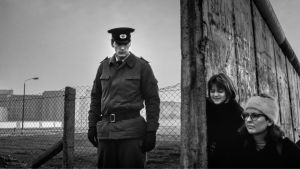
There, past and present collided, and confusion mixed with elation as people tried to grasp what had happened.
However, the photographic image that has stayed with me the longest came from a different time.
Photograph by Constantine Pittas, from exhibition at Clam Gallasův Palác, Prague
After Eastern Europe we continued to Toulouse, France. One of my goals was to visit the Musee de la Resistance & de la Deportation, where I’d hoped to find background information for my current WIP, which covers the years around the second World War. The museum’s focus should be obvious even if you don’t understand French. Despite going through the museum with the objective eye of a researcher, I found it dark and disturbing, until I found this photograph:
Need I say more?

After Toulouse we spent the final days of our trip in Paris. We’d last stayed there six months before Notre Dame caught fire, and caught a heartbreaking glimpse of the ruined cathedral in 2022. While meandering through the city we once again found a photographic exposition of the decimation of one neighborhood during the Nazi occupation. Heartbreaking, we thought as we approached the cathedral. What other sad sight awaited us. We turned the corner and saw this:

Progress. And hope. A balm for the soul.
Miko Johnston, a founding member of The Writers in Residence, is the author of the historical fiction series, “A Petal in the Wind”, as well as a contributor to several anthologies including the about-t0-be-released “Whidbey Island: An Insider’s Guide”. Miko lives in Washington (the big one) with her rocket scientist husband. Contact her at mikojohnstonauthor@gmail.com
.This article by M. Johnston was posted by Jackie Houchin

 The Writers in Residence
You must be logged in to post a comment.