Test the Integrity of Your Mystery – Part 3

Continued from last Friday.

Now that your Scene column is filled with the various locations and the action that takes place in each scene and your Character column lists every character who appears or is referenced in those scenes, let’s move on to the facts.

Information.

In this column, you will note the clues and pertinent information passed on to the reader during the scene.

Avoid Ommisions

Once this column is complete, omissions stand out. In Agatha Christie’s “One, Two, Buckle My Shoe”, Hercule Poirot notices that the shoe on a battered corpse is old and worn, whereas the same exact shoe was new and shiny when he saw it on the woman shorty before–suggesting that the woman he saw alive was an imposter. If Christie had not included a scene allowing Poirot to get a good look at the imposter’s shoe, then the detective’s discovery would have seemed omniscient, rather than logical.

If you have a scene at the end of your story where the sleuth tells all, you can make a list of her summation in the information column and cross reference it with earlier information given just to make sure you’re playing fair. For example:

“I noticed a hidiously large footprint in the begonias which could only have belonged to Gregor the Giant who worked with the traveling circus.”

Did you give the reader these clues ahead of time?
Is there a scene where you show the discovery of the footprint?
Is there a scene where you let the reader know the circus is in town? Maybe a character is perusing the local paper and saw an advertisement.
Is there a scene where the slueth at lease sees mention of Gregor the Giant, if not the giant himself?

Create Balance

Once you see all of the information as it is relayed to the reader, you may also find that you could time a revelation to better advantage. If all of the clues cluster around the beginning or end of the story, the middle will drag.

It’s especially disheartening to read an entire story where not much happens only to have the clues pop up on the final pages. (Trust me. I just read a book like this. I loved the characters, loved the dialogue, but by the last quarter of the story, I didn’t care. Where was the detection? This was supposed to be a mystery!)

It feels as if the writer is saying, “Oh! I forgot to tell you.” and “Let me get this bit in here because the ending doesn’t make any sense as it stands now!”

In Plain Site

When you look over the information imparted, you might find that you tell too much, or tell it too early. It’s not very satisfying to read a mystery when you know who the murderer is by page twenty-five. Maybe the clue could be sublter. A giant footprint outside the library window when there is a giant in town is not very subtle. What about two narrow, deep holes? What could have made these? If your references to the circus aren’t over the (big) top, it may come as a surprise to find that the holes were made by Sammy the Stilt-walking Man.

When I first began reading Agatha Chrisie, I found myself crying, “Cheat!” at the end of her books. Then I would page back through and find that the clues were all there! But they were subtle. I highly recommend writers read her books to discover how to lay a path of clues without using neon signs.

That’s it for Information. Next week I’ll show how Questions Asked can ensure there aren’t any loose ends.

Interview with Author Hannah Dennison

Hannah Dennison is the author of the Vicky Hill mystery series. Like Vicky, Hannah was an obituary writer for a small English newspaper before crossing the pond to try her hand at screenwriting. Fortunately for us, she switched to long-form narrative and a mystery writer was born!
Welcome Hannah!

Now that your third book is in print, does the writing process come easier to you, or is it more difficult to keep a series fresh?

I love this question. It couldn’t be more timely! For me, it is just as hard meeting a deadline with my fourth book—due mid March—as it was my first. If anything, the pressure is worse because I want the book to be better than the last one! Keeping the series fresh is always a challenge but having a “season long mystery” (to borrow a TV phrase) is a useful. Vicky’s ongoing story arc is how to deal with her criminal parents who are increasingly encroaching on her life. Having Vicky gradually mature as a young woman also helps. She starts off being somewhat “naive” in the romantic department but as time moves on, Vicky starts to grow up.

Your books each revolve around an eccentric English event—snail racing and hedge jumping to name two. Were these sports popular when you lived in England, or have you had to dig to find these gems?

I came across hedge jumping completely by accident. I overheard a conversation in a restaurant between a couple that was fighting over “Charlie’s ridiculous hobby.” Eavesdropping – which is what we writers do best—I learned that Charlie had an obsession for jumping over hedges. His enthusiasm was so great that weekends were spent scouring the English countryside for suitable specimens—a neat, box privet, a comfortable, springy laurel or the deadly blackthorn for Charlie to leap over. My editor liked the idea so much, I thought, well, I’m English (and eccentric by default) so I wondered what other sports American readers would not know about. Once I started digging, I was stunned by the unusual sports my fellow countrymen enjoyed—hedge cutting, Naked Farmer competitions, worm charming, bog snorkeling, flaming Tar Barrel racing and Morris dancing. The list is endless. These plot backdrops inadvertently provide my series with a “hook.” A sort of … good grief, let’s see what she’s writing about this time.

Each book adds new depth to your protagonist, Vicky Hill, as she learns about betrayal and disappointment. How do you keep developing her character and yet retain the naivety and optimism that makes Vicky so loveable?

I’m happy you feel she is developing. Walking that fine line between naivety and being TSTL – (too stupid to live) is a constant challenge for me. But like everyone, Vicky has to grow up at some point. I hint at the battles she faces ahead on dealing with her father’s criminal activities but most of all, each book does bring her nearer to the Great Seduction scene that I am very excited about writing. I’ve even thought about conducting a reader survey to see who that lucky man might be!

Gipping-on-Plym is the village where Vicky currently resides. A product of your imagination or based on someplace you know?

I lived and worked in the real town of Tiverton as an obit writer for the Tiverton Gazette—no surprises there—so yes, it is an amalgamation of Tiverton in East Devon and Totnes in South Devon (an area that has taken recycling to a new level). I have included a few places that do exist. How could I not set a scene at The Nobody Inn pub in Doddiscombleigh. They have a delicious menu for anyone who might find themselves in Devon.

I love how you bring forward minor characters from previous stories and spotlight them in later books. How do you determine which minor characters are worth expanding on?

To add to your earlier question, expanding some of the minor characters really helps keep the series fresh though I don’t know which ones will make the cut ahead of time. They tend to tell me. They also don’t do as they’re told. I have a loveable paramedic called Sexpot Steve who is infatuated with Vicky Hill and who I have tried to kill off in both Scoop! and Expose! … but he just won’t listen!

The “Cabot Cove Syndrome” says that if you have a small village and you keep killing the residents off or jailing them for murder, soon the village will be empty. On the other hand, you don’t want the new guy in town to be the killer or victim every time. How do you avoid this writing pitfall?

Yes. That’s a hard one. One thing I’ve learned about human nature is that everyone has some kind of skeleton in the closet. As my plots are character driven, it is immensely satisfying to exploit those skeletons. I’ve always given every one of my characters – major or minor – a secret. It can be as small as being an obsessive collector of vinyl records to someone who has an unreasonable dislike of hedge jumpers. Sometimes a newcomer can survive but simply act as a catalyst. I feel that making the familiar characters fascinating can at least help soften the inevitable.

Tell us what’s next for you.

My fourth book—THIEVES!—will be out January 2011. I will be submitting a proposal to my publisher, Berkley Prime Crime, for two more in the series. I’d love to see our Vicky through her first real romantic encounter especially as one of her greatest fears is dying an old maid, “pure and unsullied.” I am determined to do everything in my power to make sure that won’t happen!

Thanks so much for having me today Jackie.

Vicly’s latest exploits can be found in “Expose!” at bookstores and online, and a review of the book is at Jackie Houchin’s New & Reviews. If you’d like to know more about Hanhah, visit her website.

Test the Ingegrity of Your Mystery – Part 2

Continued from last week.

Now that you’ve listed all of the scenes including where they take place and what action occurs, move on to the second column of your chart.

Characters.

The point of listing the characters is to help you keep track of everyone who makes an appearance in your story. List every character who appears in each scene. This includes characters who are not physically present but come up indirectly in conversation. Also, if Mr. X speaks to Ms. Y on the phone, add Ms. Y to the list.

This serves a few purposes.

Avoid Irritating Surprises

If your victim has an identical twin sister and that fact is crucial to the plot, it’s not really fair to the reader if no sister has been mentioned until the crucial moment when she pops up. By all means keep the fact that she’s a twin under your hat, but even a casual mention of a sibling earlier in the story will keep your reader from throwing the book across the room when one conveniently shows up. Put twin sister in the character column of the scene where “siblings” are mentioned. 

If you want to make her appearance a complete surprise, there must be a hint that this unknown person exists, such as a conversation the victim has with her over the phone or a letter signed with her initials. The reader gets enough hints from the conversation or letter that the person involved is important even if the reader doesn’t know exactly who it is. Even an ambiguous mention by the detective that “there must have been someone else in that room the night so-and-so died” will do. If the twin sister is on the other end of the phone, has written the letter, or is the unknown someone who must have been in the room, put twin sister on your character list for the scene. 

I also list characters who I assume are involved in the story but aren’t specifically mentioned. For instance, if the victim’s will comes up in a scene, put (attorney) in the character column. The parenthesis show that you haven’t decided how to introduce the character, but that he should exist. Consider it a reminder that your sleuth wants to talk to the attorney. If the will has nothing to do with the murder, it would still be the natural inclination of the police to investigate the angle, even if it’s a dead end. You may decide to handle the will in a clever manner that won’t involve an attorney at all, but it will have been a deliberate move, not an omission.

Keep Suspects on Even Ground

Tracking the number of times a character receives mention will also ensure that the detective gives the suspect proper consideration. If Harry Cheese is the killer, but the sleuth only discusses him once during the course of the investigation, the reader will feel cheated. Conversely, if every chapter includes Harry Cheese, Harry Cheese, Harry Cheese, you might as well light a neon sign flashing Killer over his head.

Balance the Investigation

Listing the characters will also show if your story lacks character balance. Some writers have amateur detectives who assist the police. Stephanie Plum exchanges information with Joe Morelli, Cora Felton has Chief Harper, and Hercule Peroit has Chief Inspector Japp. If your sleuth and the police share an equal number of scenes, ask yourself if you want them to be co-protagonists. If your intention is to include the police officer only as a supporting character, you will have to either condense his scenes or find a way for your sleuth to uncover the same information.

Next week I’ll discuss how to avoid the bad joke syndrome. You know. You get to the punch line and say, “Wait! I forgot to tell you____!” 

Interview with J. Michael Orenduff

J. Michael Orenduff’s website claims that the award-winning author “grew up in a house so close to the Rio Grande he could Frisbee a tortilla into Mexico from his back yard, a practice frowned upon by his mother.” That must be how he makes Albuquerque, New Mexico come alive in his Pot Thief series. Orenduff also writes for the stage, and his play, The Christmas Visitor, has garnered several awards–including first prize in the Jewel Box Playwriting Contest–and was selected as one of the “Top 100” by Writer’s Digest in 2008.  Welcome Michael!

According to the Archeological Resources Protection Act, your protagonist, Hubert “Hubie” Schuze, is a pot thief. Did the ARPA really put treasure hunters out of business?

Almost. The only place it is now legal to dig for artifacts is on private land, but getting permission to do so is difficult. Most known sites are on public land. You can fish, graze cattle, cut firewood, and mine for gold on public land, but if you happen to kick up an arrowhead while hiking, you better leave it where it falls.

Hubie resides in New Mexico and studied anthropology. J. Michael Orenduff lived in New Mexico and studied anthropology. What else do you and Hubie have in common?

Almost nothing. He’s short, single, and has a full head of hair. I’m tall, bald, and happily married with two children and a grandson. Hubie hates travel and martinis. I love both.

You’ve lived in so many interesting places—Texas, Maine, Bulgaria, Chile, Bermuda. What made you place your mysteries in New Mexico?

I wanted the protagonist to have some moral ambiguity, so I made him a treasure hunter, and New Mexico is the perfect place for that.

In The Pot Thief books, Albuquerque comes to life. You convey a deep sense of the scenery and people in the details, all the way down to the food. Since you no longer live in New Mexico, how do you corroborate the details?

I spent much of my childhood in New Mexico, and the memories are as fresh as the desert air. Maybe that’s why they call them the “formative years.” New Mexico is in my blood. I have many family members and friends all over New Mexico, and I visit there every chance I get.

Your books involve scientific theories and manage to make them entertaining! The Pot Thief Who Studied Pythagoras delves into math, and The Pot Thief who Studied Ptolemy reflects on astronomy. Why this added layer? And were you worried the titles might intimidate readers?

I think the “Pot Thief” part of the title actually added a few sales to young people who thought it referred to a different kind of pot! Seriously, I believe a good book should entertain and enlighten. I spent most of my life as a teacher, so I enjoy the challenge of trying to make theories understandable and interesting. I try to work them into the story in such as way that they don’t sound like textbooks or lectures. I also get help from experts in the various disciplines. The next one in the series is The Pot Thief Who Studied Einstein, so that should be a real challenge.

As someone who’s read both books, I can attest to the fact that the science fits the mystery and is offered in an enlightening manner. I wish my high school science teacher had made class as understandable and enjoyable! 

When you write your mysteries, which do you focus on first—the crime, the scientific theory, or the antagonist?

I tried focusing on the antagonist, but in each of the first three books, a strange thing happened. I decided about halfway into the story to change who did it! Of course that required considerable re-writing, but I enjoy the process, and it makes for better ‘aha’ moments because the final story is more ingenious than the one I thought up before starting to write. I guess I have to be immersed in the book before the creative juices flow.

I understand that you recently sold out of books at the launch of The Pot Thief who studied Ptolemy. What have you done to build up a following of readers?

The successful launch of The Pot Thief Who Studied Ptolemy was due in large part to a great article in the Albuquerque Journal just days before the launch, to the hard work of the bookstore owner who publicized the event, and to the fact that it was held on the evening of the annual Holiday Stroll in Old Town where people come out to shop and watch the lighting of the Christmas tree. There were a lot of Pot Thief books under Christmas trees in Albuquerque.
I think the two main keys to building a following of readers is to be in touch with as many of them as possible and to have a new book out at least every year.

Your wife is noted art historian Lai Chew Orenduff. Have you ever thought about teaming up with her to write an art mystery?

Absolutely. She is too busy with her day job at this point, but when she retires, we definitely want to write such a book

That’s something I look forward to. Until then, what’s next on your agenda?

As mentioned above, The Pot Thief Who Studied Einstein will be out later this year. It’s complete, so I’m working on the next one and trying to find a theater company to produce one of my plays. The play, The Christmas Visitor, has won four awards from various playwriting contests and was going to be produced by a theater in Norfolk, Virginia, but they went broke last month, another victim of the economy. We give government money to banks who pay their executives billions in bonuses, but there was no stimulus money for the arts. I’ll step down from my soap box now. Thanks for the interview.

Thank you, Michael.

You can find out much more about Michael and The Pot Thief series by visiting his web site and blog and in this recent interview with author Marilyn Meredith on her blog, Marilyn’s Musings. His books can be found in many bookstores–both in store and online–and you can check your local independant bookstore as well. Michael and his wife Lai will present “A Good Cover is Worth a Thousand Words”at this June’s Public Safety Writer’s Conference in Las Vegas.

Finally, you can find a review of the first Pot Thief book (with the second soon to follow) at Jackie Houchin’s News and Reviews .

Testing the Integrity of Your Mystery – Part 1

WinR Jacqueline Vick shares a writing tool she uses when reviewing her mysteries.

Some writers thrive on it. Some writers dread it. All writers do it.

Rewrites.

Mystery rewrites involve an extra step because the story depends on logic. If there are misplaced clues, forgotten hints, or unexplained details, the climatic moment (and the murderer is…) will result in an unsatisfying “Huh?” Unfortunately, by the third pass through your manuscript, your subconscious has a tendency to fill in the missing information, because you know what should happen. This makes it difficult to catch mistakes.

One way to test the integrity of your mystery is make four columns in a notebook (electronic or paper) and then break the story into four parts: Scene, Characters, Information, and Unresolved Questions.

Scene

A scene tells its own story; it has a beginning, middle, and end. It may take place over more than one location. For instance, the conversation may start in the drawing room and then move out onto the lawn. The purpose of every scene is to reveal character and/or (but hopefully and) to move the plot forward.

In the Scene column, give a brief description including Action and Location:

Discussing clues in the Garden.

Location is important.

Everytime a new location comes up, the writer must give enough description to convey a sense of place to the reader. An author once said that if it wasn’t necessary for a scene to take place at a particular location, get rid of that location. I think the author’s point was that new locations shouldn’t appear randomly. If deadly nightshade is the weapon of choice, then it would make sense to have a scene in a the woods where the slueth could discover a ready supply of the plant. If she’s simply contemplating the appearance of a new suspect, there’s no need to describe the lovely fauna. If possible, move her to the setting of the next scene–have her ponder this new suspect while climbing the porch steps to her next interview.

And make the location fit in with your character. Poirot disliked the untidy nature of the wilderness. He wouldn’t have gone for a relaxing stroll through the woods, though he might have unwillingly traversed a path if he suspected the existence of a clue.

Action keeps the story moving.

By listing the Action, you’ll notice where the story stagnates. The detective needs to regroup and lay out the information gathered so far and readers appreciate these recaps. However, if you have ten scene descriptions in a row that read “thinks about…”, you might want to reorganize or add some action. Otherwise you’re in danger of the dreaded “talking head” syndrome.

Laying out your scenes will also make it obvious if there are bits that should either be cut or combined.  The sleuth spots a clue in the drawing room fireplace. Later, he runs into the maid and discovers the butler was suspiciously missing from his duties during the critical hours. Why go back to the drawing room twice if you can take care of it all during one visit? The sleuth follows the maid into the drawing room to ask her a question and notices the clue in the fireplace. And if there’s a dangly scene that doesn’t serve a purpose, off with its head! Let’s say the sleuth looks for the maid in the drawing room but doesn’t find her. He comes back later. Why, why, oh why would you waste space on that first trip?

Next week, find out how listing the characters in each scene can help you avoid embarrassing mistakes.

Interview with Rosemary Lord

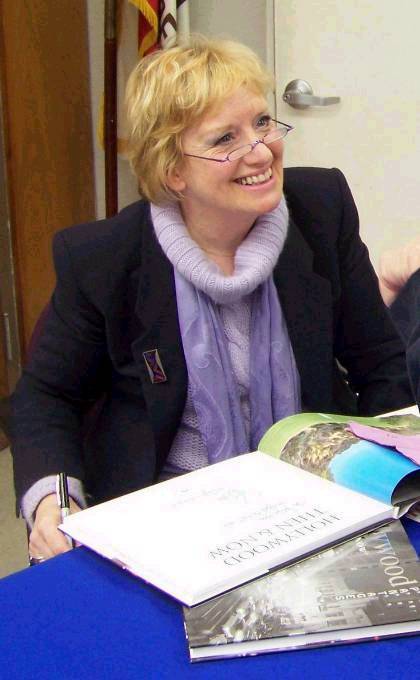
We are pleased to present WinR Rosemary Lord. Rosemary is an author, actress and is involved in issues benefiting Hollywood women and preservation. She is the author of several best-selling nonfiction books as well as a new mystery novel, “Lottie”. Welcome Rosemary!

What led an actress and best-selling non-fiction author to write a mystery?

During my years as an actress, I had often done bits of journalism as a way to pay bills between acting gigs. In England I would write interviews with some of the actors I was working with: Glenda Jackson, Marty Feldman, Spike Milligan, George Segal and so on. I wrote for the teenage magazines in the UK, such as Petticoat, Mirabelle, Jackie, and then progressed to women’s mags like Woman, Woma’s Journal etc.

When I came to America and was waiting for my Green Card, I did loads of journalism for these same magazines and American ones such as Coronet, Field Newspapers, Atlantic Review and so on. I wrote a “Letter From Hollywood” column and interviewed many of the old-time actors and film makers such as Cary Grant, Deborah Kerr, Robert Shaw, Glenn Ford, James Stewart, Edith Head, John Huston and so on.

Although my acting career progressed and kept me busy, I still loved history and the Old Hollywood. And so years down the line, when the opportunity came to write my first book, Los Angeles Then and Now, I jumped at the chance. Then came Hollywood Then and Now, in which I got to write about the people as well as the place.

I was starting another non-fiction book on Hollywood history and talking about it to a writer friend, Jacqueline Winspear, of the successful MAISIE DOBBS novels. She pointed out that as I found those olden days so intriguing, why didn’t I write a murder mystery set in Old Hollywood? I explained that I wouldn’t know where to begin with writing a mystery. And she said that she had not set out to write a mystery when she started writing MAISIE DOBBS. So with that encouragement, all the little pieces of stories that had been running round inside my brain, began to knit together.

You’ve recently put the final touches on your historical mystery. Can you tell us a bit about the plot and central character?

So the novel I have now finished is set in 1920s Hollywood, during the Silent Era. It was inspired from reading so many old documents I had uncovered in researching my non-fiction books. Because it is set during Prohibition, there was a lot of corruption going on, of course, but people’s behavior was still very controlled and strict. Which is why the new Movie folk in Hollywood were considered wicked and immoral. And any girls working in this industry were considered ‘loose women.’ So this is the world my young heroine, Lottie, struggles with. And because she is from England and had lived through World War I, it was like living in Paradise for her to move to sunny California, where oranges grew everywhere and she has the opportunity to work in “flickers.” And, yes, there is a murder. But other than that, I’m not saying more at this point!

How did you research old-time Hollywood?

Apart from the research that I already had from my previous books, with authenticated documents I had studied, the 1920s were a time when my mum and her sister had been working in the theatre. They were dancers from early childhood, heavily chaperoned, and had travelled all over England, France and Morocco and other exotic places. They had a “Bluebird” dancing act! And they had appeared in shows with Maurice Chevalier and many other entertainers of that era.

My mum LOVED Hollywood and always wanted to come here to work. So she subscribed to Hollywood Fan Magazines and watched the silent movies – her favorites were Clara Bow and Theda Bara – and tried to copy their make-up and fashions. I have been able to use so much of what she had told me about her young years for my heroine. And my mum was a great reader: always talking about “Aggie Christie” and her stories. And once Mum was married and had all of us kids and so no longer was a dancer, she became a writer. She used to write some of the fifteen minute “Morning Mysteries,” for BBC Radio and “Mystery At Midnight,” for Capitol Radio in England.

Also my Dad, who was in the Royal Navy, had been to Hollywood during Prohibition. And I loved to hear him talk about the speakeasies and how he had met Jean Harlow and danced with Anita Page! And my Grandpa, on my Dad’s side, was a Detective in Bristol, England. (My Dad was in the same class as Cary Grant – then Archibald Leach – at Primary School.) So I think my curiosity and questioning that my characters have, must have been channeled from him.

These days, people are popping their own homemade movies on the interenet without a thought. What methods did you employ to make the early days of filmmaking seem fresh and exciting to your readers?

I think that one of the problems with entertainment today, is that all of these “How it was made” shows take all the mystique out of movies. Many people today think that they can make movies or write a Best Seller without having to learn how, because they have learned a few trade secrets. That’s why I love films like “Cinema Paradiso,” in which we were transported back to the days of the primitive censorship of removing THE KISSES(!) from those wonderful movies. And the challenge of bicycling from one village to another with the next film reel, so the audience can see the end of the movie. That is the magic of a simpler life.

And in my novel, I have tried to bring my readers into that early time when the audience heard no dialogue – so the director was talking all the way through the scene, and the noise from the stage next to them would spill over. But the audience would use their own imagination far more than today. Today, all the details are filled in for them. In those early days, they were still working out how to produce special effects and perform stunts. And there many dreadful injuries, some fatal, because the actors were not considered too valuable. They could always be replaced! And they would work 18 hour days, in horrible conditions – but be thrilled to have a job. I loved inhabiting that simpler and more appreciative world.

You are also the author of the best-selling non-fiction book, Hollywood, Then and Now. What differences did you find in writing a non-fiction book on Hollywood and a fictional account of the industry?

The difference with writing fiction, after my non-fiction books, is that now I have the opportunity to color things. I can take actual happenings and change the people involved, fictionalize them, and hook them into another real life incident and come up with a wonderful “What if…” moment. But on the other side of it, having all that rich research at my fingertips, I hope that I can have the readers feel the integrity and authenticity of the people and situations from times gone by.

As an actress who has worked on well-loved shows such as “Monty Python’s Flying Circus” and “Dr. Who” and who has acted with greats like Sir Anthony Hopkins, tell us how acting informs your writing? Does it help? Or is it a hinderence? Would you recommend that writers take a beginning acting class or improv class?

As an actress I have been fortunate to work with some terrific actors over the years. In England it was not so much the Star System you have here, so actors may play the lead one week and the next time they would have one line. You all learned to “muck in together.” I had a bit part in the film of “Alice in Wonderland” and was in the same scene as Dame Flora Robson, John Gielgud, Ralph Richardson, Sir Michael Horden, Michael Crawford and a host of others in a lengthy Court Room scene that we worked on for many, many days. (I was the Chief Clerk of the Court in a Parrot costume!) But it was fascinating watching these great actors interact. And they were all considerate, humble and hysterically funny. And, as a writer, I find my acting experience helps so much with my characters, as they all have these different voices that I seem to channel! Anyone watching me write would think I should be in a loony bin, as I argue out loud back and forth in different dialects!

As an actress, are you tempted to write a script or a play?

I have written scripts years ago. I wrote a sitcom set in present day Hollywood, that the head of BBC Comedy ‘sat on’ for a couple of years, telling me how great it was. But then he got fired… And my husband, Rick and I wrote a docudrama script for a PBS series many years ago. But I must confess, I much prefer the world of novelists. Novelists – and especially Mystery novelists – are the greatest people in the world. They are encouraging, supportive and have such curious minds and great senses of humor! Script writers – like actors – seem so competitive and age conscious! It appears to be a crime to be a script writer or an actor once you reach forty years old! But novelists – well they are smart enough to go on for ever.

What’s next for you?

And so now I am going to catch up on my reading. I have a stack of novels I am anxious to read – and clearing out my office. I am wishing for the Clutter Clearing Fairy to appear on my doorstep. And then I shall start on my next book in this series. For now I have to deal with the coming of sound – of “Talkers”….!

Writing Nonfiction for a Nonprofit

We all know, or should know, the difference between nonfiction and fiction. The former is just-the-facts and the latter allows plenty of latitude to tinker with the truth. And the most obvious difference between for-profit writing and nonprofit writing is. . . the profit.

Of course, many nonprofits do pay their writers a salary. In my case, however, I volunteer at the Glendale-Crescenta Valley (California) Chapter of the American Red Cross (www.arcglendale.org), and I do it free of charge – which doesn’t mean there isn’t ample payback for my time and trouble.

Volunteer writing, aside from getting one published with a byline and providing opportunities to meet some really cool people, is a terrific training ground. Here are some things I’ve learned in my three years of producing an e-newsletter for the Red Cross.

 
  • Get used to no-frills working conditions. Forget the private office and state-of-the-art equipment. Forget instant IT support when your computer seizes up; in most cases you are the IT support. On the plus side, your hours are usually flexible and so is your work location; I’ve typed up more than one newsletter from my home office during a lull in my other activities, wearing my comfy sweats, and with a dog snoozing at my feet.

  • Develop your initiative skills. Nobody’s going to spoon-feed you information. This is a good lesson for any writer. Use the internet, one of the best friends a writer ever had. Before I interview someone for the newsletter, I put their name in the search engine to see what I find and help me prepare my questions. Keep your ears and eyes and mind open for story opportunities. Ask questions. Persist.

  • Producing a newsletter for a nonprofit is not hard journalism, but neither should it be a “puff piece” pretending everything is fine when it isn’t. For example, when interviewing a disaster volunteer for a profile, I don’t ask things like “What do you really hate about working for the Red Cross?” I do ask them, “What challenges do you face, and how do you deal with them?”

  • Stay humble. Your time is not as important as that of a Disaster Action Team Captain who just got back from the site of a residential fire, helping a family cope with the loss of everything near and dear to them. Respect others’ time and sensibilities. Cultivate a thick skin.

  • Stay objective. Temper the urge to tout the terrific work the nonprofit is doing with hyperbole and lavish praise. This is where you stick to the facts, which do the job more convincingly. One of my personal challenges is always to do justice to the people I write about – usually “average citizens” like the rest of us who give up their leisure time to teach CPR classes or fly off to the scene of a hurricane, usually at great personal inconvenience and cost. But at the same time I don’t want to come off like a simple-minded hero worshipper. Usually just telling their story, in their words, does the job.

  • Stay factual – and, as with any kind of journalism, do your fact-checking. Confirm spelling of names, phone numbers, web site addresses.

Being a volunteer nonfiction writer for a nonprofit organization won’t make you rich. It could make you famous – stranger things have happened. One thing’s for sure: you’ll meet some great people who are doing good work for the betterment of their organization/community/country/etc.

It can renew your faith in humanity and your hope for our future.

Interview with Patricia Wynn

Patricia Wynn is the author of 10 romance novels from Harlequin, Fawcett, and Dorchester, and is the author of the Blue Satan mystery series. She is also the founder of Pemberly Press which publishes mysteries “for readers with eager minds“. Finally, she is the founder of the Texas Lyme Disease Association, which she still serves long distance as a member of the Board of Directors.

Welcome Patricia!

Like many mystery authors, you also write romances. What connection do you find between these two genres?
I’ve always been a fan of mysteries with romantic subplots and romances with mystery subplots. They make for a good combination. Both genres have satisfying endings: i.e., boy gets girl and murderer is caught, which are reassuring messages for an escape reader like me. Otherwise, they have different structures and genre requirements.

Tell us about your Blue Satan mystery series.

The Blue Satan series combines all the things I like best in fiction: mystery, romance, history, and adventure. It draws on my favorite literary traditions: the great romantic adventure classics like The Scarlet Pimpernel and Andre Dumas’s books (The Count of Monte Cristo, The Man in the Iron Mask, etc.); the romance and social satire of Jane Austen and Georgette Heyer; and classic British whodunits; but also historical novels that convey social and political issues in times of unrest.

It takes place in the early years of George I’s reign, beginning in 1715, the year of a major Jacobite rebellion in Great Britain. (The Jacobites were followers of James Stuart and attempted several times to restore the Stuarts to the throne.) There’s a lot of political intrigue and espionage along with swashbuckling action.

My detectives are a duo: Gideon Viscount St. Mars, who’s been accused of a crime he did not commit and becomes the highwayman Blue Satan, and Hester Kean, waiting woman to her cousin Isabella, the Countess of Hawkhurst, who has access to court society. Gideon detects at night and using disguises, as well as occasional male force, while Hester pursues her inquiries in the light of day. Their romance develops over the course of the series, and the series plot questions are whether they will marry and whether Gideon’s name will ever be cleared.

You travel to England for research. Can you tell us about your methods once you get to that country? Are you digging through archives? Visiting sites that were around in the 18th century?

I’ve had different goals on different trips, but I’m on the go from the moment I land to the second I leave. The first time I went for research on this particular series, I tried to see every building in London and Westminster that was built before 1715 to get a sense of what the city would have looked like, and artifacts from the Stuart period to see what was in use. The Museum of London and the Geoffrey show furniture and objects by era. Some of the great houses, like Leeds Castle and Penshurst, have smaller museums with collections like dog collars and weapons, and older pieces of furniture, so I can see how houses were furnished, what the upholstery was like, quaint objects, etc.

On that first trip I also explored Kent, the setting for some of the first two books, in particular the villages I planned to use, like Hawkhurst , and the Weald, which was once an immense forest. I visited smugglers’ villages, like Rye in Sussex. At all these places, I bought books of local history with pictures of ancient houses to help me since my visual memory is so bad. I took notes on plants and birds, every detail I could find to give my writing authenticity.

On my most recent trip, which was in January, I particularly wanted to see what the dawn was like that time of year for the opening scene in my next book, A Killing Frost. Then, I spent every day in a library or museum libraries, looking at books and maps from the period, searching for possible cover art (I find the pictures that are used for my covers), and visiting some of the museums I’ve missed, like the Museum of Garden History at Lambeth.

Next trip will have to be after March when the National Trust properties are opened to the public. I want to visit Ham House, which is supposed to be the best preserved and most complete collection of 17th century fashion and power. I’ll visit as many houses as I can, and will hope by that time that the new Galleries of Modern London at the Museum of London will be open, which will cover London from 1666 on. It can be very frustrating to discover that what you’ve gone to see is closed for renovation or, as on my last trip, for the only week of the year that the British Museum Library was closed.

What happens if you can’t find the information you’re looking for? Do you leave the subject out? Or make an educated guess?

I really hate to guess, because that’s when I make mistakes, but sometimes I have to. For instance, there are no records of the interiors of most of the houses I might like to use to set a scene. I can’t even discover the exact layout of St. James’s Palace in 1716, for instance. So I use what has been published and have to be vague about the rest. Many of the churches were torn down and rebuilt, or destroyed in the Second World War, and of course, they go through transformations over 300 years. It may take me three hours to find a detail of an old church I can use, which will only result in three sentences. By and large, I do research and try to weave my story around what is known, but if I need to put a scene in one of the royal palaces, then I do my best to find out what it really was like. So many of the personal accounts for the years 1715-16 were destroyed because people were afraid of being arrested for treason and they burned their letters and journals.

Your various books have earned critical acclaim, a nomination for the RITA Award, a Silver Medal from PMA , the Benjamin Franklin Award for Best Genre Novel, and a starred review from Library Journal. While the awards are impressive, did these accolades translate into increased sales and recognition of your books?
The Benjamin Franklin Award and the favorable reviews from Library Journal have probably increased my sales to libraries and attention from reviewers. Otherwise I can’t tell they’ve had any impact. Public libraries only buy books that have been reviewed in a major review publication. My accolades have not been of the kind to be seen widely by readers, but they may help me get wider reviews.
You are the founder of Pemberley Press, a charter member of The Author’s Studio and a member of the Independent Book Publishers Association. Pemberley Press specifically publishes historical mysteries. Do your books stand a chance against those released by the larger publishing houses?
Yes and no. My distributor, Independent Publishers Group, has a nationwide sales force and relationships with every wholesaler, chain, and many independent bookstores , so the distribution is good and the books are easily available. I’ve seen my hardcover releases on the New Fiction shelves at some Barnes & Noble stores. That said, the major publishers have the money to pay for placement of their books in stores, like on end caps and at the front of the store. They can also publish in mass market format, which reaches more readers. It would be very hard to win an Agatha Award, for instance, with a book that comes out in hardcover original, for the simple reason that not enough people will buy it and read it in order to vote. And the economies of mass market are such that small presses cannot publish in that format. There is also some bias against small press among institutional buyers, although readers never notice who published a book.
One of my authors, Marion Moore Hill, has impressive sales by anyone’s standards, but she tours widely and frequently. She’s developed the Deadly Past mystery series, which has struck a chord with readers, and she’s an example of how an author can help make her own success by getting her titles into stores.
What were the major obstacles involved in setting up an independent publishing house?
My biggest mental obstacle was fulfillment. I could not imagine storing and shipping out books, but I contracted with Publishers Storage & Shipping in Michigan to fill my orders. That was before I landed such a good distributor. The learning curve was very high on digital typesetting with a layout program. I also had to establish a relationship with every single wholesaler, which was time-consuming, but at least possible when I started. Ingram had opened a window to small press, which they subsequently narrowed, forcing small presses to use a distributor. I believe they did this because processing returns to so many small entities became too onerous, but as I used a fulfillment house, I was never forced out of Ingram. Now my distributor maintains these relationships and handles all orders, and if I were to go back to being my own distributor, I would have to re-establish them. As the book business has become digitized, the technical aspect of the interactions between publisher and wholesaler and even fulfillment houses has become more sophisticated, and I would find learning all that a daunting challenge.
If an author wanted to submit to an independent publisher, what advice would you give her to make certain that the house is reputable?
I would contact the press’s authors and ask them what their relationship is like, what the general terms of their contracts are, whether they are paid on time and if bookstores seem able to get their books. This last can be spotty. The chains have their own internal systems and some independents will only buy from Ingram. That is not the publisher’s fault, but occasionally an author will discover that a certain bookstore cannot or will not carry her book because 1) it’s not in their system yet; or 2) it’s not at Ingram, and they will not buy directly from the publisher or even another wholesaler. This still occasionally happens with Pemberley titles. Ingram now charges a 60% discount on publishers that do not maintain a certain level of sales, which makes them prohibitive for some small presses to deal with. Those same publishers may sell well through Baker & Taylor. One well-known mystery bookstore in PA will only acquire books directly from the major NY publishers and refuses to deal with Ingram or small presses. So there will be variations, but if the books are easily orderable and the publisher pays on time, that should be reputable enough.
Two cautions, however. Just because a book is orderable doesn’t mean it will be stocked in every bookstore. Barnes & Noble, for instance, will order an unknown author’s books for a signing, but will not usually stock them otherwise, even if they are designated as “stock” books. Except for perpetual top sellers, authors’ backlists are not routinely carried, but will only appear in stores for a 3-4 week period upon release, or not at all. There are too many competing titles every month and booksellers must make the decision whether to risk their shelf space on a title that is not by a well-known author. That is why it’s smart for authors to get out and schedule signings – to get their books into the stores.
Also, do not be confused by the difference between a small press and a publishing services company. A small press undertakes all the costs and activities of publishing and has a contract with an author for royalties. The author pays a publishing services company for editing, book design, printing, and fulfillment. Books from publishing services companies are rarely if ever sold through bookstores.
What’s next on your agenda?
I’m working on the fourth Blue Satan mystery, A Killing Frost. It opens in January, 1716, when the Thames River had frozen solid and a fair was held on the ice. St. Mars’s groom Tom discovers a frozen body on the ice, dressed in a most peculiar manner and leaning grotesquely against one of the booths. The dead man was a friend of Harrowby, Lord Hawkhurst, who asks Hester to investigate. St. Mars helps her uncover the murderer, of course, while also attempting to free a Jacobite rebel from Newgate. Lots of fun will be had by all!
You can visit Patricia at her web site and her books are available from Pemberly Press or booksellers such as Amazon.com and Barnes and Noble.  

Do Writing Books Help?

There are plenty of writing books out there–books by authors, books by teachers, books by experts. Do they really help? The WinRs have varying opinions.

MK Johnston

Writing requires a balance between creativity, technique, and the realities of the marketplace. Whether books or magazine articles, the sources I find most helpful are the ones that strike a balance between the art, science, and business of writing. Once I defined my goals as a writer, I searched for source material to help me achieve them – to become a better writer, to produce works of quality, to get published, to connect with readers who would enjoy my work.

I generally prefer books over magazine articles because they go into greater depth, though I also favor articles on one specific topic or current issue. My sources range from how to write/write better books to novels with similar themes which I study for technique. Any well written book that is pleasurable to read can be inspirational, too.

There have been several authors whose books I’ve found extremely helpful; the works of Sol Stein and Noah Lukeman would top my list. I’ve learned a lot from them, but I’ve relearned even more. Sometimes I need to remind myself of what must be done and sometimes it takes hearing the same information restated, or stated in a different way, to get through to me.

Ultimately, learning is a partnership between the writer and reader. We have to be receptive to the information; it has to be presented in a way that gets us to recognize its importance and incorporate it into our writing. That’s why I often restated information in my recent tutorial “Learning the Basics ‘Chapter One’ at a Time”.

Once you establish your goal, seek out source material to help you reach it. Use all the tools available to help you, from blogs like this one to libraries.

Jacqueline Vick

A very good point, Miriam. I had a stack of magazines “this high” at home, and I kept putting off reading through them. Then I picked a subject I wanted to study, searched for articles related to this one topic, and got rid of the rest. I’m sure I’ll soon have another stack to go through with a different topic in mind.

Out of the miriad of writing books that I’ve had, I found a few tips have stuck with me.

Robert McKee’s “Story” has great information about beats.

Anne Lamott’s “Bird by Bird” let me know that sh#tty first drafts were a good thing.

Walter Mosley reminds me to write every day in “This Year You Write Your Novel”.

Michael Hauge’s “Selling Your Story in 60 Seconds” is a book I refer to often when I’m not clear on what my story is about. Honing a pitch makes it clear where the story is lacking.

I look to Stephen King’s “On Writing” for reminders about writing tight.

I noticed that the books I like fall into two catagories: books by authors and screenwriting books. Maybe authors have better insights on the writing process, or maybe their wordsmith skills make the information more interesting.  Also, novel writers should not dismiss screenwriting books as “not for me”. A good script moves, and your novel should, too. Applying screenplay structure can tighten your story.

The books I’ve found least helpful fall under writing manuals–technical books put out by Writer’s Digest etc. They usually contain dry information that puts me to sleep.

Another great source of information is other writers. Without Jackie Houchin’s advice to “cut 20% in the editing process”, my short stories would be novellas. After reading Bonnie’s shorts, I rush back to my own and ask, “Are my characters  human enough?” Miriam reminds me it’s all in the details, and then Gayle advises, “Does it serve the story?” With Rosemary in mind, I write characters that an actress might want to sink her teeth into.

It’s all good.

Bonnie Schroeder brings us a list of her favorite books.

1. Bird by Bird – Anne Lamott. Far and away the most inspiring and motivating, and once I internalized her concept of the “really shitty first draft” I felt free to create dreck with the assurance it might, eventually, turn into something readable – but only if I got those dreadful words down on the page in the first place.

2. A Writer’s Time – Kenneth Atchity. The back-copy blurb says it all: “[Atchity] shows you how to activate the creative process, how to transform anxiety into ‘productive elation,’ how to separate the vision of a project from re-vision, and how to set up a writing agenda that won’t defeat you.”

3. The Writer’s Journey – Christopher Vogler. A splendid look at how to incorporate classic mythic structure into your storyline. Based on the work of Joseph Campbell. I can’t tell you how many times Vogler has helped me figure out “what happens next” and why one version works and another doesn’t.

4. On Writing – Stephen King. Lessons from the master. I just wish he followed his own advice more closely.

5. 13 Ways of Looking at the Novel – Jane Smiley. I confess that most of this 570-page manuscript was too academic, even pretentious, for my taste. But the two chapters on “A Novel of Your Own (I) and (II)” are spectacular and cover craft and inspiration. And it is infinitely reassuring to know that a Pulitzer-Prize-winning novelist like Smiley struggles with the same writing demons (well, some of them) we all do.

6. The Elements of Style – William Strunk Jr. and E. B. White. Almost everything you need to know about English usage in less than 100 pages.

GB Pool

I have never read a writing book that taught me anything. I read other people’s books, the good, the bad, and the ugly, to learn.

Jacqueline Vick

Gayle brings up an excellent point. Study what other writers are doing. Don’t imitate them, but learn from them. Read the classics, read your contemporaries. Find out what they’re doing right and apply it to your own writing.

Jackie Houchin

One of my favorite books on writing for children is “Creating Characters Kids Will Love” by Elaine Marie Alphin. My copy is well used, with penciled-in notes, underlines, asterisks and arrows.

This book is loaded with ideas, instruction and examples. Each section within the many chapters ends with “Read the Pros,” a suggested reading list of specific chapters in specific books that illustrate what was taught, followed by a “Try it Yourself” section with thought-provoking, idea-stimulating writing exercises. A very accessible book that you will return to again and again.

The other fantastic book on writing for children is “Story Sparkers, A Creativity Guide for Children’s Writers” by Debbie Dadey and Marcia Thornton Jones, who use many examples from their own “Adventures of the Bailey School Kids” series.

This book is packed full of good ideas, charts, check lists and illustrations. It gives the reader many opportunities to try out what they are learning with fun exercises in writing, observing, and interviewing. This is another book that you will want to refer to often.

The two very helpful books for writing adult mystery fiction are authored by two, what else, mystery writers.

Gillian Roberts’ “You Can Write a Mystery” gives practical suggestions for dealing with problems that come up in the writing process, beginning with the “Fifteen Commandments for Mystery Writers Who Want to be Published.” She then covers topics from, your sleuth, victim and villain to POVs to plotting (learning to think backwards) and hiding clues, with a final chapter on marketing.

Carolyn Wheat’s “How To Write Killer Fiction” discusses the difference between mystery and a suspense fiction (yes, there are clear distinctions!). She lists and describes dozens of sub-genres and crossovers and offers book titles as examples. The book is divided into three parts, Part 1: The Funhouse of Mystery, Part 2: The Roller Coaster of Suspense, Part 3: The Writing Process.

What about you? Do you have a favorite book you’d like to share with us? We’d love to hear from you.

Interview with Incentive Marketer Mary Grant of Enhanced Performance Group

Enhanced Performance Group specializes in Incentive Marketing. Who better to ask about ways to promote writers and their services?
Thank you Mary, for being with us.

Book authors are being called upon to do more of their own marketing, and freelancers have always had to promote their own businesses. Incentives and premiums sound like good tools, but what are they?

Incentives, simply put, are tangible and intangible items that motivate an individual toward the achievement of a goal. Premiums can be both tangible incentive items or branded marketing items. In the incentive industry, the terms are often interchangeable.

Premiums sound like something writers can use to promote themselves and their services at conferences and library events. Can you tell us how this works and give an example or two of some of the more creative items you’ve come up with?

A premium item with a logo or message on it serves as a useful tool to keep your audience engaged in you or your book. They can also be a great traffic builder as I have yet to see anyone turn down a free pen at a convention. Premium items should be useful, appropriate to your market and carry your message or logo to be effective.

There are a number of examples I could site, however, I believe it might be more beneficial to make your readers aware of the power of brand marketing through the use of premiums. As we look around our homes or cars, I guarantee that within 10 minutes you will be able to identify 10-20 branded premium items you use every day. For instance, your travel mug, coffee mug, jacket, t-shirt, pen, notepad, refrigerator calendar, refrigerator magnet, cap, icescraper, ruler, etc. are most-likely all items that carry a logo that you might use in your everyday lives. Each time you use that item, you view that companies’ logo/message. According to the Ad Specialty Industry (ASI), 62% of customers do business with the company after receiving the promotional product. Furthermore, 84% of customers remember the business that provided them with the promotional product. And finally, at $.004 per impression, promotional products have the best cost per investment of popular advertising media. Clearly these items are effective in both building brand awareness and increasing sales.

Incentives are used to motivate, and the first thing that comes to my mind is motivating salespeople to perform. Is there a way that writers could use incentives to increase book sales or promote their freelance businesses?

Of course! The basic principles of an incentive program can be applied to just about any situation where you want to gain a desired outcome from a target audience. Basic incentive elements are: 1) Know what motivates the audience; 2) Clearly state the goal and the award for achievement; 3) Communicate with the audience frequently and let them know their progress toward the goal and, finally; 4) Give the award to those who achieve the goal.

As an example, let’s say you want to get 25 people at a convention to review the first three chapters of your book online. At the convention, you provide an example of a ceramic coffee mug imprinted with your name, the name of your story and your web address. You have imprinted pens with your name, web address and title of the book to hand out to visitors to your booth. You explain that the first 25 people to review the book will receive the coffee mug for their time. You provide the pen which has the information to complete the request. Once your first 25 reviews come in, you follow up by mailing the “winners” the mug along with a catchy message (or another chapter of the book). Additionally, you’ll have others reviewing the book and visiting your site so you’ll have additional opportunities to interact with them.

You also do event planning. In writer terms, this could be anything from a book signing or book launch to a writer’s conference. What are some of the advantages of hiring a professional to handle the details?

There are several advantages to letting a professional handle the details: site selection, negotiation skills, experience in operating other events to know what works and what doesn’t. However, the biggest advantage is that it allows the sponsor or participant to attend the meeting and focus on the content as opposed to the logistics.

What’s the most important consideration that anyone planning an event should keep in mind?

Know your goal or expected outcome of the meeting and have a clear budget in mind.

Most people think of lectures and classes when they think of conferences, but I understand that you’ve arranged some pretty fun stuff to motivate attendees. Can you give us some examples?

Sure. Sometimes it’s fun to “cleverly disguise” a learning event as a game. We’ve done such things as Wii tournaments to encourage teamwork and game shows to test product knowledge. There are many other examples as well that are dependent upon the goal, the budget, the location and the audience. It is, of course, important to remember that while there is a time for fun, there is some content that calls for lectures and classes. However, the utilization of lighting, décor, etc. can have a huge affect on the effectiveness of the presentation.

In your experience, have you noticed a common mistake that clients make when they try to promote their product to clients?

Yes. They look at what most appeals to them and not what would appeal to the audience. When talking about your own business, it’s important to remember that it IS business and while your writing may be very personal to you, the art of promoting it is should be strictly business.

You also help clients put together websites and newsletters by coordinating the talent necessary to deliver the final product. When you first talk to the client, what are the two most important questions you ask that help you understand the client’s vision?

If I have to choose two things, the first would be “What is the goal of the publication” and “What is your budget?” Obviously people are looking for a desired outcome so that’s clearly the top priority. The second question is sometimes an uncomfortable one but a necessary one. However, it’s critical to know when choosing talent and vendors. That way there are no surprises and everyone works toward the same goal. That’s not to say that you will receive an inferior product if your budget is low. It simply means that we may look for other, more cost-effective ways to attain the desired outcome.

You also write copy for your clients. What should writers keep in mind when penning for corporate clients?

Know the client’s business. I’m not saying that you need to know every part number of every piece of inventory but a general knowledge of who they are, what they do, how they go to business and what their current situation is will certainly give you an advantage in both your writing and your conversation. And, frankly, the client will appreciate your research. Know the audience and know specifically what the mood of the piece is to be. Clearly you will write differently for a training manual than you would an incentive announcement. Finally, don’t try to be something you aren’t. If technical writing is not your forte, let them know and perhaps give them a referral to a technical writer. They will appreciate your honesty, you’ll save face, and you may get an additional referral by the technical writer whom you referred.

Business marketing practices are changing. What direction is Enhanced Performance Group moving?

Unfortunately, in this economic climate, promotional products and incentive programs are the first expenditure to be cut from most corporate budgets. While our service offerings remain the same, we continue to focus on educating our customers on the importance of promoting during a down economy. According to the Advertising Specialty Institute, if you advertise, promote or incent when everyone else stops marketing, your message is more likely to be noticed due to fewer ads in the market and, you or your business are more likely to be remembers when everyone starts advertising again.

Mary is available to arrange conferences, book launches and other events as well as to discuss premium items. To contact her, call 630-263-9300. Her website, www.enhanced-perform.com is being retooled, but we’ll include an update when it’s finished.  

Thank you again, Mary, for sharing such valuable information!